Miss North Maths

Full paper C2

Paper 2 style · Calculator · 80 marks · 1 hour 30 minutes

How it works. Type each answer in its box. Tap any underlined word on the paper to see what it wants you to do. Stuck? Open the fact sheet under the question. When you finish, press Mark my paper, then check each question against the mark scheme and give yourself the marks you earned, including method marks.
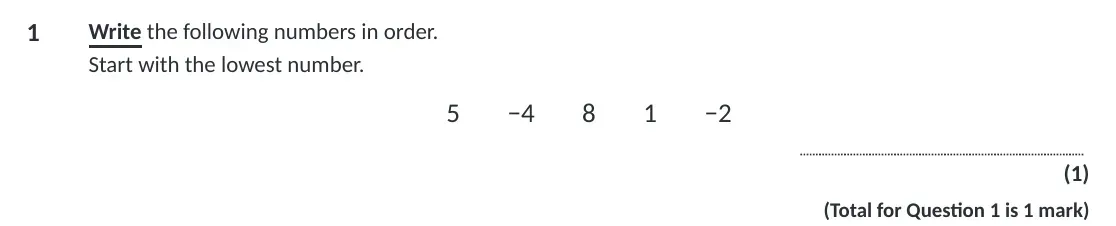
1 Write the following numbers in order. Start with the lowest number. 5 −4 8 📄 sheet: Ordering negative numbers 1 −2 (1) (Total for Question 1 is 1 mark)
2 Change 7000 millilitres to litres. litres 📄 sheet: Converting units (Total for Question 2 is 1 mark) (1)

3 Write 47 as a decimal. 100 📄 sheet: Converting fractions, decimals and percentages (1) (Total for Question 3 is 1 mark)
4 Write down the multiple of 8 that is between 50 and 60 📄 sheet: and multiples (1) (Total for Question 4 is 1 mark)
5 Complete the statement below to make it correct. ……………… × k = 5k (1) 📄 sheet: Place value and number facts (Total for Question 5 is 1 mark)
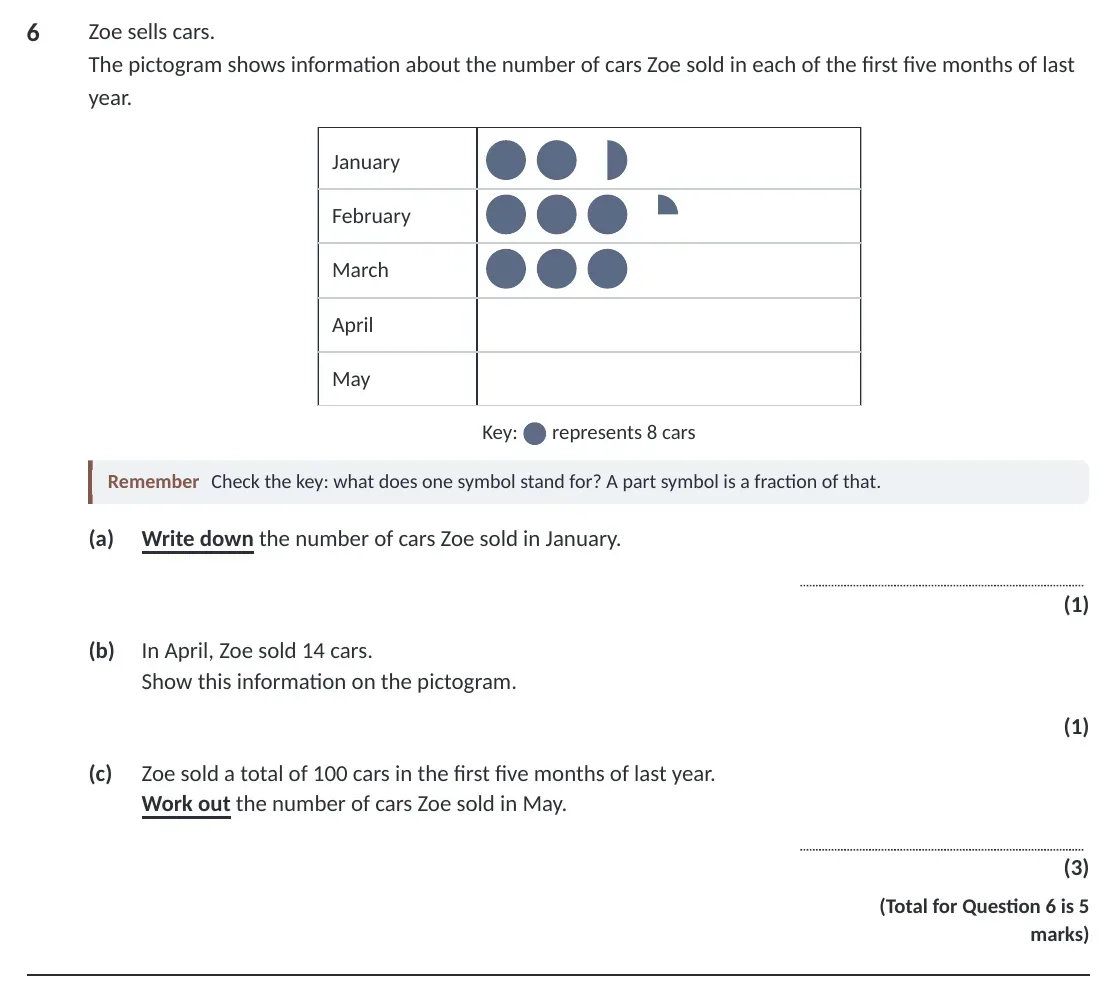
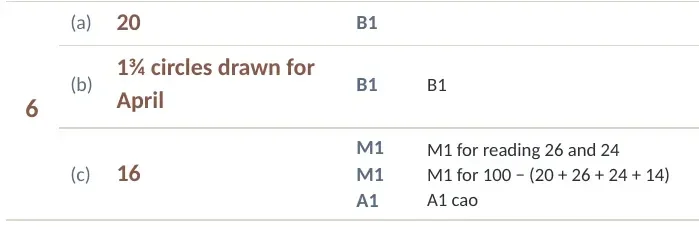
6 Zoe sells cars. The pictogram shows information about the number of cars Zoe sold in each of the first five months of last year. January February March April May Key: represents 8 cars Remember Check the key: what does one symbol stand for? A part symbol is a fraction of that. (a) Write down the number of cars Zoe sold in January. (1) (b) In April, Zoe sold 14 cars. Show this information on the
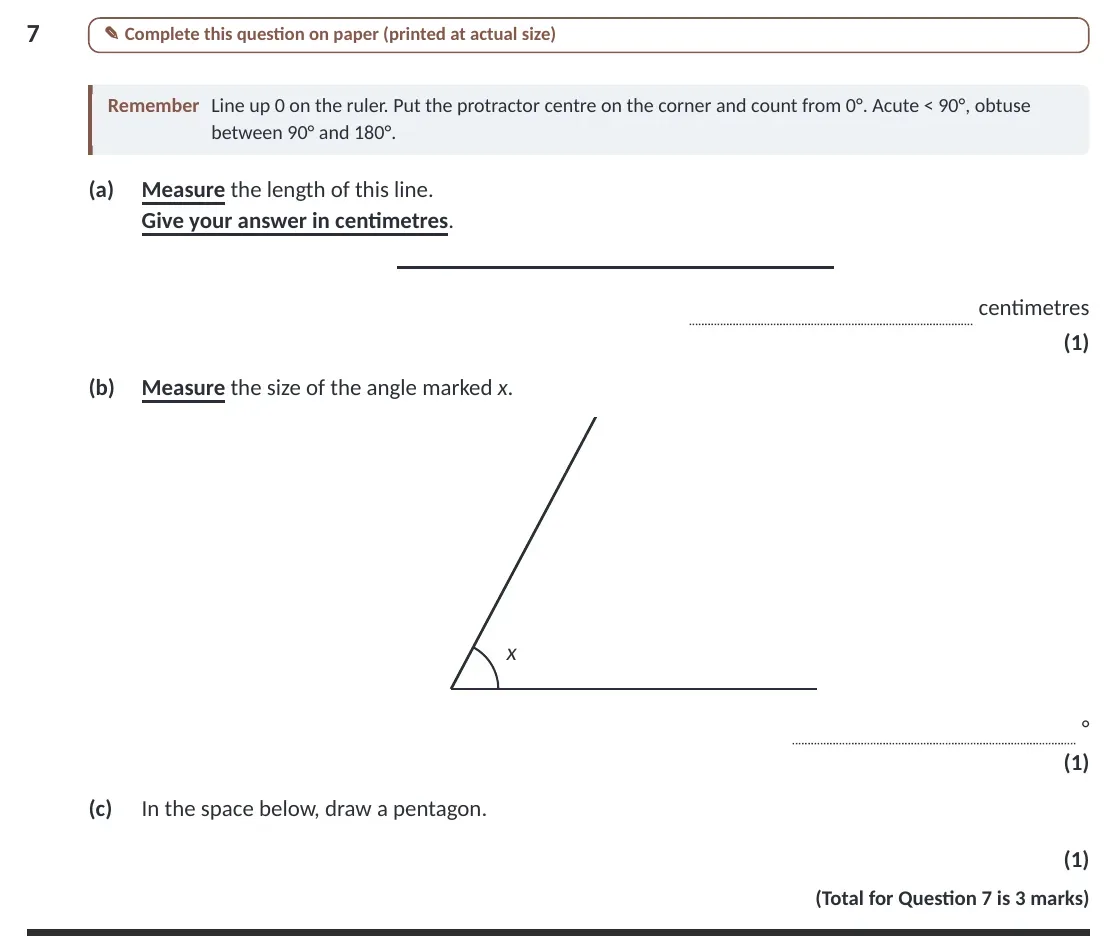
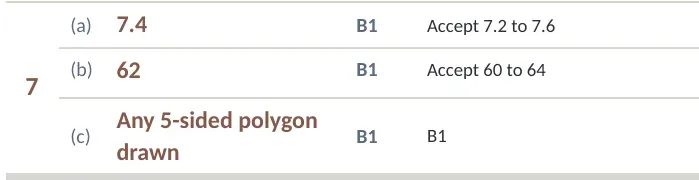
7 ✎ Complete this question on paper (printed at actual size) Remember Line up 0 on the ruler. Put the protractor centre on the corner and count from 0°. Acute < 90°, obtuse between 90° and 180°. (a) Measure the length of this line. Give your answer in centimetres. centimetres (1) (b) Measure the size of the angle marked x. x ° (1) (c) In the space below, draw a pentagon. 📄 sheet: Measuring and rea

✎ You need a ruler, protractor or compasses for this one. Do it on paper, then mark it below.

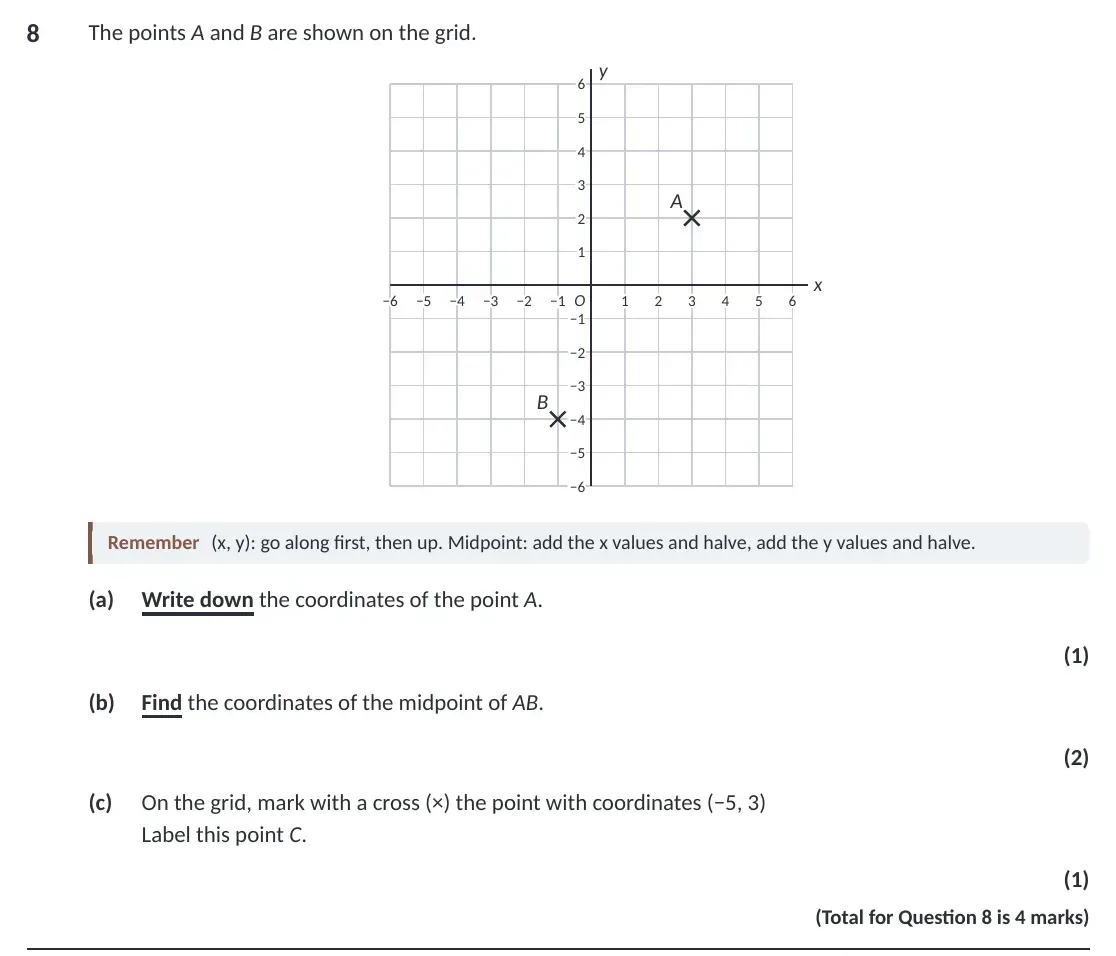
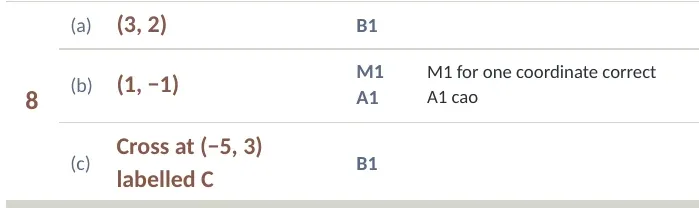
8 The points A and B are shown on the grid. 6 y 5 4 3 A 2 1 −6 −5 −4 −3 −1 O −1 −2 1 2 3 4 5 6 x −2 B −3 −4 −5 −6 Remember (x, y): go along first, then up. Midpoint: add the x values and halve, add the y values and halve. (a) Write down the coordinates of the point A. (1) (b) Find the coordinates of the midpoint of AB. (2) (c) On the grid, mark with a cross (×) the point with coordinates (−5, 3) L
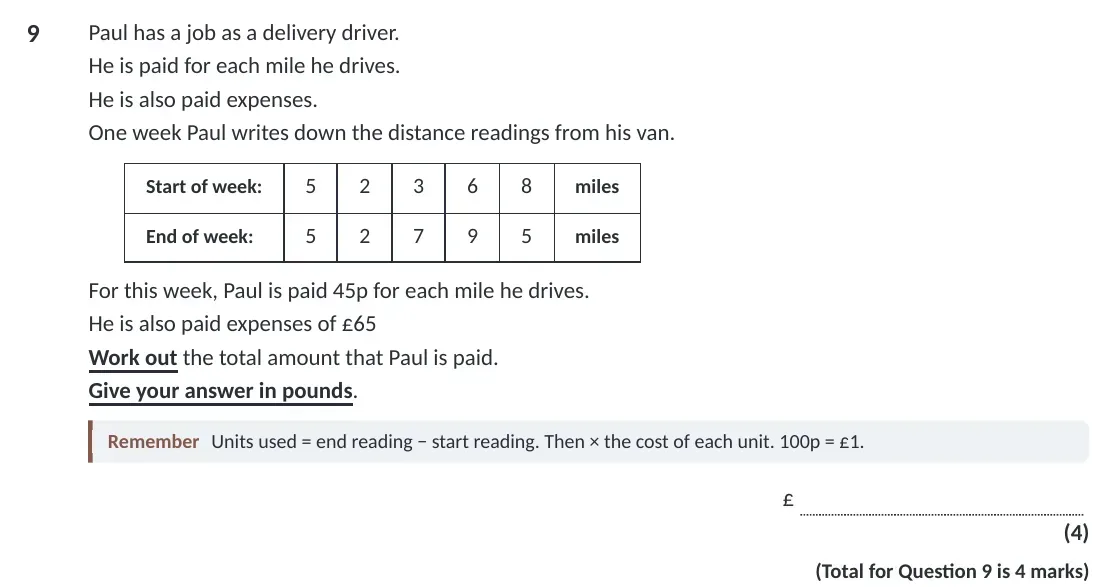
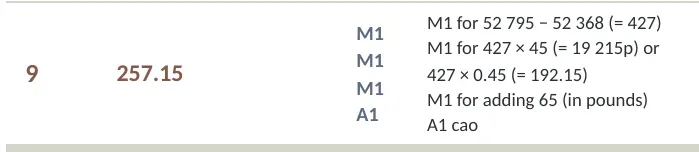
9 Paul has a job as a delivery driver. He is paid for each mile he drives. He is also paid expenses. One week Paul writes down the distance readings from his van. Start of week: 5 2 3 6 8 miles End of week: 5 2 7 9 5 miles For this week, Paul is paid 45p for each mile he drives. He is also paid expenses of £65 Work out the total amount that Paul is paid. Give your answer in pounds. Remember Units
10 A spinner can land on red (R) or blue (B). Kim spins the spinner 3 times. List all the possible outcomes. 📄 sheet: Listing outcomes (2) (Total for Question 10 is 2 marks)
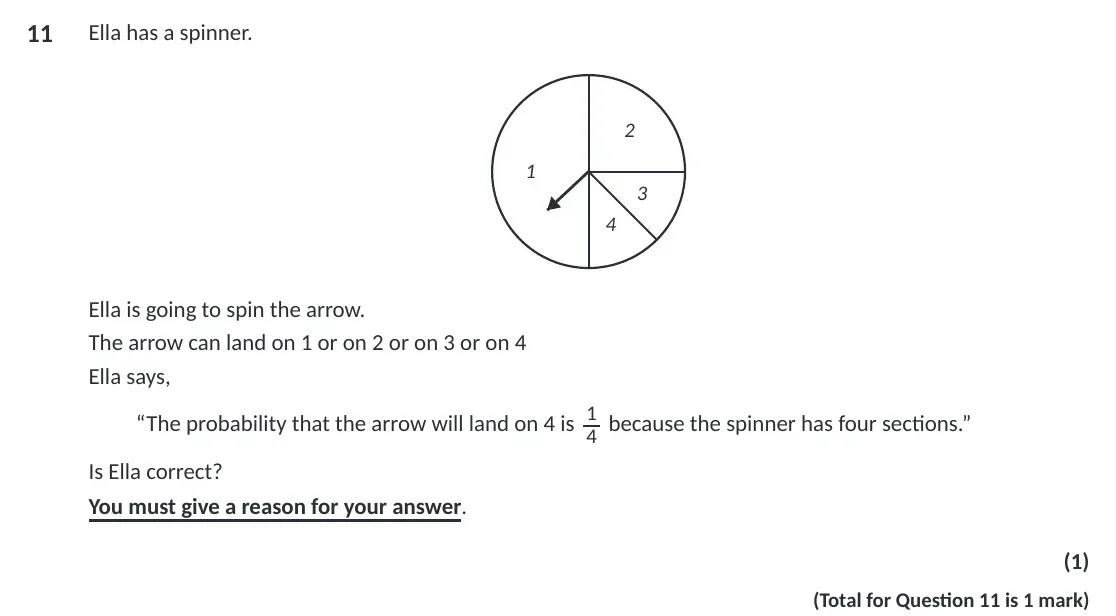
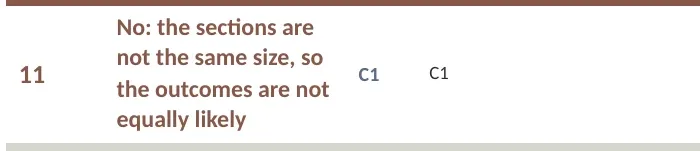
11 Ella has a spinner. 2 1 3 4 Ella is going to spin the arrow. The arrow can land on 1 or on 2 or on 3 or on 4 Ella says, “The probability that the arrow will land on 4 is 1 because the spinner has four sections.” 4 Is Ella correct? You must give a reason for your answer. 📄 sheet: Probability of single events (1) (Total for Question 11 is 1 mark)
12 Leo buys 30 bottles of drink. 3 of the 30 bottles are water. 5 The rest of the 30 bottles are juice. Each bottle of juice holds 330 millilitres. Work out the total amount of juice in the bottles that Leo buys. Remember Fraction of an amount: ÷ by the bottom, × by the top. Percentage: 10% = ÷ 10, 1% = ÷ 100, or use a multiplier (35% = 0.35). millilitres 📄 sheet: Converting units (3) (Total for Q
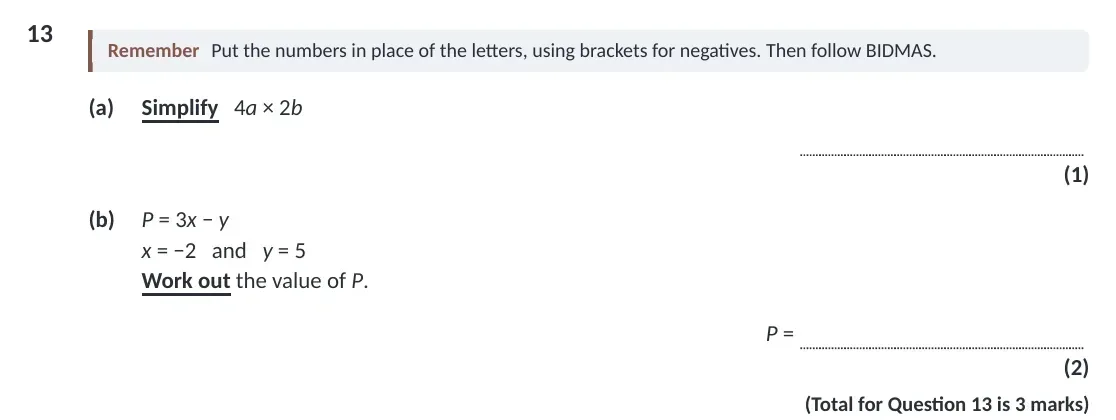
13 Remember Put the numbers in place of the letters, using brackets for negatives. Then follow BIDMAS. (a) Simplify 4a × 2b (1) (b) P = 3x − y x = −2 and y = 5 Work out the value of P. P = 📄 sheet: 📄 sheet: Substitution (2) (Total for Question 13 is 3 marks)
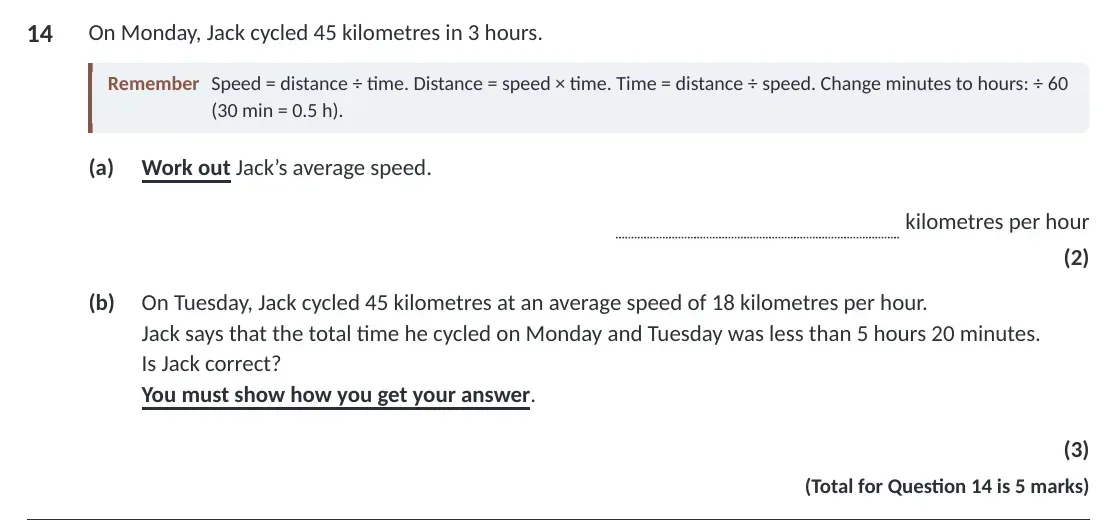
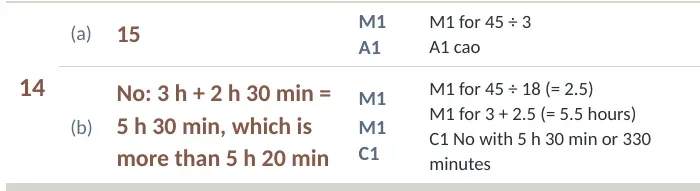
14 On Monday, Jack cycled 45 kilometres in 3 hours. Remember Speed = distance ÷ time. Distance = speed × time. Time = distance ÷ speed. Change minutes to hours: ÷ 60 (30 min = 0.5 h). (a) Work out Jack’s average speed. kilometres per hour (2) (b) On Tuesday, Jack cycled 45 kilometres at an average speed of 18 kilometres per hour. Jack says that the total time he cycled on Monday and Tuesday was le
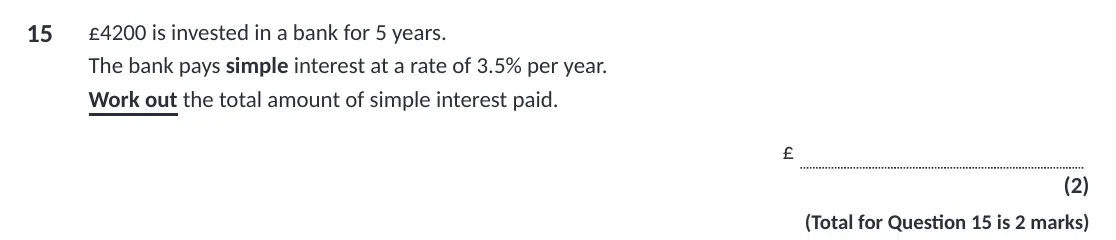
15 £4200 is invested in a bank for 5 years. The bank pays simple interest at a rate of 3.5% per year. Work out the total amount of simple interest paid. £ (2) 📄 sheet: Simple and compound interest (Total for Question 15 is 2 marks)
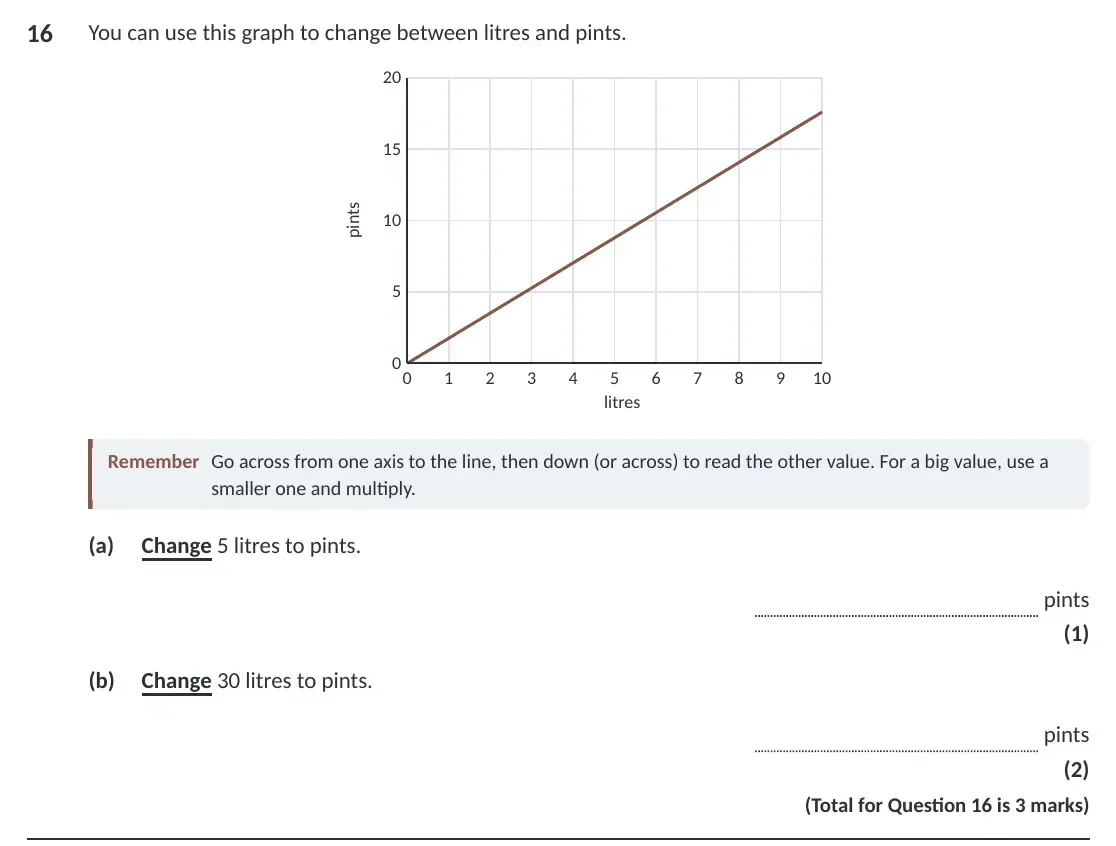
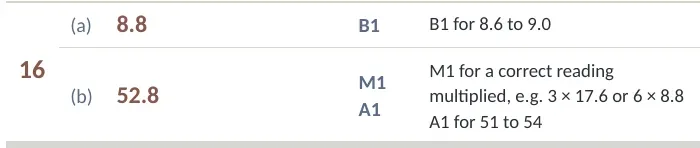
16 You can use this graph to change between litres and pints. 20 pints 15 10 5 0 0 1 2 3 4 5 6 litres 7 8 9 10 Remember Go across from one axis to the line, then down (or across) to read the other value. For a big value, use a smaller one and multiply. (a) Change 5 litres to pints. pints (1) (b) Change 30 litres to pints. pints 📄 sheet: Measuring and reading scales (2) (Total for Question 16 is 3
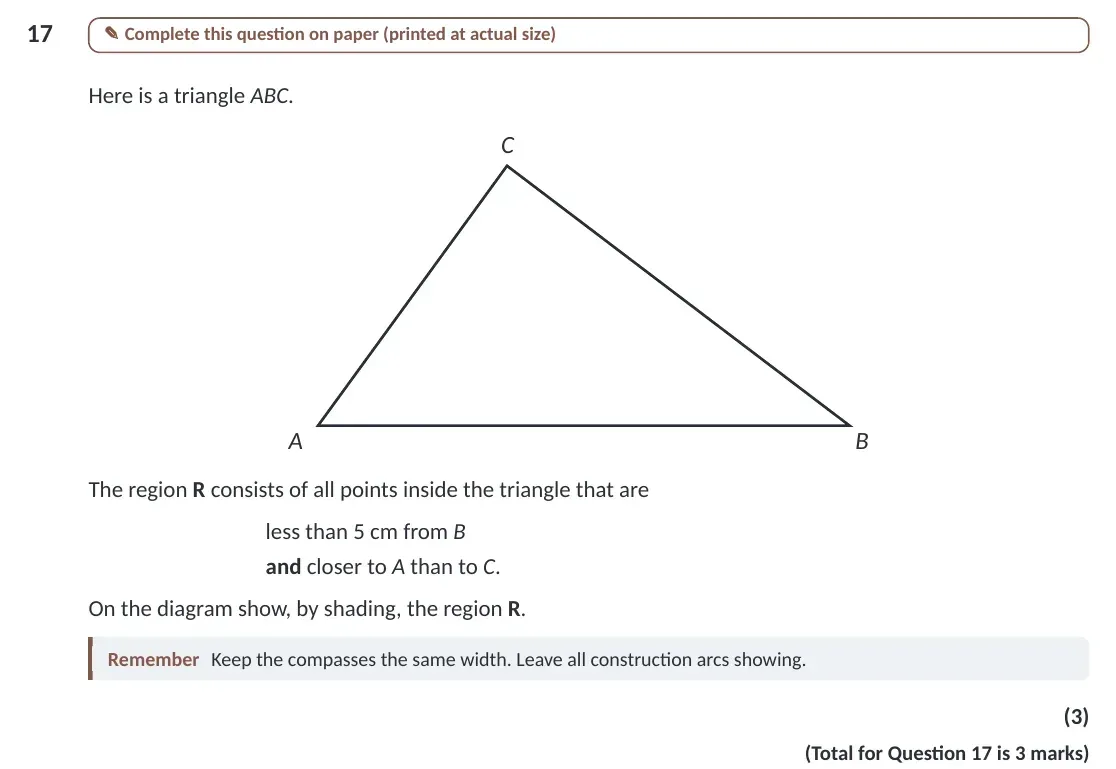
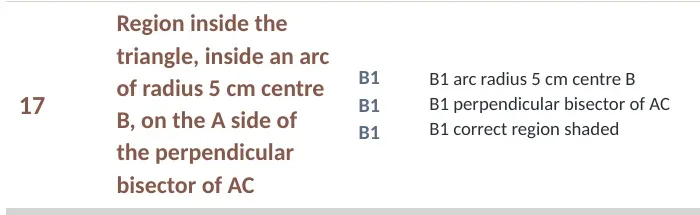
17 ✎ Complete this question on paper (printed at actual size) Here is a triangle ABC. C A B The region R consists of all points inside the triangle that are less than 5 cm from B and closer to A than to C. On the diagram show, by shading, the region R. Remember Keep the compasses the same width. Leave all construction arcs showing. (3) 📄 sheet: Constructions (Total for Question 17 is 3 marks)

✎ You need a ruler, protractor or compasses for this one. Do it on paper, then mark it below.

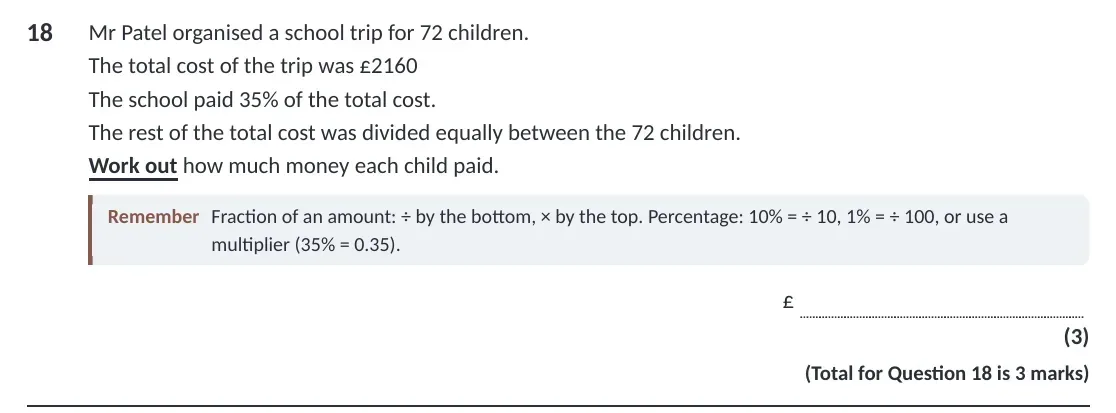
18 Mr Patel organised a school trip for 72 children. The total cost of the trip was £2160 The school paid 35% of the total cost. The rest of the total cost was divided equally between the 72 children. Work out how much money each child paid. Remember Fraction of an amount: ÷ by the bottom, × by the top. Percentage: 10% = ÷ 10, 1% = ÷ 100, or use a multiplier (35% = 0.35). £ 📄 sheet: Percentage pro
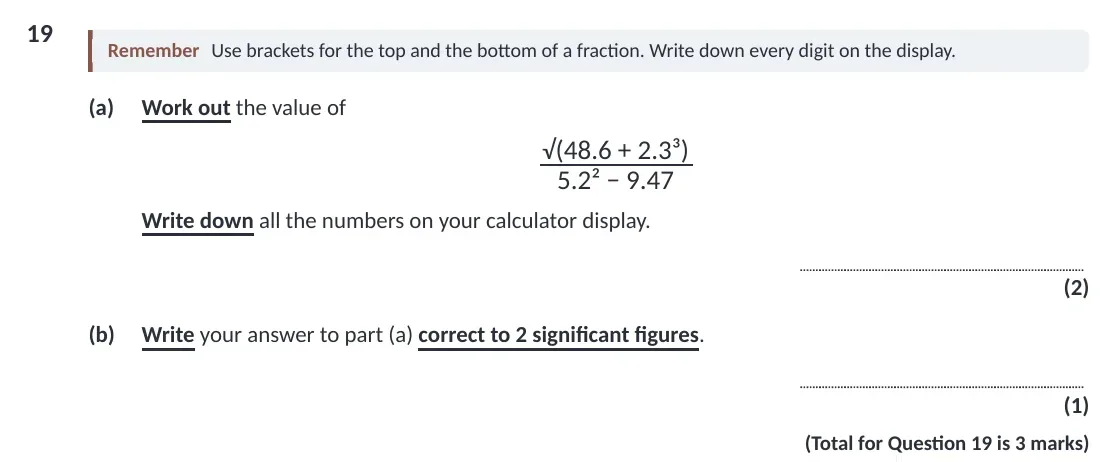
19 Remember Use brackets for the top and the bottom of a fraction. Write down every digit on the display. (a) Work out the value of √(48.6 + 2.3³) 5.2² − 9.47 Write down all the numbers on your calculator display. (2) (b) Write your answer to part (a) correct to 2 significant figures. (1) 📄 sheet: Decimal places and significant figures (Total for Question 19 is 3 marks)
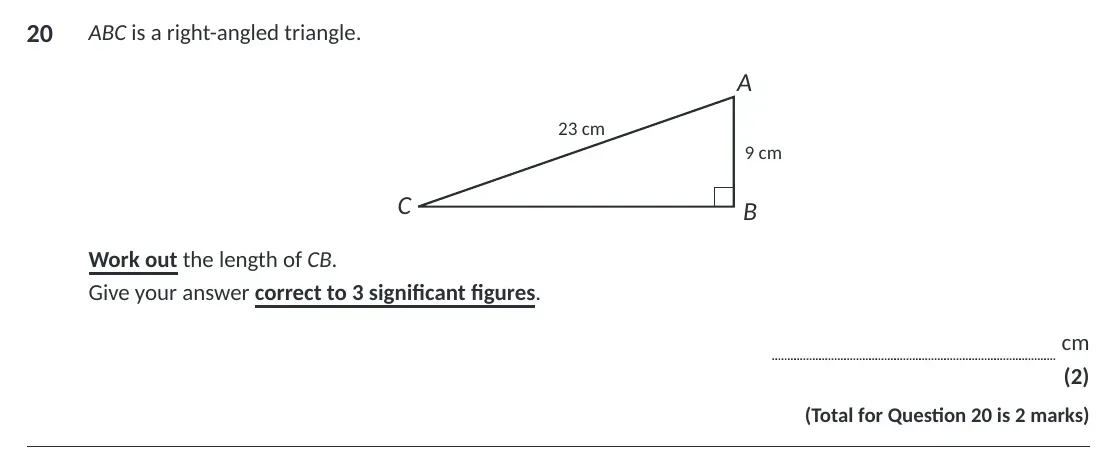
20 ABC is a right-angled triangle. A 23 cm 9 cm C B Work out the length of CB. Give your answer correct to 3 significant figures. cm 📄 sheet: Pythagoras (2) (Total for Question 20 is 2 marks)
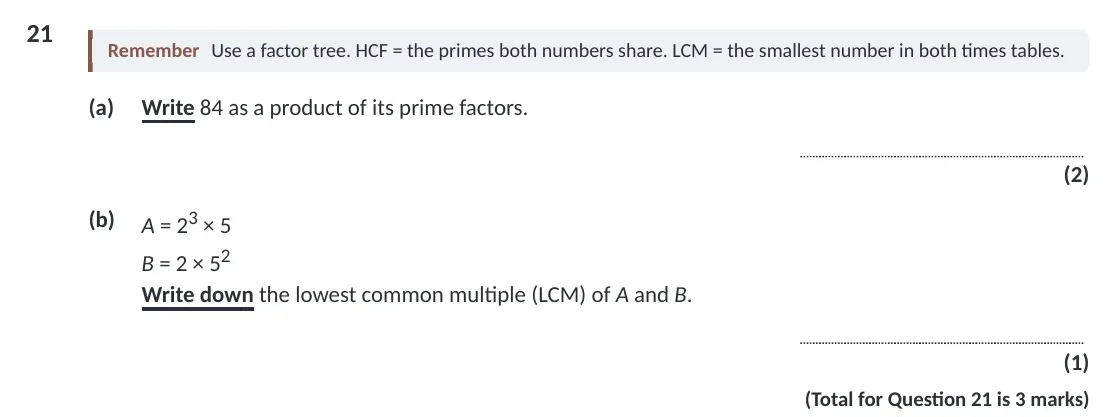
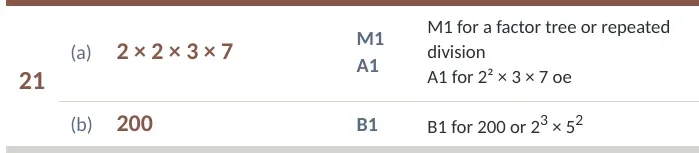
21 Remember Use a factor tree. HCF = the primes both numbers share. LCM = the smallest number in both times tables. (a) Write 84 as a product of its prime factors. (2) (b) A = 2 3 × 5 B = 2 × 5 2 Write down the lowest common multiple (LCM) of A and B. (1) 📄 sheet: HCF and LCM (Total for Question 21 is 3 marks)
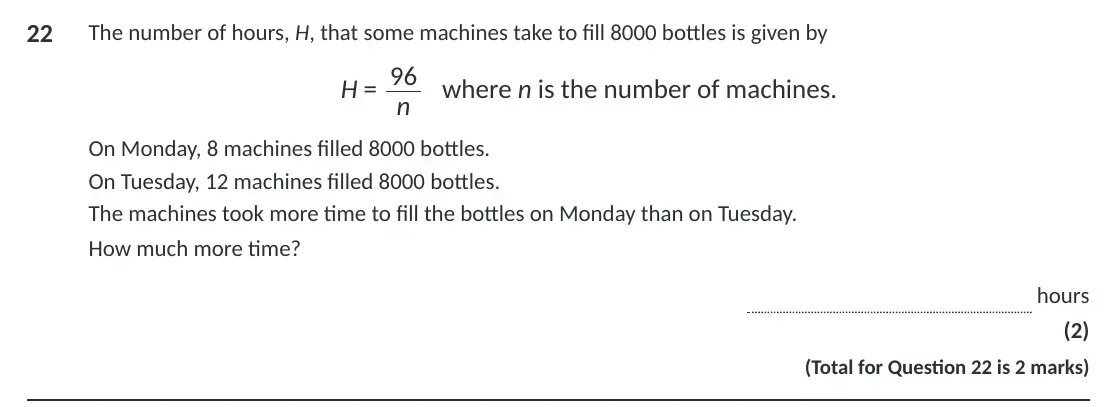
22 The number of hours, H, that some machines take to fill 8000 bottles is given by H = 96 where n is the number of machines. n On Monday, 8 machines filled 8000 bottles. On Tuesday, 12 machines filled 8000 bottles. The machines took more time to fill the bottles on Monday than on Tuesday. How much more time? hours 📄 sheet: Inverse proportion, card 1 (2) (Total for Question 22 is 2 marks)
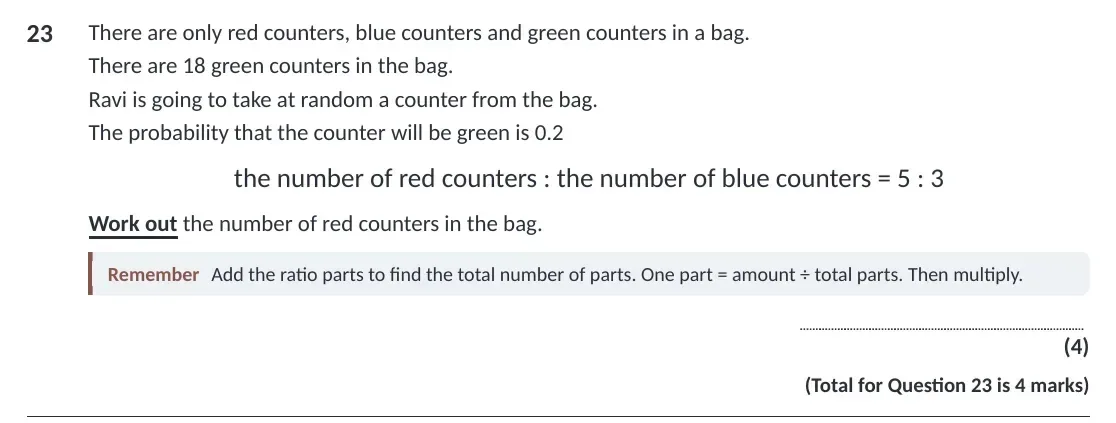
23 There are only red counters, blue counters and green counters in a bag. There are 18 green counters in the bag. Ravi is going to take at random a counter from the bag. The probability that the counter will be green is 0.2 the number of red counters : the number of blue counters = 5 : 3 Work out the number of red counters in the bag. Remember Add the ratio parts to find the total number of parts
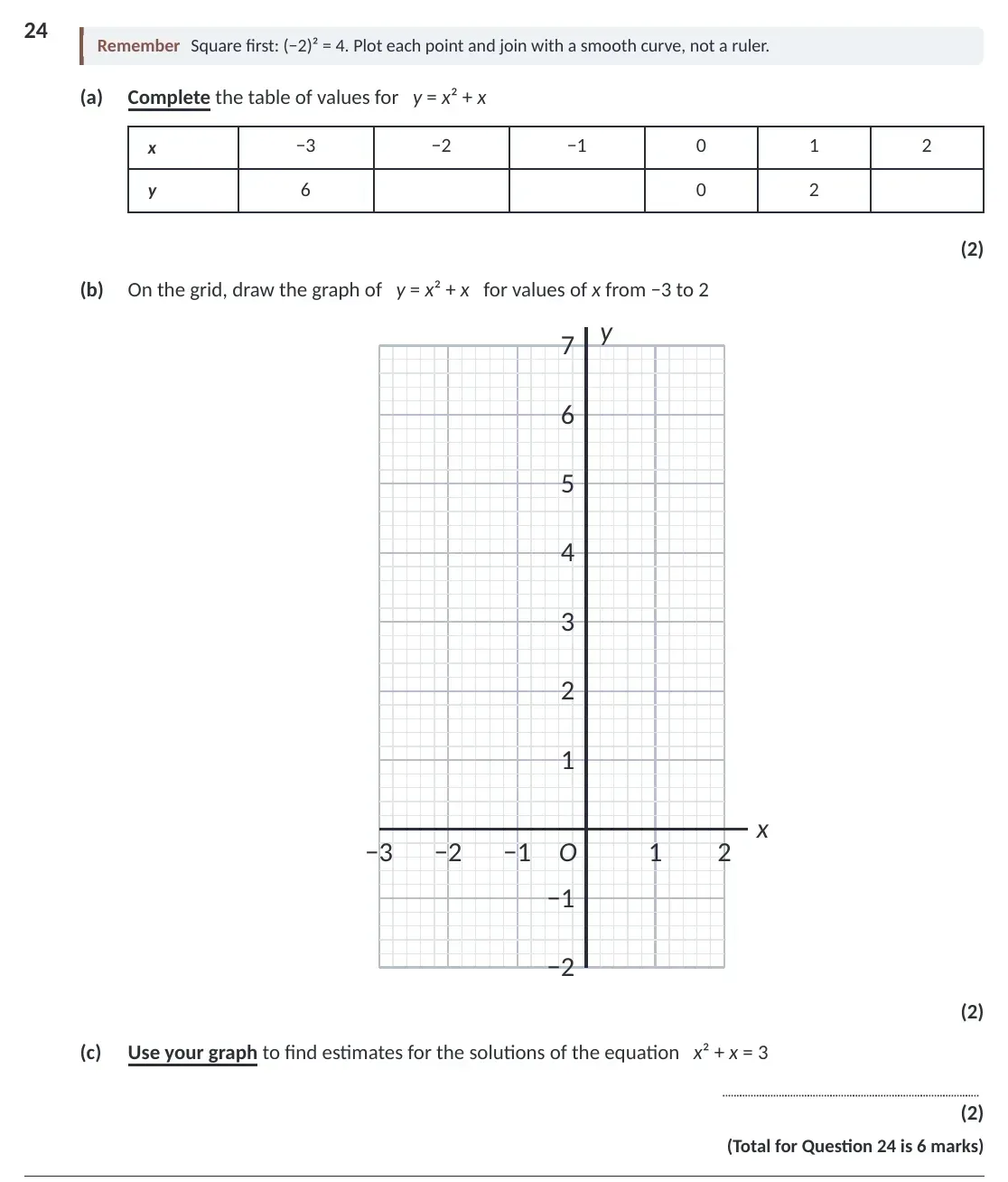
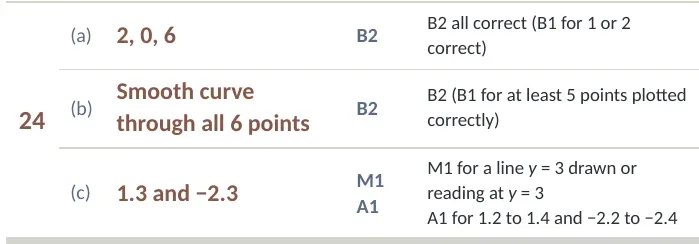
24 Remember Square first: (−2)² = 4. Plot each point and join with a smooth curve, not a ruler. (a) Complete the table of values for y = x² + x x −3 y 6 −2 −1 0 1 0 2 2 (2) (b) On the grid, draw the graph of y = x² + x for values of x from −3 to 2 7 y 6 5 4 3 2 1 −3 −2 −1 O 1 2 x −1 −2 (2) (c) Use your graph to find estimates for the solutions of the equation x² + x = 3 📄 sheet: Drawing and using
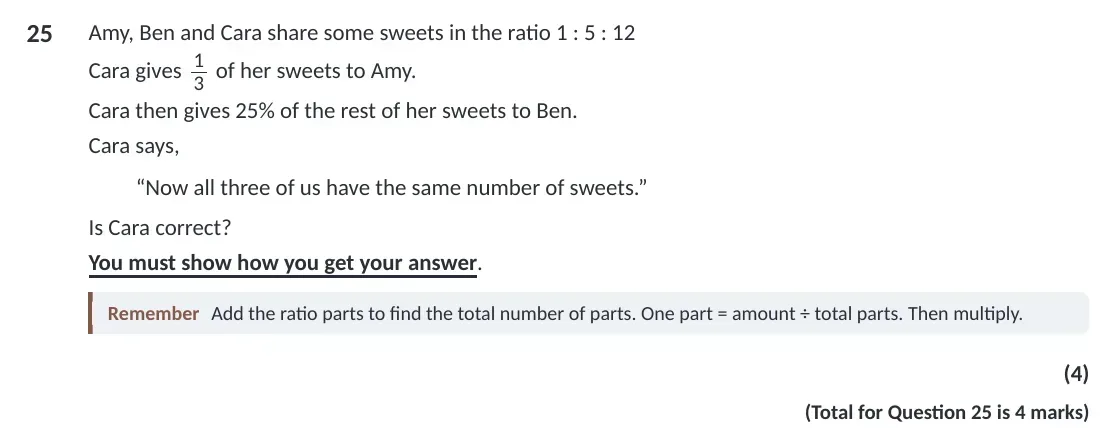
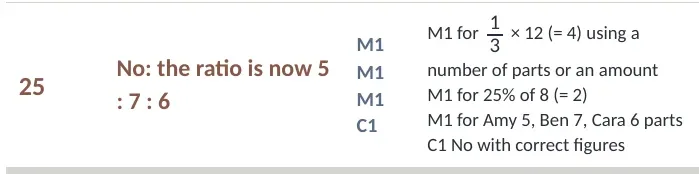
25 Amy, Ben and Cara share some sweets in the ratio 1 : 5 : 12 Cara gives 1 of her sweets to Amy. 3 Cara then gives 25% of the rest of her sweets to Ben. Cara says, “Now all three of us have the same number of sweets.” Is Cara correct? You must show how you get your answer. Remember Add the ratio parts to find the total number of parts. One part = amount ÷ total parts. Then multiply. (4) 📄 sheet:
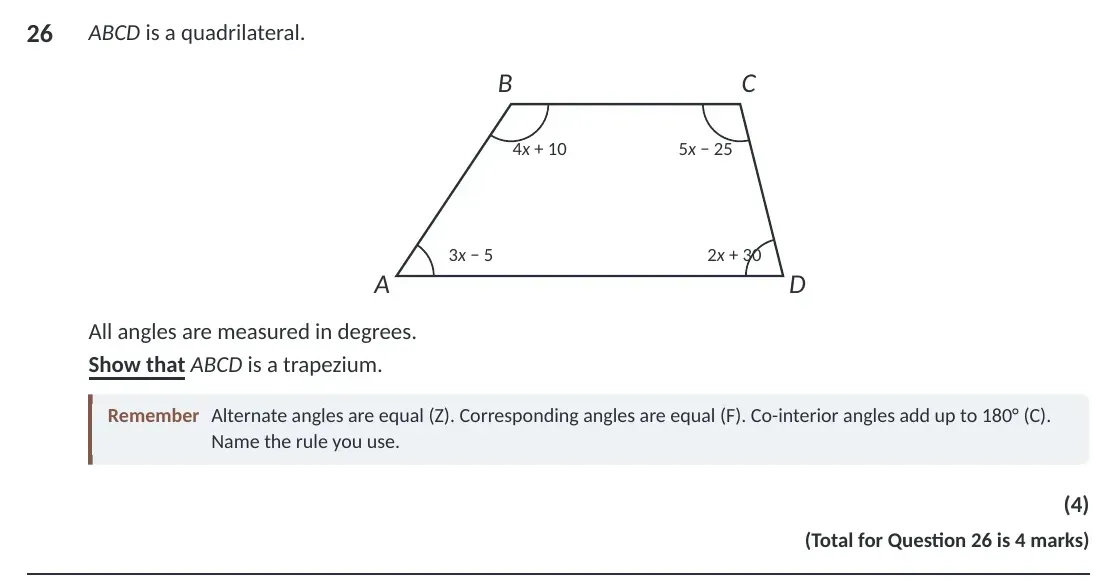
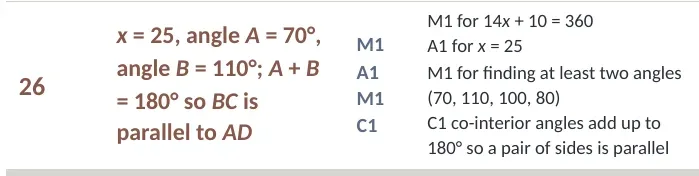
26 ABCD is a quadrilateral. B 4x + 10 3x − 5 A C 5x − 25 2x + 30 D All angles are measured in degrees. Show that ABCD is a trapezium. Remember Alternate angles are equal (Z). Corresponding angles are equal (F). Co-interior angles add up to 180° (C). Name the rule you use. 📄 sheet: Angle facts (4) (Total for Question 26 is 4 marks)
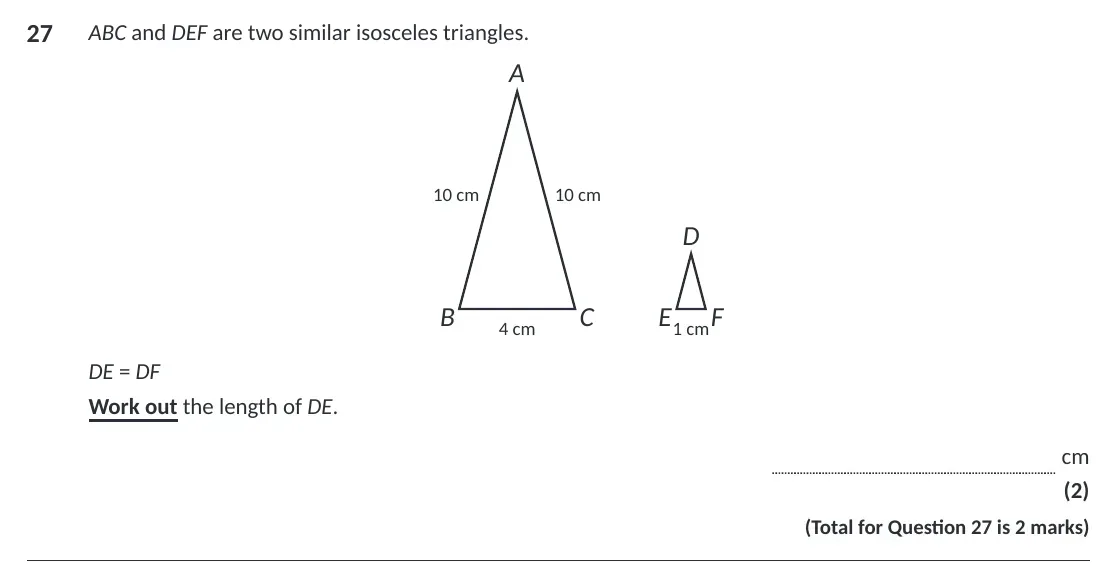
27 ABC and DEF are two similar isosceles triangles. A 10 cm 10 cm D B 4 cm C E 1 cm F DE = DF Work out the length of DE. cm 📄 sheet: Similar shapes (2) (Total for Question 27 is 2 marks)
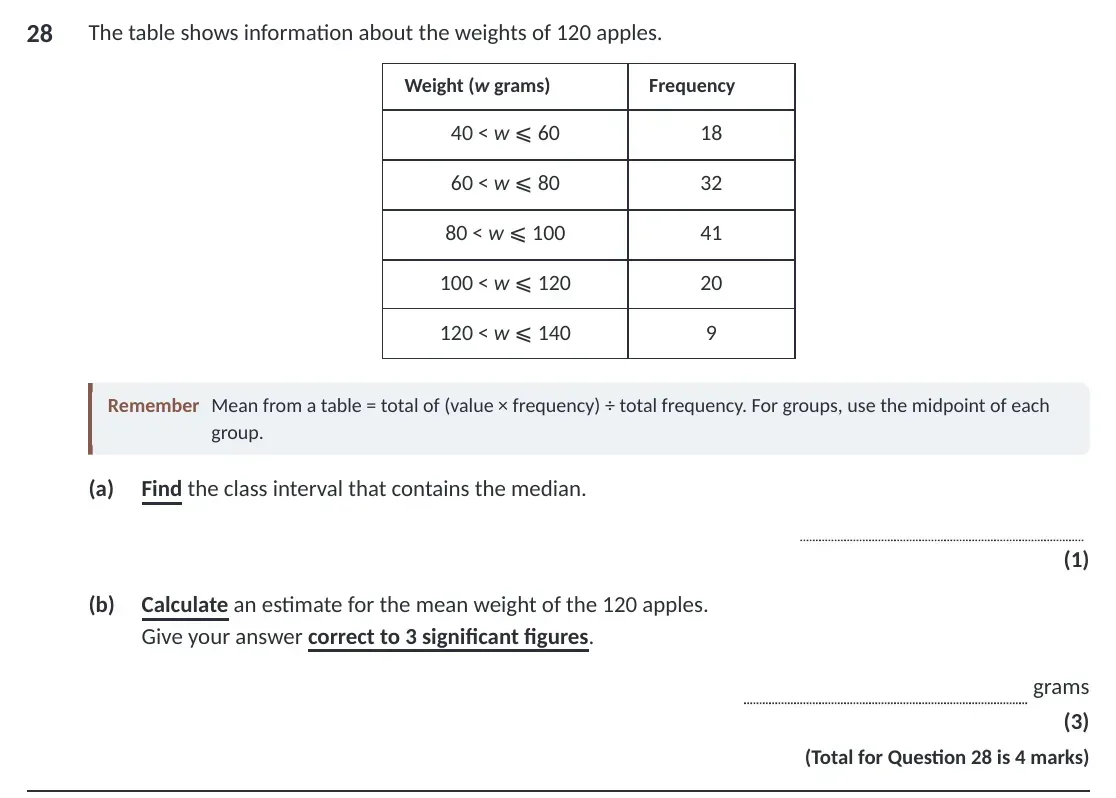
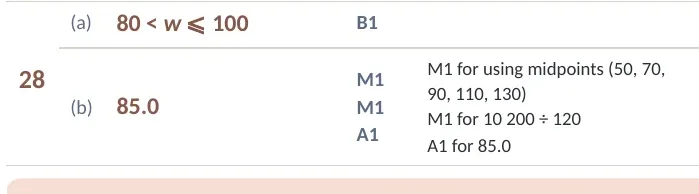
28 The table shows information about the weights of 120 apples. Weight (w grams) Frequency 40 < w ⩽ 60 18 60 < w ⩽ 80 32 80 < w ⩽ 100 41 100 < w ⩽ 120 20 120 < w ⩽ 140 9 Remember Mean from a table = total of (value × frequency) ÷ total frequency. For groups, use the midpoint of each group. (a) Find the class interval that contains the median. (1) (b) Calculate an estimate for the mean weight of th
◀ C1All papersC3 ▶
Answer the questions, then mark your paper.