Miss North Maths
GCSE Foundation › Algebra

Factorising

Everything you need to know, on one fact sheet. On the Year 11 revision planner in week 8.
1. Watch

Miss North: FactorisingVideo coming soon. Use the fact sheet below in the meantime.

2. Learn the facts

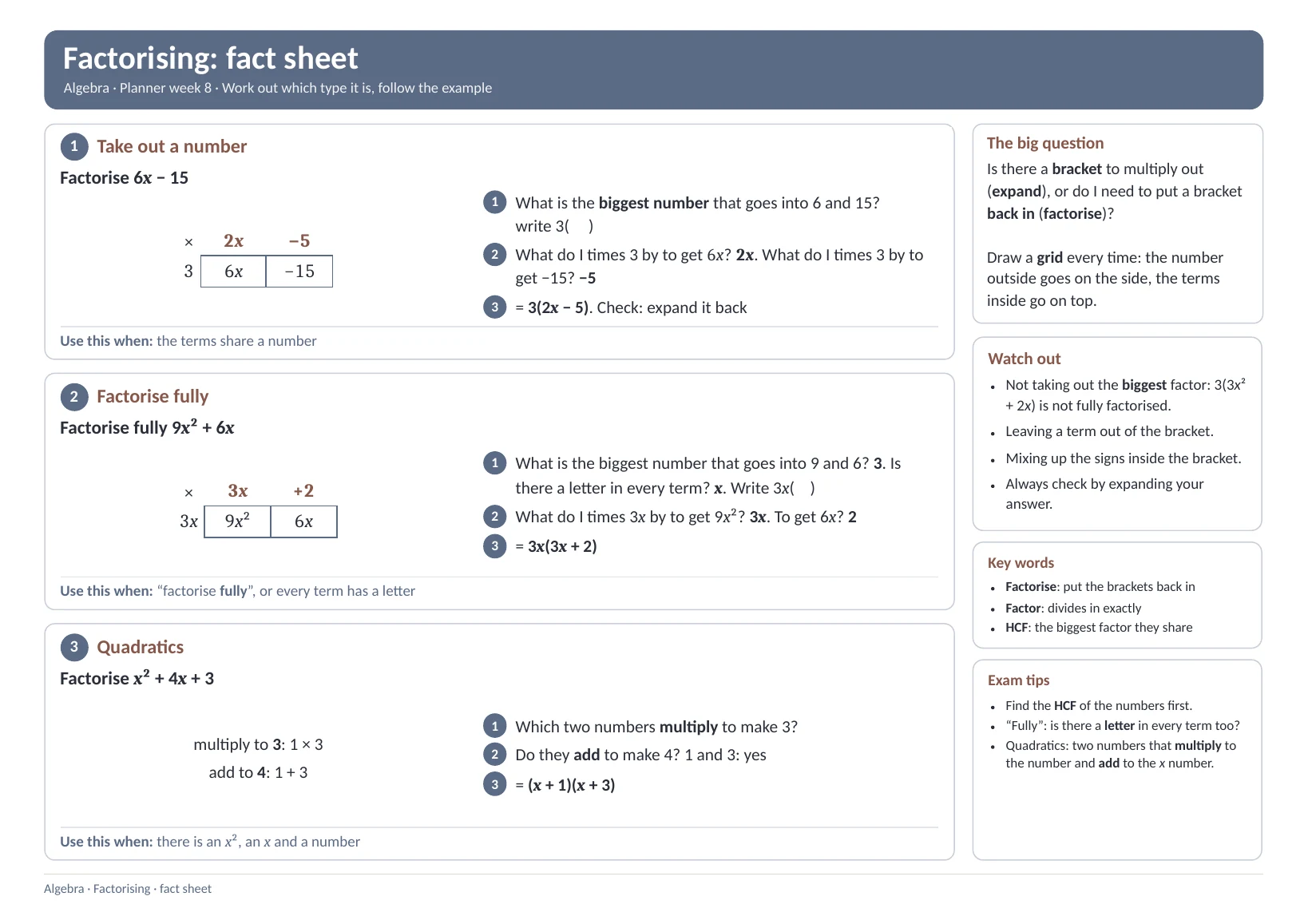
Factorising fact sheet: Factorising
1 of 1 · FactorisingTap the sheet to open it full size

See it move

Explore first, then try 5 questions. Press Board to fill the screen.

Which method? Follow the flowchart

Start at the top, answer each question and follow the arrows to the method you need. Tap it to open it full size.
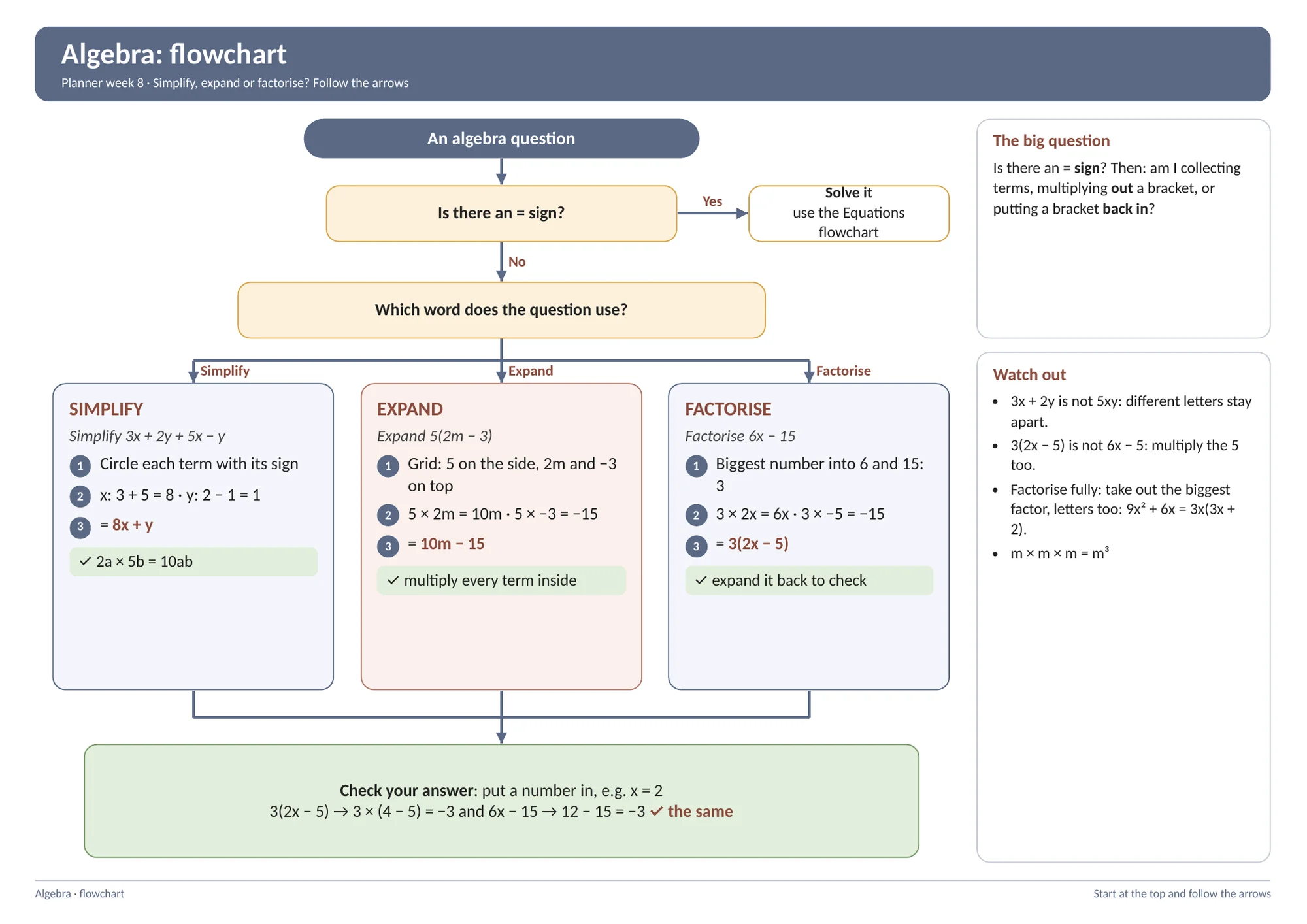
Algebra flowchart: which method to use
Algebra flowchartPrint the flowchart (PDF)

3. Practice questions

Try each one on paper first, then check.

Your score: 0 / 13 marks
1
Grade 2Non-calculator1 mark

Factorise 5x + 20 (1)

Show the answer
5(x + 4)
B1
Watch out: Writing 5(x + 20). Divide both terms by 5.
2
Grade 3Non-calculator1 mark

Factorise 9y − 12 (1)

Show the answer
3(3y − 4)
B1
Watch out: Losing the minus sign. The sign stays with the 12 inside the bracket.
3
Grade 3Non-calculator1 mark

Factorise p² + 7p (1)

Show the answer
p(p + 7)
B1
Watch out: Writing p(p² + 7). Take one p out of each term.
4
Grade 4Non-calculator2 marks

Factorise fully 8a² − 20a (2)

Show the answer
4a(2a − 5)
B2 4a(2a − 5); B1 a partly factorised answer such as 4(2a² − 5a) or a(8a − 20)
Watch out: Taking out 4 or a but not both. "Fully" means take out the HCF of the numbers and the letters: 4a.
5
Grade 5Non-calculator2 marks

Factorise x² + 9x + 20 (2)

Show the answer
(x + 4)(x + 5)
M1 two numbers that multiply to 20 and add to 9; A1
Watch out: Picking 2 and 10 (multiply to 20 but add to 12). They must multiply to 20 and add to 9.
6
Grade 5Non-calculator2 marks

Factorise x² − 3x − 10 (2)

Show the answer
(x − 5)(x + 2)
M1 (x ± 5)(x ± 2); A1
Watch out: Getting the signs the wrong way round. Check by expanding: −5 + 2 = −3.
7
Grade 3Non-calculator4 marks
(a)Factorise 10t + 26(1)
(b)Factorise x² − 11x(1)
(c)Factorise fully 12c + 30(2)
Show the answer
(a) 2(5t + 13)
(b) x(x − 11)
(c) 6(2c + 5)
(a) B1 2(5t + 13); (b) B1 x(x − 11); (c) B2 6(2c + 5); B1 a partly factorised answer, e.g. 2(6c + 15)
Watch out: (c) Taking out a common factor that is not the HIGHEST: 2(6c + 15) is not fully factorised. The HCF is 6.

4. Quiz yourself

The Blooket for this topic is coming soon.

5. Print it

The whole factorising fact sheet as a PDF, 1 page, ready to print or keep on your phone.

Download the fact sheet (PDF)