Shape B is an enlargement of shape A with scale factor 3. A side of shape A is 4 cm. Work out the length of the matching side of shape B. (1)
1. Watch
Miss North: Similar shapesVideo coming soon. Use the fact sheet below in the meantime.
2. Learn the facts
3. Practice questions
Try each one on paper first, then check.
Your score: 0 / 9 marks
1
12 cm
B1
Watch out: Adding 3 instead of multiplying. Enlargements multiply every length by the scale factor.
2
Triangle PQR is similar to triangle XYZ. PQ = 5 cm and XY = 15 cm. QR = 7 cm. Work out the length of YZ. (2)
Show the answer
21 cm
M1 scale factor 15 ÷ 5 = 3; A1 21 cm
Watch out: Adding 10 (15 − 5) to 7. Similar shapes multiply, they don’t add.
3
Rectangle A is 6 cm by 4 cm. Rectangle B is 15 cm by 10 cm. Are the rectangles similar? Give a reason. (2)
Show the answer
Yes: both sides are multiplied by 2.5
M1 15 ÷ 6 or 10 ÷ 4; C1 yes, with 2.5 both times
Watch out: Comparing differences (15 − 6 = 9, 10 − 4 = 6). Check the multipliers are the same.
4
Two similar cylinders have heights 8 cm and 20 cm. The smaller cylinder has a radius of 3 cm. Work out the radius of the larger cylinder. (2)
Show the answer
7.5 cm
M1 20 ÷ 8 = 2.5; A1 7.5 cm
Watch out: Using the wrong pair: match height with height to find the scale factor.
5
Triangle ABC is similar to triangle DEF. AB = 6 cm, DE = 9 cm, EF = 12 cm. Work out BC. (2)
Show the answer
8 cm
M1 6 ÷ 9 (or 12 ÷ 1.5); A1 8 cm
Watch out: Multiplying by 1.5 when going from the big shape to the small one. Divide when the shape gets smaller.
4. Quiz yourself
The Blooket for this topic is coming soon.
5. Print it
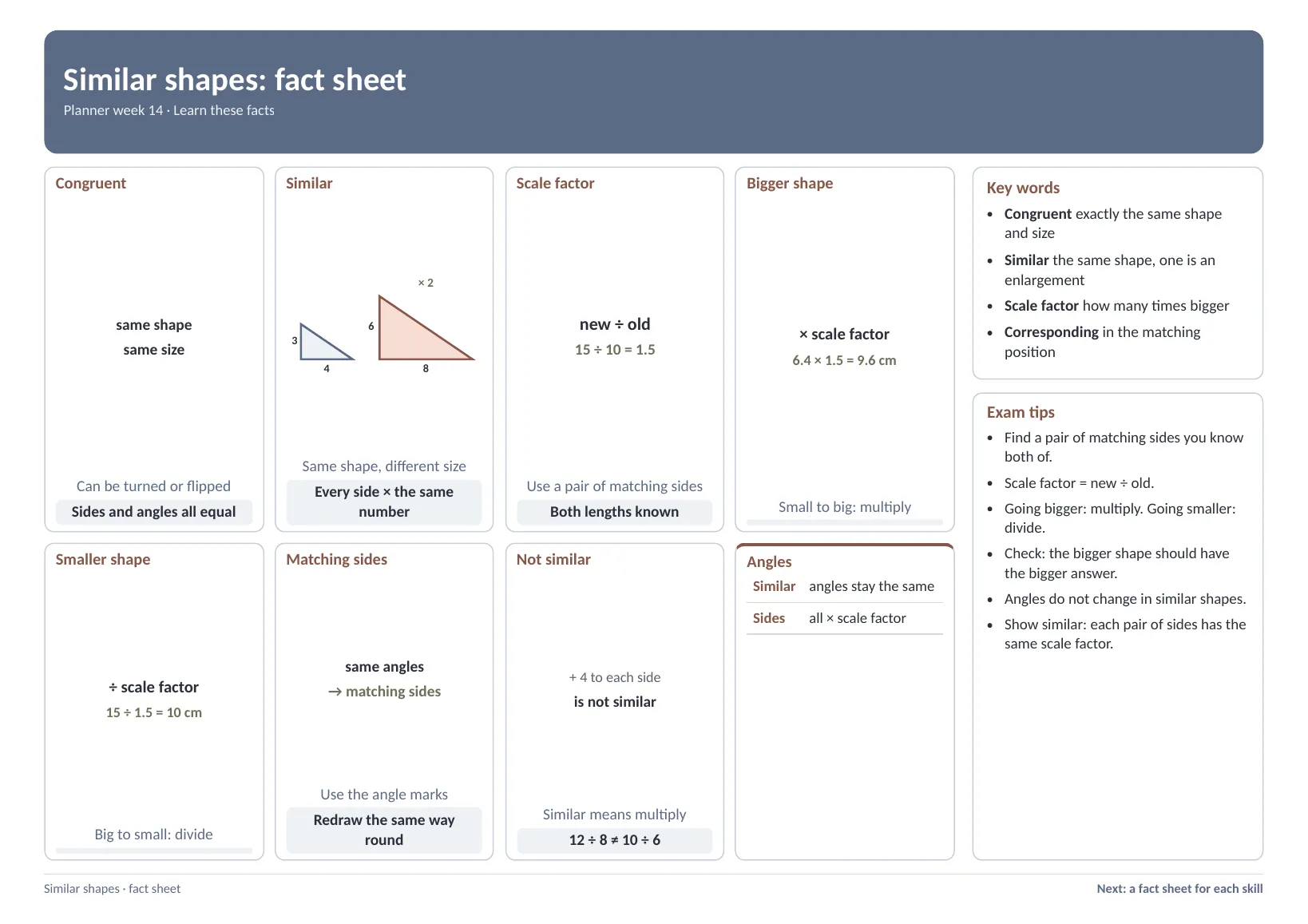
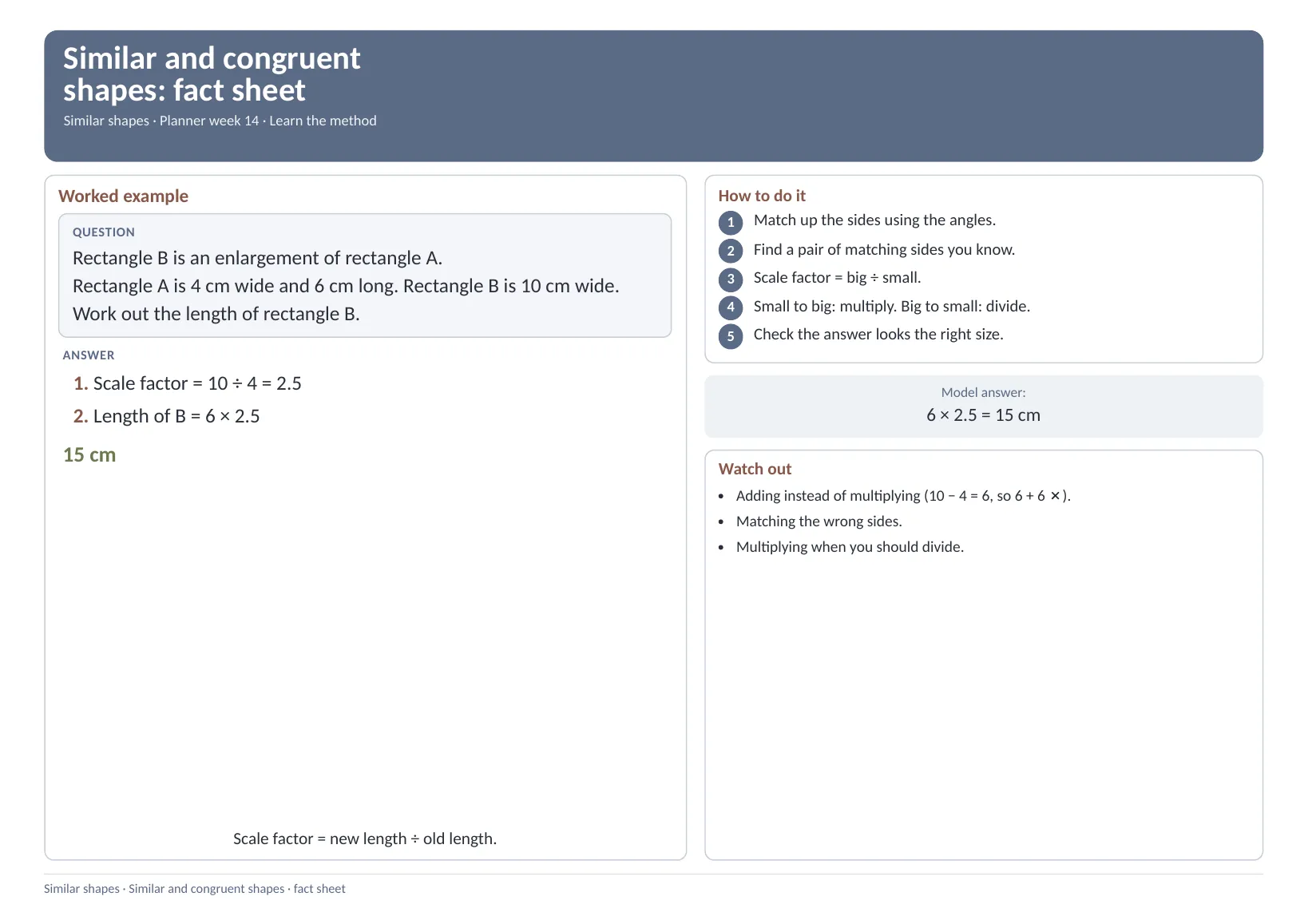
The whole similar shapes fact sheet as a PDF, 2 pages, ready to print or keep on your phone.
Download the fact sheet (PDF)
