Miss North Maths

Full paper C1

Paper 1 style · Non-calculator · 80 marks · 1 hour 30 minutes

How it works. Type each answer in its box. Tap any underlined word on the paper to see what it wants you to do. Stuck? Open the fact sheet under the question. When you finish, press Mark my paper, then check each question against the mark scheme and give yourself the marks you earned, including method marks.

1 Write the number 27 642 correct to the nearest thousand. (1) 📄 sheet: Rounding to the nearest 10, 100 or 1000 (Total for Question 1 is 1 mark)
2 Write 0.7 as a percentage. % (1) 📄 sheet: Converting fractions, decimals and percentages (Total for Question 2 is 1 mark)
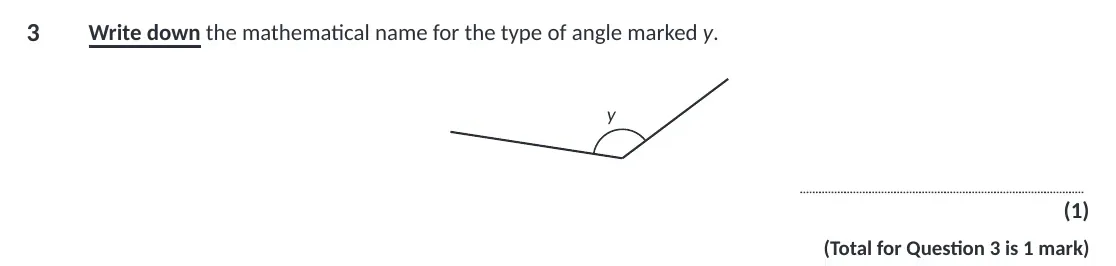
3 Write down the mathematical name for the type of angle marked y. y (1) 📄 sheet: Angle facts (Total for Question 3 is 1 mark)
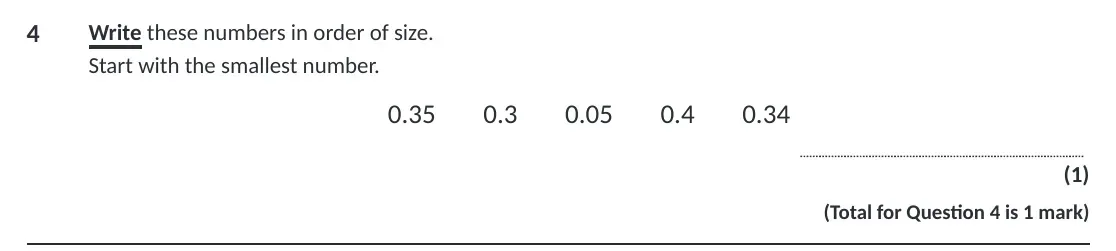
4 Write these numbers in order of size. Start with the smallest number. 0.35 📄 sheet: Ordering decimals 0.3 0.05 0.4 0.34 (1) (Total for Question 4 is 1 mark)
5 Find the square root of 81 (1) 📄 sheet: Powers and roots (Total for Question 5 is 1 mark)
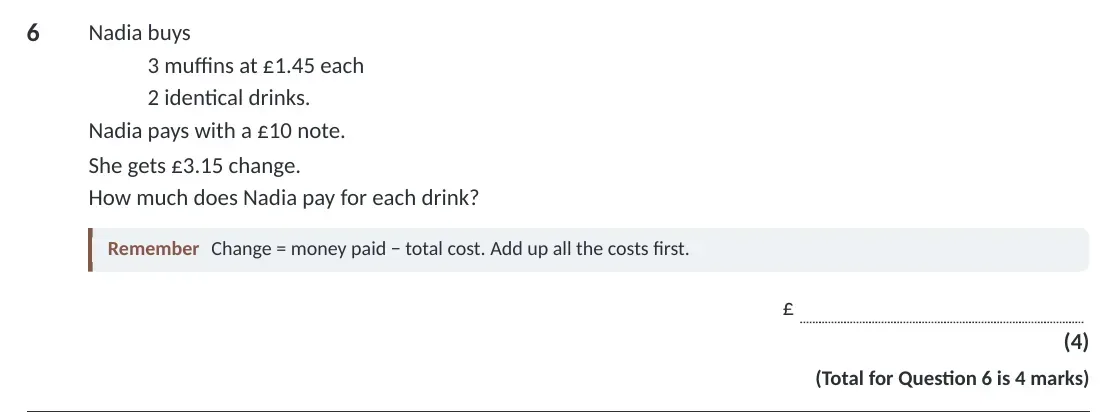
6 Nadia buys 3 muffins at £1.45 each 2 identical drinks. Nadia pays with a £10 note. She gets £3.15 change. How much does Nadia pay for each drink? Remember Change = money paid − total cost. Add up all the costs first. £ 📄 sheet: Shopping, change and offers (4) (Total for Question 6 is 4 marks)
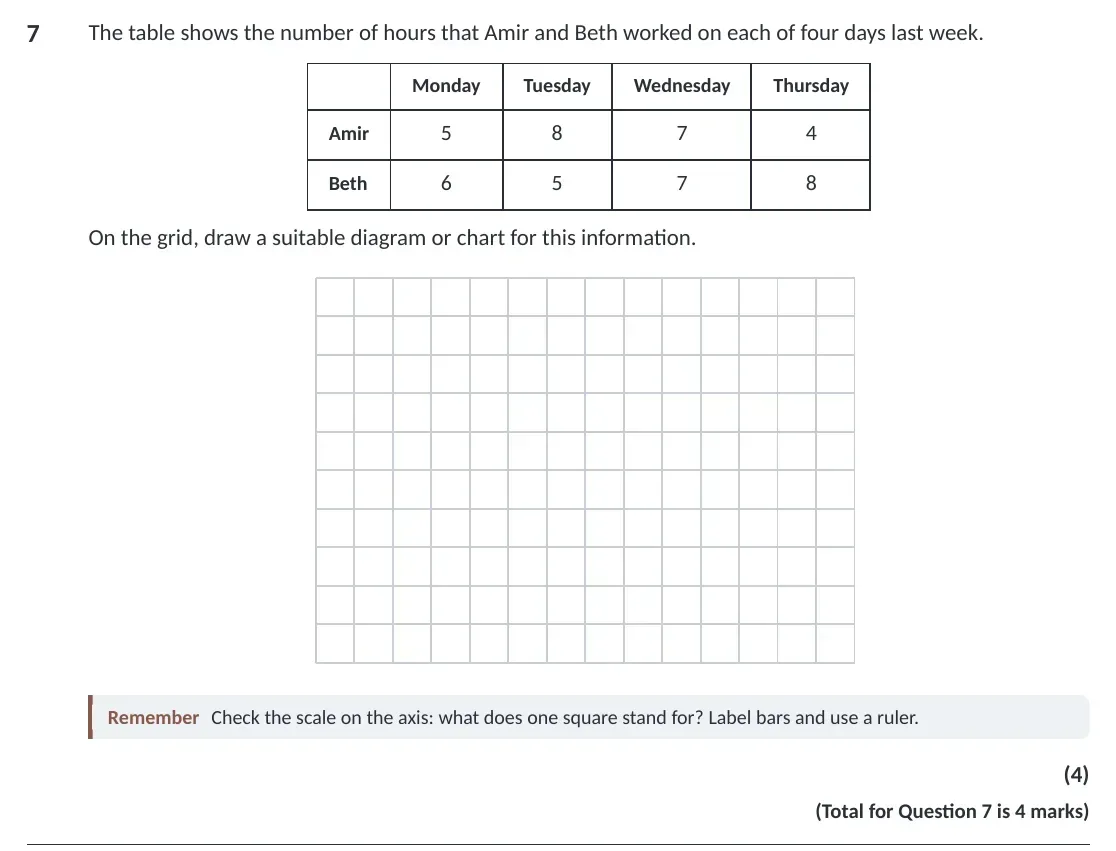
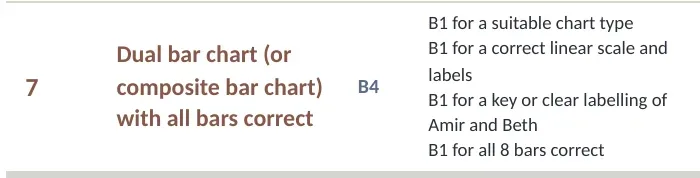
7 The table shows the number of hours that Amir and Beth worked on each of four days last week. Monday Tuesday Wednesday Thursday Amir 5 8 7 4 Beth 6 5 7 8 On the grid, draw a suitable diagram or chart for this information. Remember Check the scale on the axis: what does one square stand for? Label bars and use a ruler. 📄 sheet: Bar charts and line graphs (4) (Total for Question 7 is 4 marks)
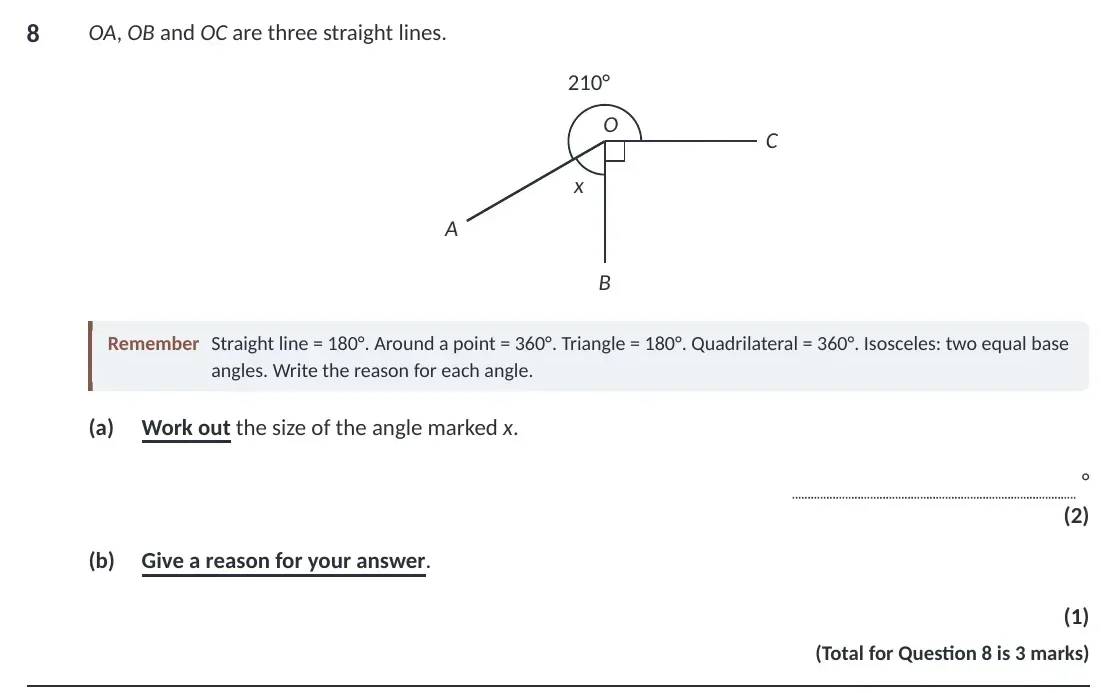
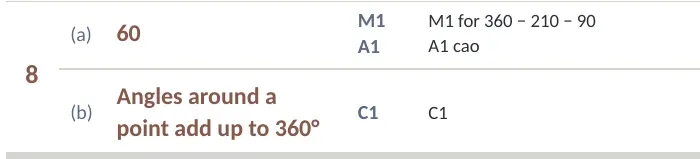
8 OA, OB and OC are three straight lines. 210° O C x A B Remember Straight line = 180°. Around a point = 360°. Triangle = 180°. Quadrilateral = 360°. Isosceles: two equal base angles. Write the reason for each angle. (a) Work out the size of the angle marked x. ° (2) (b) Give a reason for your answer. 📄 sheet: Angle facts (1) (Total for Question 8 is 3 marks)

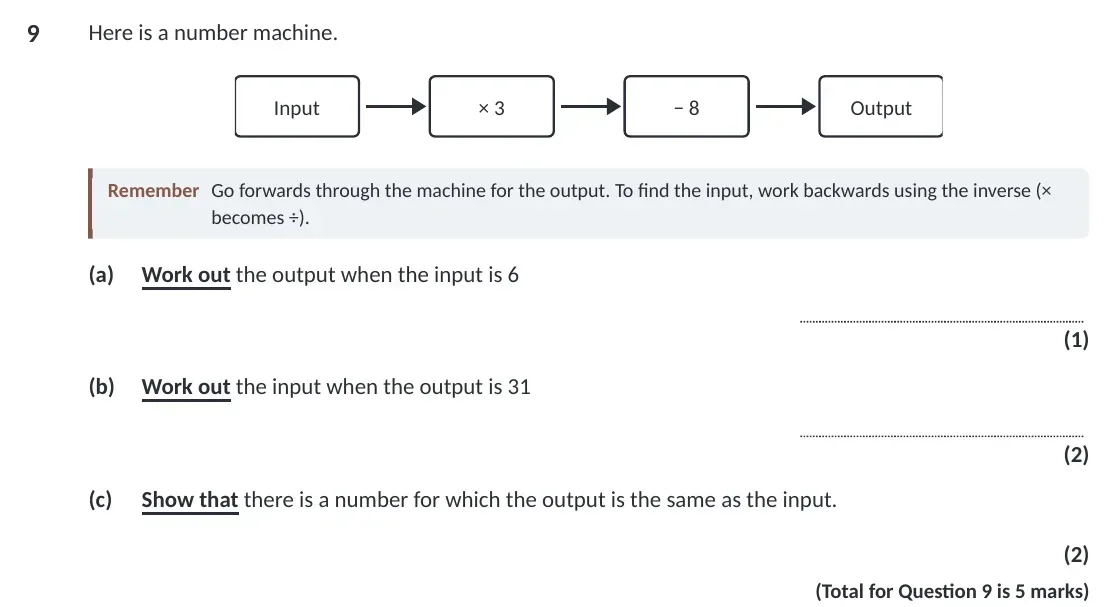
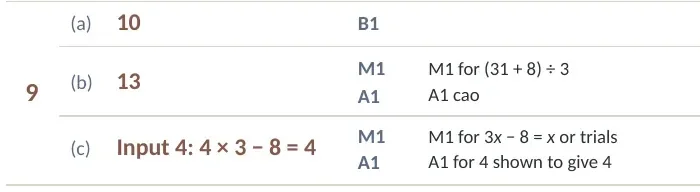
9 Here is a number machine. Input × 3 − 8 Output Remember Go forwards through the machine for the output. To find the input, work backwards using the inverse (× becomes ÷). (a) Work out the output when the input is 6 (1) (b) Work out the input when the output is 31 (2) (c) Show that there is a number for which the output is the same as the input. 📄 sheet: Number problems and number machines (2) (T
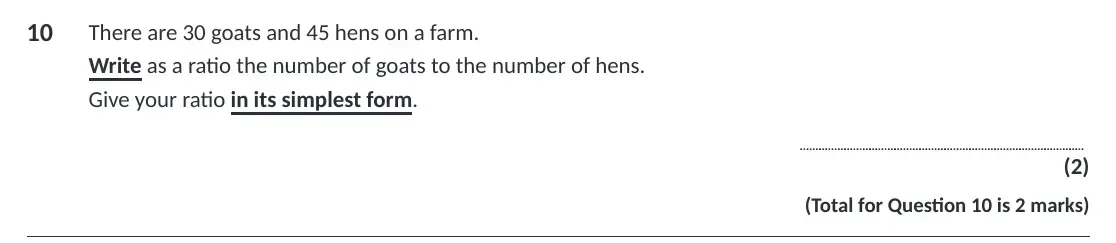
10 There are 30 goats and 45 hens on a farm. Write as a ratio the number of goats to the number of hens. Give your ratio in its simplest form. 📄 sheet: Writing and simplifying ratios (2) (Total for Question 10 is 2 marks)
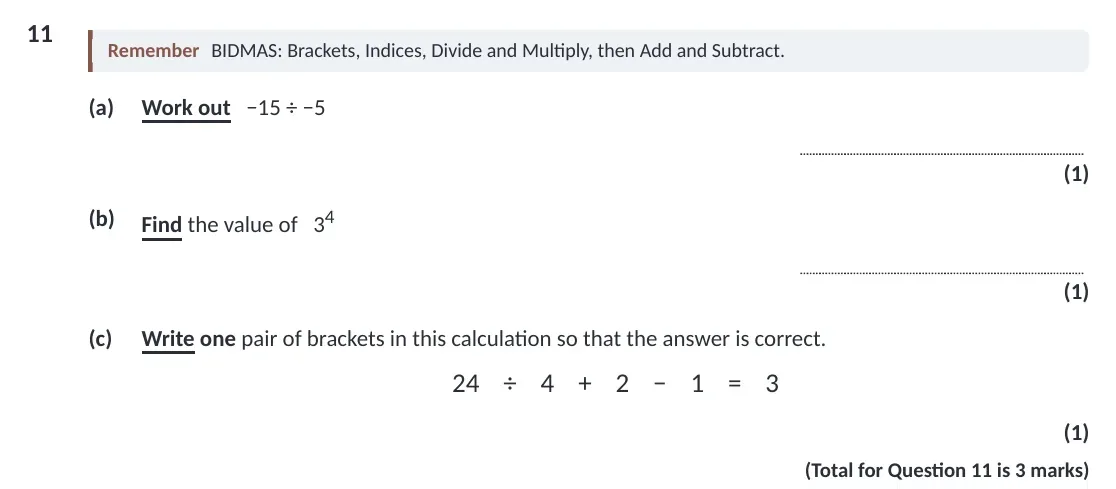
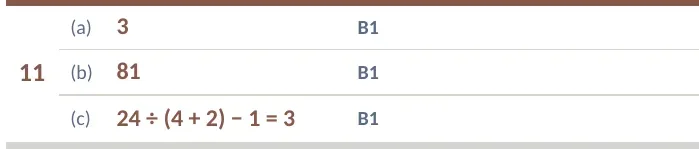
11 Remember BIDMAS: Brackets, Indices, Divide and Multiply, then Add and Subtract. (a) Work out −15 ÷ −5 (1) (b) Find the value of 3 4 (1) (c) Write one pair of brackets in this calculation so that the answer is correct. 24 ÷ 4 + 2 − 1 = 3 📄 sheet: Powers and roots 📄 sheet: Place value and written calculation (1) (Total for Question 11 is 3 marks)
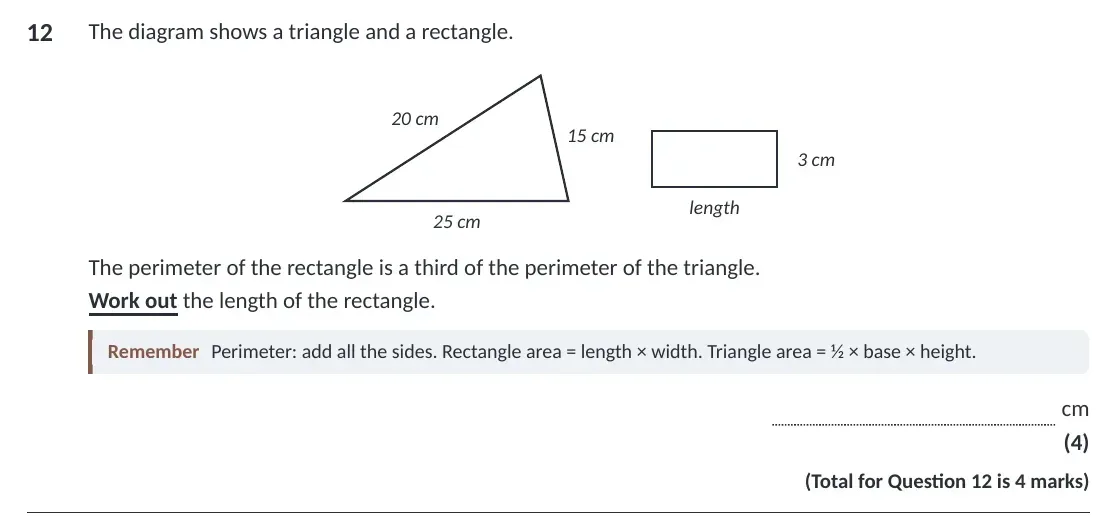
12 The diagram shows a triangle and a rectangle. 20 cm 25 cm 15 cm 3 cm length The perimeter of the rectangle is a third of the perimeter of the triangle. Work out the length of the rectangle. Remember Perimeter: add all the sides. Rectangle area = length × width. Triangle area = ½ × base × height. cm 📄 sheet: Perimeter (4) (Total for Question 12 is 4 marks)
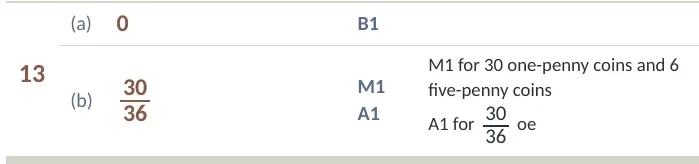
13 There are only £5 notes and £10 notes in a purse. Jo takes at random a note from the purse. Remember Probabilities add up to 1. P(event) = number of ways it can happen ÷ total number of outcomes. AND means multiply. (a) Write down the probability that Jo takes a note with a value of more than £20 (1) (b) There are only 1p coins and 5p coins in a jar. The total value of the coins in the jar is 6
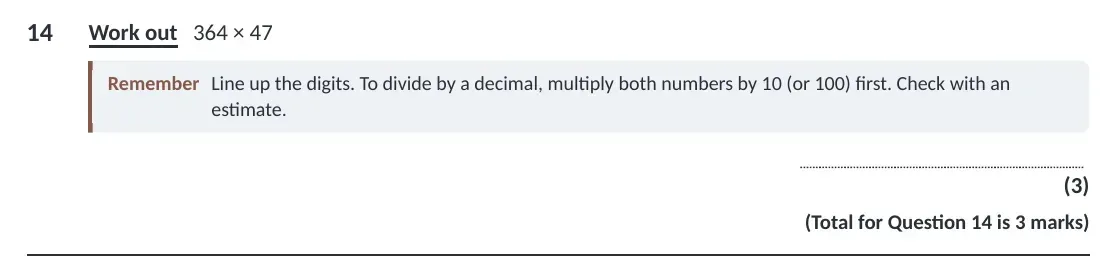
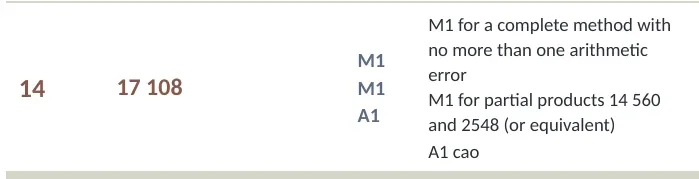
14 Work out 364 × 47 Remember Line up the digits. To divide by a decimal, multiply both numbers by 10 (or 100) first. Check with an estimate. 📄 sheet: Written calculation (3) (Total for Question 14 is 3 marks)
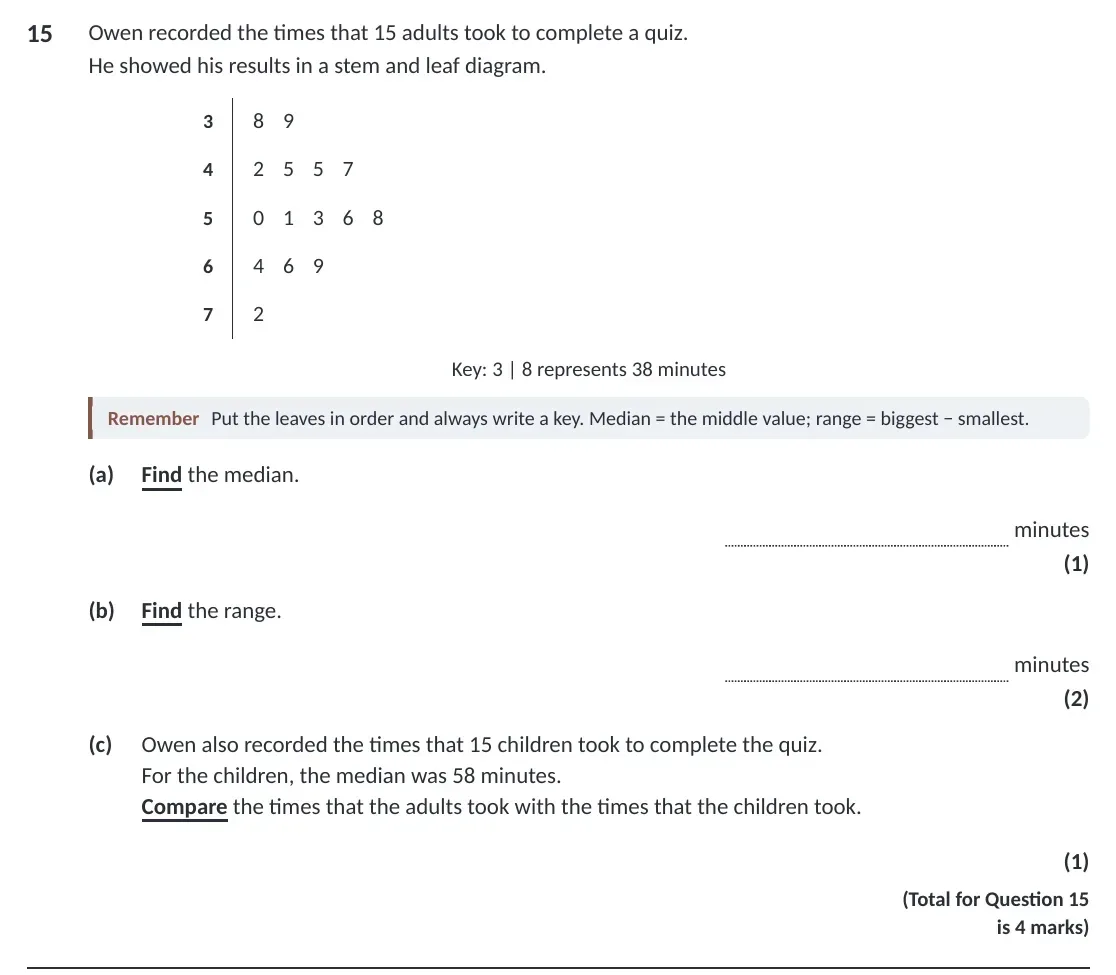
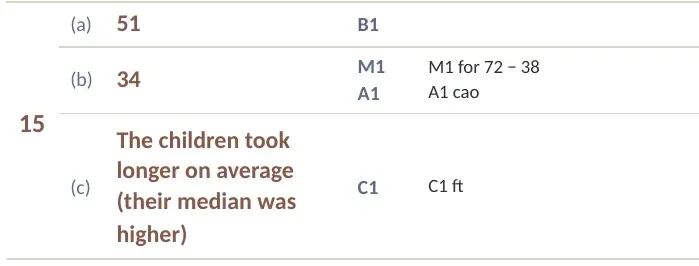
15 Owen recorded the times that 15 adults took to complete a quiz. He showed his results in a stem and leaf diagram. 3 8 9 4 2 5 5 7 5 0 1 3 6 8 6 4 6 9 7 2 Key: 3 | 8 represents 38 minutes Remember Put the leaves in order and always write a key. Median = the middle value; range = biggest − smallest. (a) Find the median. minutes (1) (b) Find the range. minutes (2) (c) Owen also recorded the times
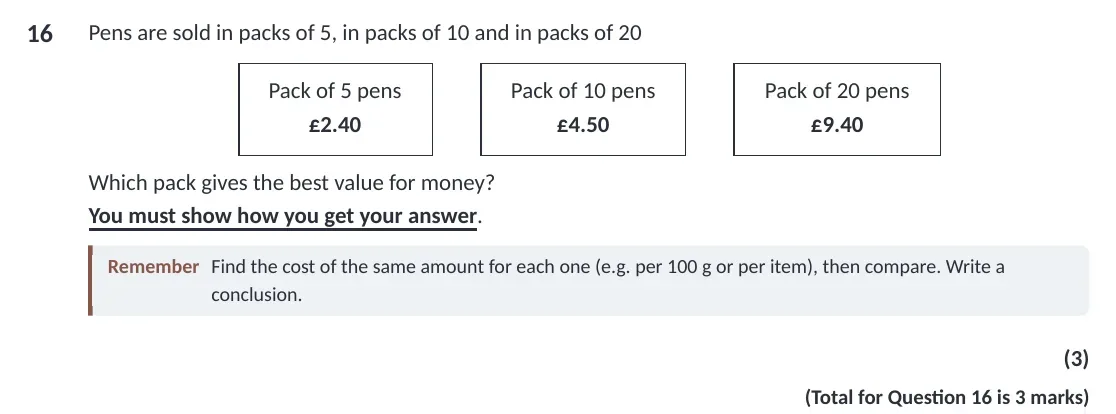
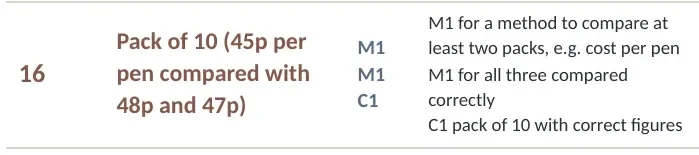
16 Pens are sold in packs of 5, in packs of 10 and in packs of 20 Pack of 5 pens Pack of 10 pens Pack of 20 pens £2.40 £4.50 £9.40 Which pack gives the best value for money? You must show how you get your answer. Remember Find the cost of the same amount for each one (e.g. per 100 g or per item), then compare. Write a conclusion. (3) 📄 sheet: Best buys (Total for Question 16 is 3 marks)
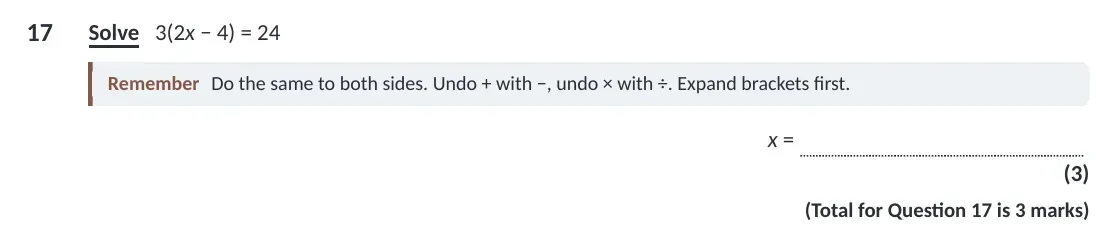
17 Solve 3(2x − 4) = 24 Remember Do the same to both sides. Undo + with −, undo × with ÷. Expand brackets first. x = 📄 sheet: Solving equations, card 2 (3) (Total for Question 17 is 3 marks)
18 Write down the value of 7 0 📄 sheet: Powers and roots (1) (Total for Question 18 is 1 mark)
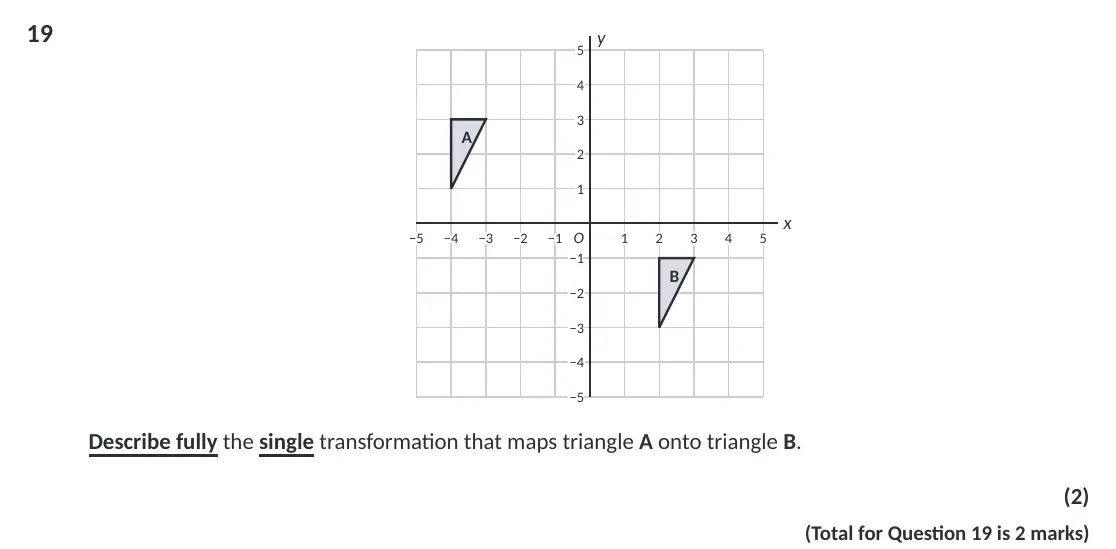
19 5 y 4 3 A 2 1 −5 −4 −3 −2 −1 O −1 1 2 3 4 5 x B −2 −3 −4 −5 Describe fully the single transformation that maps triangle A onto triangle B. (2) 📄 sheet: Translation (Total for Question 19 is 2 marks)
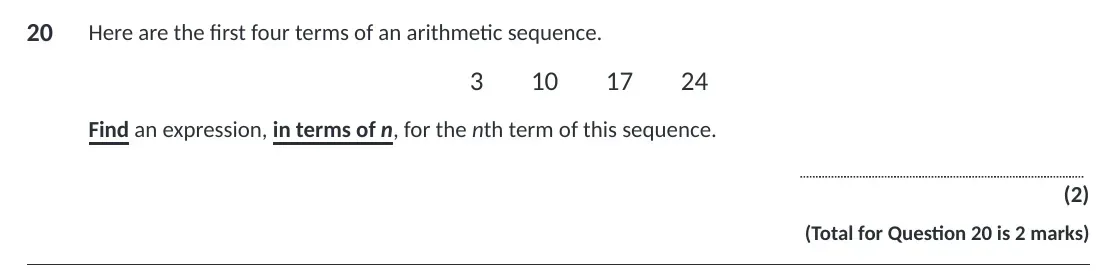
20 Here are the first four terms of an arithmetic sequence. 3 10 17 24 Find an expression, in terms of n, for the nth term of this sequence. 📄 sheet: The nth term, card 1 (2) (Total for Question 20 is 2 marks)
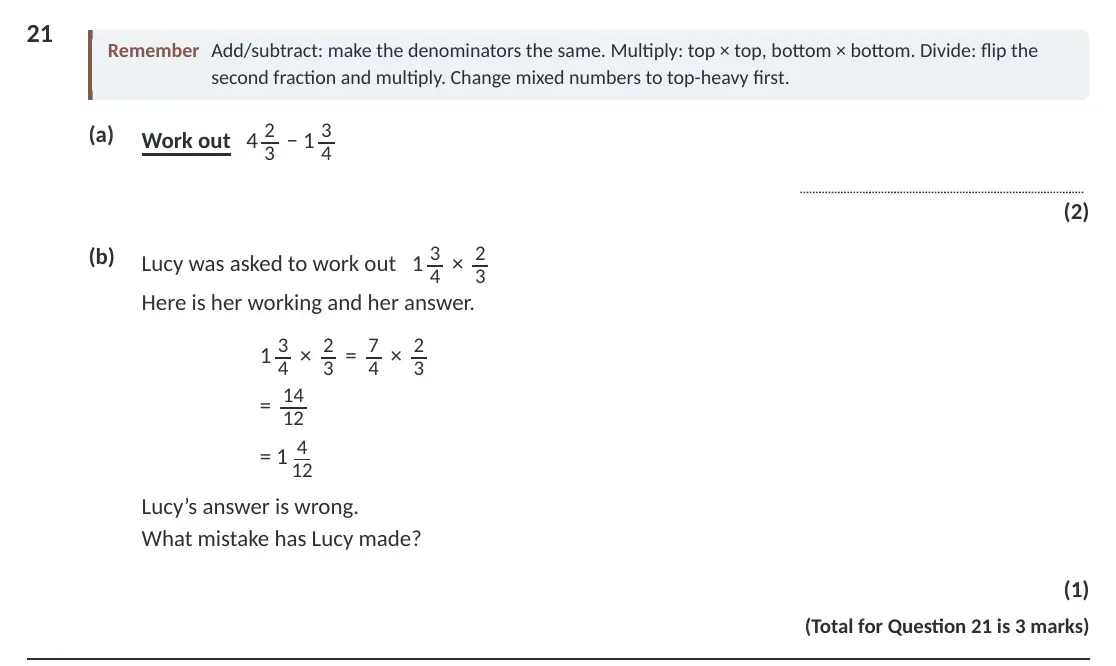
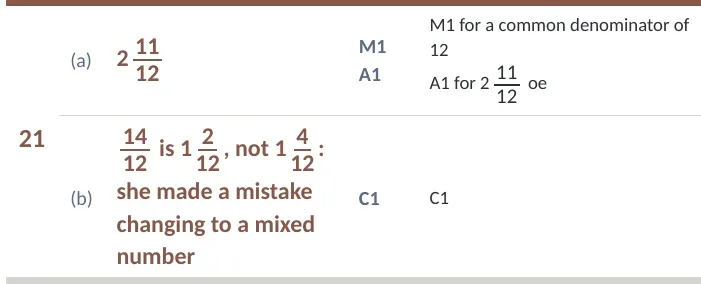
21 Remember Add/subtract: make the denominators the same. Multiply: top × top, bottom × bottom. Divide: flip the second fraction and multiply. Change mixed numbers to top-heavy first. (a) Work out 4 2 − 1 3 3 4 (2) (b) Lucy was asked to work out 1 3 × 2 4 Here is her working and her answer. 3 1 3 × 2 = 7 × 2 4 3 14 = 12 = 1 4 12 4 3 Lucy’s answer is wrong. What mistake has Lucy made? 📄 sheet: Calc
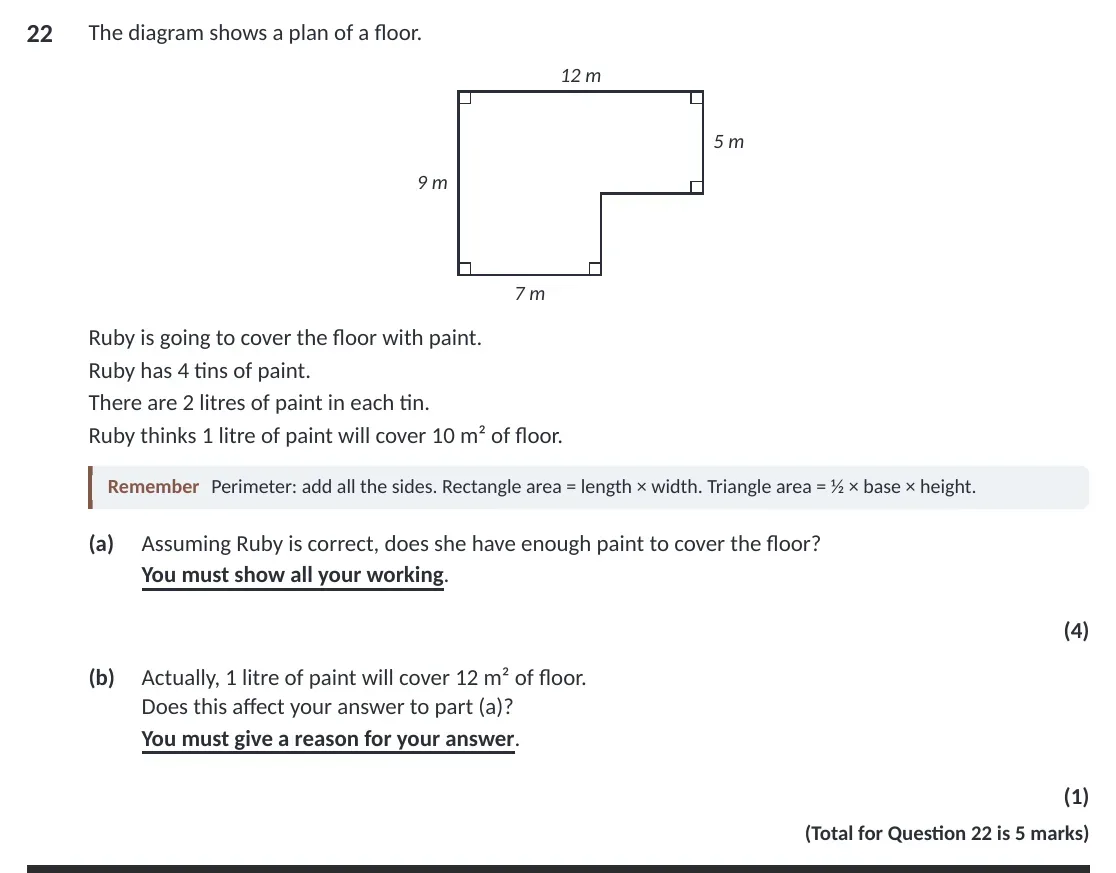
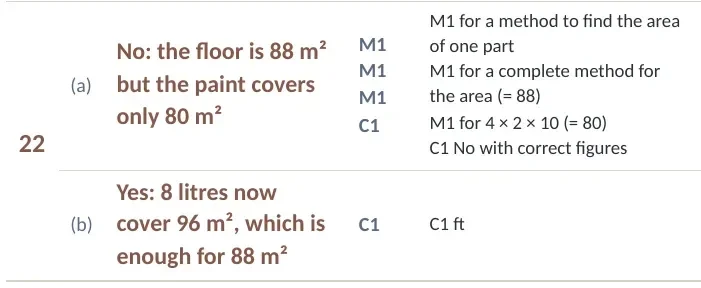
22 The diagram shows a plan of a floor. 12 m 5 m 9 m 7 m Ruby is going to cover the floor with paint. Ruby has 4 tins of paint. There are 2 litres of paint in each tin. Ruby thinks 1 litre of paint will cover 10 m² of floor. Remember Perimeter: add all the sides. Rectangle area = length × width. Triangle area = ½ × base × height. (a) Assuming Ruby is correct, does she have enough paint to cover th
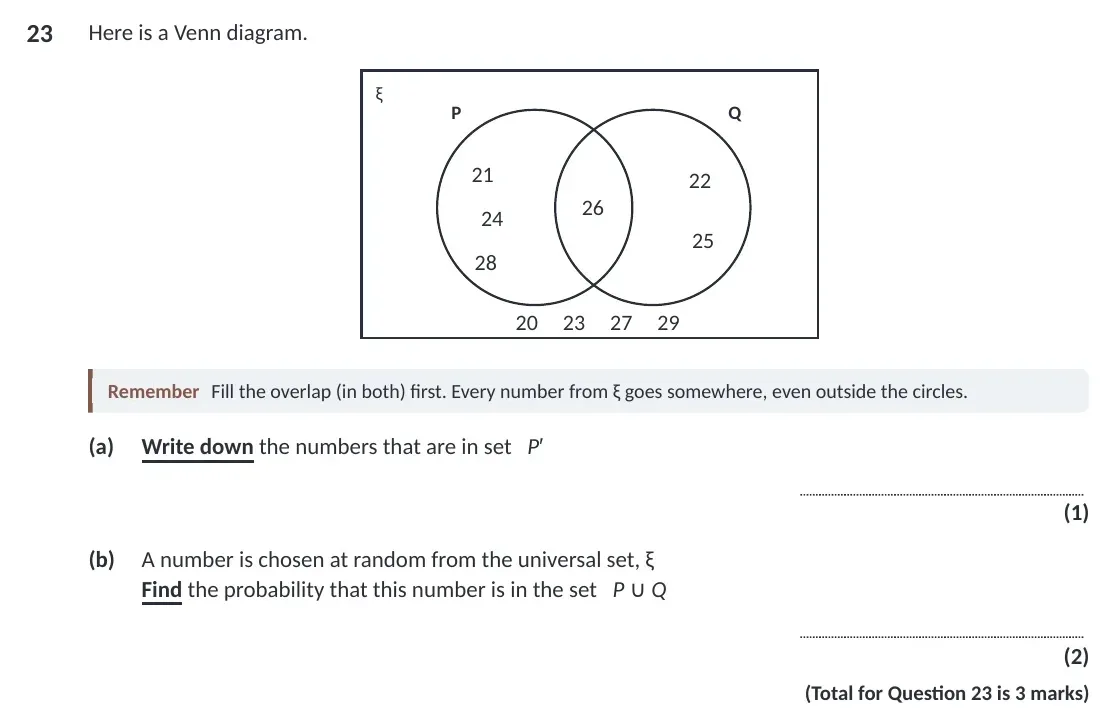
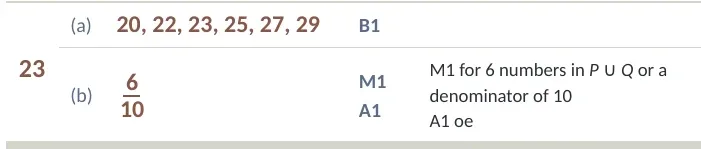
23 Here is a Venn diagram. ξ P Q 21 22 26 24 25 28 20 23 27 29 Remember Fill the overlap (in both) first. Every number from ξ goes somewhere, even outside the circles. (a) Write down the numbers that are in set P′ (1) (b) A number is chosen at random from the universal set, ξ Find the probability that this number is in the set P ∪ Q 📄 sheet: Venn diagrams (2) (Total for Question 23 is 3 marks)
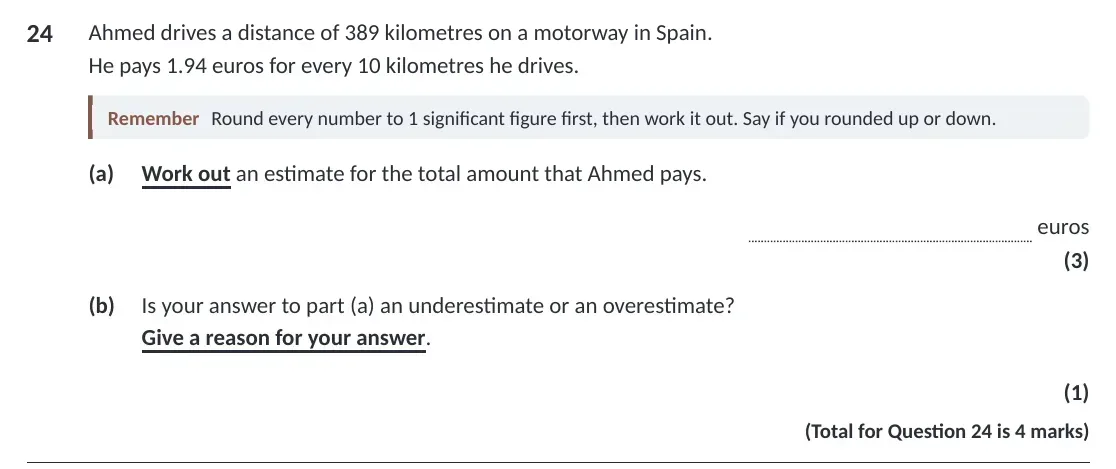
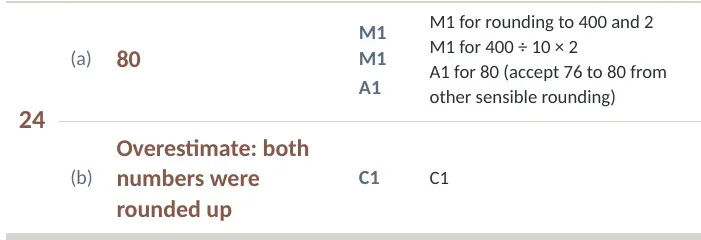
24 Ahmed drives a distance of 389 kilometres on a motorway in Spain. He pays 1.94 euros for every 10 kilometres he drives. Remember Round every number to 1 significant figure first, then work it out. Say if you rounded up or down. (a) Work out an estimate for the total amount that Ahmed pays. euros (3) (b) Is your answer to part (a) an underestimate or an overestimate? Give a reason for your answe
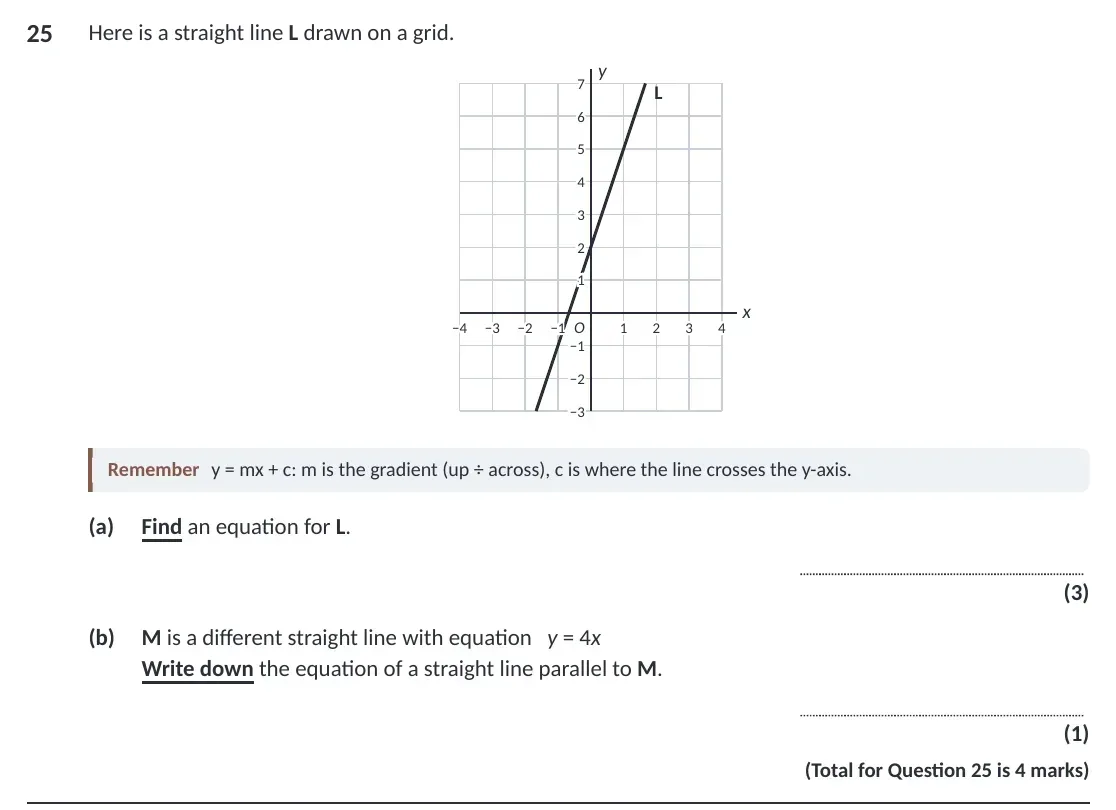
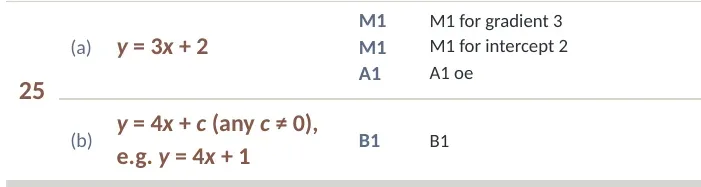
25 Here is a straight line L drawn on a grid. 7 y L 6 5 4 3 2 1 −4 −3 −2 −1 O −1 1 2 3 4 x −2 −3 Remember y = mx + c: m is the gradient (up ÷ across), c is where the line crosses the y-axis. (a) Find an equation for L. (3) (b) M is a different straight line with equation y = 4x Write down the equation of a straight line parallel to M. 📄 sheet: Gradient and y = mx + c (1) (Total for Question 25 is
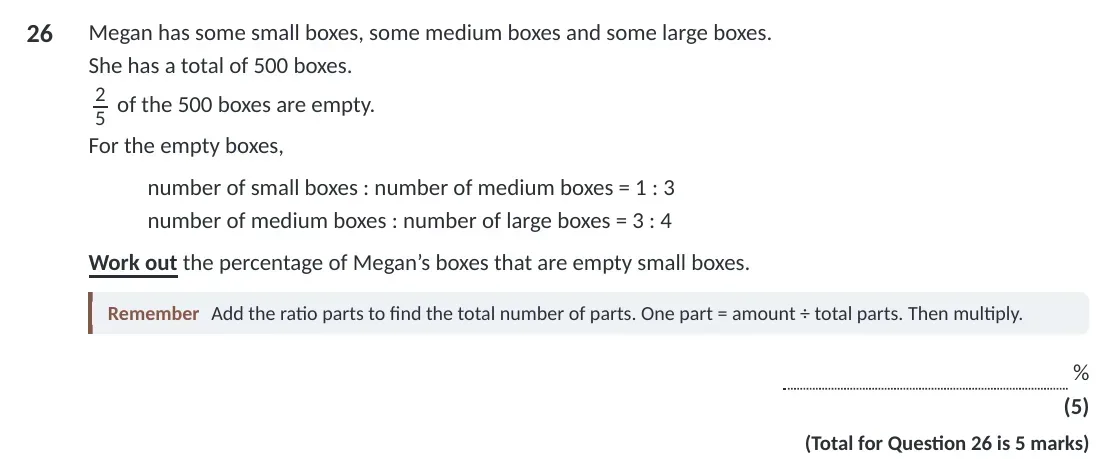
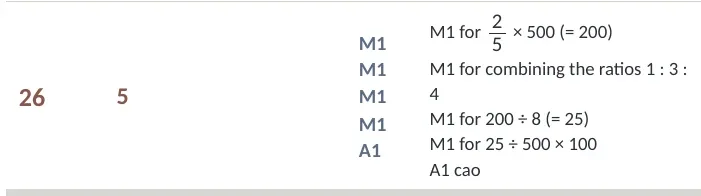
26 Megan has some small boxes, some medium boxes and some large boxes. She has a total of 500 boxes. 2 of the 500 boxes are empty. 5 For the empty boxes, number of small boxes : number of medium boxes = 1 : 3 number of medium boxes : number of large boxes = 3 : 4 Work out the percentage of Megan’s boxes that are empty small boxes. Remember Add the ratio parts to find the total number of parts. One
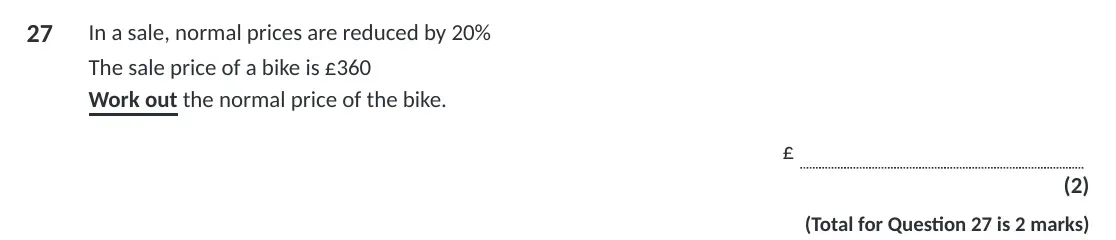
27 In a sale, normal prices are reduced by 20% The sale price of a bike is £360 Work out the normal price of the bike. £ 📄 sheet: Reverse percentages, card 1 (2) (Total for Question 27 is 2 marks)
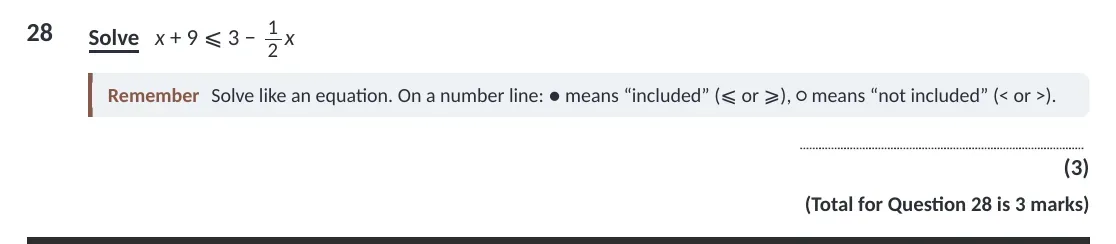
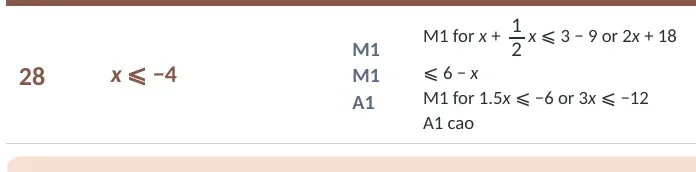
28 Solve x + 9 ⩽ 3 − 1 x 2 Remember Solve like an equation. On a number line: ● means “included” (⩽ or ⩾), ○ means “not included” (< or >). (3) 📄 sheet: Solving inequalities (Total for Question 28 is 3 marks)
◀ B3All papersC2 ▶
Answer the questions, then mark your paper.