Miss North Maths

Full paper G2

Paper 2 style · Calculator · 80 marks · 1 hour 30 minutes

How it works. Type each answer in its box. Tap any underlined word on the paper to see what it wants you to do. Stuck? Open the fact sheet under the question. When you finish, press Mark my paper, then check each question against the mark scheme and give yourself the marks you earned, including method marks.

1 Write 2583 to the nearest 10 (1) 📄 sheet: Rounding to the nearest 10, 100 or 1000 (Total for Question 1 is 1 mark)
2 Write a fraction in the box to make the calculation correct. 1 − 2 = 7 (1) 📄 sheet: Writing and simplifying fractions, card 1 (Total for Question 2 is 1 mark)
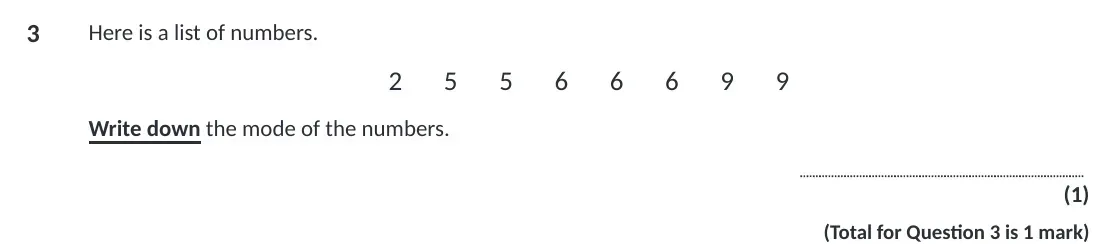
3 Here is a list of numbers. 2 5 5 6 6 6 9 9 Write down the mode of the numbers. 📄 sheet: Mean, median, mode and range, card 2 (1) (Total for Question 3 is 1 mark)
4 Write down a 3 digit number that is a multiple of 4 📄 sheet: and multiples (1) (Total for Question 4 is 1 mark)
5 Write 0.65 as a percentage. % (1) 📄 sheet: Converting fractions, decimals and percentages (Total for Question 5 is 1 mark)
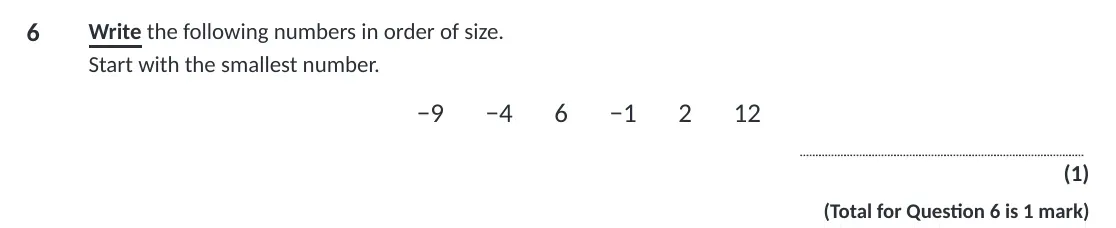
6 Write the following numbers in order of size. Start with the smallest number. −9 −4 6 −1 2 12 (1) 📄 sheet: Ordering negative numbers (Total for Question 6 is 1 mark)
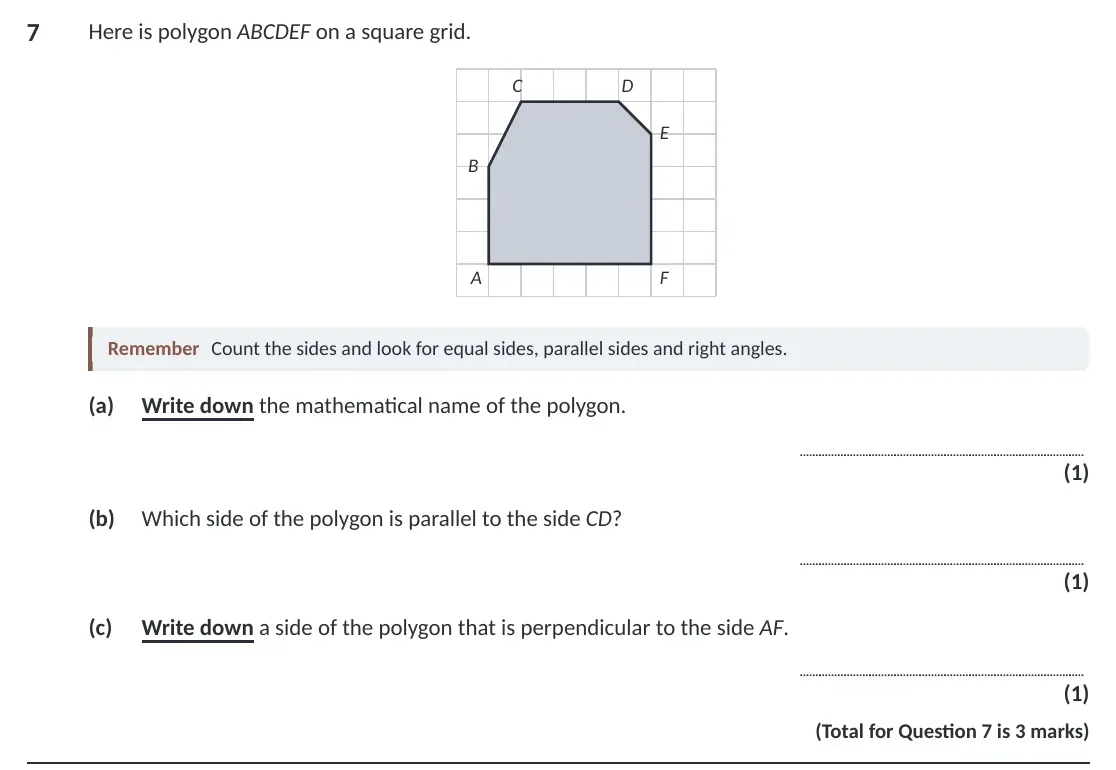
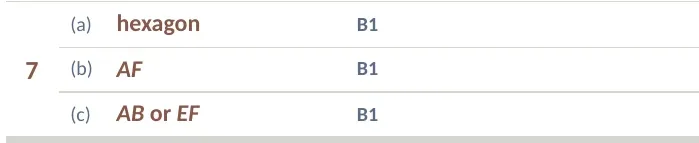
7 Here is polygon ABCDEF on a square grid. C D E B A F Remember Count the sides and look for equal sides, parallel sides and right angles. (a) Write down the mathematical name of the polygon. (1) (b) Which side of the polygon is parallel to the side CD? (1) (c) Write down a side of the polygon that is perpendicular to the side AF. 📄 sheet: Angles in polygons (1) (Total for Question 7 is 3 marks)
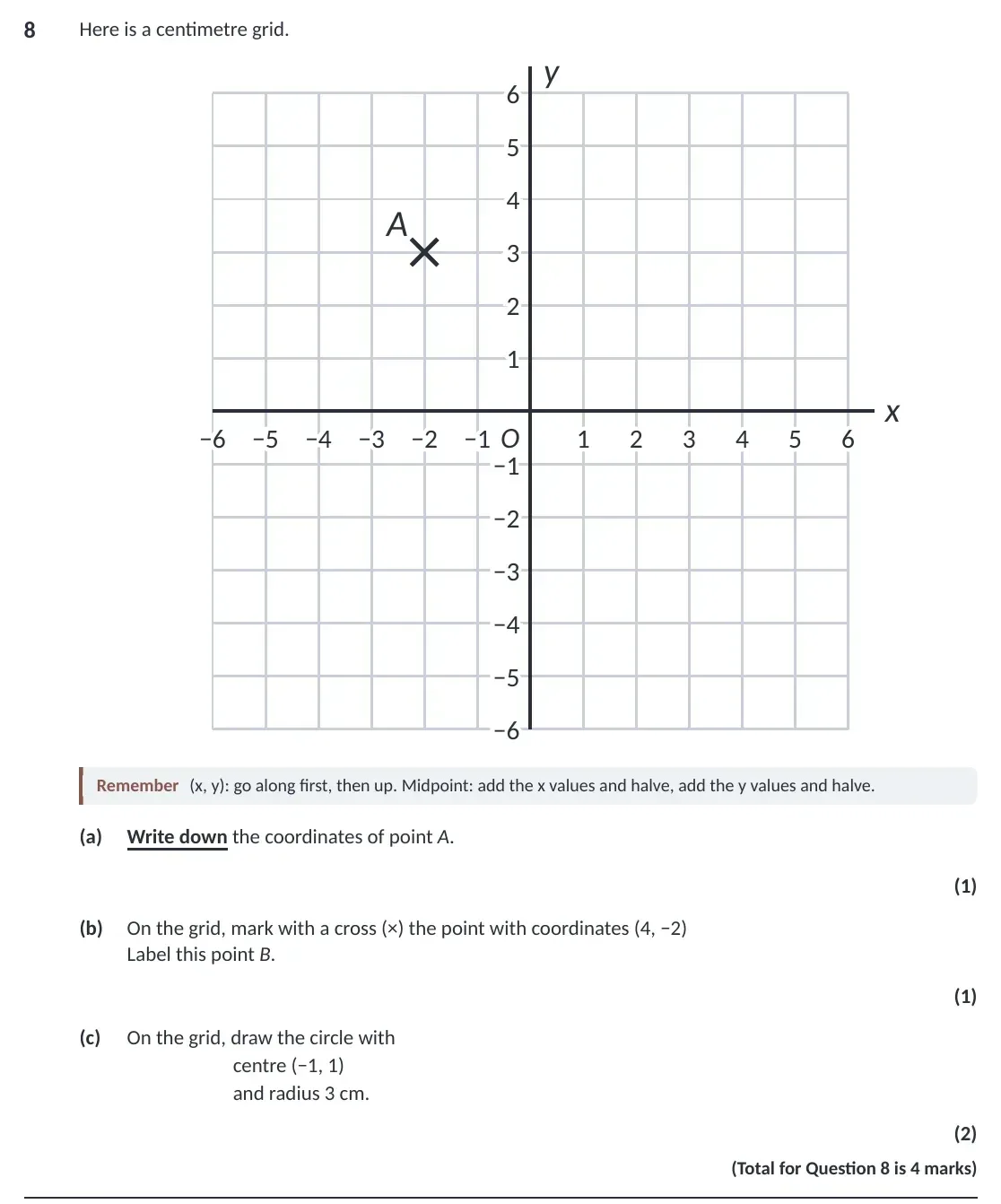
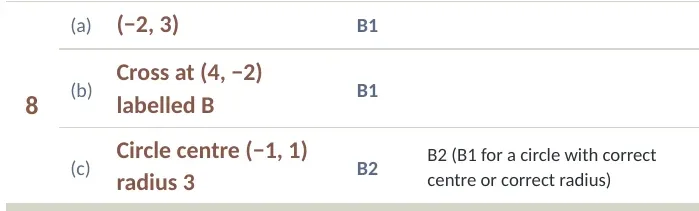
8 Here is a centimetre grid. 6 y 5 A 4 3 2 1 −6 −5 −4 −3 −2 −1 O −1 1 2 3 4 5 6 x −2 −3 −4 −5 −6 Remember (x, y): go along first, then up. Midpoint: add the x values and halve, add the y values and halve. (a) Write down the coordinates of point A. (1) (b) On the grid, mark with a cross (×) the point with coordinates (4, −2) Label this point B. (1) (c) On the grid, draw the circle with centre (−1,
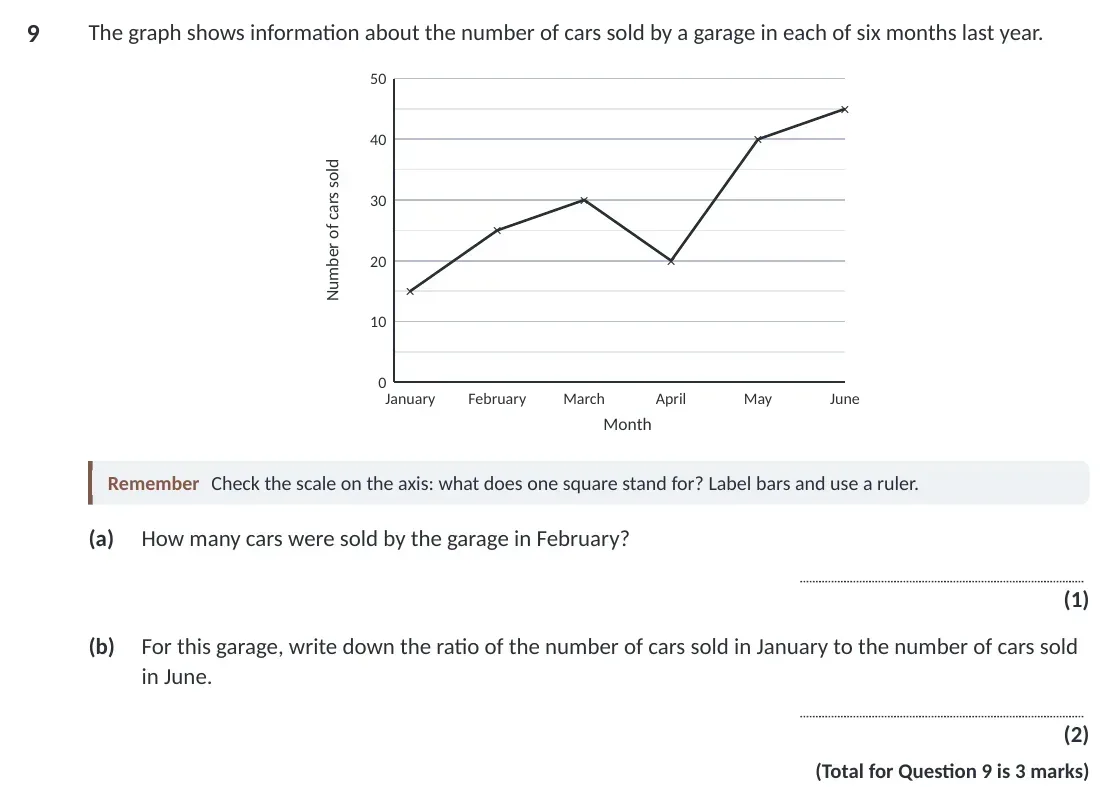
9 The graph shows information about the number of cars sold by a garage in each of six months last year. 50 × × Number of cars sold 40 × 30 × × 20 × 10 0 January February March April May June Month Remember Check the scale on the axis: what does one square stand for? Label bars and use a ruler. (a) How many cars were sold by the garage in February? (1) (b) For this garage, write down the ratio of
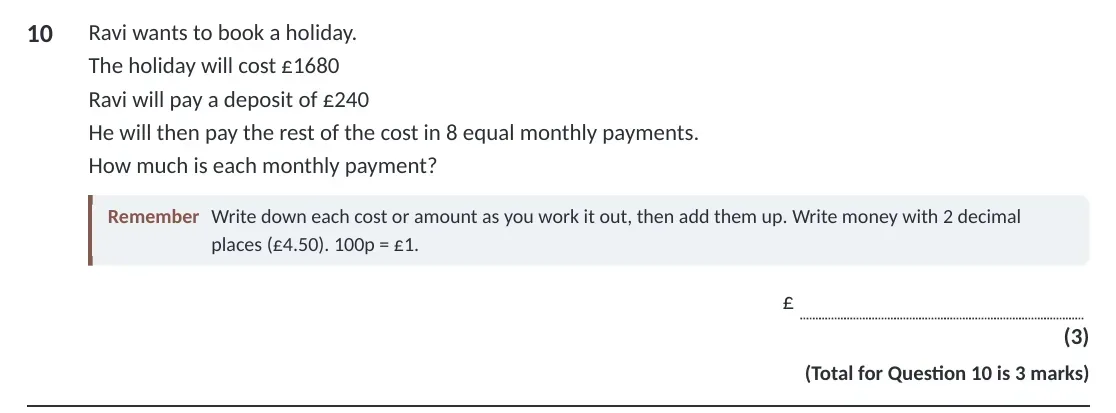
10 Ravi wants to book a holiday. The holiday will cost £1680 Ravi will pay a deposit of £240 He will then pay the rest of the cost in 8 equal monthly payments. How much is each monthly payment? Remember Write down each cost or amount as you work it out, then add them up. Write money with 2 decimal places (£4.50). 100p = £1. £ 📄 sheet: Wages, bills and payments (3) (Total for Question 10 is 3 marks
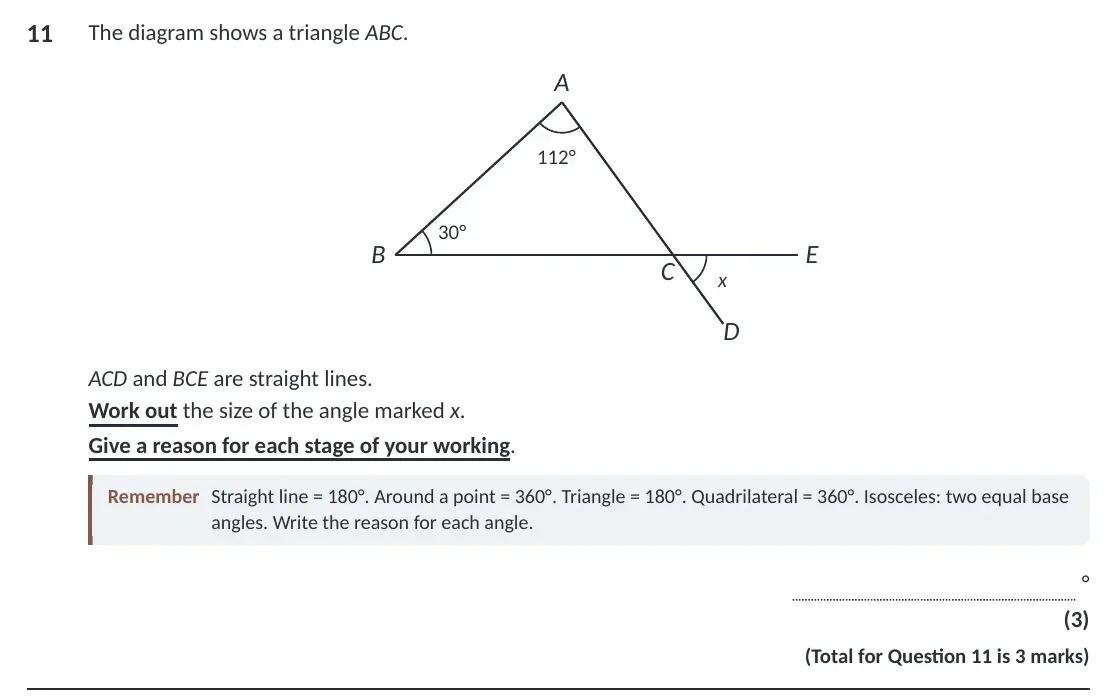
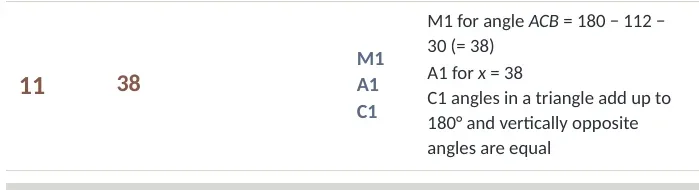
11 The diagram shows a triangle ABC. A 112° B 30° C x E D ACD and BCE are straight lines. Work out the size of the angle marked x. Give a reason for each stage of your working. Remember Straight line = 180°. Around a point = 360°. Triangle = 180°. Quadrilateral = 360°. Isosceles: two equal base angles. Write the reason for each angle. ° 📄 sheet: Angle facts (3) (Total for Question 11 is 3 marks)
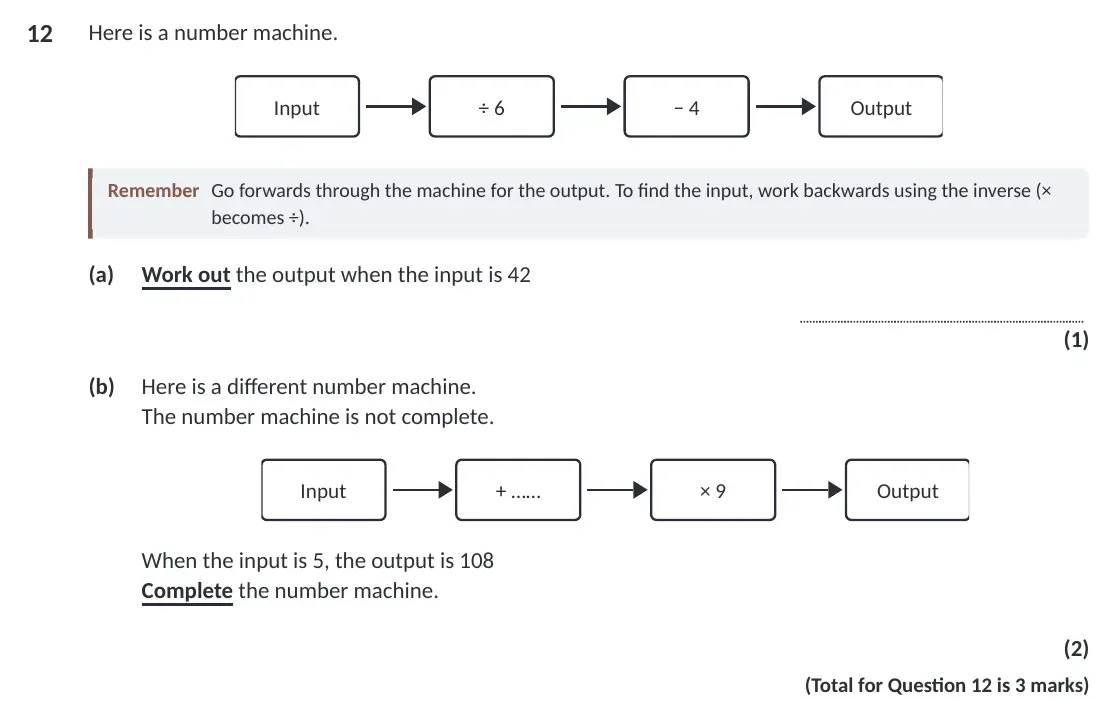
12 Here is a number machine. Input ÷ 6 − 4 Output Remember Go forwards through the machine for the output. To find the input, work backwards using the inverse (× becomes ÷). (a) Work out the output when the input is 42 (1) (b) Here is a different number machine. The number machine is not complete. Input + …… × 9 Output When the input is 5, the output is 108 Complete the number machine. (2) 📄 sheet
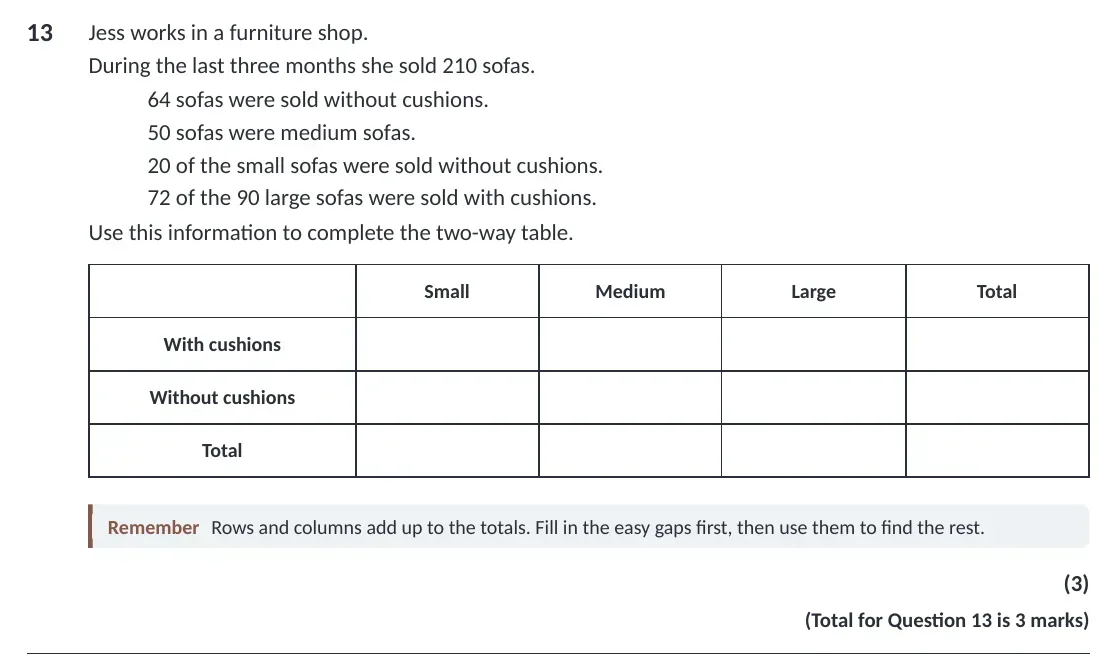
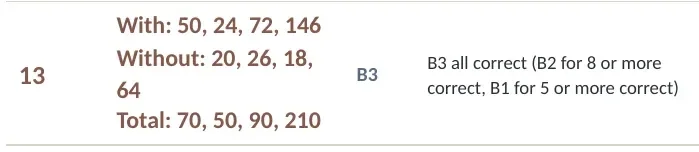
13 Jess works in a furniture shop. During the last three months she sold 210 sofas. 64 sofas were sold without cushions. 50 sofas were medium sofas. 20 of the small sofas were sold without cushions. 72 of the 90 large sofas were sold with cushions. Use this information to complete the two-way table. Small Medium Large Total With cushions Without cushions Total Remember Rows and columns add up to t
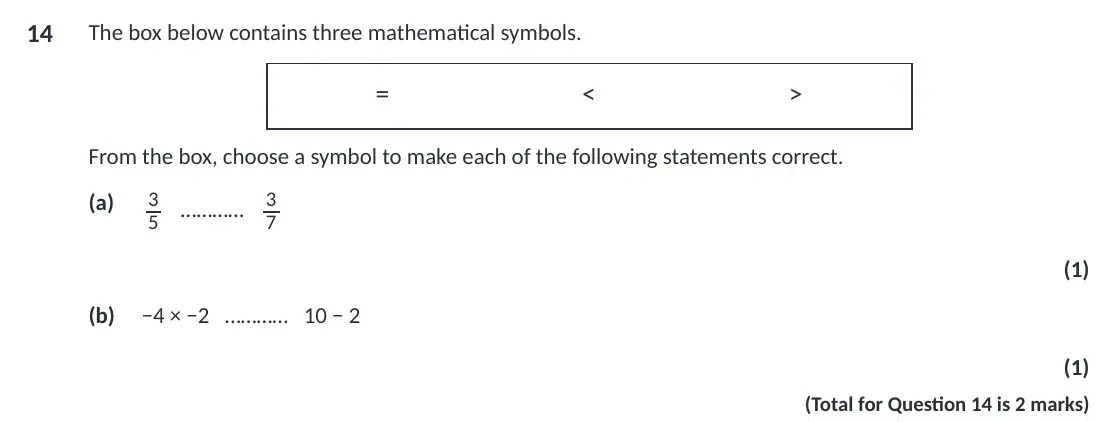
14 The box below contains three mathematical symbols. = < > From the box, choose a symbol to make each of the following statements correct. (a) 3 5 ………… 3 7 (1) (b) −4 × −2 ………… 10 − 2 (1) 📄 sheet: Inequalities on a number line (Total for Question 14 is 2 marks)
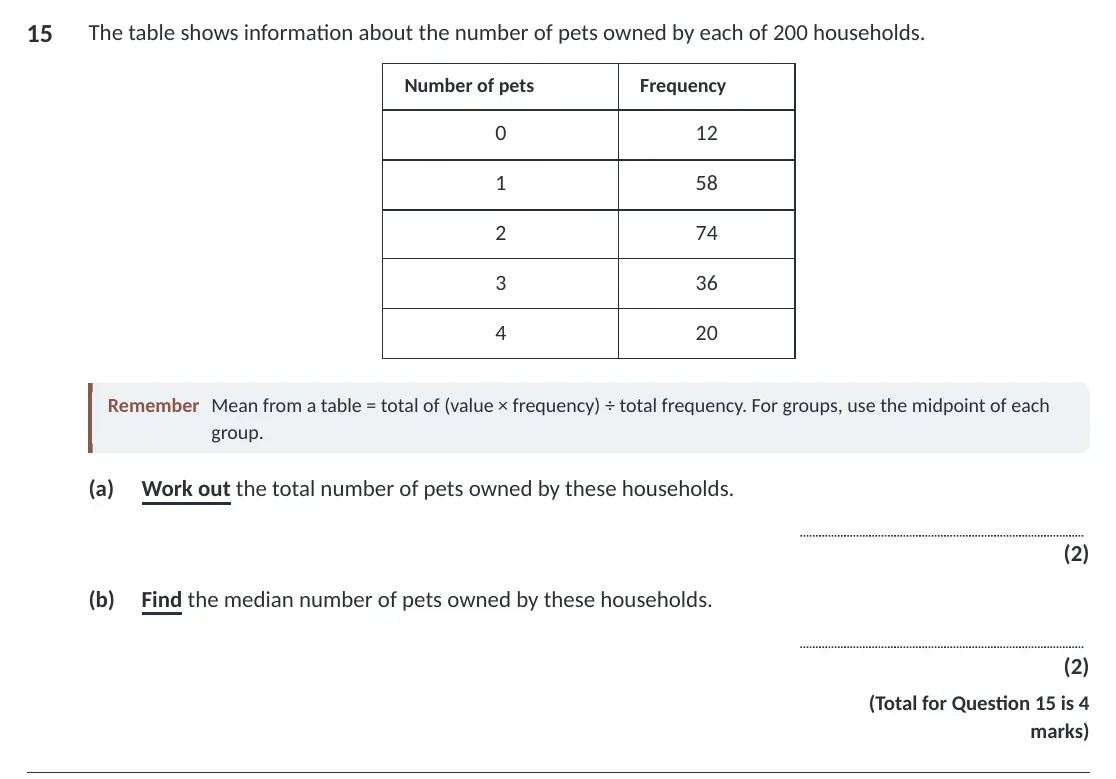
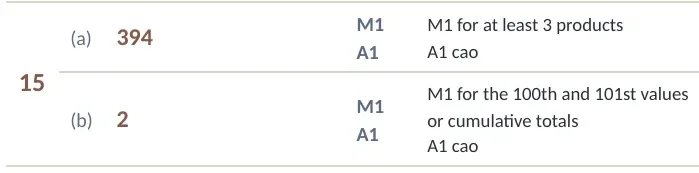
15 The table shows information about the number of pets owned by each of 200 households. Number of pets Frequency 0 12 1 58 2 74 3 36 4 20 Remember Mean from a table = total of (value × frequency) ÷ total frequency. For groups, use the midpoint of each group. (a) Work out the total number of pets owned by these households. (2) (b) Find the median number of pets owned by these households. 📄 sheet:
16 On a scale drawing, a field has length 15.5 cm and width 8.4 cm. The real length of the field is 62 metres. Work out, in metres, the real width of the field. Remember Real distance = map distance × scale. 100 cm = 1 m, 1000 m = 1 km (100 000 cm = 1 km). metres (3) 📄 sheet: Scale drawings (Total for Question 16 is 3 marks)
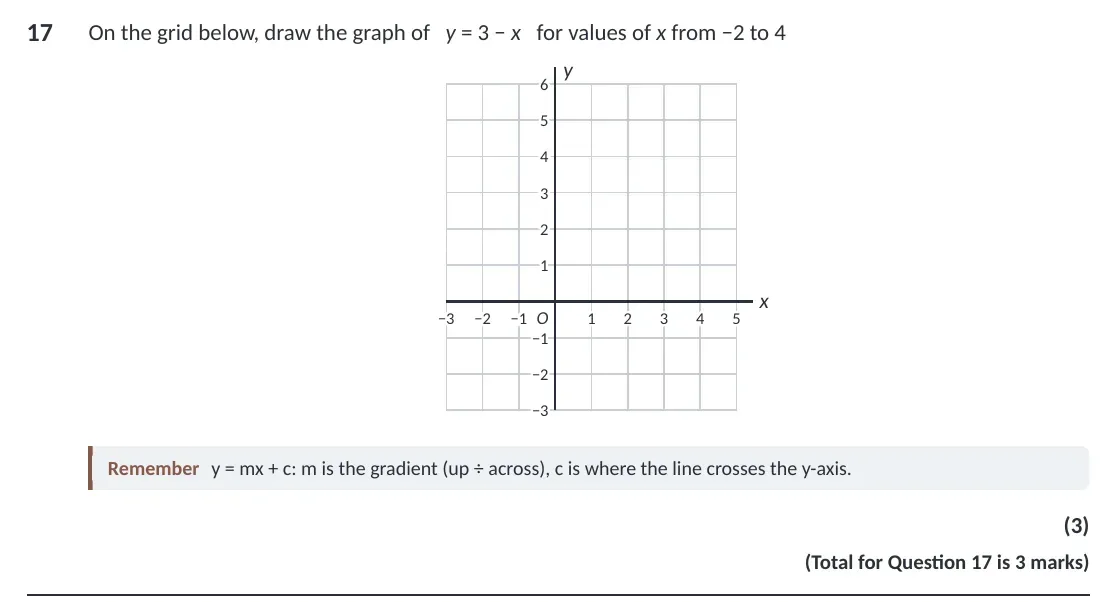
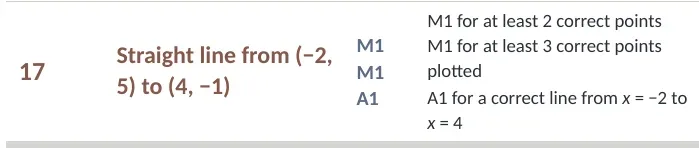
17 On the grid below, draw the graph of y = 3 − x for values of x from −2 to 4 6 y 5 4 3 2 1 −3 −2 −1 O −1 1 2 3 4 5 x −2 −3 Remember y = mx + c: m is the gradient (up ÷ across), c is where the line crosses the y-axis. 📄 sheet: Drawing straight line graphs (3) (Total for Question 17 is 3 marks)
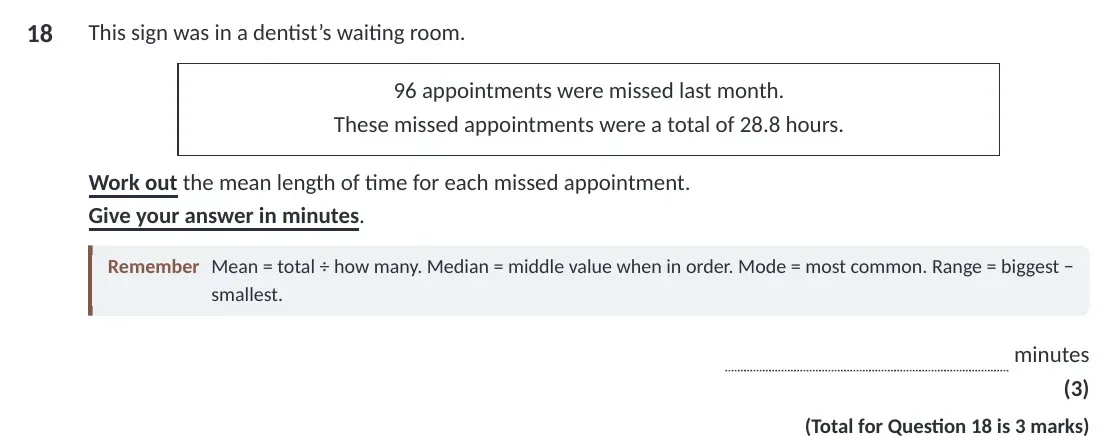
18 This sign was in a dentist’s waiting room. 96 appointments were missed last month. These missed appointments were a total of 28.8 hours. Work out the mean length of time for each missed appointment. Give your answer in minutes. Remember Mean = total ÷ how many. Median = middle value when in order. Mode = most common. Range = biggest − smallest. minutes (3) 📄 sheet: Mean, median, mode and range,
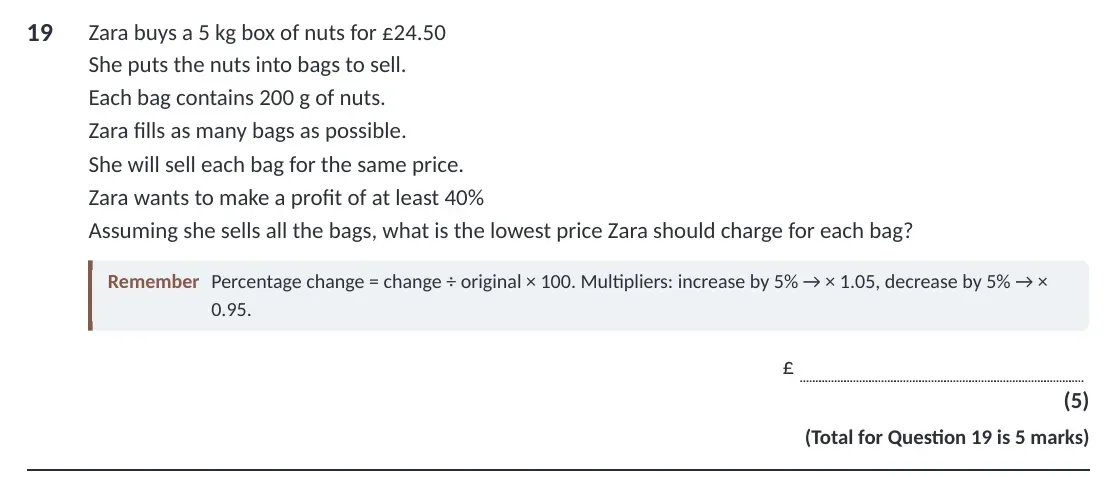
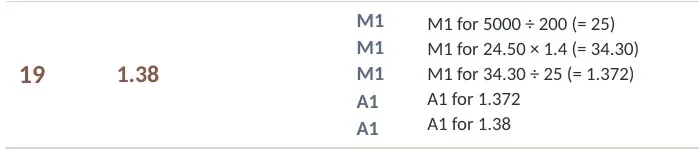
19 Zara buys a 5 kg box of nuts for £24.50 She puts the nuts into bags to sell. Each bag contains 200 g of nuts. Zara fills as many bags as possible. She will sell each bag for the same price. Zara wants to make a profit of at least 40% Assuming she sells all the bags, what is the lowest price Zara should charge for each bag? Remember Percentage change = change ÷ original × 100. Multipliers: incre
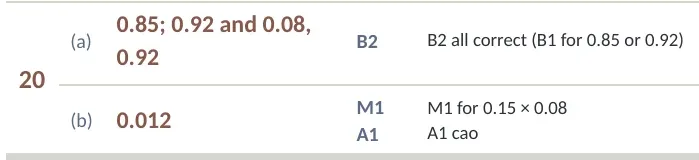
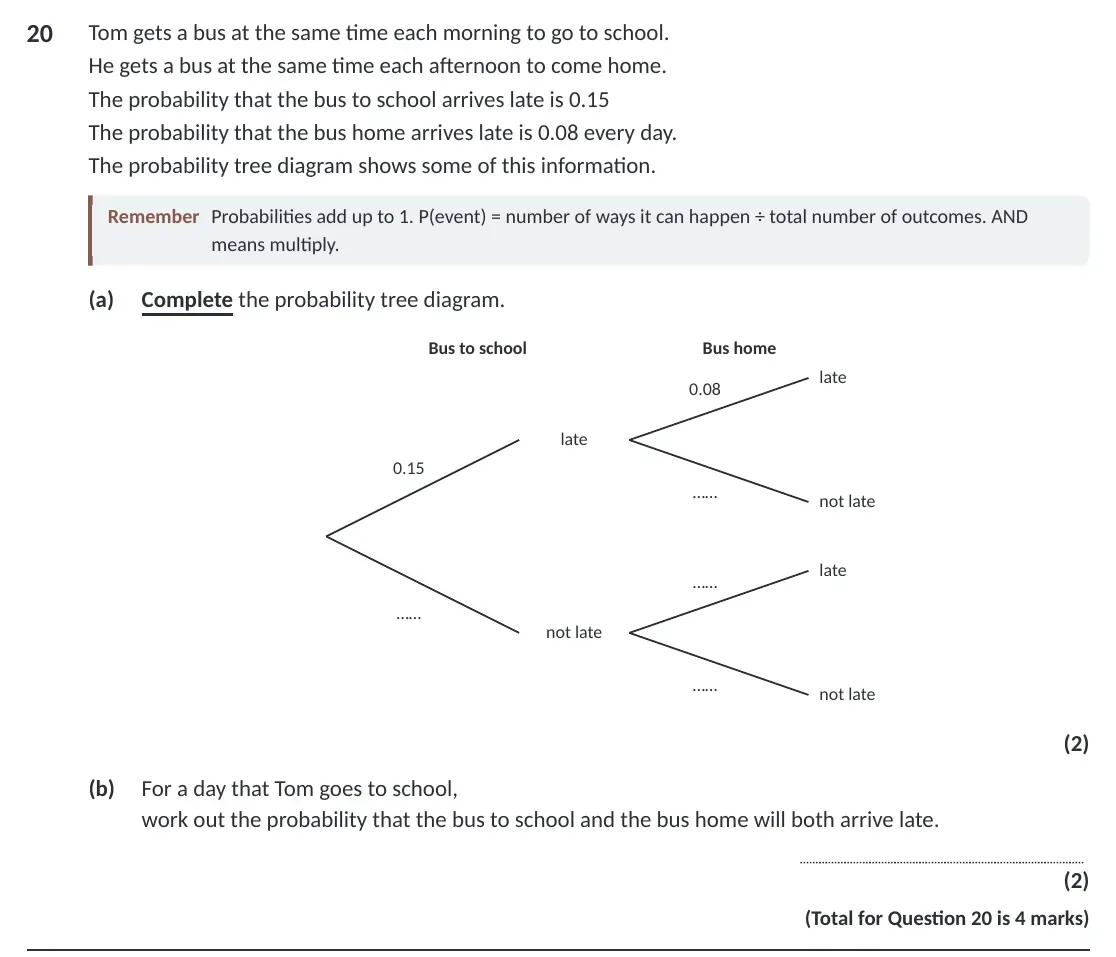
20 Tom gets a bus at the same time each morning to go to school. He gets a bus at the same time each afternoon to come home. The probability that the bus to school arrives late is 0.15 The probability that the bus home arrives late is 0.08 every day. The probability tree diagram shows some of this information. Remember Probabilities add up to 1. P(event) = number of ways it can happen ÷ total numb
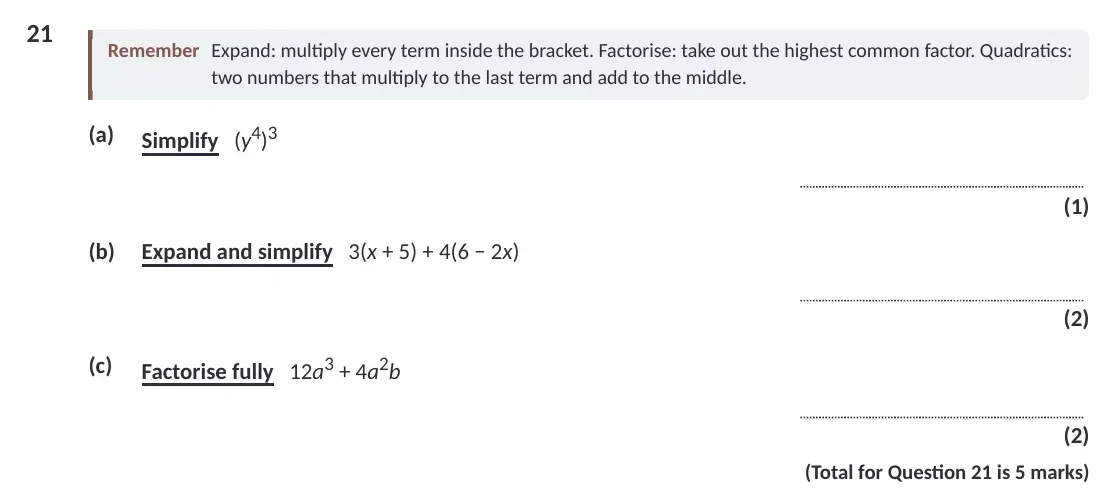
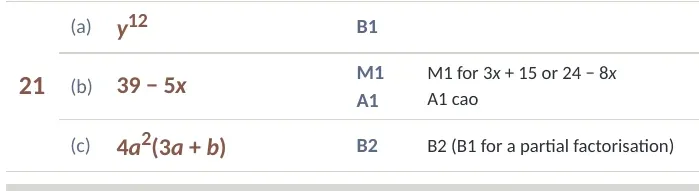
21 Remember Expand: multiply every term inside the bracket. take out the highest common factor. Quadratics: two numbers that multiply to the last term and add to the middle. (a) Simplify (y 4 ) 3 (1) (b) Expand and simplify 3(x + 5) + 4(6 − 2x) (2) (c) fully 12a 3 + 4a 2 b (2) 📄 sheet: card 2 📄 sheet: Index laws (Total for Question 21 is 5 marks)
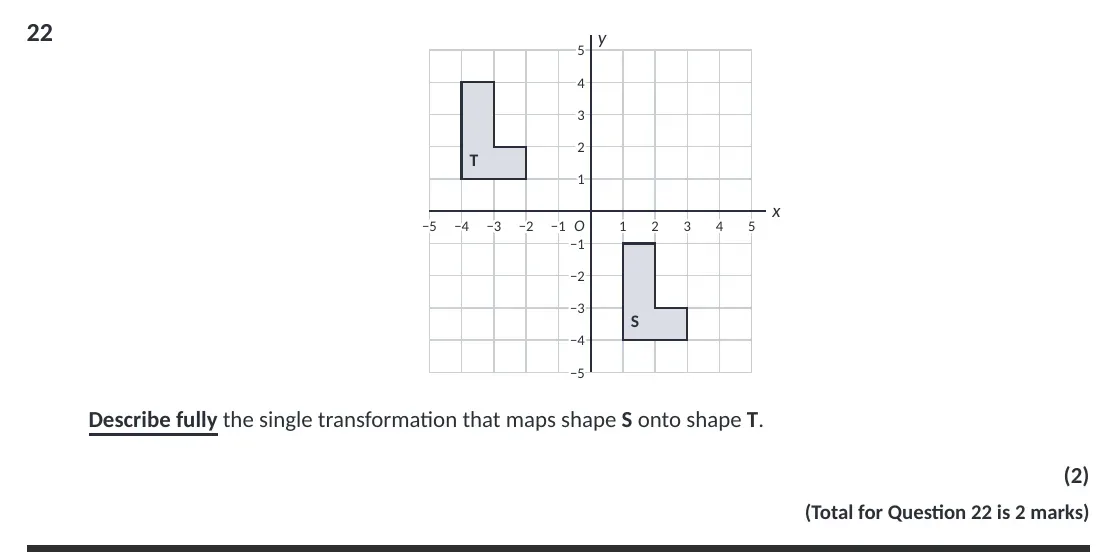
22 5 y 4 3 2 T −5 −4 1 −3 −2 −1 O −1 1 2 3 4 5 x −2 −3 −4 S −5 Describe fully the single transformation that maps shape S onto shape T. 📄 sheet: Translation (2) (Total for Question 22 is 2 marks)
23 The length of a swimming pool is 50 metres, correct to the nearest metre. Complete the error interval for the length of the swimming pool. 📄 sheet: Error intervals (2) (Total for Question 23 is 2 marks)
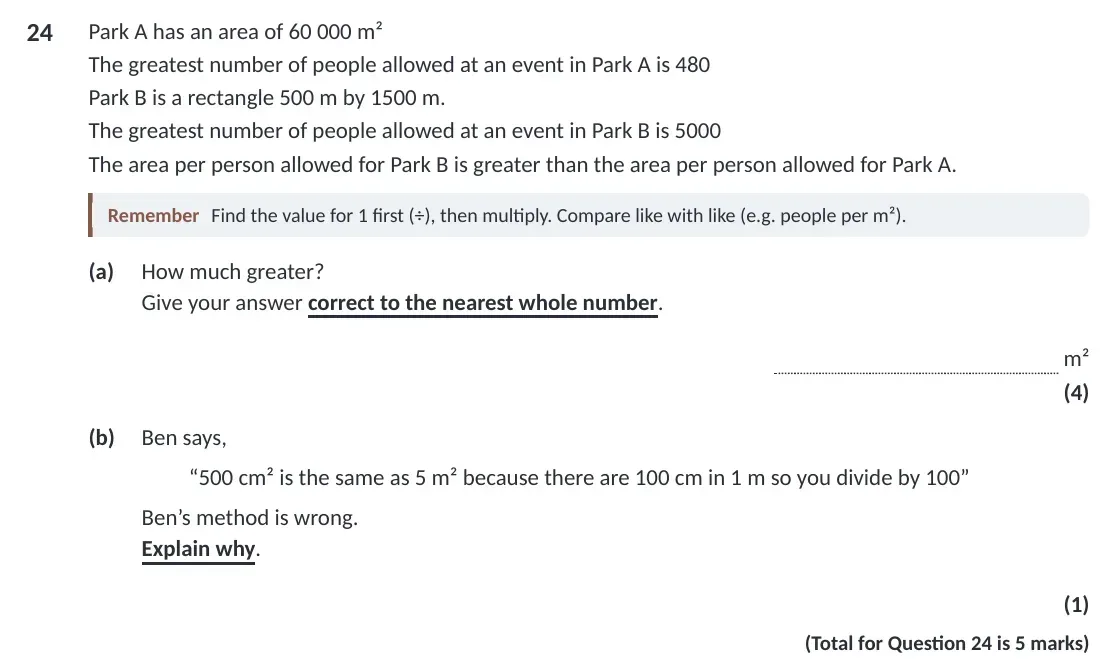
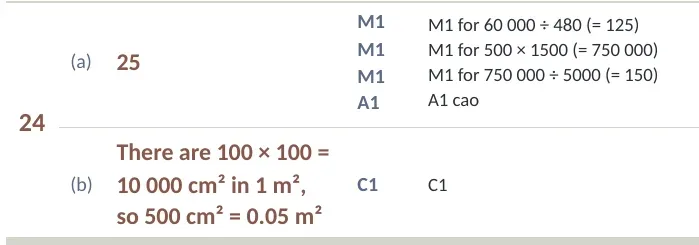
24 Park A has an area of 60 000 m² The greatest number of people allowed at an event in Park A is 480 Park B is a rectangle 500 m by 1500 m. The greatest number of people allowed at an event in Park B is 5000 The area per person allowed for Park B is greater than the area per person allowed for Park A. Remember Find the value for 1 first (÷), then multiply. Compare like with like (e.g. people per
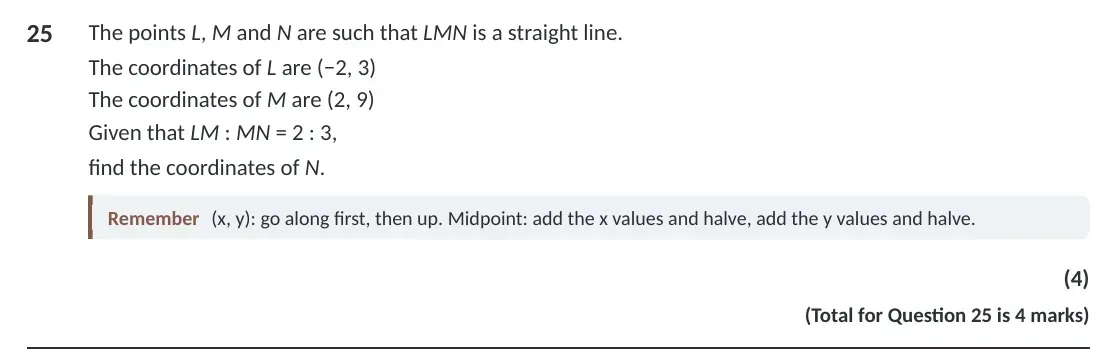
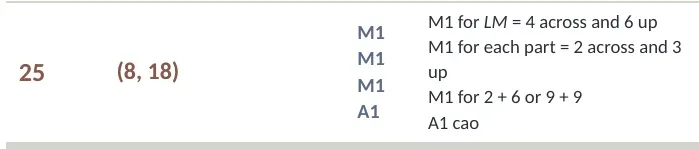
25 The points L, M and N are such that LMN is a straight line. The coordinates of L are (−2, 3) The coordinates of M are (2, 9) Given that LM : MN = 2 : 3, find the coordinates of N. Remember (x, y): go along first, then up. Midpoint: add the x values and halve, add the y values and halve. 📄 sheet: Coordinates and midpoints (4) (Total for Question 25 is 4 marks)
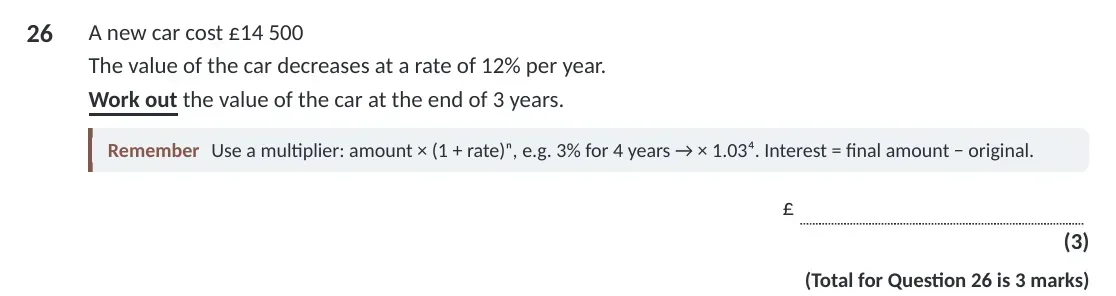
26 A new car cost £14 500 The value of the car decreases at a rate of 12% per year. Work out the value of the car at the end of 3 years. Remember Use a multiplier: amount × (1 + rate)ⁿ, e.g. 3% for 4 years → × 1.03⁴. Interest = final amount − original. £ (3) 📄 sheet: Simple and compound interest (Total for Question 26 is 3 marks)
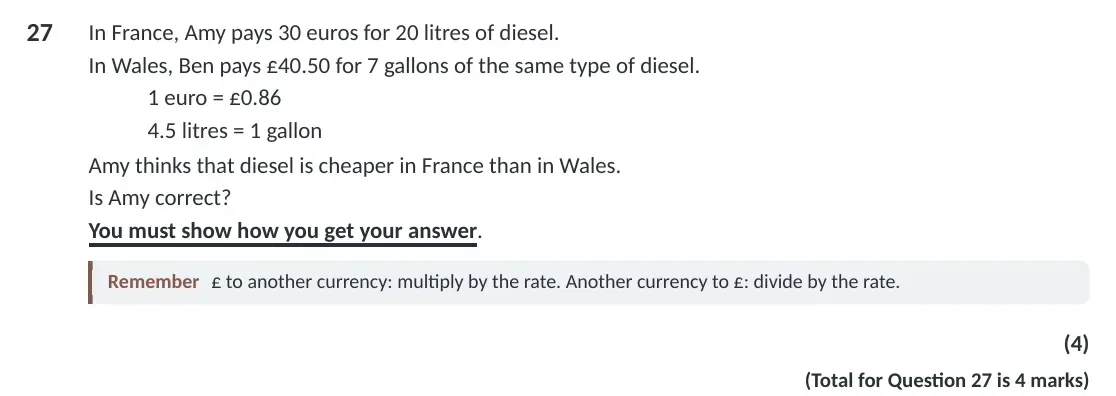
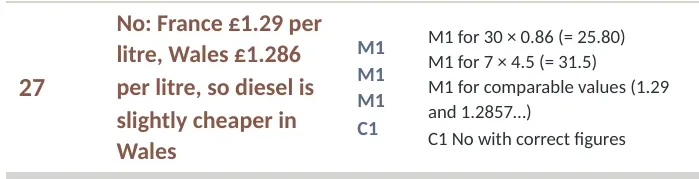
27 In France, Amy pays 30 euros for 20 litres of diesel. In Wales, Ben pays £40.50 for 7 gallons of the same type of diesel. 1 euro = £0.86 4.5 litres = 1 gallon Amy thinks that diesel is cheaper in France than in Wales. Is Amy correct? You must show how you get your answer. Remember £ to another currency: multiply by the rate. Another currency to £: divide by the rate. (4) 📄 sheet: Best buys (Tot
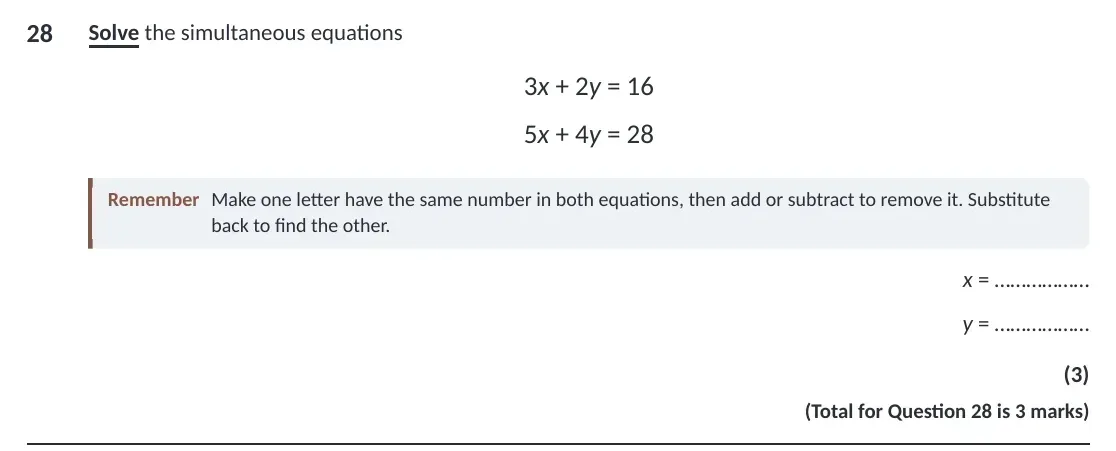
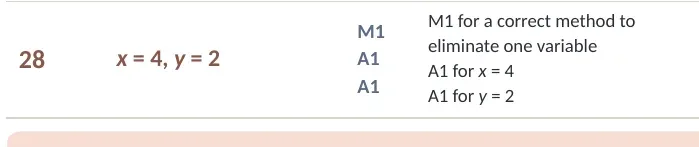
28 Solve the simultaneous equations 3x + 2y = 16 5x + 4y = 28 Remember Make one letter have the same number in both equations, then add or subtract to remove it. Substitute back to find the other. x = ……………… y = ……………… 📄 sheet: Simultaneous equations (3) (Total for Question 28 is 3 marks)
◀ G1All papersG3 ▶
Answer the questions, then mark your paper.