Miss North Maths

Full paper B1

Paper 1 style · Non-calculator · 80 marks · 1 hour 30 minutes

How it works. Type each answer in its box. Tap any underlined word on the paper to see what it wants you to do. Stuck? Open the fact sheet under the question. When you finish, press Mark my paper, then check each question against the mark scheme and give yourself the marks you earned, including method marks.

1 Write 40% as a decimal. (1) 📄 sheet: Converting fractions, decimals and percentages (Total for Question 1 is 1 mark)
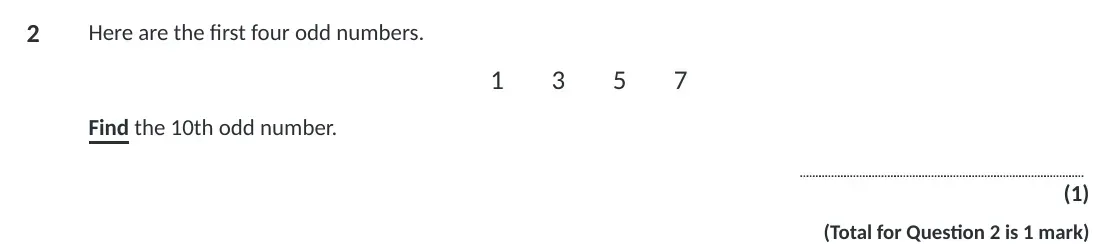
2 Here are the first four odd numbers. 1 3 5 7 Find the 10th odd number. 📄 sheet: Place value and number facts (1) (Total for Question 2 is 1 mark)
3 Change 23 centimetres into millimetres. millimetres 📄 sheet: Converting units (Total for Question 3 is 1 mark) (1)
4 Write down the multiple of 6 that is between 40 and 45 📄 sheet: and multiples (1) (Total for Question 4 is 1 mark)
5 Work out 700 + 268 📄 (1)
6 Tom hires a bike for 6 days. He pays £18 for each day. He also pays £15 for a helmet. Tom pays with three £50 notes. Work out how much change he should get. Remember Change = money paid − total cost. Add up all the costs first. £ 📄 sheet: Shopping, change and offers (3) (Total for Question 6 is 3 marks)
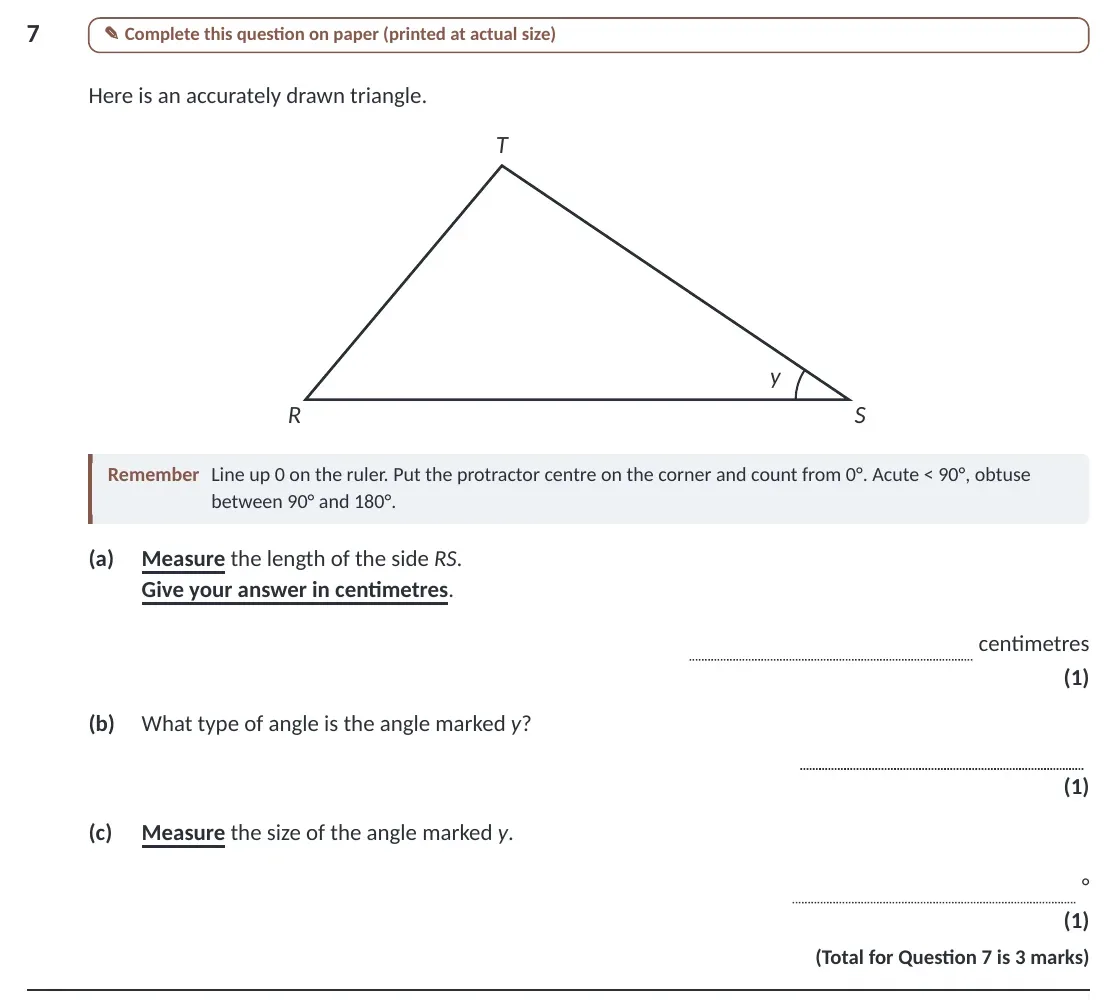
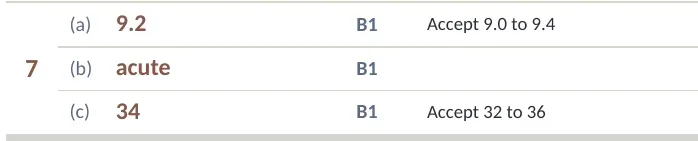
7 ✎ Complete this question on paper (printed at actual size) Here is an accurately drawn triangle. T y R S Remember Line up 0 on the ruler. Put the protractor centre on the corner and count from 0°. Acute < 90°, obtuse between 90° and 180°. (a) Measure the length of the side RS. Give your answer in centimetres. centimetres (1) (b) What type of angle is the angle marked y? (1) (c) Measure the size

✎ You need a ruler, protractor or compasses for this one. Do it on paper, then mark it below.

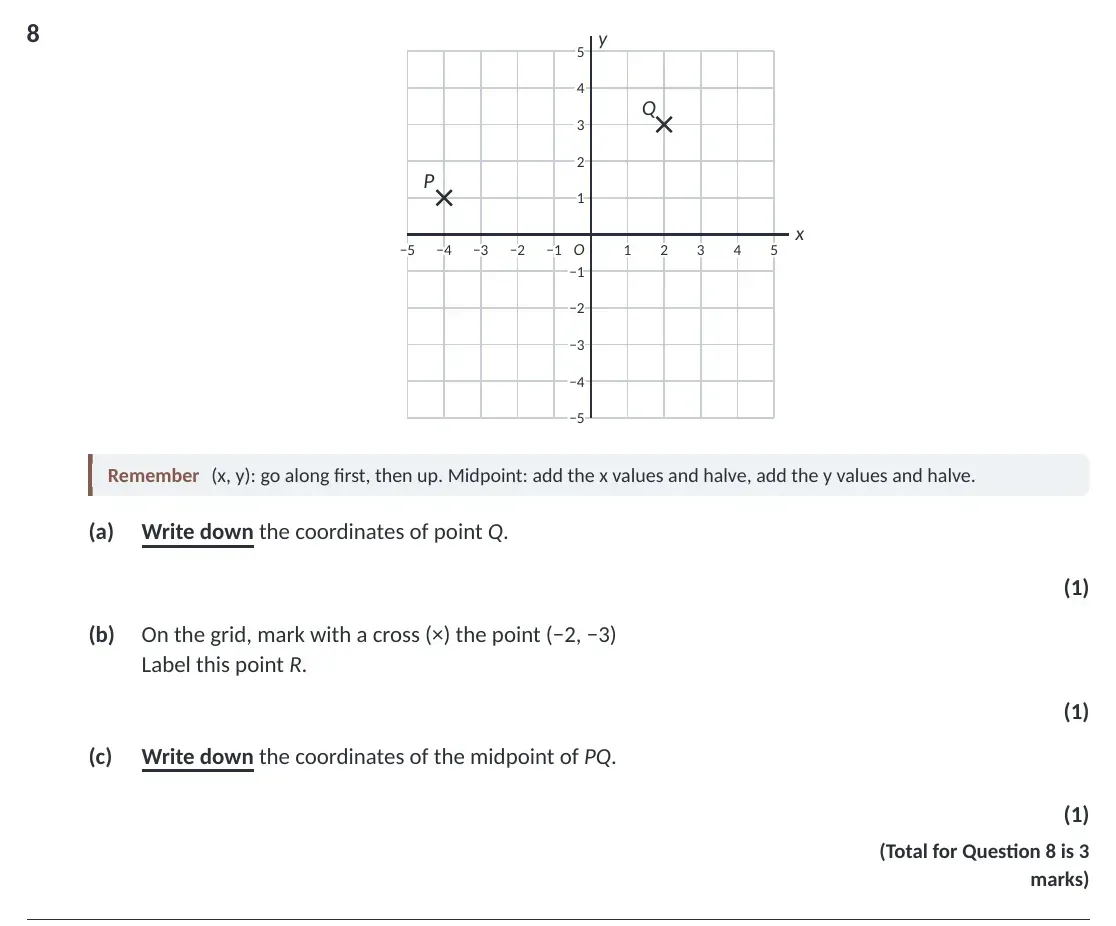
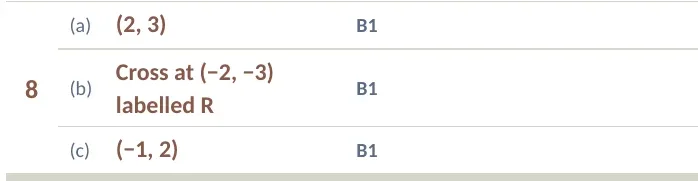
8 5 y 4 Q 3 2 P −5 1 −4 −3 −2 −1 O −1 1 2 3 4 5 x −2 −3 −4 −5 Remember (x, y): go along first, then up. Midpoint: add the x values and halve, add the y values and halve. (a) Write down the coordinates of point Q. (1) (b) On the grid, mark with a cross (×) the point (−2, −3) Label this point R. (1) (c) Write down the coordinates of the midpoint of PQ. 📄 sheet: Coordinates and midpoints 📄 sheet: Pla
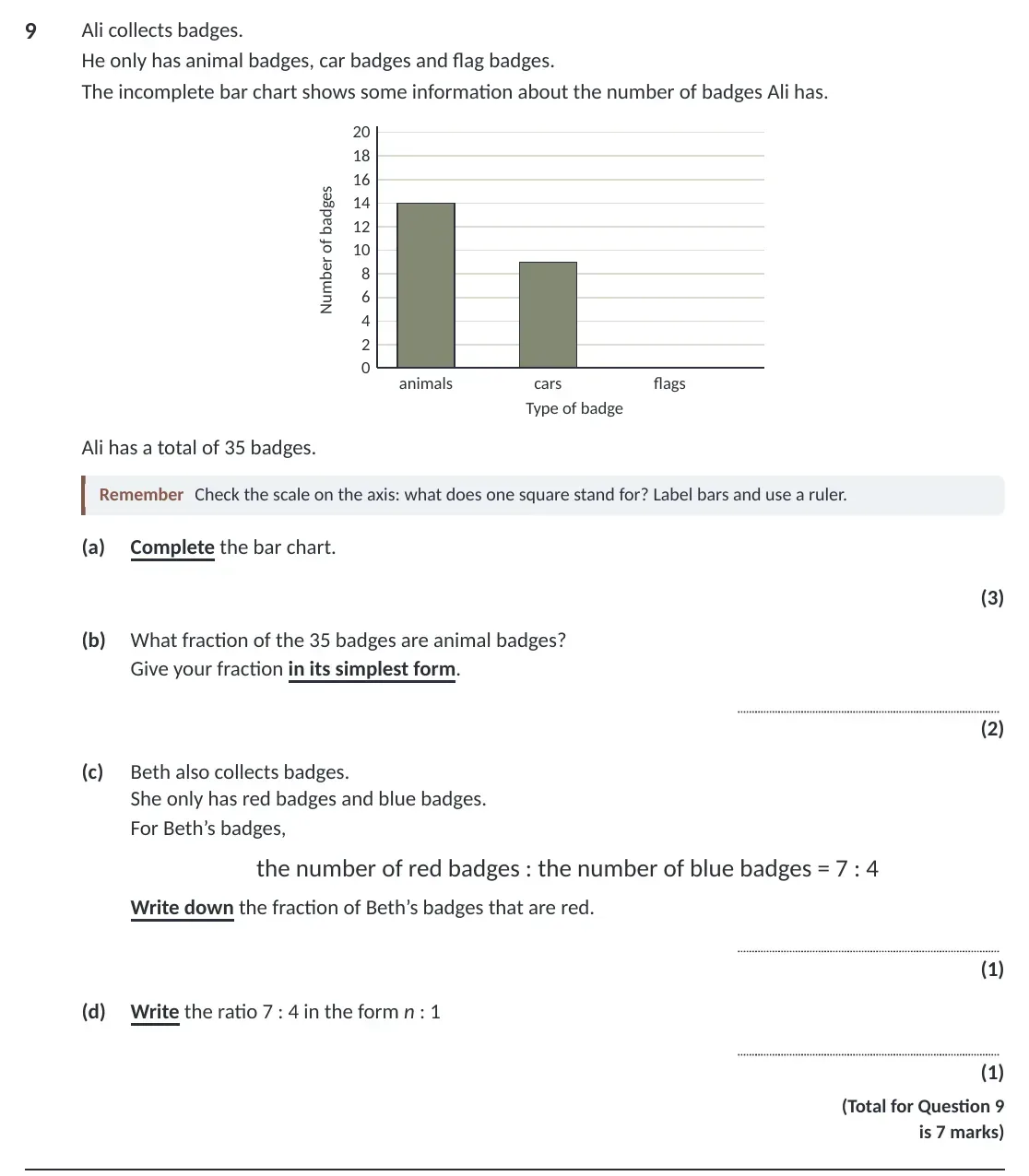
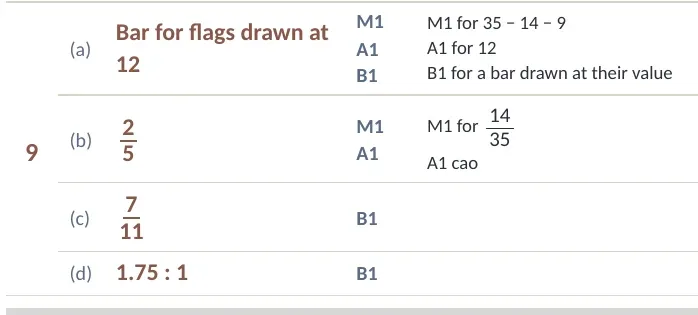
9 Ali collects badges. He only has animal badges, car badges and flag badges. Number of badges The incomplete bar chart shows some information about the number of badges Ali has. 20 18 16 14 12 10 8 6 4 2 0 animals cars Type of badge flags Ali has a total of 35 badges. Remember Check the scale on the axis: what does one square stand for? Label bars and use a ruler. (a) Complete the bar chart. (3)
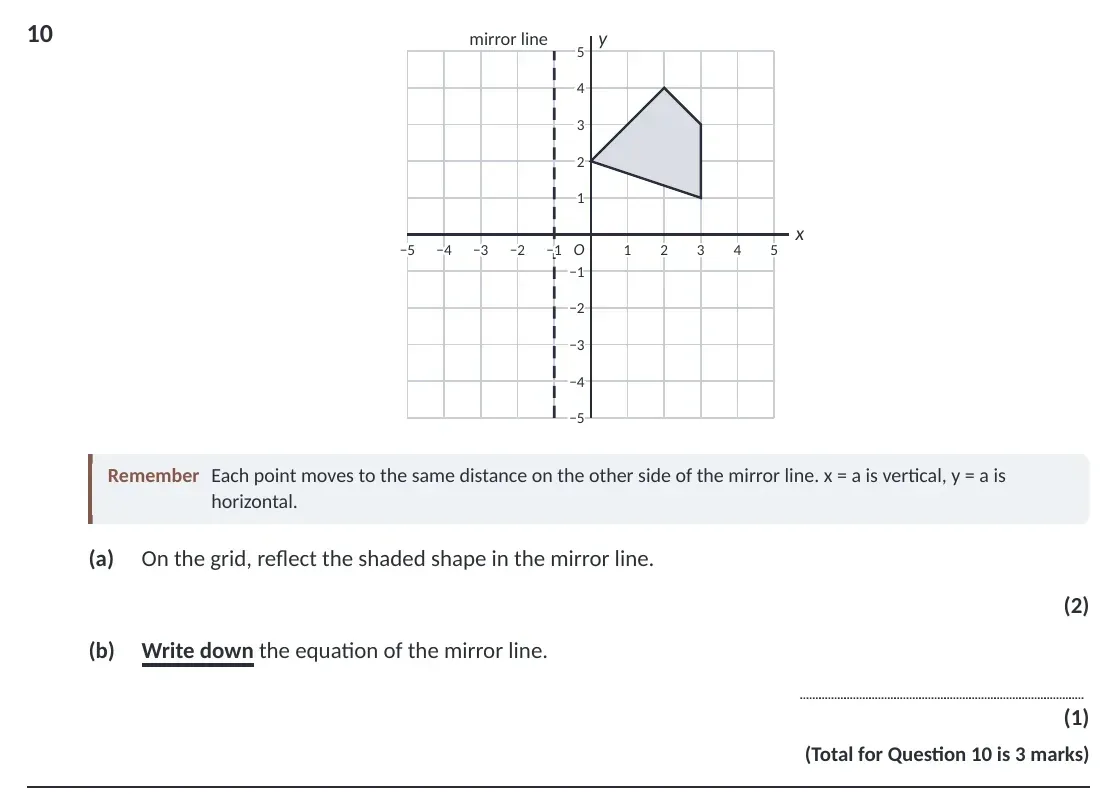
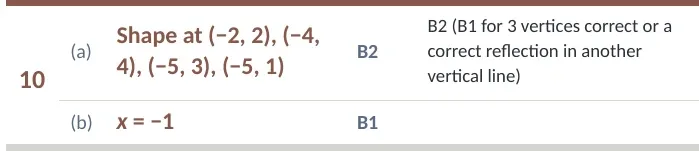
10 mirror line 5 y 4 3 2 1 −5 −4 −3 −2 −1 O −1 1 2 3 4 5 x −2 −3 −4 −5 Remember Each point moves to the same distance on the other side of the mirror line. x = a is vertical, y = a is horizontal. (a) On the grid, reflect the shaded shape in the mirror line. (2) (b) Write down the equation of the mirror line. 📄 sheet: Reflection (1) (Total for Question 10 is 3 marks)
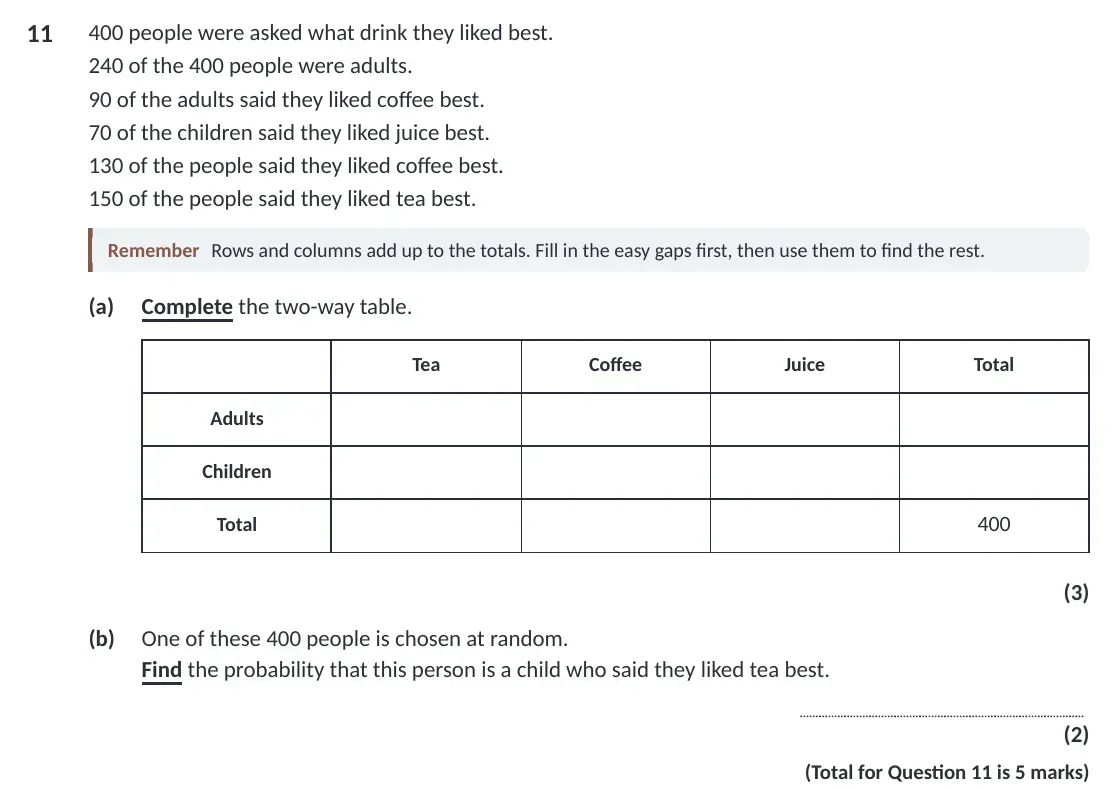
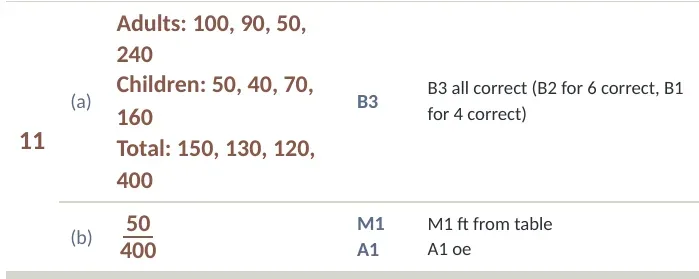
11 400 people were asked what drink they liked best. 240 of the 400 people were adults. 90 of the adults said they liked coffee best. 70 of the children said they liked juice best. 130 of the people said they liked coffee best. 150 of the people said they liked tea best. Remember Rows and columns add up to the totals. Fill in the easy gaps first, then use them to find the rest. (a) Complete the tw
12 Mia was asked to work out 20 − 8 ÷ 2 Mia wrote 20 − 8 = 12 She then worked out 12 ÷ 2 Explain what is wrong with Mia’s method. 📄 sheet: BIDMAS (1) (Total for Question 12 is 1 mark)
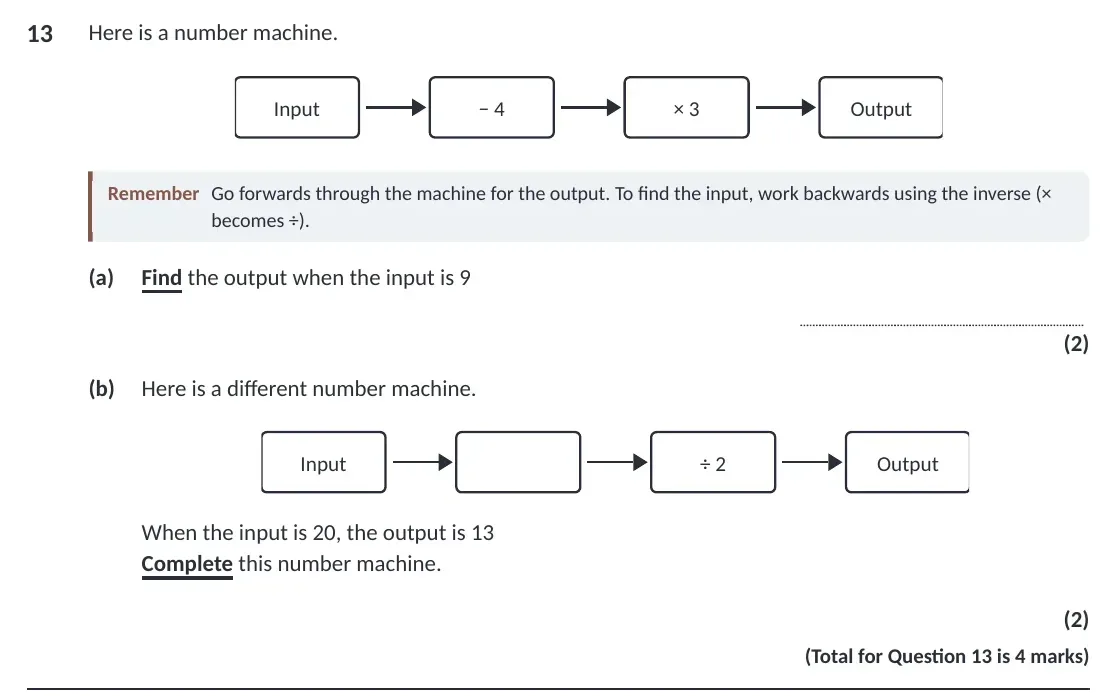
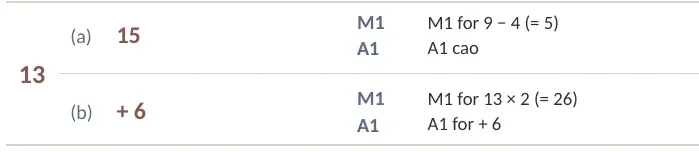
13 Here is a number machine. Input − 4 × 3 Output Remember Go forwards through the machine for the output. To find the input, work backwards using the inverse (× becomes ÷). (a) Find the output when the input is 9 (2) (b) Here is a different number machine. Input ÷ 2 Output When the input is 20, the output is 13 Complete this number machine. 📄 sheet: Number problems and number machines (2) (Total
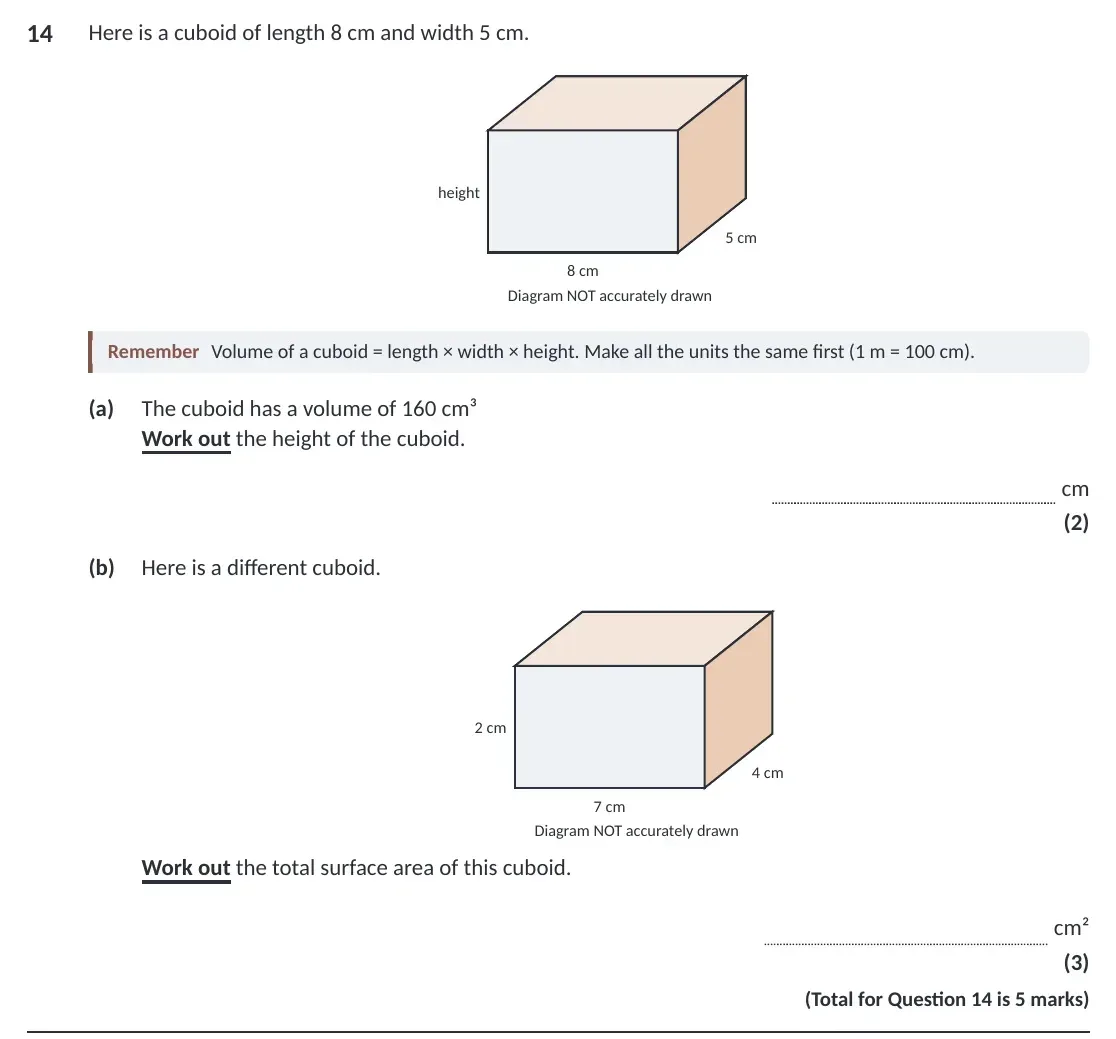
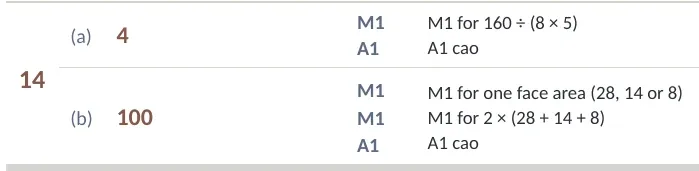
14 Here is a cuboid of length 8 cm and width 5 cm. height 5 cm 8 cm Diagram NOT accurately drawn Remember Volume of a cuboid = length × width × height. Make all the units the same first (1 m = 100 cm). (a) The cuboid has a volume of 160 cm³ Work out the height of the cuboid. cm (2) (b) Here is a different cuboid. 2 cm 4 cm 7 cm Diagram NOT accurately drawn Work out the total surface area of this c
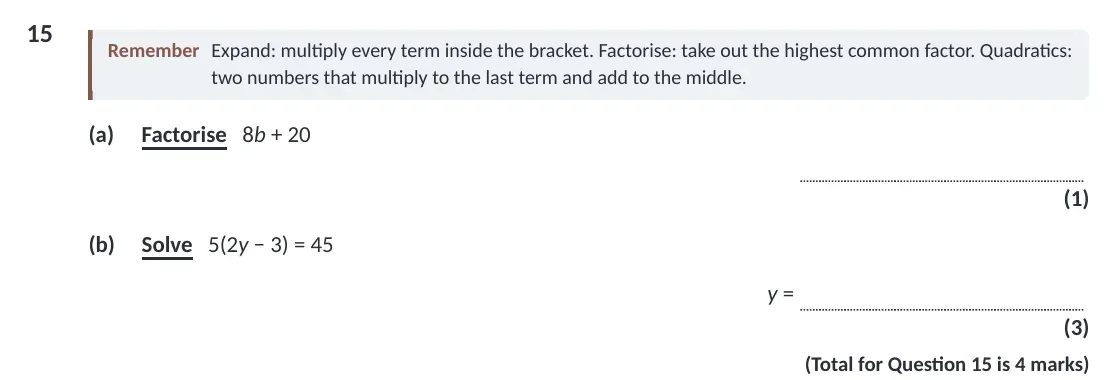
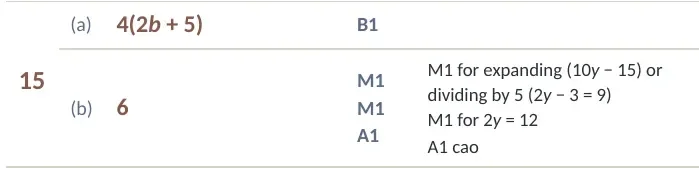
15 Remember Expand: multiply every term inside the bracket. take out the highest common factor. Quadratics: two numbers that multiply to the last term and add to the middle. (a) 8b + 20 (1) (b) Solve 5(2y − 3) = 45 y = (3) 📄 sheet: card 1 (Total for Question 15 is 4 marks)
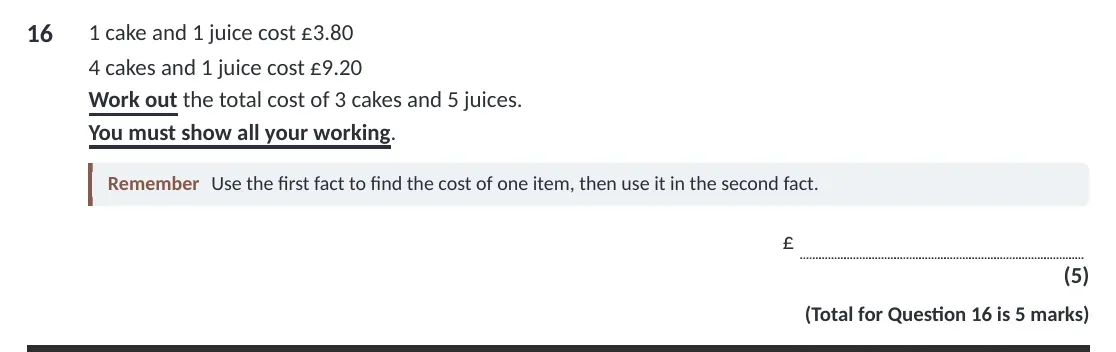
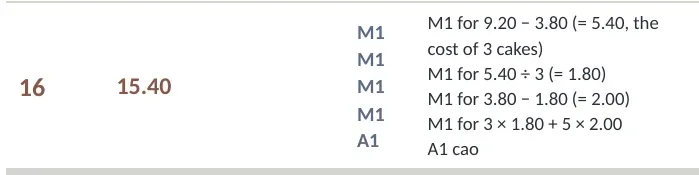
16 1 cake and 1 juice cost £3.80 4 cakes and 1 juice cost £9.20 Work out the total cost of 3 cakes and 5 juices. You must show all your working. Remember Use the first fact to find the cost of one item, then use it in the second fact. £ 📄 sheet: Shopping, change and offers (5) (Total for Question 16 is 5 marks)
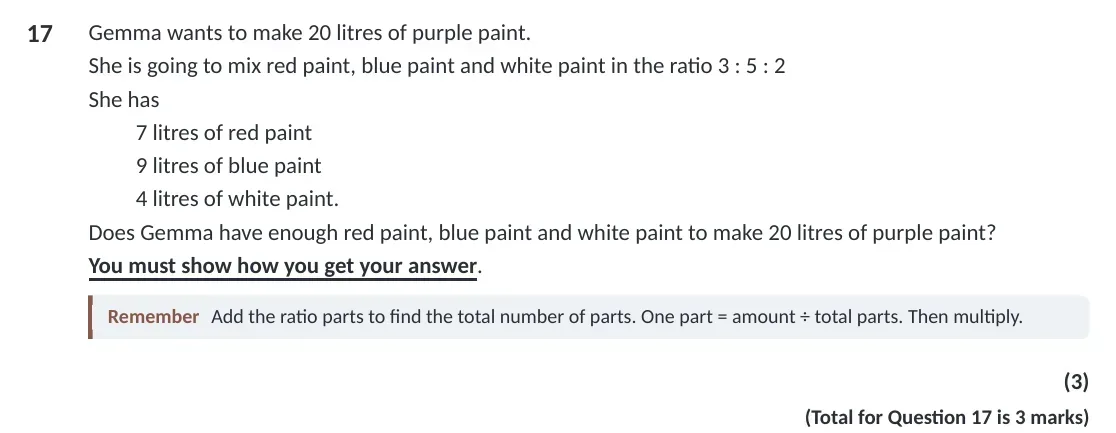
17 Gemma wants to make 20 litres of purple paint. She is going to mix red paint, blue paint and white paint in the ratio 3 : 5 : 2 She has 7 litres of red paint 9 litres of blue paint 4 litres of white paint. Does Gemma have enough red paint, blue paint and white paint to make 20 litres of purple paint? You must show how you get your answer. Remember Add the ratio parts to find the total number of
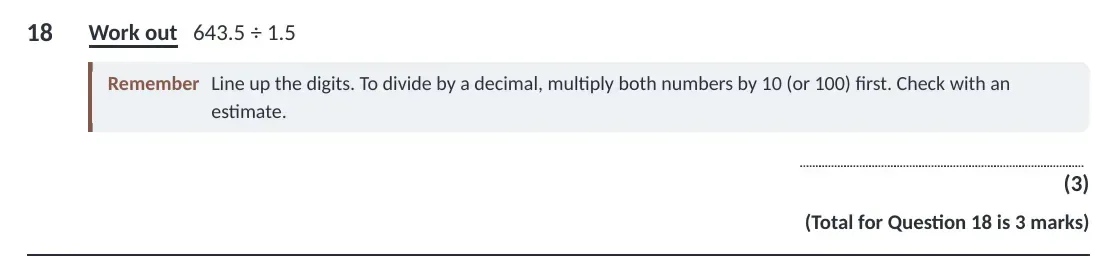
18 Work out 643.5 ÷ 1.5 Remember Line up the digits. To divide by a decimal, multiply both numbers by 10 (or 100) first. Check with an estimate. 📄 sheet: Written calculation (3) (Total for Question 18 is 3 marks)
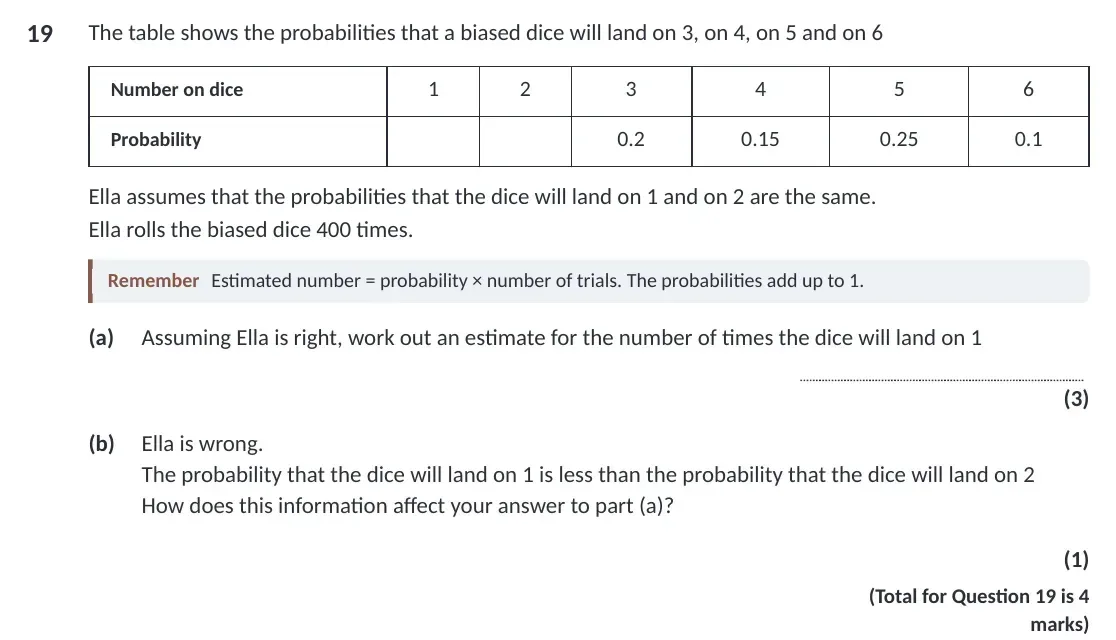
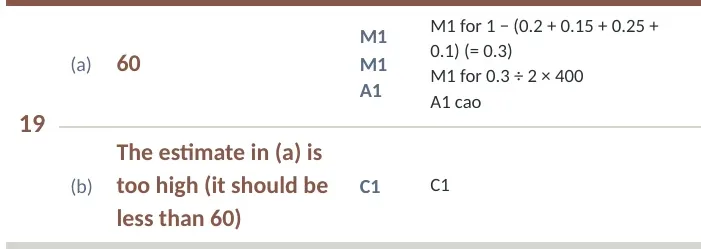
19 The table shows the probabilities that a biased dice will land on 3, on 4, on 5 and on 6 1 Number on dice Probability 2 3 4 5 6 0.2 0.15 0.25 0.1 Ella assumes that the probabilities that the dice will land on 1 and on 2 are the same. Ella rolls the biased dice 400 times. Remember Estimated number = probability × number of trials. The probabilities add up to 1. (a) Assuming Ella is right, work o
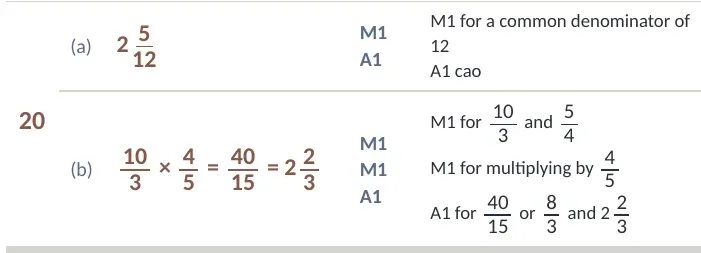
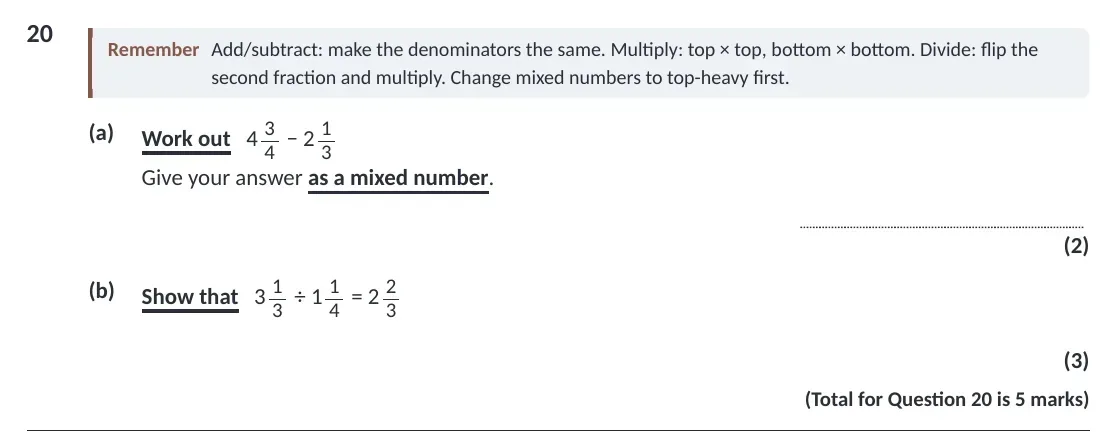
20 Remember Add/subtract: make the denominators the same. Multiply: top × top, bottom × bottom. Divide: flip the second fraction and multiply. Change mixed numbers to top-heavy first. (a) Work out 4 3 − 2 1 4 3 Give your answer as a mixed number. (2) (b) Show that 3 1 ÷ 1 1 = 2 2 3 4 3 📄 sheet: Calculating with fractions (3) (Total for Question 20 is 5 marks)
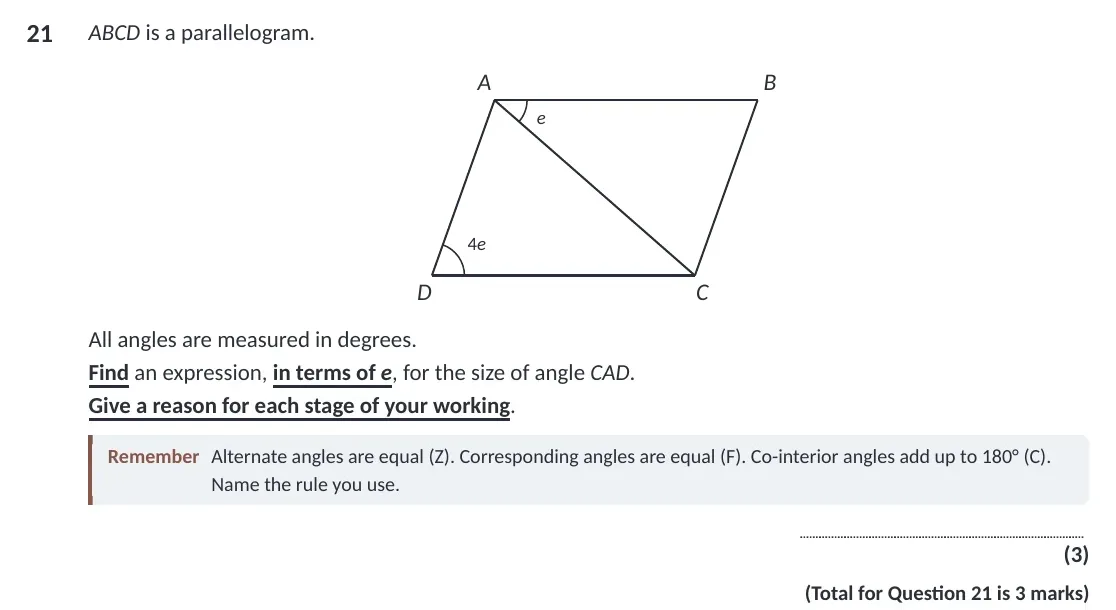
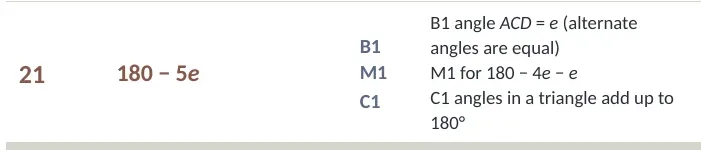
21 ABCD is a parallelogram. A B e 4e D C All angles are measured in degrees. Find an expression, in terms of e, for the size of angle CAD. Give a reason for each stage of your working. Remember Alternate angles are equal (Z). Corresponding angles are equal (F). Co-interior angles add up to 180° (C). Name the rule you use. 📄 sheet: Angle facts (3) (Total for Question 21 is 3 marks)
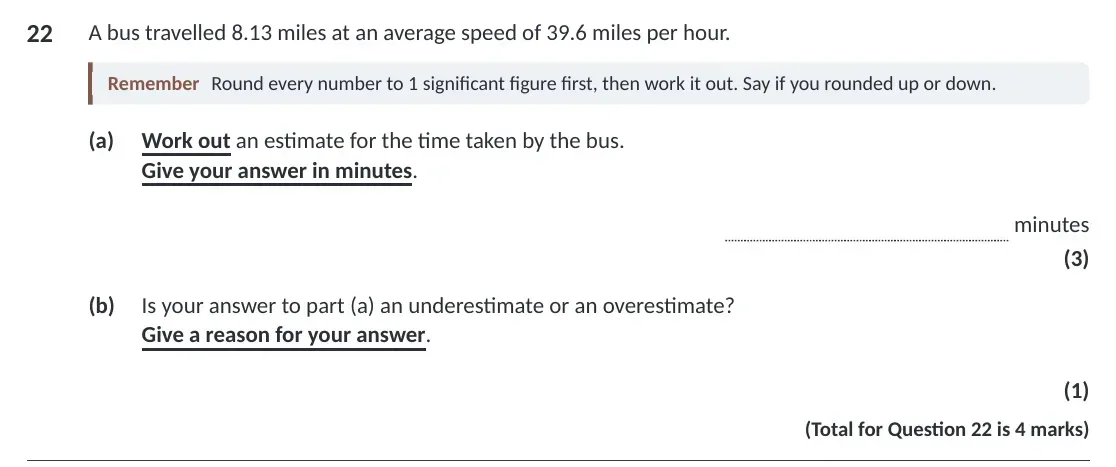
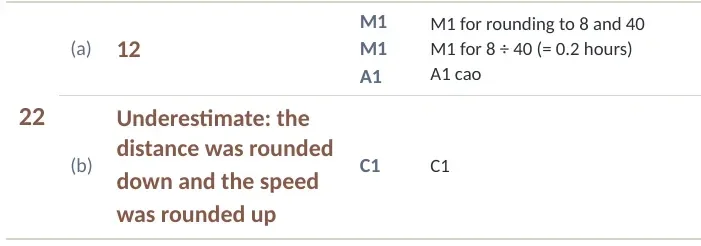
22 A bus travelled 8.13 miles at an average speed of 39.6 miles per hour. Remember Round every number to 1 significant figure first, then work it out. Say if you rounded up or down. (a) Work out an estimate for the time taken by the bus. Give your answer in minutes. minutes (3) (b) Is your answer to part (a) an underestimate or an overestimate? Give a reason for your answer. 📄 sheet: Speed, distan
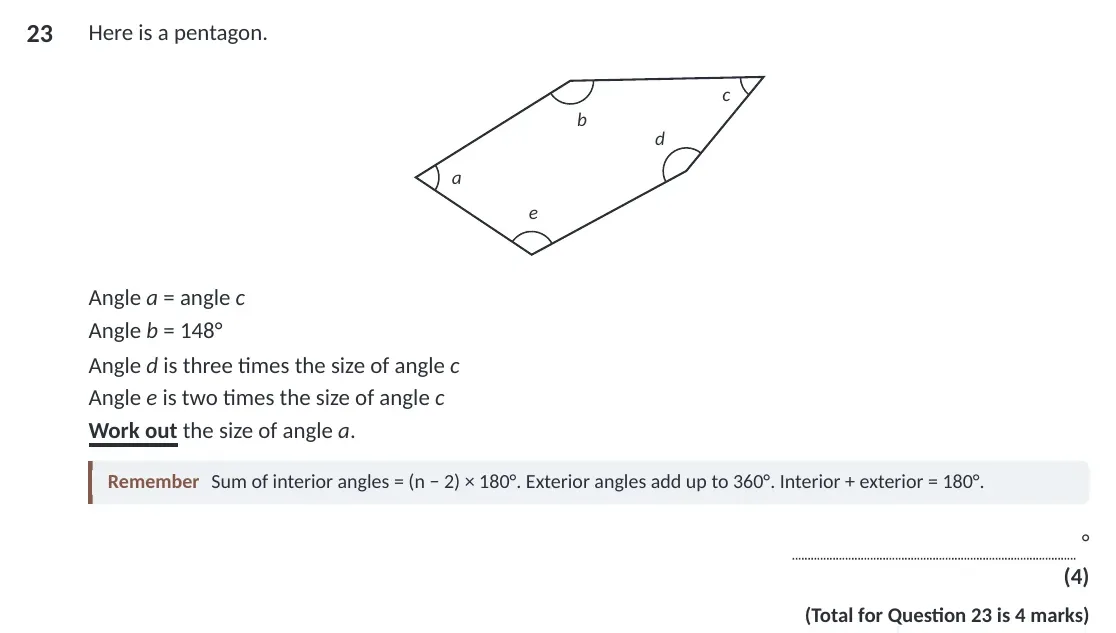
23 Here is a pentagon. c b d a e Angle a = angle c Angle b = 148° Angle d is three times the size of angle c Angle e is two times the size of angle c Work out the size of angle a. Remember Sum of interior angles = (n − 2) × 180°. Exterior angles add up to 360°. Interior + exterior = 180°. ° (4) 📄 sheet: Angles in polygons (Total for Question 23 is 4 marks)
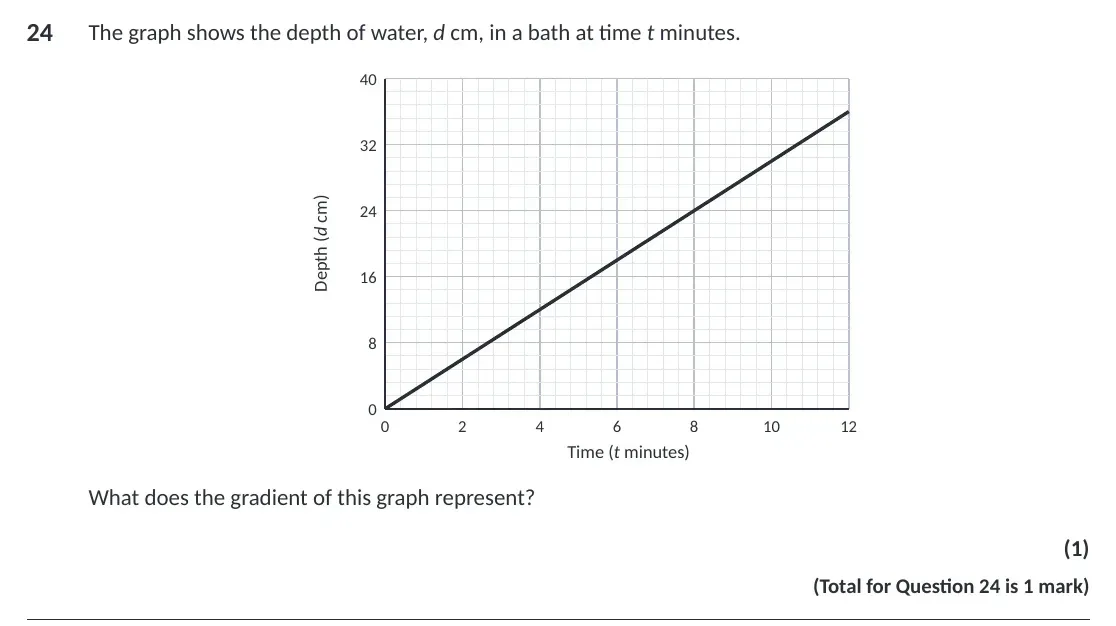
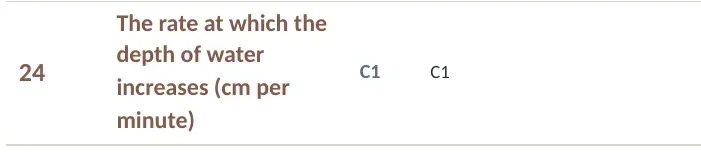
24 The graph shows the depth of water, d cm, in a bath at time t minutes. 40 Depth (d cm) 32 24 16 8 0 0 2 4 6 8 10 12 Time (t minutes) What does the gradient of this graph represent? 📄 sheet: Gradient and y = mx + c (1) (Total for Question 24 is 1 mark)
25 Make p the subject of the formula y = 5p + 8 (2) 📄 sheet: Rearranging formulae (Total for Question 25 is 2 marks)
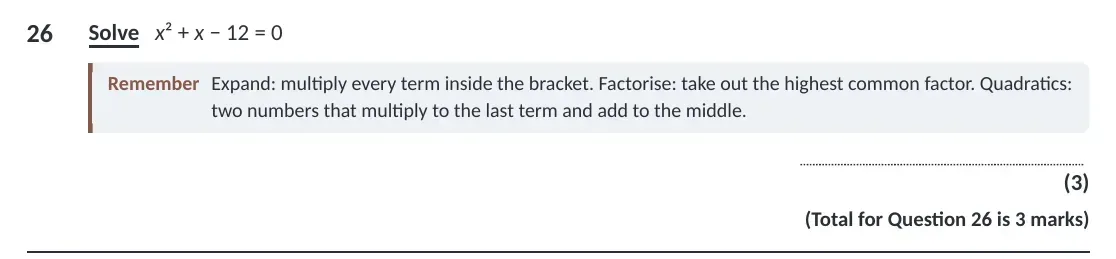
26 Solve x² + x − 12 = 0 Remember Expand: multiply every term inside the bracket. take out the highest common factor. Quadratics: two numbers that multiply to the last term and add to the middle. (3) 📄 sheet: Solving quadratics (Total for Question 26 is 3 marks)
◀ A3All papersB2 ▶
Answer the questions, then mark your paper.