Miss North Maths

Full paper F1

Paper 1 style · Non-calculator · 80 marks · 1 hour 30 minutes

How it works. Type each answer in its box. Tap any underlined word on the paper to see what it wants you to do. Stuck? Open the fact sheet under the question. When you finish, press Mark my paper, then check each question against the mark scheme and give yourself the marks you earned, including method marks.

1 Write 0.9 as a fraction. 📄 sheet: Converting fractions, decimals and percentages (Total for Question 1 is 1 mark) (1)
2 (1) (Total for Question 2 is 1 mark) Work out 4 3 📄 sheet: Primes, squares, odd and even
(1) (Total for Question 3 is 1 mark) Work out 30 ÷ (4 + 2) 📄 sheet: BIDMAS 3
Write down a factor of 48 that is between 10 and 15 📄 sheet: and multiples 4 (1) (Total for Question 4 is 1 mark)
5 Simplify 2 × a × 6 × b 📄 sheet: Expressions (1) (Total for Question 5 is 1 mark)
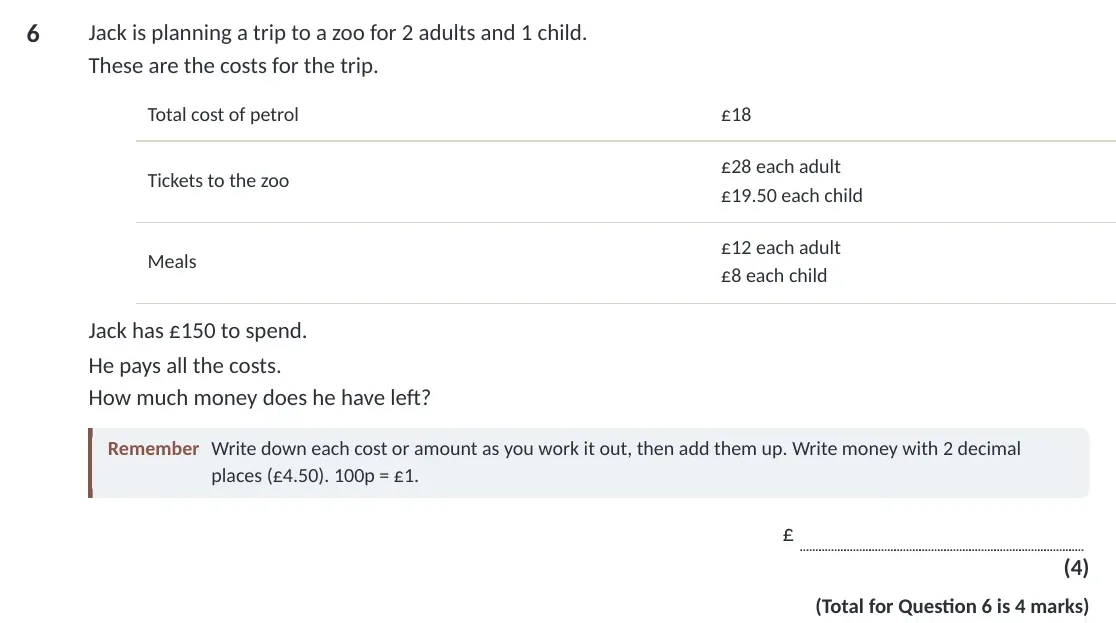
6 Jack is planning a trip to a zoo for 2 adults and 1 child. These are the costs for the trip. Total cost of petrol £18 Tickets to the zoo £28 each adult £19.50 each child Meals £12 each adult £8 each child Jack has £150 to spend. He pays all the costs. How much money does he have left? Remember Write down each cost or amount as you work it out, then add them up. Write money with 2 decimal places
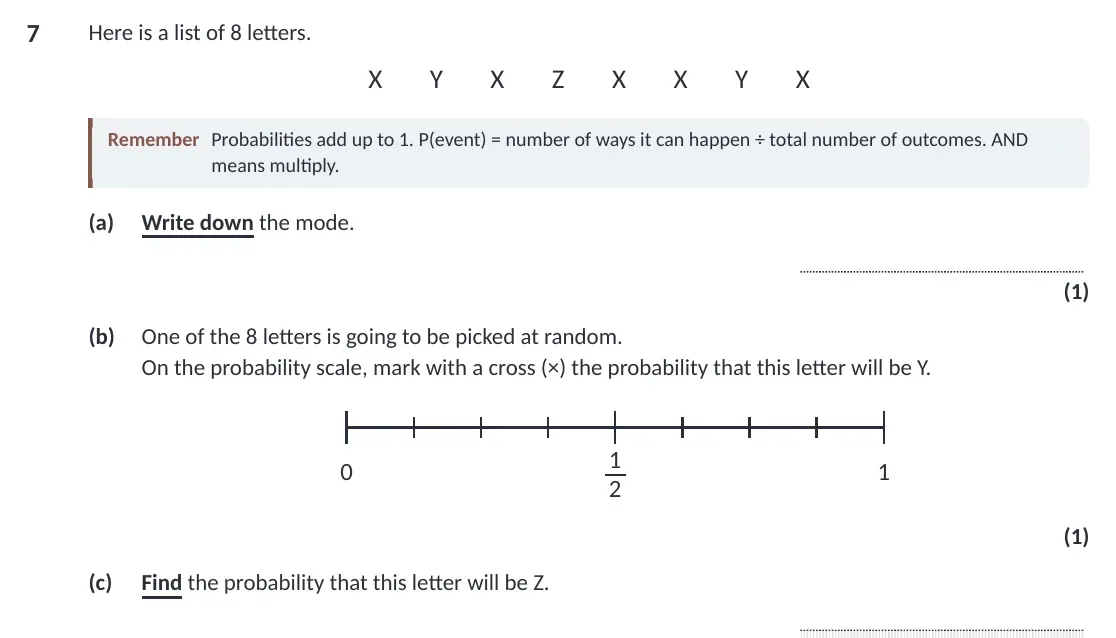
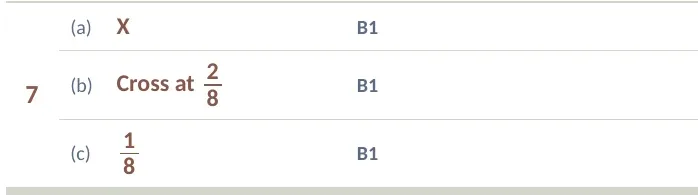
7 Here is a list of 8 letters. X Y X Z X X Y X Remember Probabilities add up to 1. P(event) = number of ways it can happen ÷ total number of outcomes. AND means multiply. (a) Write down the mode. (1) (b) One of the 8 letters is going to be picked at random. On the probability scale, mark with a cross (×) the probability that this letter will be Y. 0 1 2 1 (1) (c) Find the probability that this let
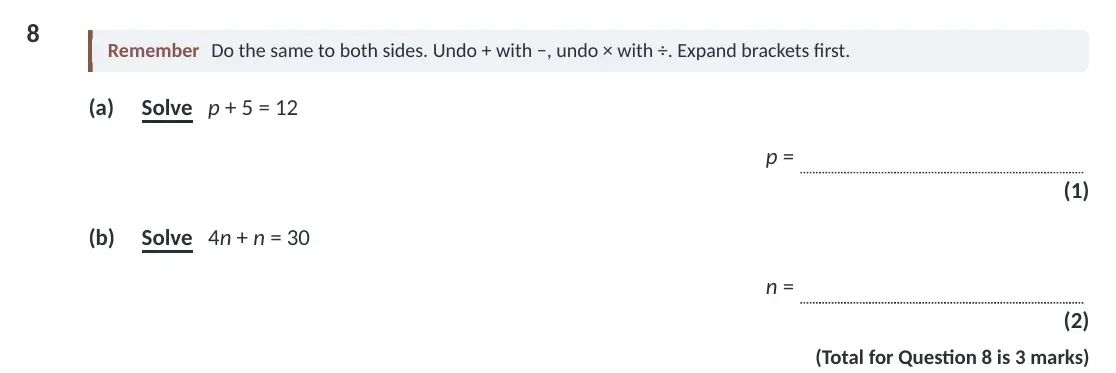
8 Remember Do the same to both sides. Undo + with −, undo × with ÷. Expand brackets first. (a) Solve p + 5 = 12 p = (1) (b) Solve 4n + n = 30 n = (2) 📄 sheet: Solving equations, cards 1 and 4 (Total for Question 8 is 3 marks)
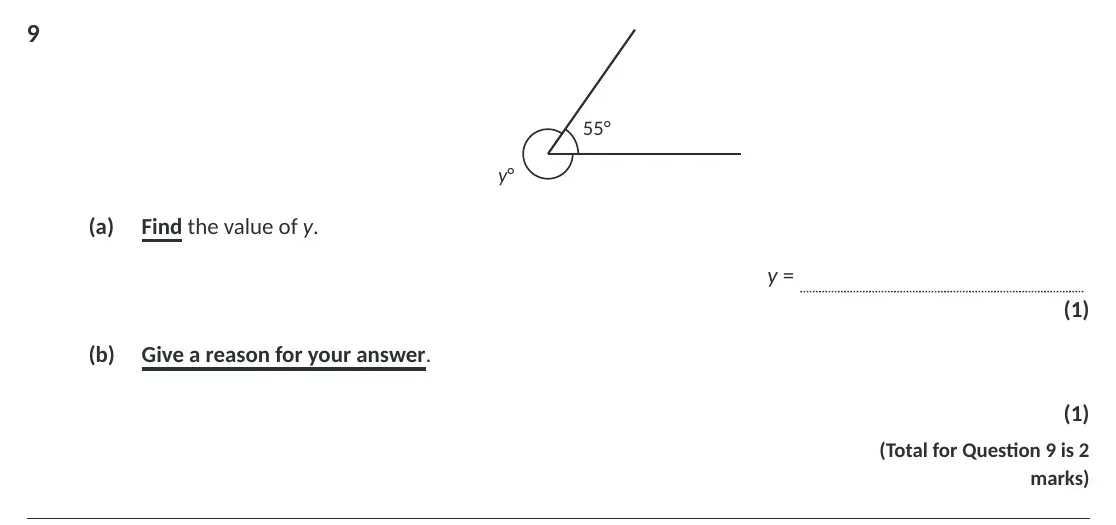
9 55° y° (a) Find the value of y. y = (1) (b) Give a reason for your answer. 📄 sheet: Angle facts 📄 sheet: Place value and written calculation 📄 sheet: Substitution (1) (Total for Question 9 is 2 marks)
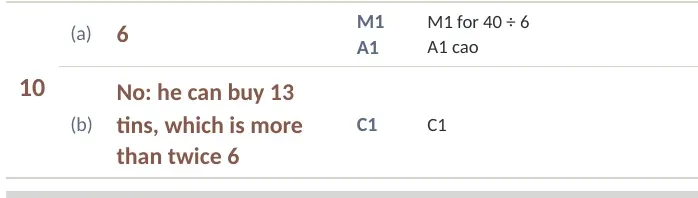
10 A shop sells tins of paint. Each tin of paint costs £6 Ryan has £40 Remember Write down each cost or amount as you work it out, then add them up. Write money with 2 decimal places (£4.50). 100p = £1. (a) Work out the greatest number of tins of paint Ryan can buy. (2) (b) In a sale on Saturday, tins of paint are sold at half price. Ryan thinks that the greatest number of tins of paint he can now
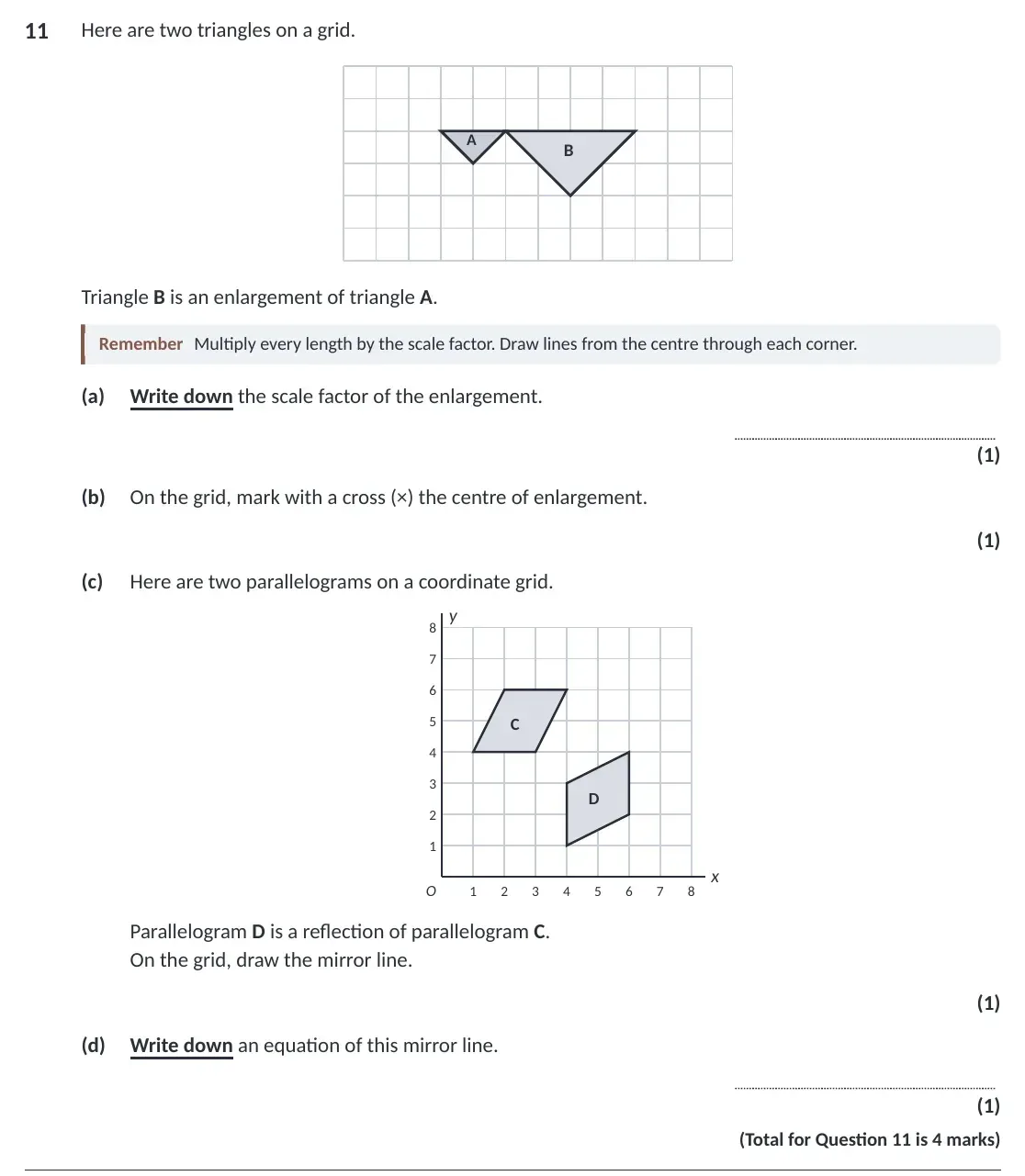
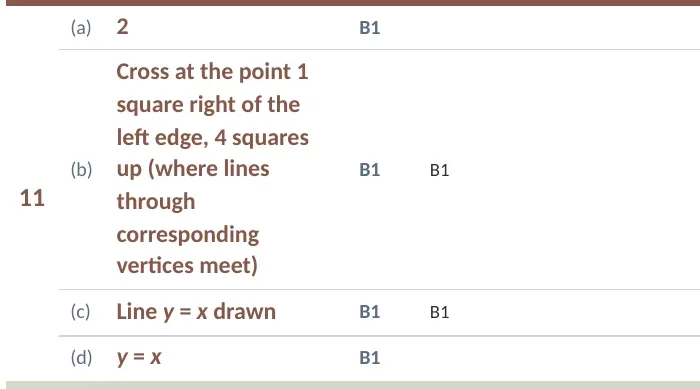
11 Here are two triangles on a grid. A B Triangle B is an enlargement of triangle A. Remember Multiply every length by the scale factor. Draw lines from the centre through each corner. (a) Write down the scale factor of the enlargement. (1) (b) On the grid, mark with a cross (×) the centre of enlargement. (1) (c) Here are two parallelograms on a coordinate grid. 8 y 7 6 5 C 4 3 D 2 1 O 1 2 3 4 5 6
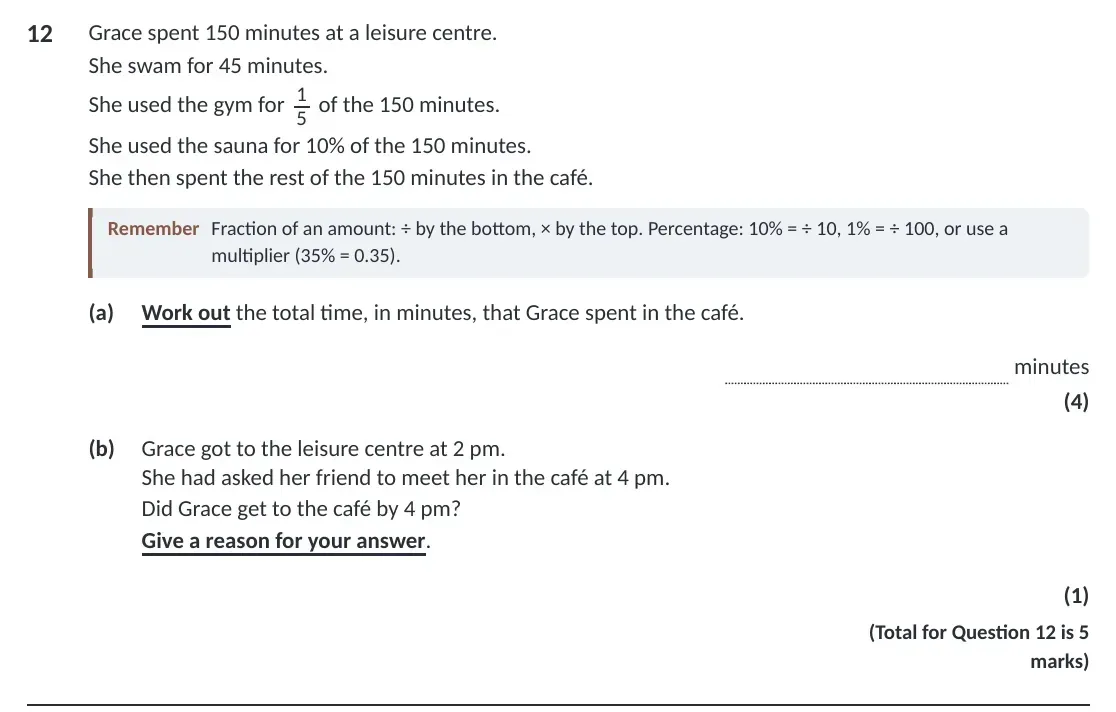
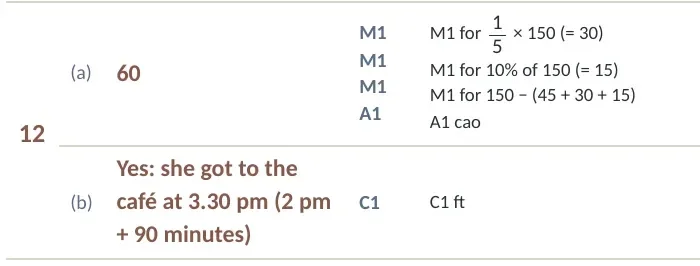
12 Grace spent 150 minutes at a leisure centre. She swam for 45 minutes. She used the gym for 1 of the 150 minutes. 5 She used the sauna for 10% of the 150 minutes. She then spent the rest of the 150 minutes in the café. Remember Fraction of an amount: ÷ by the bottom, × by the top. Percentage: 10% = ÷ 10, 1% = ÷ 100, or use a multiplier (35% = 0.35). (a) Work out the total time, in minutes, that
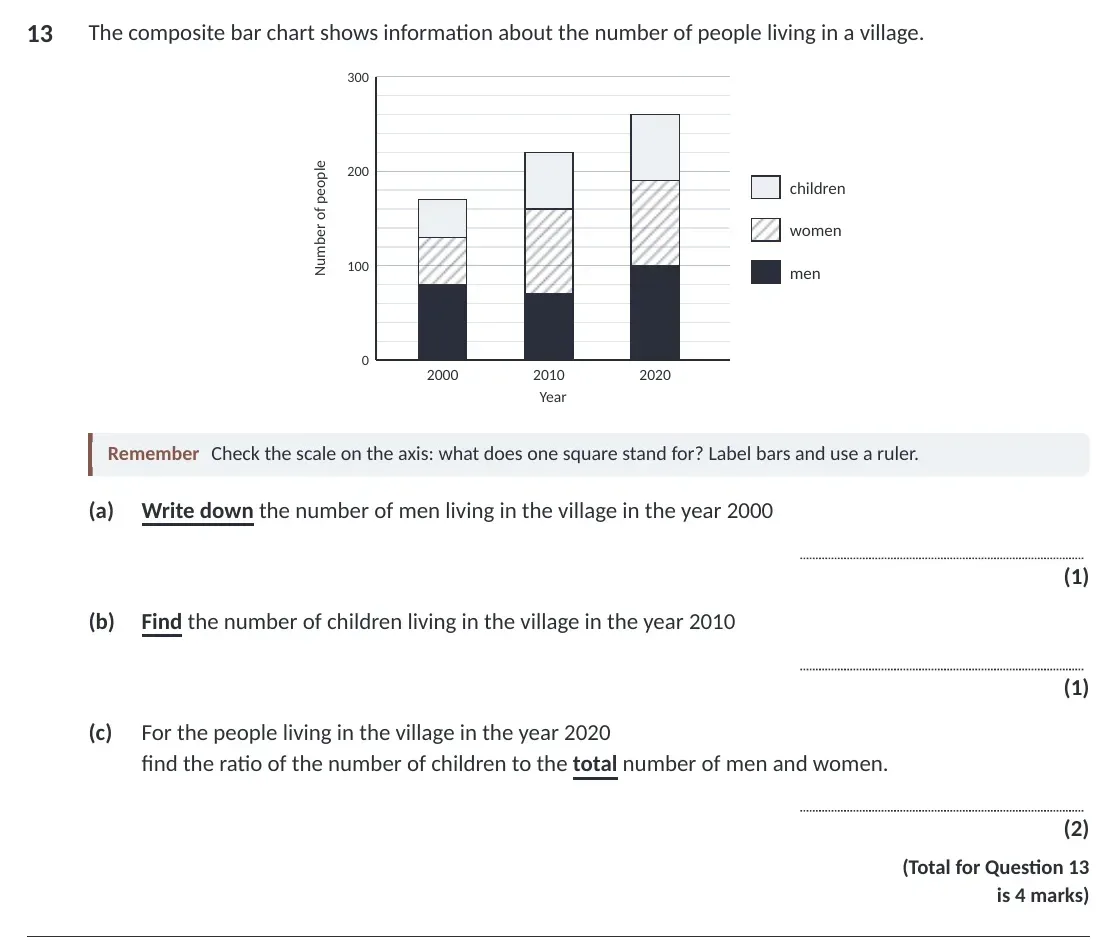
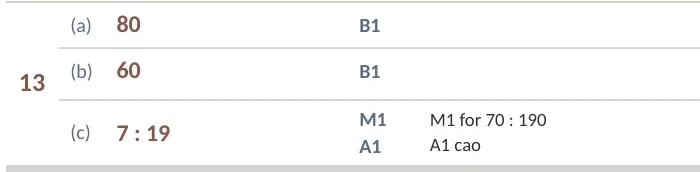
13 The composite bar chart shows information about the number of people living in a village. Number of people 300 200 children women 100 0 men 2000 2010 Year 2020 Remember Check the scale on the axis: what does one square stand for? Label bars and use a ruler. (a) Write down the number of men living in the village in the year 2000 (1) (b) Find the number of children living in the village in the ye
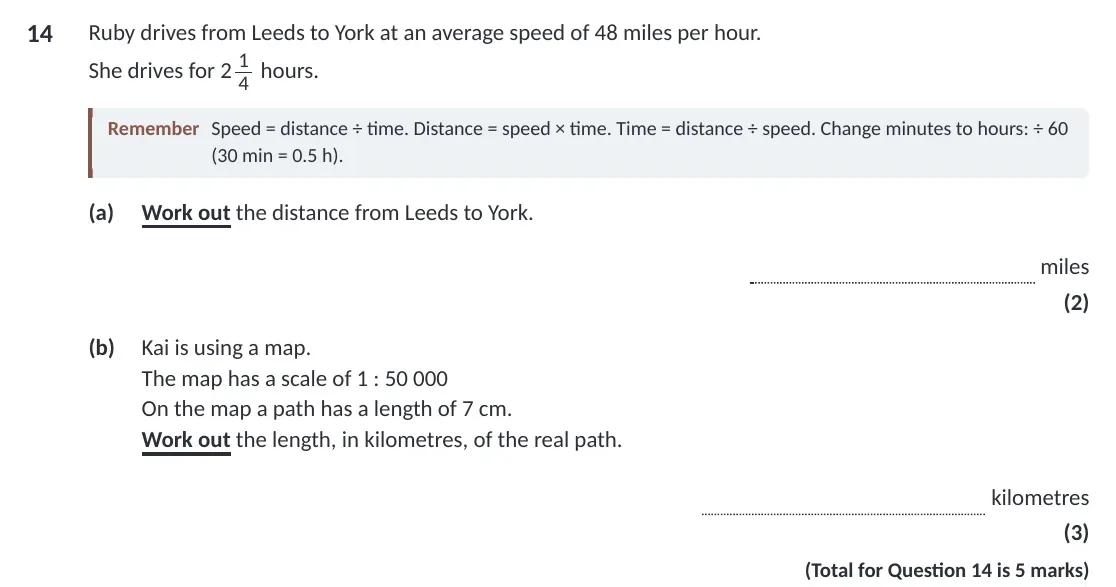
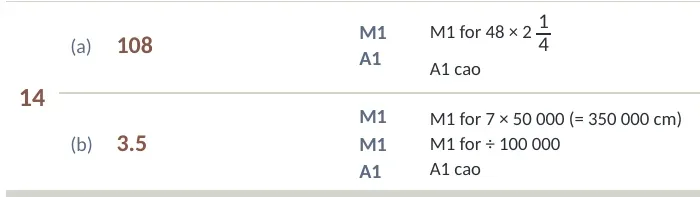
14 Ruby drives from Leeds to York at an average speed of 48 miles per hour. She drives for 2 1 hours. 4 Remember Speed = distance ÷ time. Distance = speed × time. Time = distance ÷ speed. Change minutes to hours: ÷ 60 (30 min = 0.5 h). (a) Work out the distance from Leeds to York. miles (2) (b) Kai is using a map. The map has a scale of 1 : 50 000 On the map a path has a length of 7 cm. Work out t
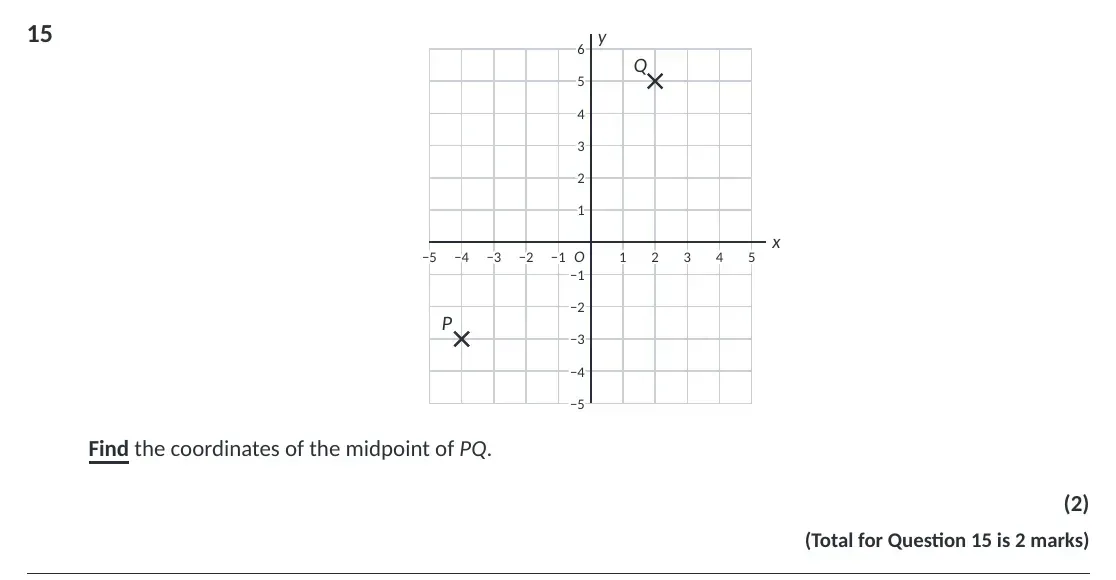
15 6 y Q 5 4 3 2 1 −5 −4 −3 P −2 −1 O −1 1 2 3 4 5 x −2 −3 −4 −5 Find the coordinates of the midpoint of PQ. 📄 sheet: Coordinates and midpoints (2) (Total for Question 15 is 2 marks)
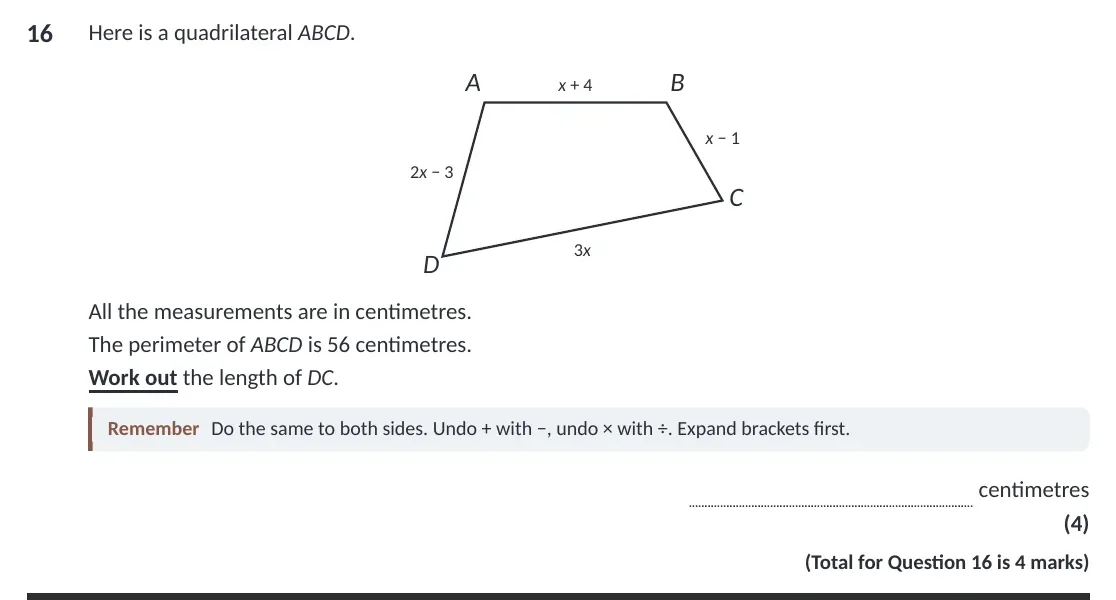
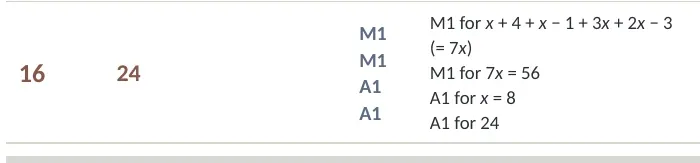
16 Here is a quadrilateral ABCD. A x + 4 B x − 1 2x − 3 D C 3x All the measurements are in centimetres. The perimeter of ABCD is 56 centimetres. Work out the length of DC. Remember Do the same to both sides. Undo + with −, undo × with ÷. Expand brackets first. centimetres 📄 sheet: Area and perimeter with algebra (4) (Total for Question 16 is 4 marks)
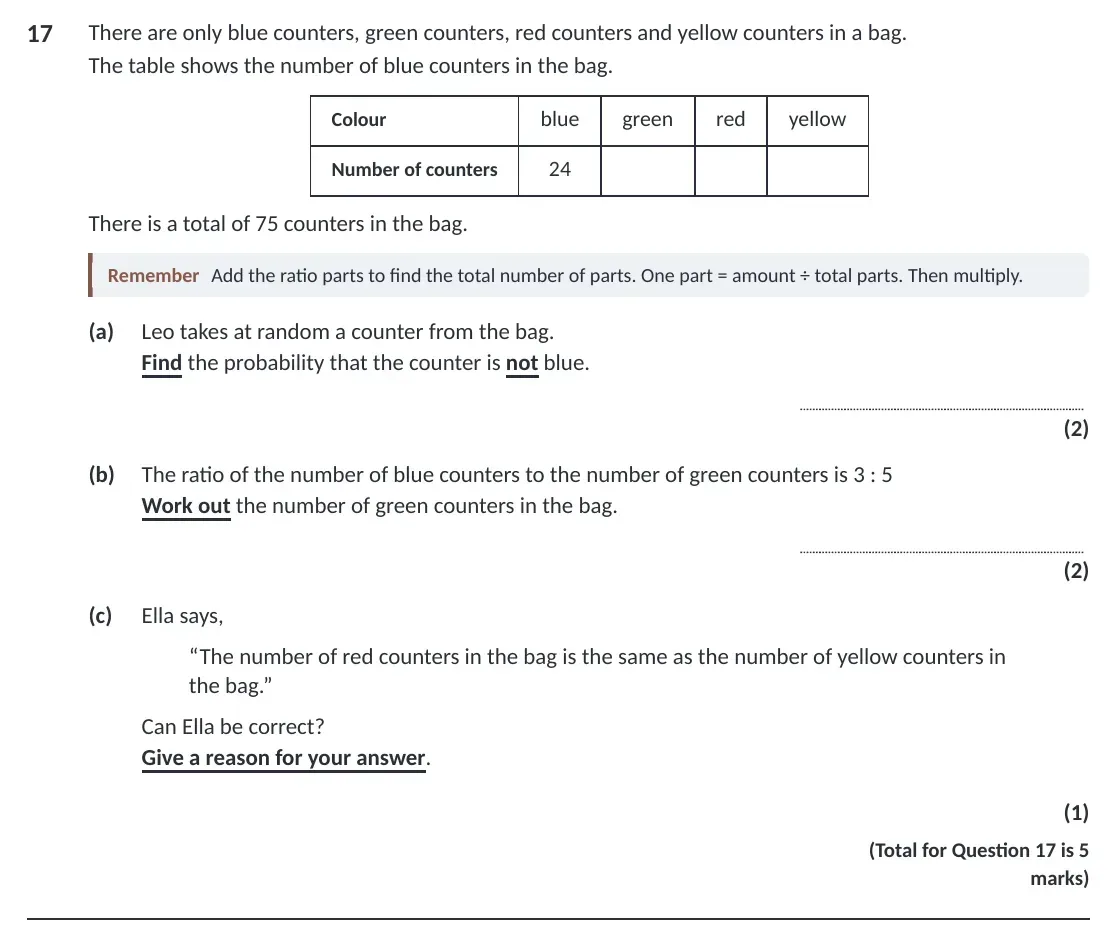
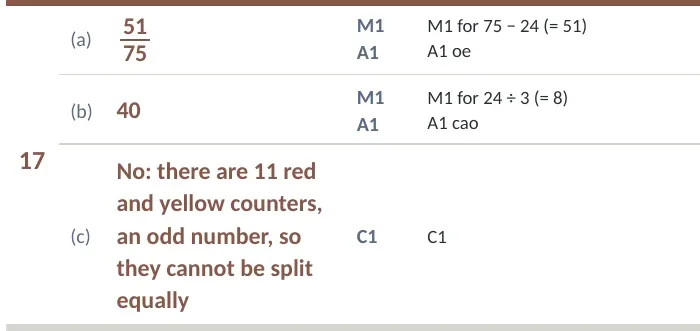
17 There are only blue counters, green counters, red counters and yellow counters in a bag. The table shows the number of blue counters in the bag. Colour blue Number of counters 24 green red yellow There is a total of 75 counters in the bag. Remember Add the ratio parts to find the total number of parts. One part = amount ÷ total parts. Then multiply. (a) Leo takes at random a counter from the ba
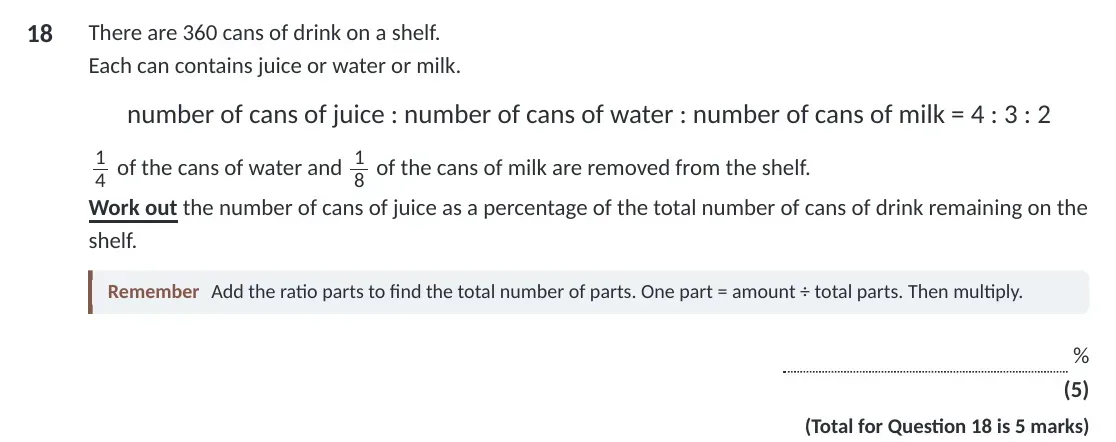
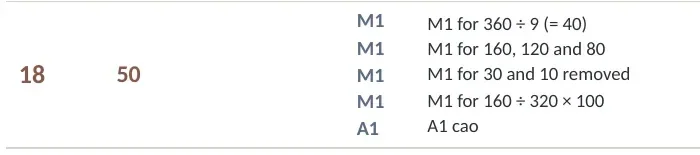
18 There are 360 cans of drink on a shelf. Each can contains juice or water or milk. number of cans of juice : number of cans of water : number of cans of milk = 4 : 3 : 2 1 of the cans of water and 1 of the cans of milk are removed from the shelf. 4 8 Work out the number of cans of juice as a percentage of the total number of cans of drink remaining on the shelf. Remember Add the ratio parts to f
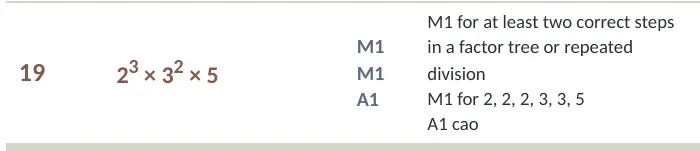
19 Write 360 as a product of powers of its prime factors. Remember Use a factor tree. HCF = the primes both numbers share. LCM = the smallest number in both times tables. 📄 sheet: Product of prime factors (3) (Total for Question 19 is 3 marks)
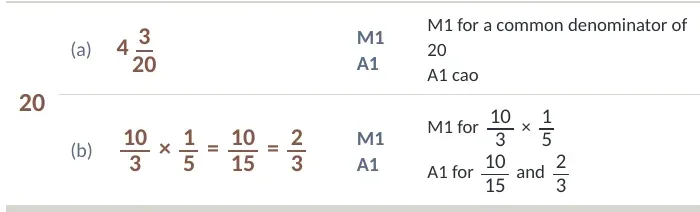
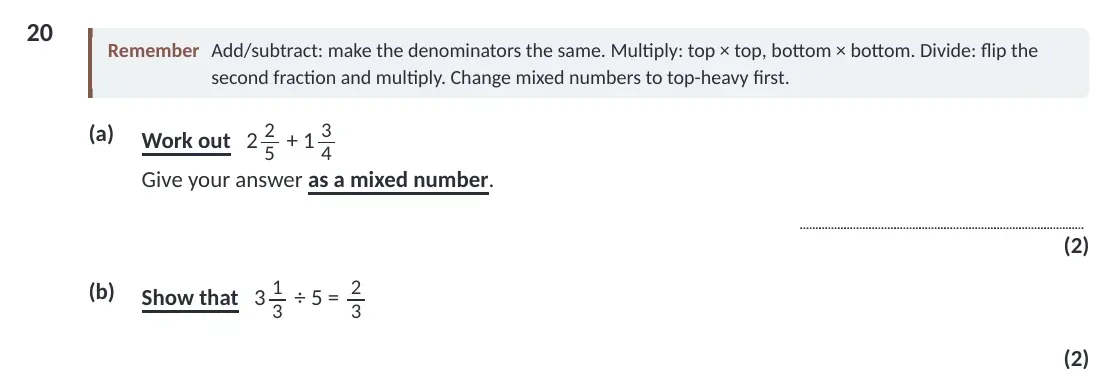
20 Remember Add/subtract: make the denominators the same. Multiply: top × top, bottom × bottom. Divide: flip the second fraction and multiply. Change mixed numbers to top-heavy first. (a) Work out 2 2 + 1 3 5 4 Give your answer as a mixed number. (2) (b) Show that 3 1 ÷ 5 = 2 3 3 📄 (2)
21 Simplify (3 −4 × 3 7 ) 2 Give your answer as a power of 3 (2) 📄 sheet: Laws of indices (Total for Question 21 is 2 marks)
22 Work out 0.006 × 0.41 (2) 📄 sheet: Written calculation (Total for Question 22 is 2 marks)
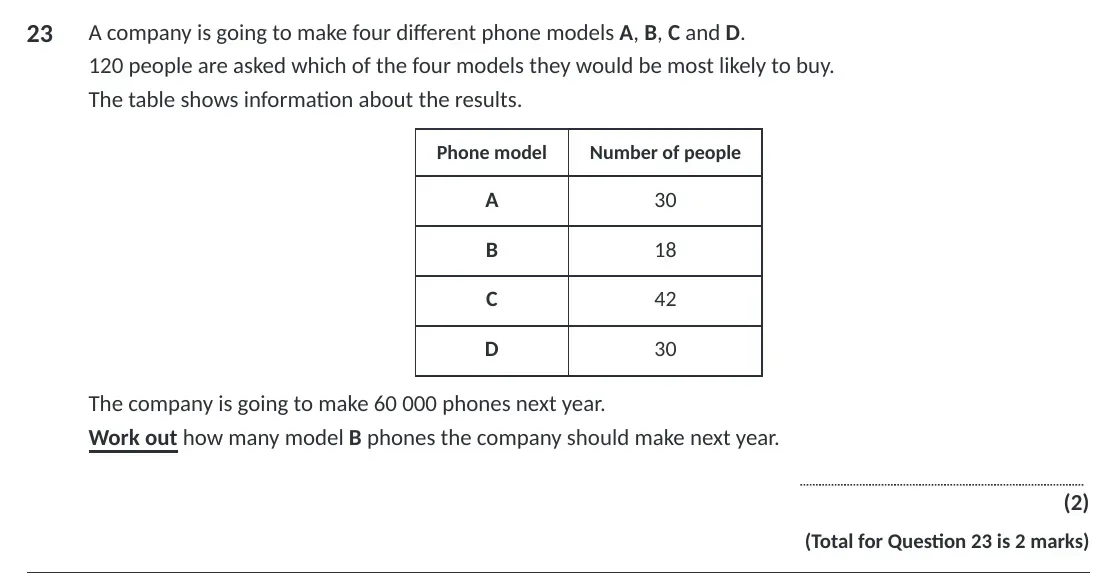
23 A company is going to make four different phone models A, B, C and D. 120 people are asked which of the four models they would be most likely to buy. The table shows information about the results. Phone model Number of people A 30 B 18 C 42 D 30 The company is going to make 60 000 phones next year. Work out how many model B phones the company should make next year. 📄 sheet: Recipes and direct p
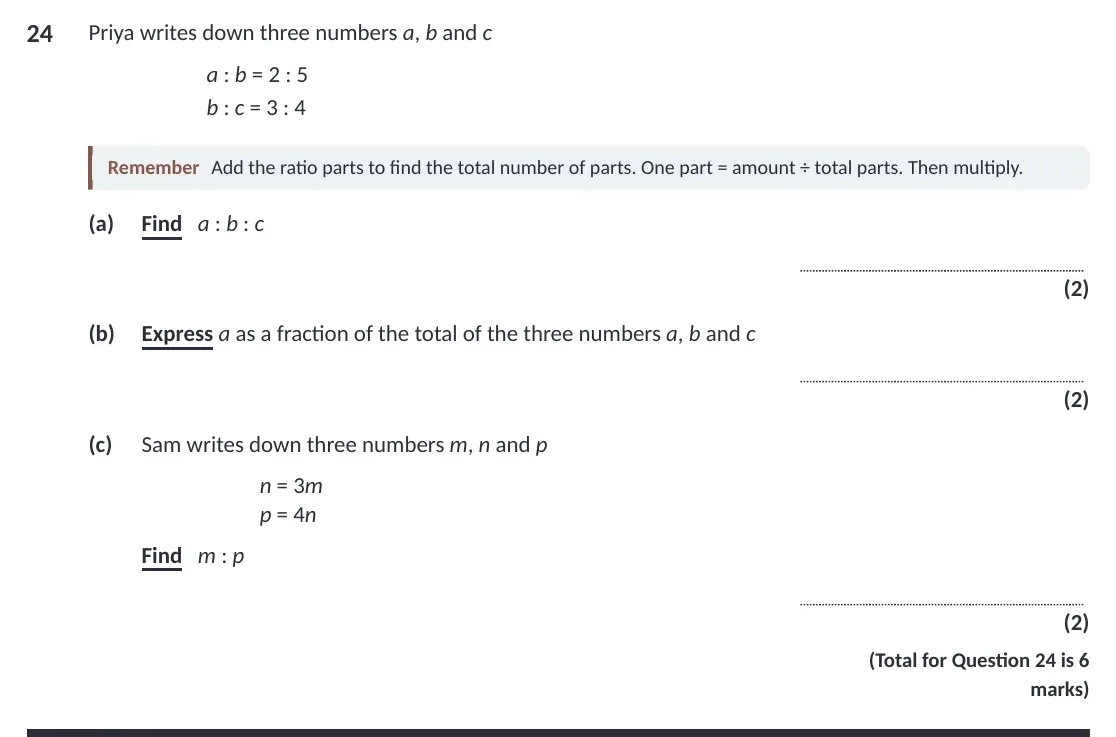
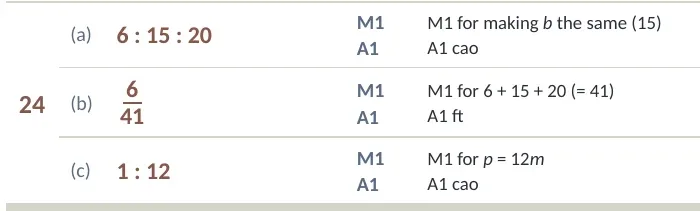
24 Priya writes down three numbers a, b and c a : b = 2 : 5 b : c = 3 : 4 Remember Add the ratio parts to find the total number of parts. One part = amount ÷ total parts. Then multiply. (a) Find a : b : c (2) (b) Express a as a fraction of the total of the three numbers a, b and c (2) (c) Sam writes down three numbers m, n and p n = 3m p = 4n Find m : p 📄 sheet: Ratio 📄 sheet: Fractions 📄 sheet: P
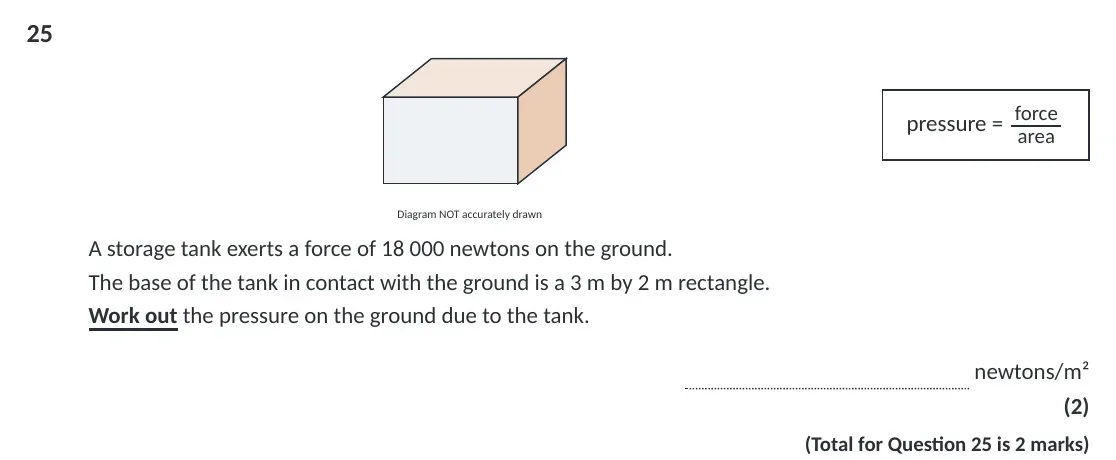
25 pressure = force area Diagram NOT accurately drawn A storage tank exerts a force of 18 000 newtons on the ground. The base of the tank in contact with the ground is a 3 m by 2 m rectangle. Work out the pressure on the ground due to the tank. newtons/m² (2) 📄 sheet: Compound measures (Total for Question 25 is 2 marks)
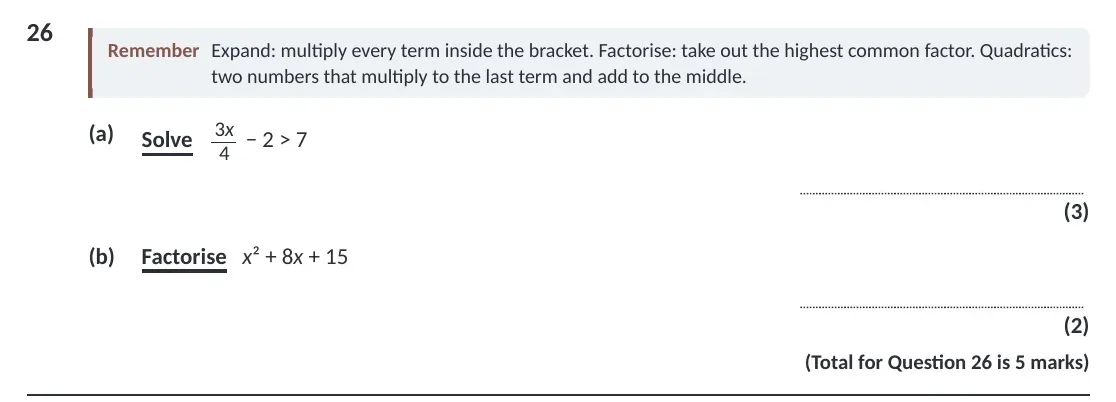
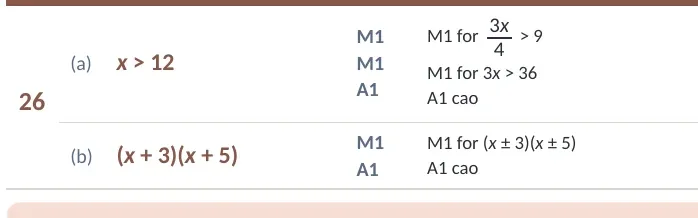
26 Remember Expand: multiply every term inside the bracket. take out the highest common factor. Quadratics: two numbers that multiply to the last term and add to the middle. (a) Solve 3x − 2 > 7 4 (3) (b) x² + 8x + 15 📄 sheet: card 3 📄 sheet: Inequalities (2) (Total for Question 26 is 5 marks)
◀ E3All papersF2 ▶
Answer the questions, then mark your paper.