Miss North Maths

Half paper N8

Paper 1 style · Non-calculator · 36 marks · about 35–40 minutes

How it works. Type each answer in its box. Tap any underlined word on the paper to see what it wants you to do. Stuck? Open the fact sheet under the question. When you finish, press Mark my paper, then check each question against the mark scheme and give yourself the marks you earned, including method marks.

1 Write 9 as a percentage. 10 % 📄 sheet: Finding percentages (Total for Question 1 is 1 mark) (1)
2 Write 3 as a decimal. 100 📄 sheet: Converting fractions, decimals and percentages (1) (Total for Question 2 is 1 mark)
3 Write 285 correct to the nearest ten. 📄 sheet: Rounding to the nearest 10, 100 or 1000 (1) (Total for Question 3 is 1 mark)
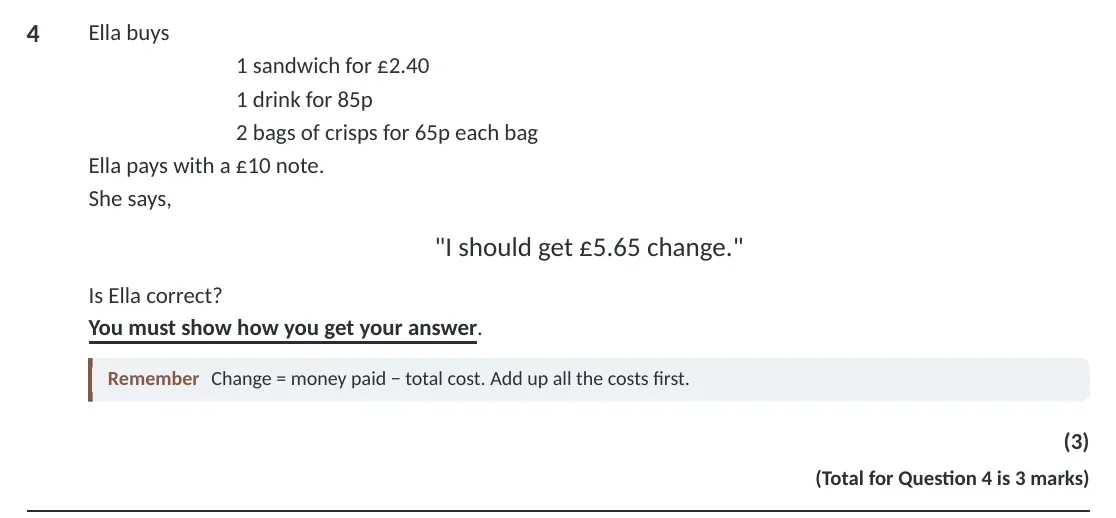
4 Ella buys 1 sandwich for £2.40 1 drink for 85p 2 bags of crisps for 65p each bag Ella pays with a £10 note. She says, "I should get £5.65 change." Is Ella correct? You must show how you get your answer. Remember Change = money paid − total cost. Add up all the costs first. 📄 sheet: Shopping, change and offers (3) (Total for Question 4 is 3 marks)
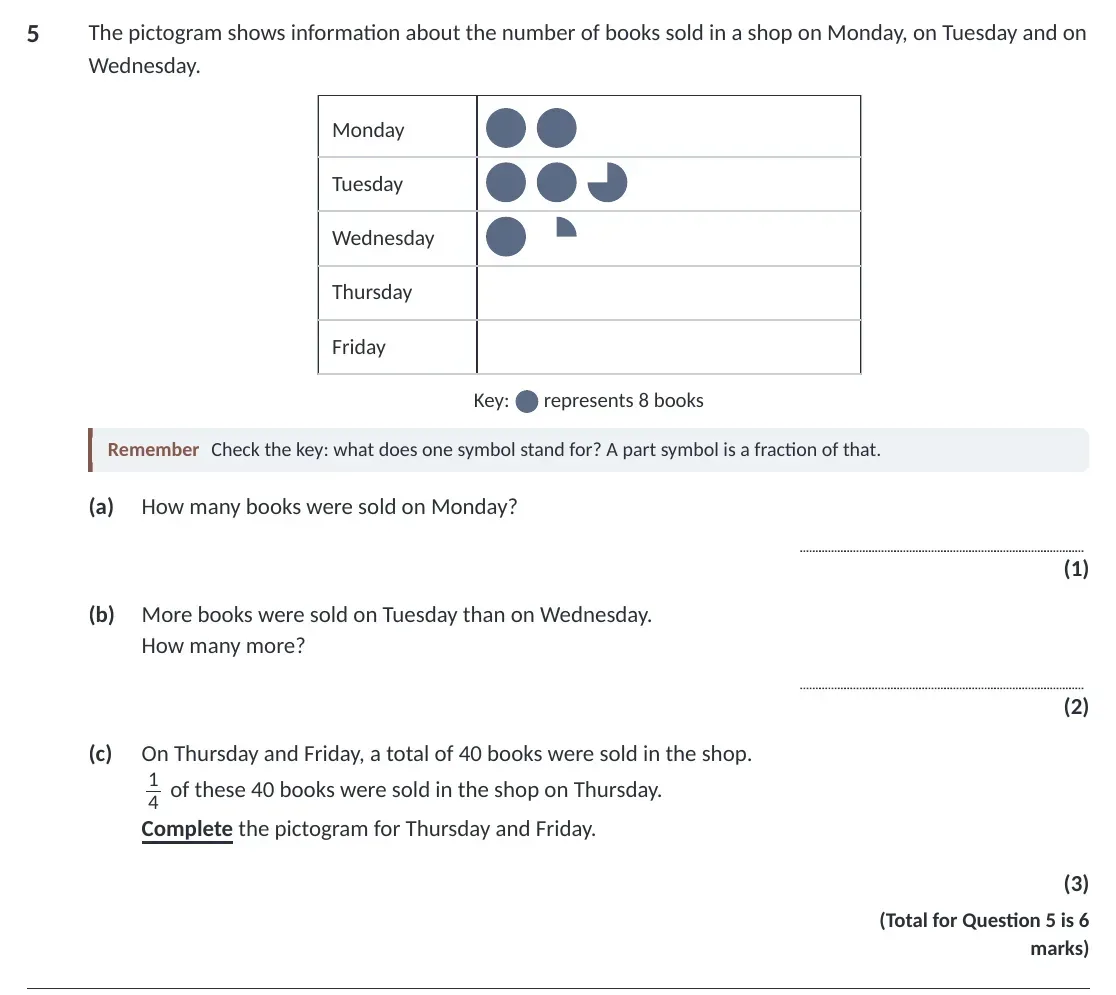
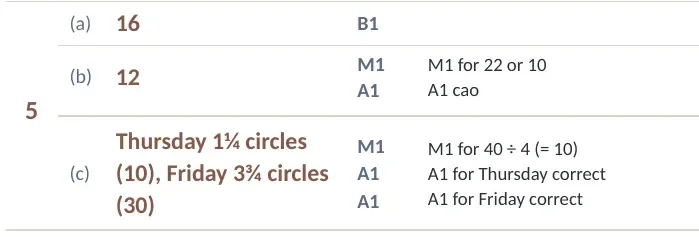
5 The pictogram shows information about the number of books sold in a shop on Monday, on Tuesday and on Wednesday. Monday Tuesday Wednesday Thursday Friday Key: represents 8 books Remember Check the key: what does one symbol stand for? A part symbol is a fraction of that. (a) How many books were sold on Monday? (1) (b) More books were sold on Tuesday than on Wednesday. How many more? (2) (c) On Th
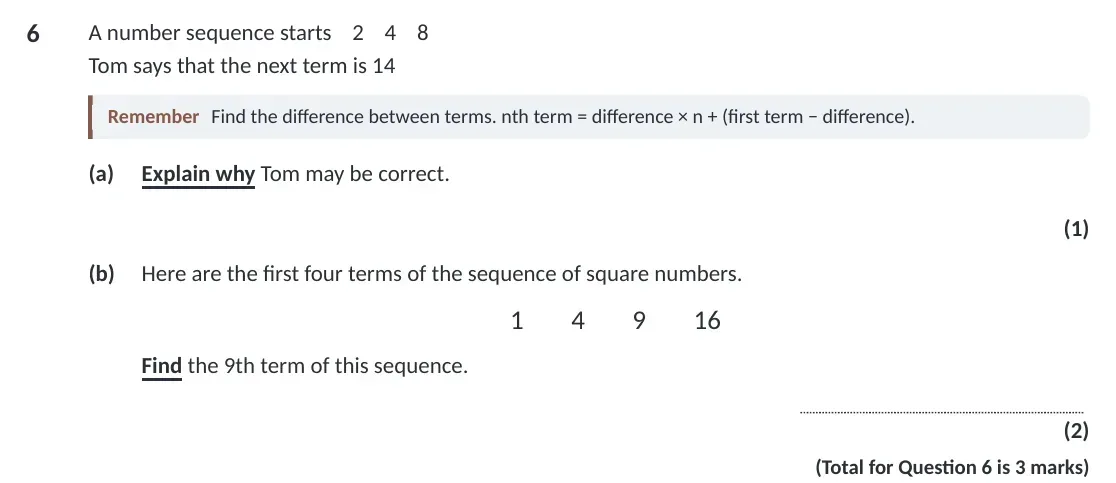
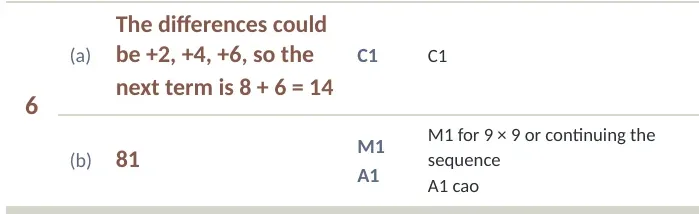
6 A number sequence starts 2 4 8 Tom says that the next term is 14 Remember Find the difference between terms. nth term = difference × n + (first term − difference). (a) Explain why Tom may be correct. (1) (b) Here are the first four terms of the sequence of square numbers. 1 4 9 16 Find the 9th term of this sequence. (2) 📄 sheet: Term-to-term rules and patterns (Total for Question 6 is 3 marks)
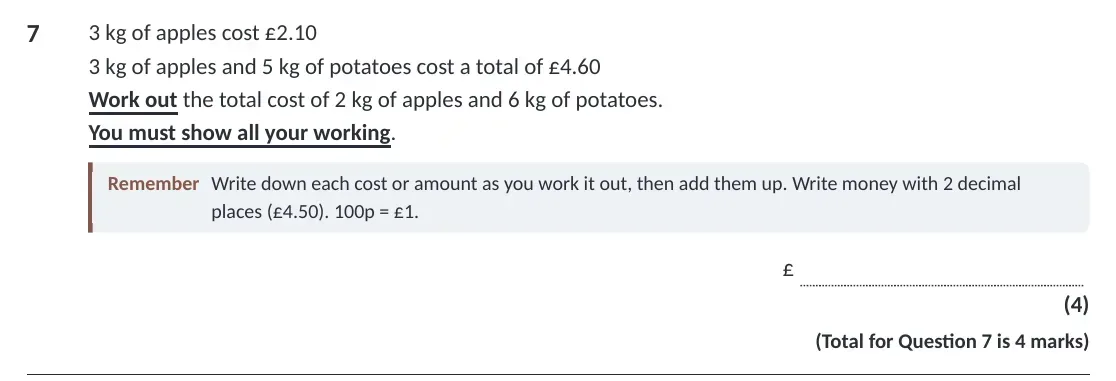
7 3 kg of apples cost £2.10 3 kg of apples and 5 kg of potatoes cost a total of £4.60 Work out the total cost of 2 kg of apples and 6 kg of potatoes. You must show all your working. Remember Write down each cost or amount as you work it out, then add them up. Write money with 2 decimal places (£4.50). 100p = £1. £ 📄 sheet: Shopping, change and offers (4) (Total for Question 7 is 4 marks)
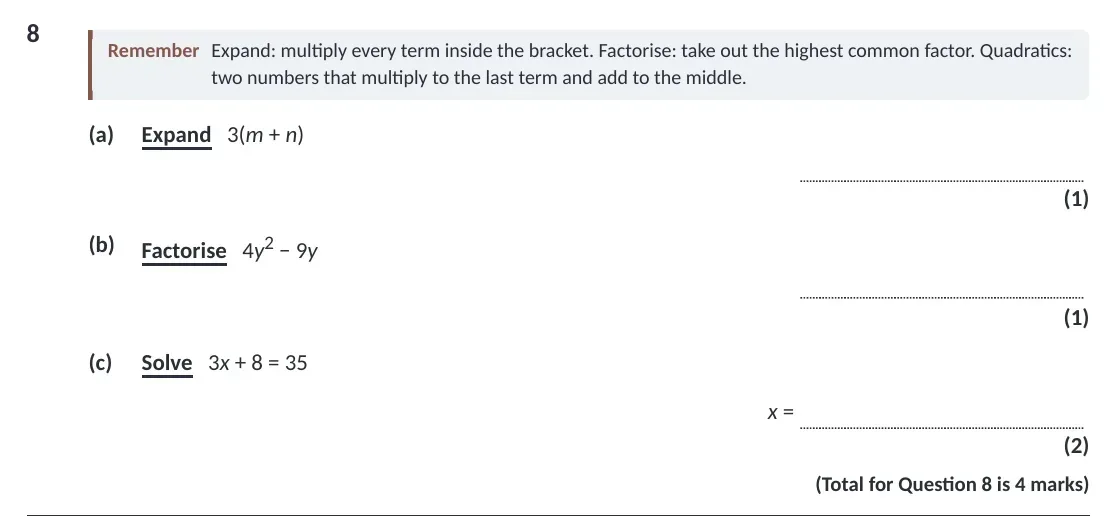
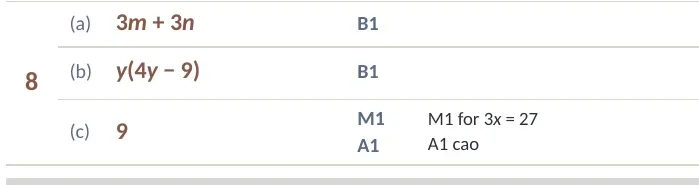
8 Remember Expand: multiply every term inside the bracket. take out the highest common factor. Quadratics: two numbers that multiply to the last term and add to the middle. (a) Expand 3(m + n) (1) (b) 4y 2 − 9y (1) (c) Solve 3x + 8 = 35 x = 📄 sheet: card 2 📄 sheet: Equations (2) (Total for Question 8 is 4 marks)
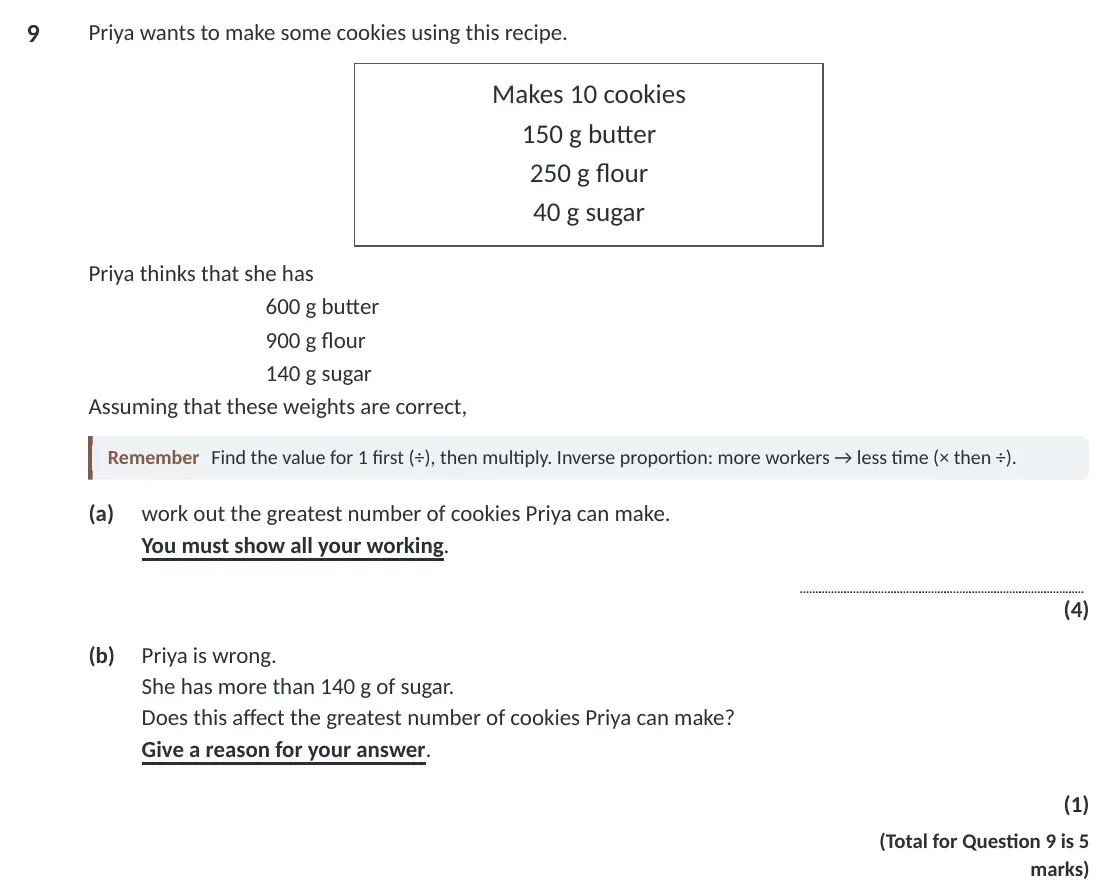
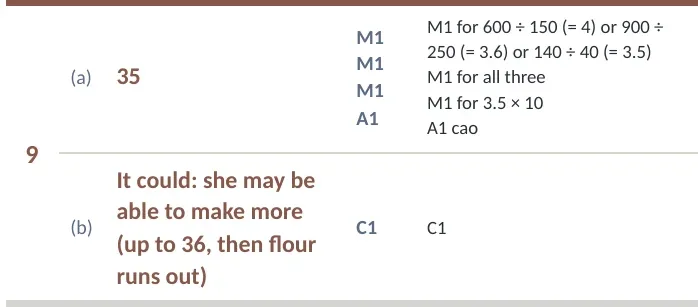
9 Priya wants to make some cookies using this recipe. Makes 10 cookies 150 g butter 250 g flour 40 g sugar Priya thinks that she has 600 g butter 900 g flour 140 g sugar Assuming that these weights are correct, Remember Find the value for 1 first (÷), then multiply. Inverse proportion: more workers → less time (× then ÷). (a) work out the greatest number of cookies Priya can make. You must show al
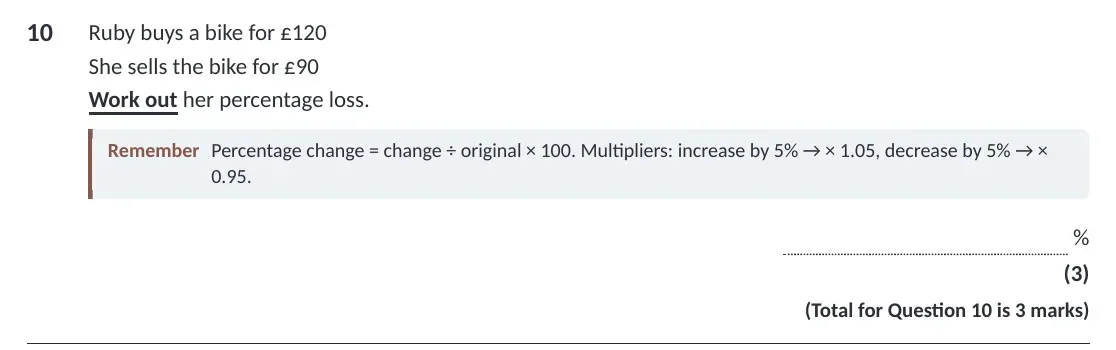
10 Ruby buys a bike for £120 She sells the bike for £90 Work out her percentage loss. Remember Percentage change = change ÷ original × 100. Multipliers: increase by 5% → × 1.05, decrease by 5% → × 0.95. % 📄 sheet: Percentage change, profit and loss, card 1 (3) (Total for Question 10 is 3 marks)
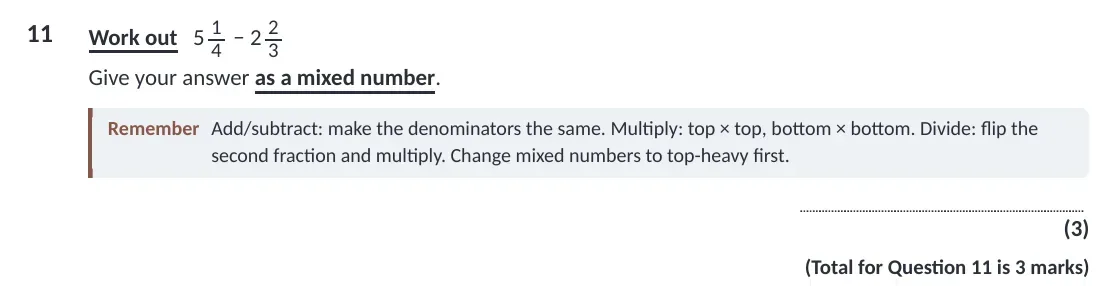
11 Work out 5 1 − 2 2 4 3 Give your answer as a mixed number. Remember Add/subtract: make the denominators the same. Multiply: top × top, bottom × bottom. Divide: flip the second fraction and multiply. Change mixed numbers to top-heavy first. (3) 📄 sheet: Calculating with fractions (Total for Question 11 is 3 marks)
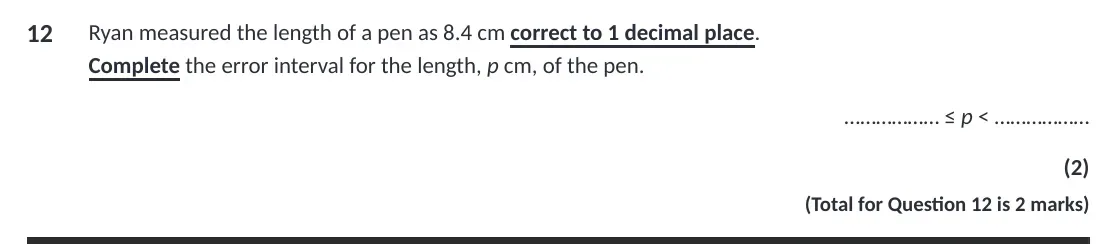
12 Ryan measured the length of a pen as 8.4 cm correct to 1 decimal place. Complete the error interval for the length, p cm, of the pen. ……………… ≤ p < ……………… (2) 📄 sheet: Error intervals (Total for Question 12 is 2 marks)
◀ N7All papersC1 ▶
Answer the questions, then mark your paper.