Miss North Maths

Half paper N3

Paper 1 style · Non-calculator · 36 marks · about 35–40 minutes

How it works. Type each answer in its box. Tap any underlined word on the paper to see what it wants you to do. Stuck? Open the fact sheet under the question. When you finish, press Mark my paper, then check each question against the mark scheme and give yourself the marks you earned, including method marks.

1 Write 25 609 correct to the nearest thousand. (1) 📄 sheet: Rounding to the nearest 10, 100 or 1000 (Total for Question 1 is 1 mark)
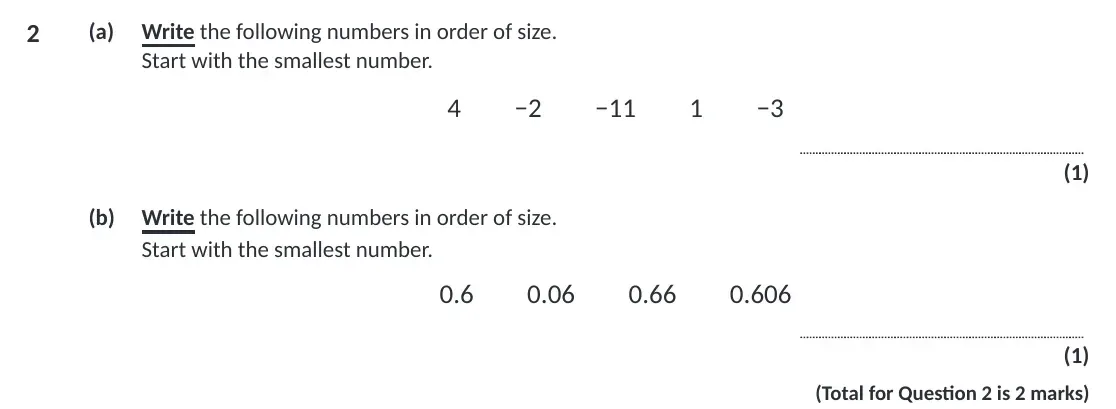
2 (a) Write the following numbers in order of size. Start with the smallest number. 4 −2 −11 1 −3 (1) (b) Write the following numbers in order of size. Start with the smallest number. 0.6 📄 sheet: Ordering decimals 0.06 0.66 0.606 (1) (Total for Question 2 is 2 marks)
3 Write 45% as a fraction. 📄 sheet: Writing and simplifying fractions, card 1 (1) (Total for Question 3 is 1 mark)
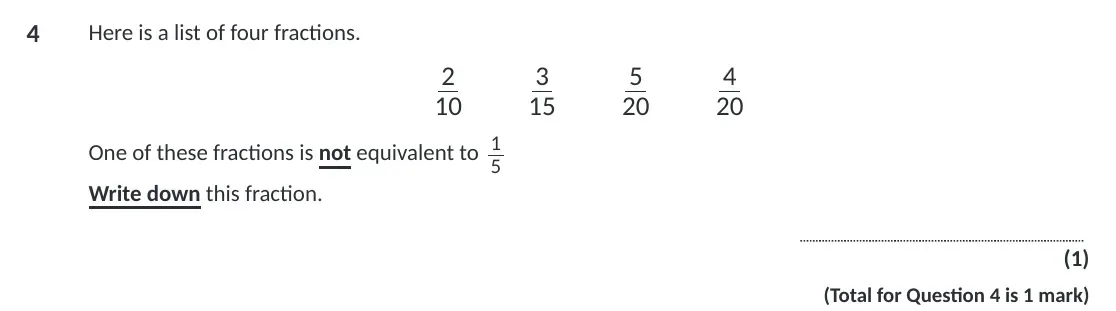
4 Here is a list of four fractions. 2 10 3 15 5 20 4 20 One of these fractions is not equivalent to 1 5 Write down this fraction. (1) 📄 sheet: Writing and simplifying fractions, card 1 (Total for Question 4 is 1 mark)
5 Write down the first multiple of 8 that is greater than 50 (1) 📄 sheet: Place value and number facts (Total for Question 5 is 1 mark)
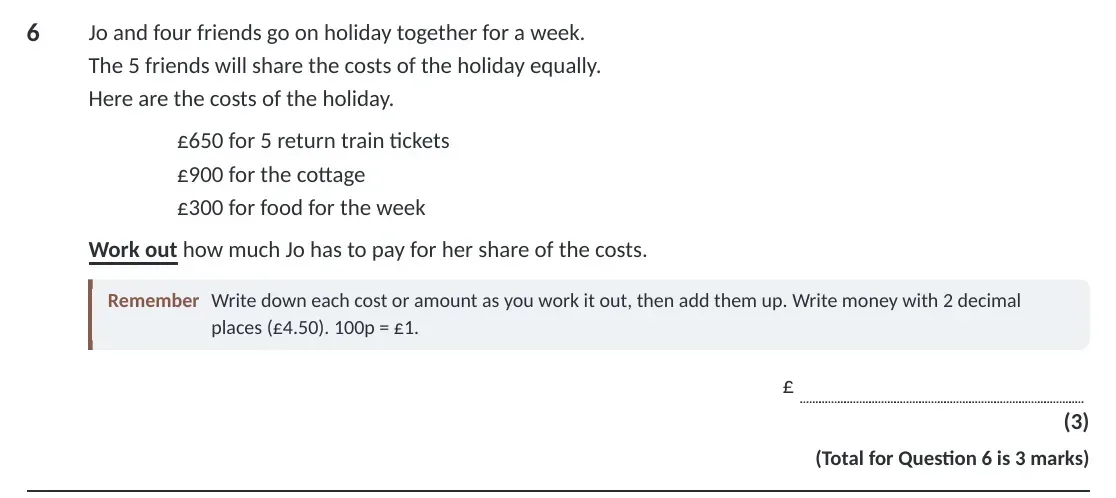
6 Jo and four friends go on holiday together for a week. The 5 friends will share the costs of the holiday equally. Here are the costs of the holiday. £650 for 5 return train tickets £900 for the cottage £300 for food for the week Work out how much Jo has to pay for her share of the costs. Remember Write down each cost or amount as you work it out, then add them up. Write money with 2 decimal plac
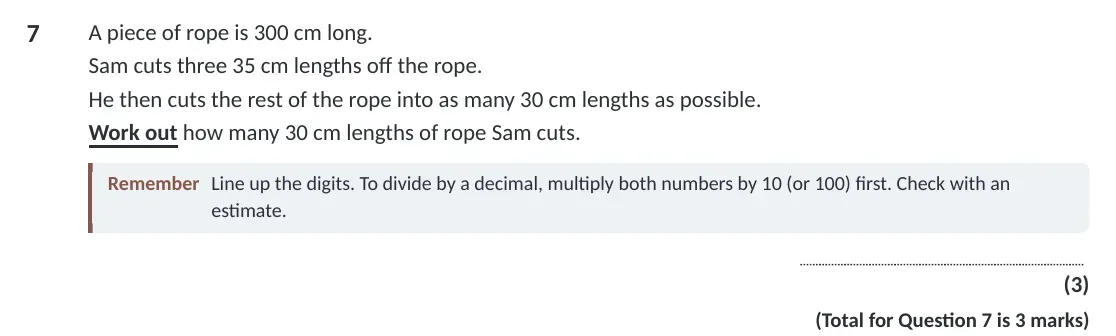
7 A piece of rope is 300 cm long. Sam cuts three 35 cm lengths off the rope. He then cuts the rest of the rope into as many 30 cm lengths as possible. Work out how many 30 cm lengths of rope Sam cuts. Remember Line up the digits. To divide by a decimal, multiply both numbers by 10 (or 100) first. Check with an estimate. 📄 sheet: Number problems and number machines (3) (Total for Question 7 is 3 ma
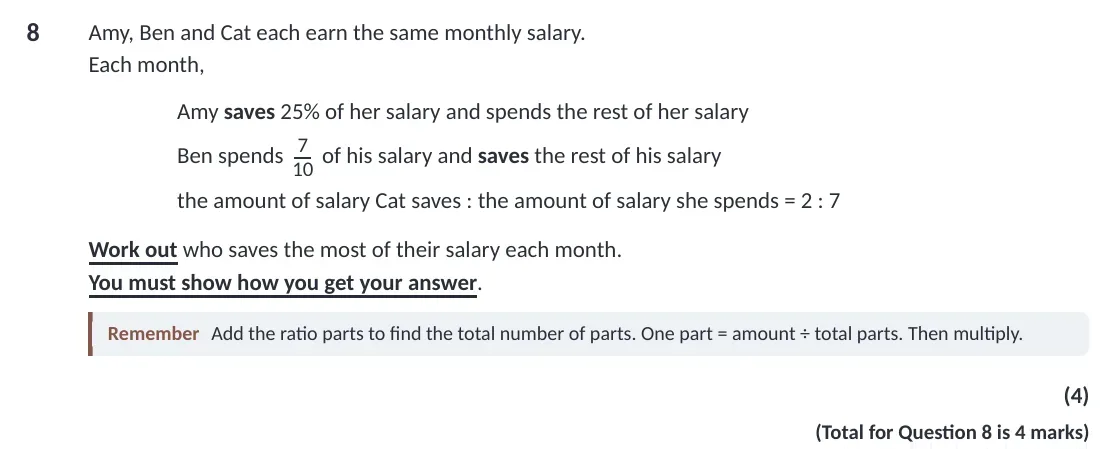
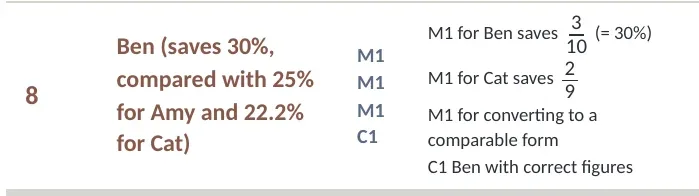
8 Amy, Ben and Cat each earn the same monthly salary. Each month, Amy saves 25% of her salary and spends the rest of her salary Ben spends 7 of his salary and saves the rest of his salary 10 the amount of salary Cat saves : the amount of salary she spends = 2 : 7 Work out who saves the most of their salary each month. You must show how you get your answer. Remember Add the ratio parts to find the
9 Work out 35% of 240 grams. grams 📄 sheet: Finding percentages (2) (Total for Question 9 is 2 marks)
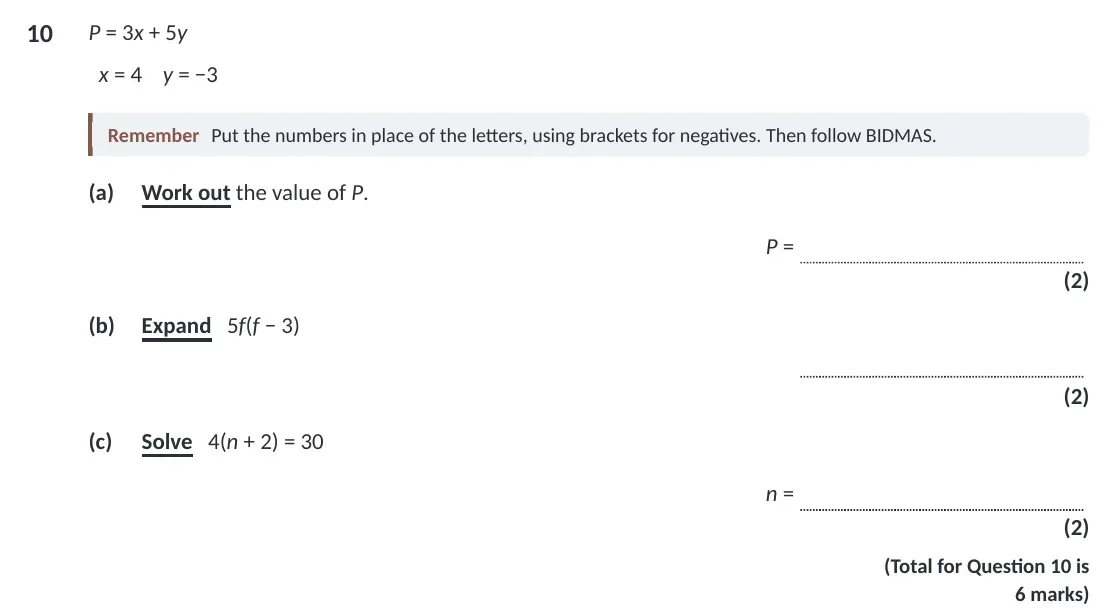
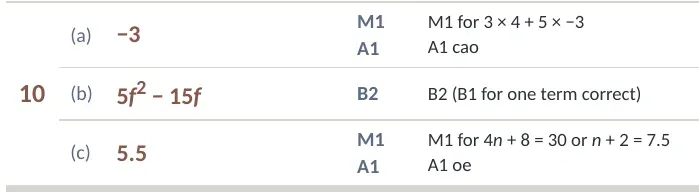
10 P = 3x + 5y x = 4 y = −3 Remember Put the numbers in place of the letters, using brackets for negatives. Then follow BIDMAS. (a) Work out the value of P. P = (2) (b) Expand 5f(f − 3) (2) (c) Solve 4(n + 2) = 30 n = 📄 sheet: 📄 sheet: Equations 📄 sheet: Expanding brackets, card 1 📄 sheet: Substitution (2) (Total for Question 10 is 6 marks)
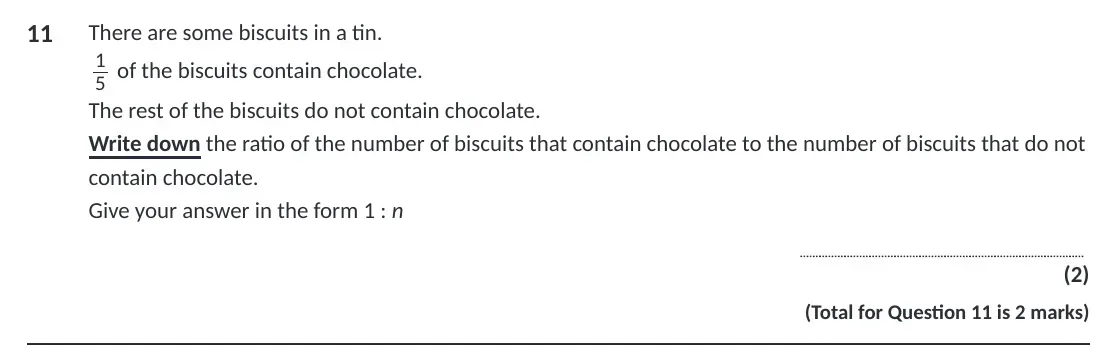
11 There are some biscuits in a tin. 1 of the biscuits contain chocolate. 5 The rest of the biscuits do not contain chocolate. Write down the ratio of the number of biscuits that contain chocolate to the number of biscuits that do not contain chocolate. Give your answer in the form 1 : n 📄 sheet: Ratios and fractions (2) (Total for Question 11 is 2 marks)
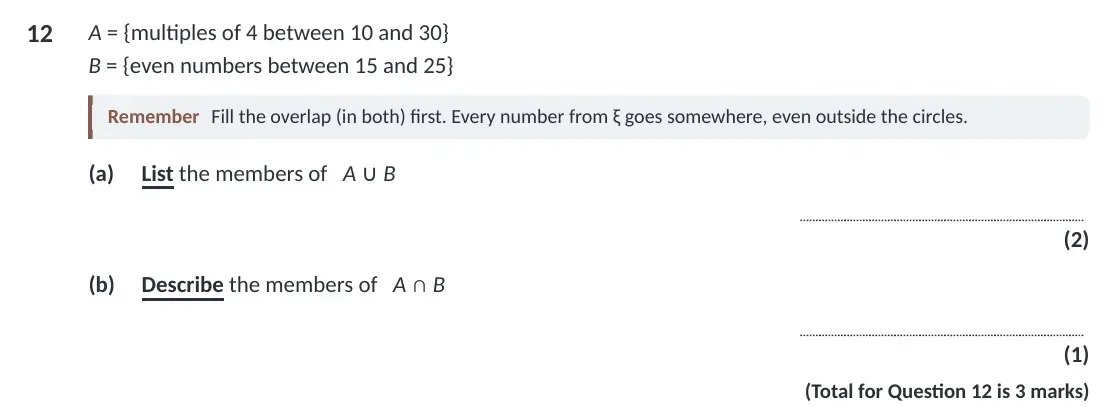
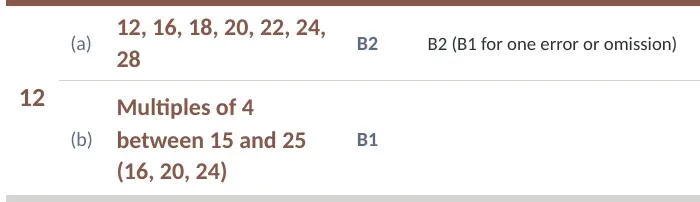
12 A = {multiples of 4 between 10 and 30} B = {even numbers between 15 and 25} Remember Fill the overlap (in both) first. Every number from ξ goes somewhere, even outside the circles. (a) List the members of A ∪ B (2) (b) Describe the members of A ∩ B (1) 📄 sheet: Venn diagrams (Total for Question 12 is 3 marks)
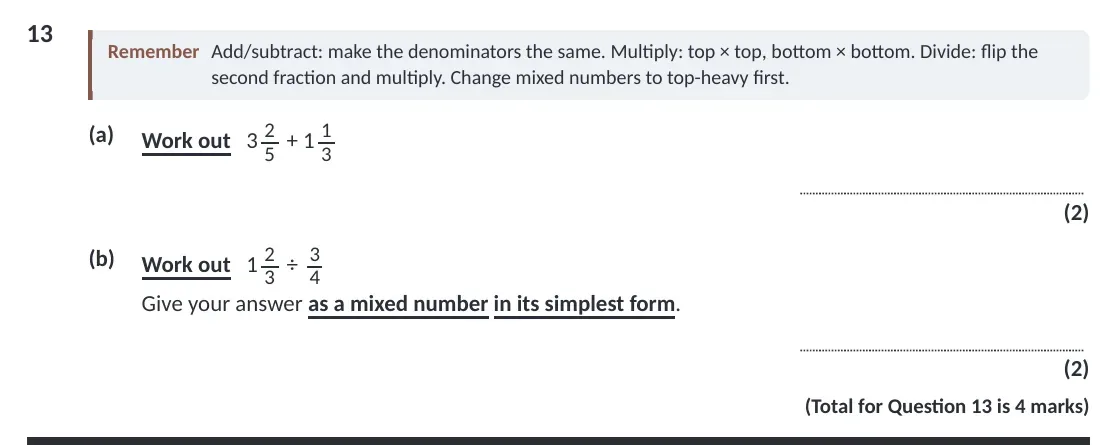
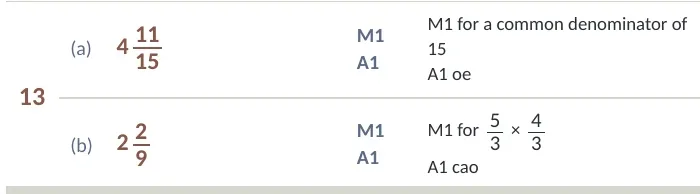
13 Remember Add/subtract: make the denominators the same. Multiply: top × top, bottom × bottom. Divide: flip the second fraction and multiply. Change mixed numbers to top-heavy first. (a) Work out 3 2 + 1 1 5 3 (2) (b) Work out 1 2 ÷ 3 3 4 Give your answer as a mixed number in its simplest form. 📄 sheet: Calculating with fractions (2) (Total for Question 13 is 4 marks)
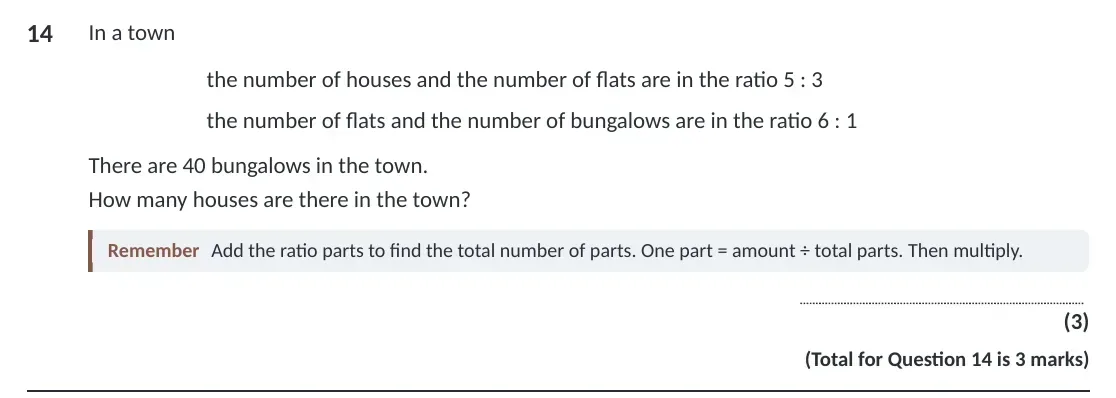
14 In a town the number of houses and the number of flats are in the ratio 5 : 3 the number of flats and the number of bungalows are in the ratio 6 : 1 There are 40 bungalows in the town. How many houses are there in the town? Remember Add the ratio parts to find the total number of parts. One part = amount ÷ total parts. Then multiply. (3) 📄 sheet: Ratio (Total for Question 14 is 3 marks)
◀ N2All papersN4 ▶
Answer the questions, then mark your paper.