Miss North Maths

Half paper C16

Paper 3 style · Calculator · 36 marks · about 35–40 minutes

How it works. Type each answer in its box. Tap any underlined word on the paper to see what it wants you to do. Stuck? Open the fact sheet under the question. When you finish, press Mark my paper, then check each question against the mark scheme and give yourself the marks you earned, including method marks.

1 Write 8% as a decimal. 📄 sheet: Converting fractions, decimals and percentages (1) (Total for Question 1 is 1 mark)
2 Write down two factors of 26 📄 sheet: and multiples (1) (Total for Question 2 is 1 mark)
3 Work out 1 of 108 9 📄 sheet: Fractions of amounts and shapes, card 1 (1) (Total for Question 3 is 1 mark)
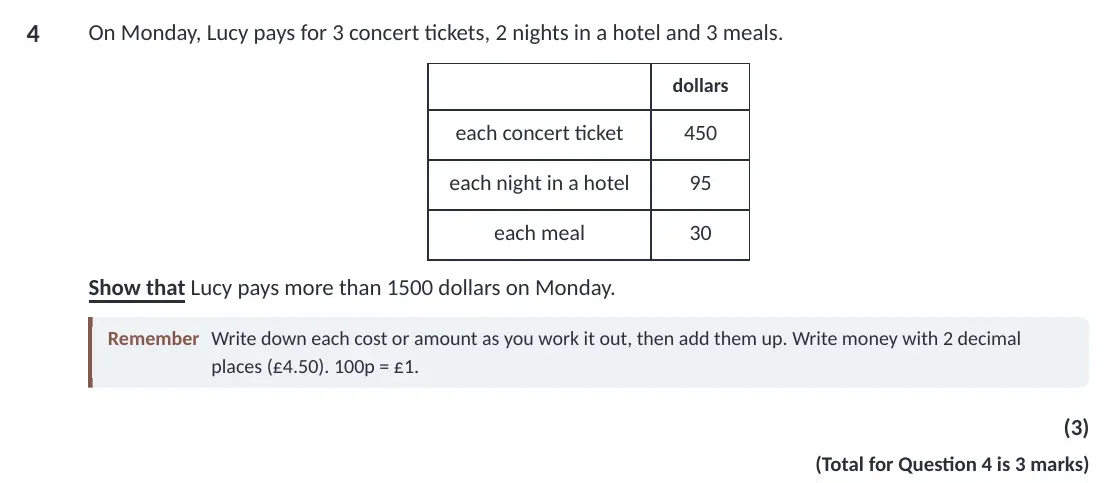
4 On Monday, Lucy pays for 3 concert tickets, 2 nights in a hotel and 3 meals. dollars each concert ticket 450 each night in a hotel 95 each meal 30 Show that Lucy pays more than 1500 dollars on Monday. Remember Write down each cost or amount as you work it out, then add them up. Write money with 2 decimal places (£4.50). 100p = £1. (3) 📄 sheet: Planning costs and sharing (Total for Question 4 is
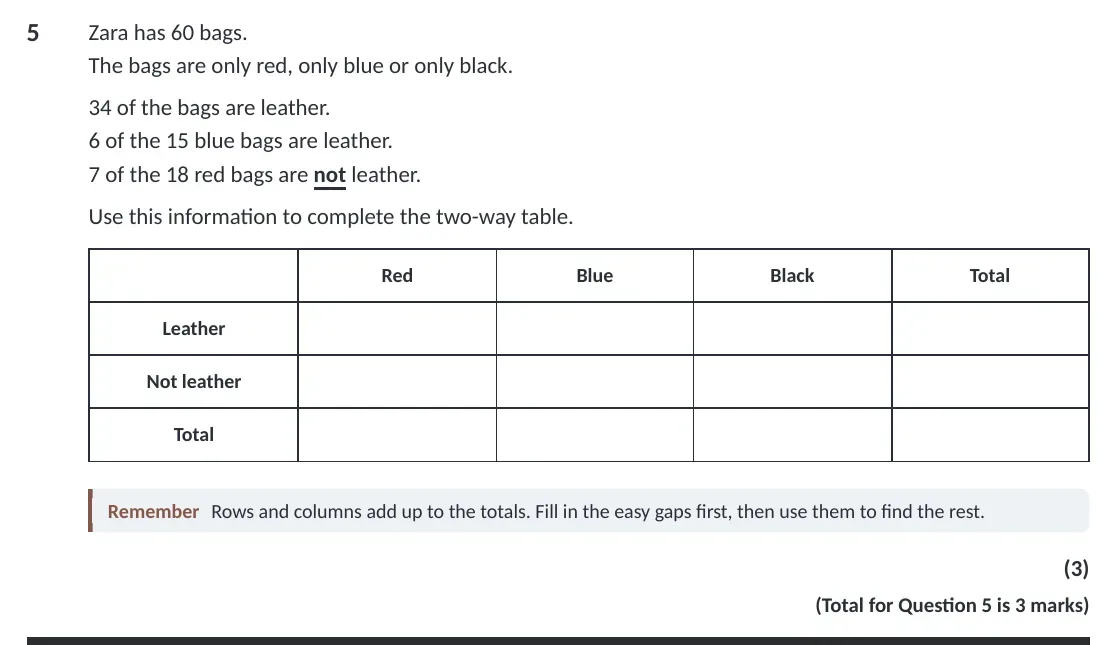
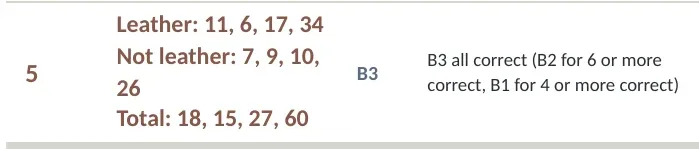
5 Zara has 60 bags. The bags are only red, only blue or only black. 34 of the bags are leather. 6 of the 15 blue bags are leather. 7 of the 18 red bags are not leather. Use this information to complete the two-way table. Red Blue Black Total Leather Not leather Total Remember Rows and columns add up to the totals. Fill in the easy gaps first, then use them to find the rest. 📄 sheet: Two-way tables
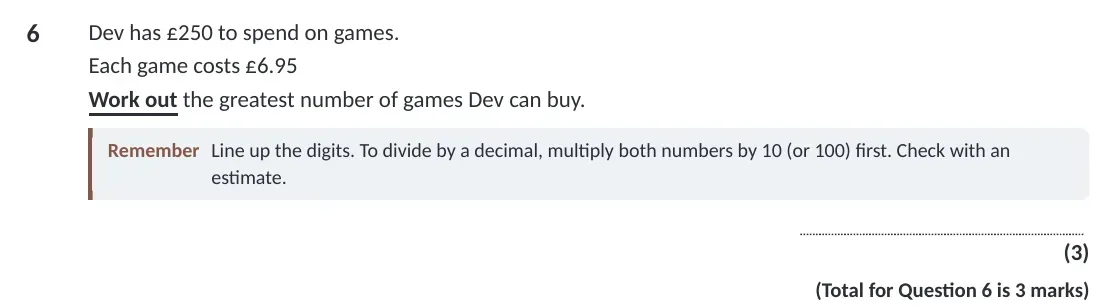
6 Dev has £250 to spend on games. Each game costs £6.95 Work out the greatest number of games Dev can buy. Remember Line up the digits. To divide by a decimal, multiply both numbers by 10 (or 100) first. Check with an estimate. (3) 📄 sheet: Shopping, change and offers (Total for Question 6 is 3 marks)
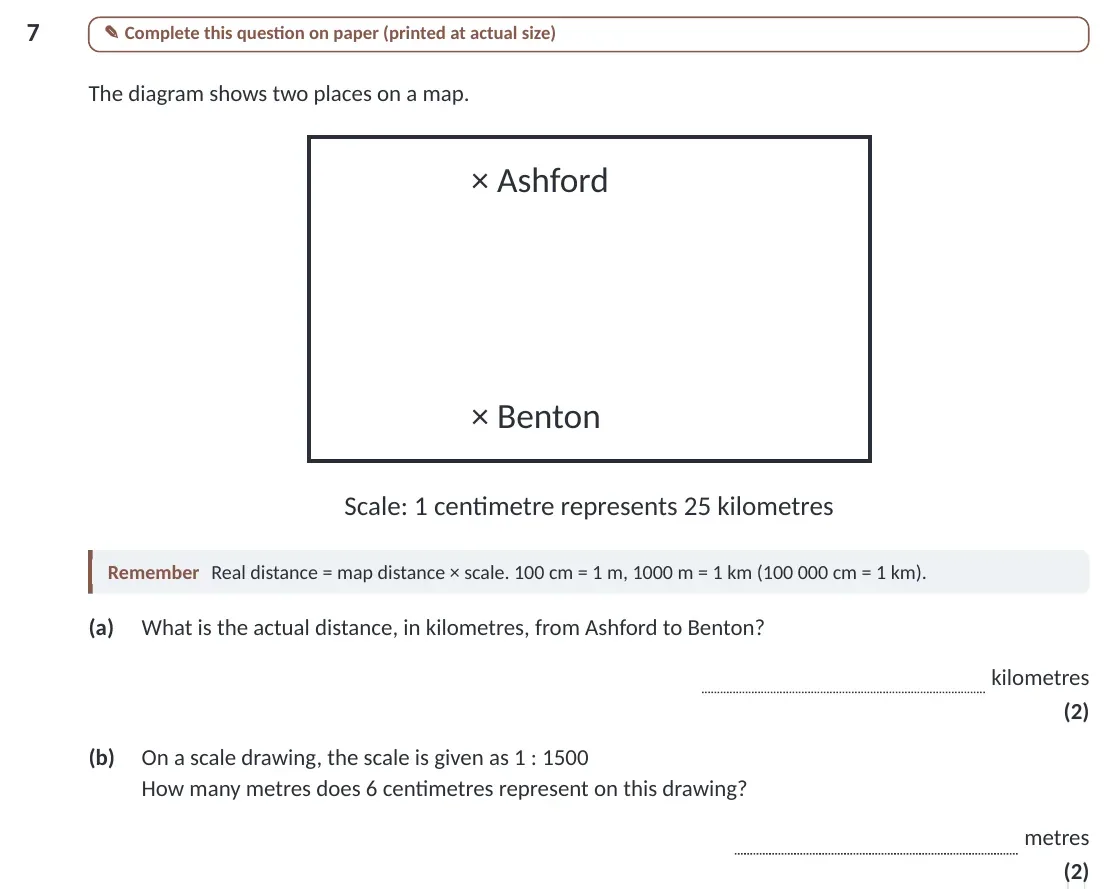
7 ✎ Complete this question on paper (printed at actual size) The diagram shows two places on a map. × Ashford × Benton Scale: 1 centimetre represents 25 kilometres Remember Real distance = map distance × scale. 100 cm = 1 m, 1000 m = 1 km (100 000 cm = 1 km). (a) What is the actual distance, in kilometres, from Ashford to Benton? kilometres (2) (b) On a scale drawing, the scale is given as 1 : 150

✎ You need a ruler, protractor or compasses for this one. Do it on paper, then mark it below.

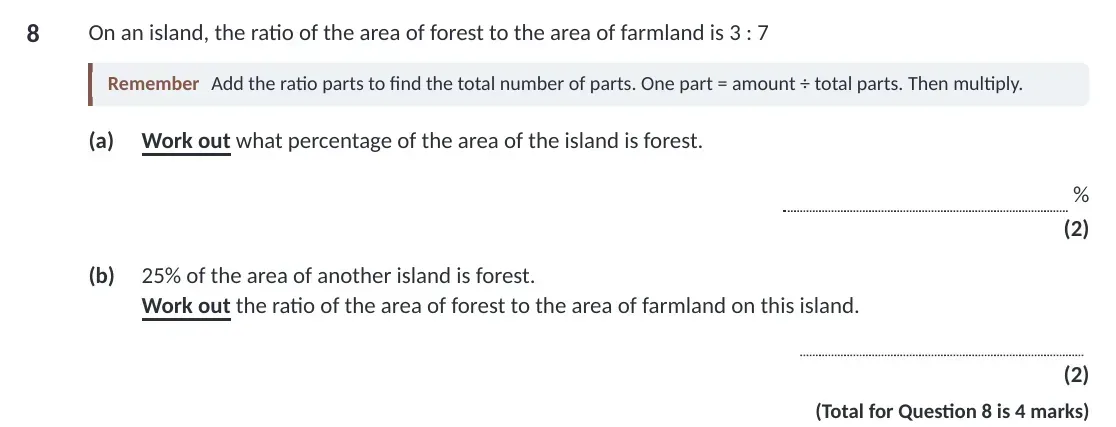
8 On an island, the ratio of the area of forest to the area of farmland is 3 : 7 Remember Add the ratio parts to find the total number of parts. One part = amount ÷ total parts. Then multiply. (a) Work out what percentage of the area of the island is forest. % (2) (b) 25% of the area of another island is forest. Work out the ratio of the area of forest to the area of farmland on this island. (2) 📄
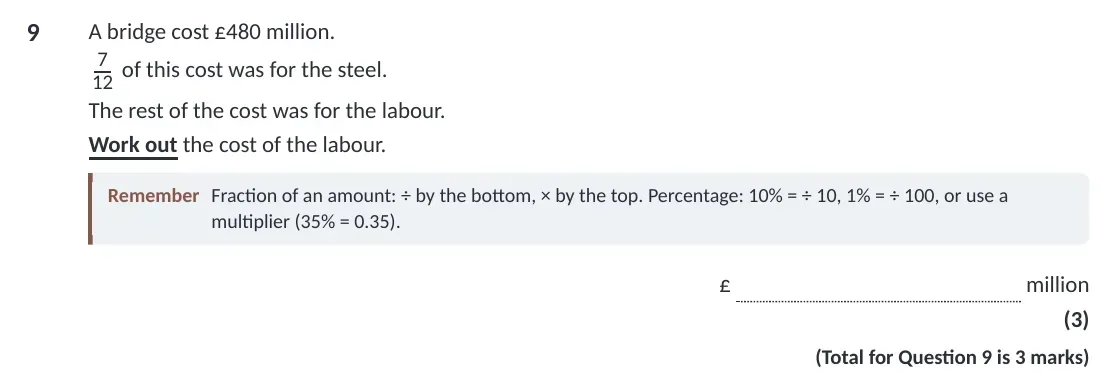
9 A bridge cost £480 million. 7 of this cost was for the steel. 12 The rest of the cost was for the labour. Work out the cost of the labour. Remember Fraction of an amount: ÷ by the bottom, × by the top. Percentage: 10% = ÷ 10, 1% = ÷ 100, or use a multiplier (35% = 0.35). £ 📄 sheet: Planning costs and sharing (3) (Total for Question 9 is 3 marks) million
10 Ellie measures all the angles around a point. Her results are 52°, 136°, 52° and 110° Explain why these results cannot be true. 📄 sheet: Angle facts (1) (Total for Question 10 is 1 mark)
11 Change 3 m 2 into cm 2 cm² (1)
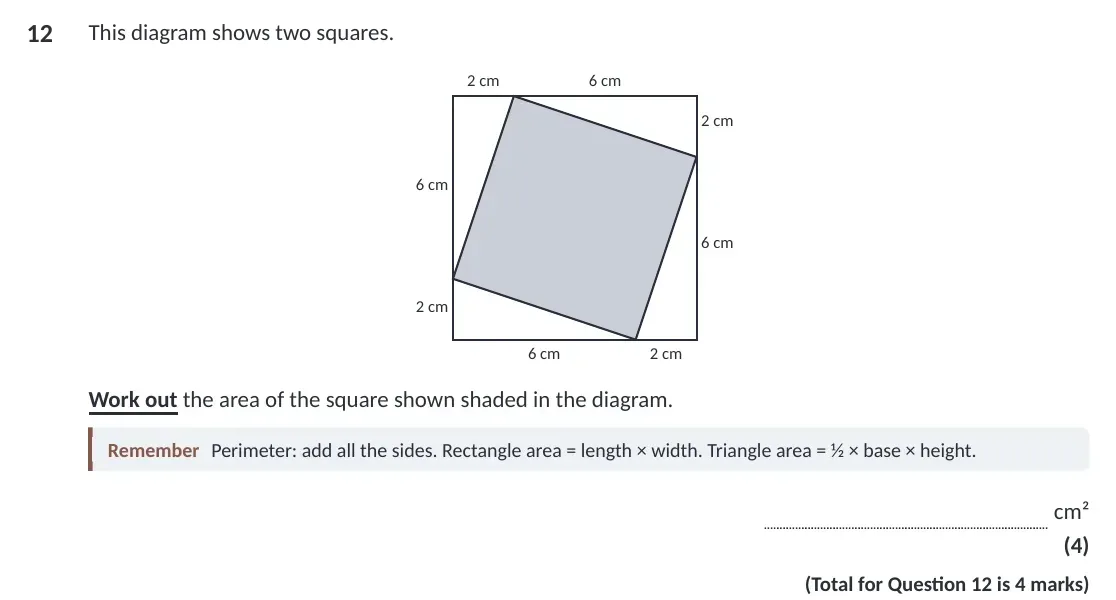
12 This diagram shows two squares. 2 cm 6 cm 2 cm 6 cm 6 cm 2 cm 6 cm 2 cm Work out the area of the square shown shaded in the diagram. Remember Perimeter: add all the sides. Rectangle area = length × width. Triangle area = ½ × base × height. cm² (4) 📄 sheet: Area (Total for Question 12 is 4 marks)
Fact sheet: Area
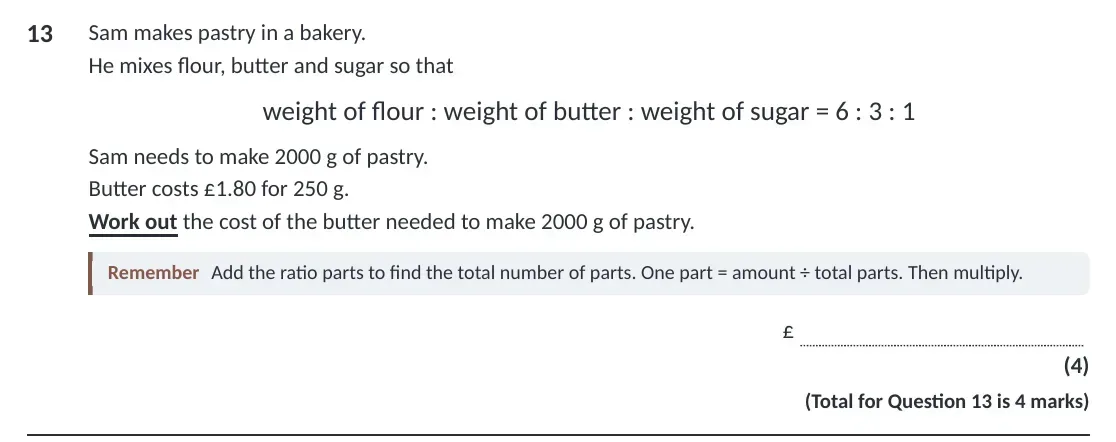
13 Sam makes pastry in a bakery. He mixes flour, butter and sugar so that weight of flour : weight of butter : weight of sugar = 6 : 3 : 1 Sam needs to make 2000 g of pastry. Butter costs £1.80 for 250 g. Work out the cost of the butter needed to make 2000 g of pastry. Remember Add the ratio parts to find the total number of parts. One part = amount ÷ total parts. Then multiply. £ 📄 sheet: Sharing
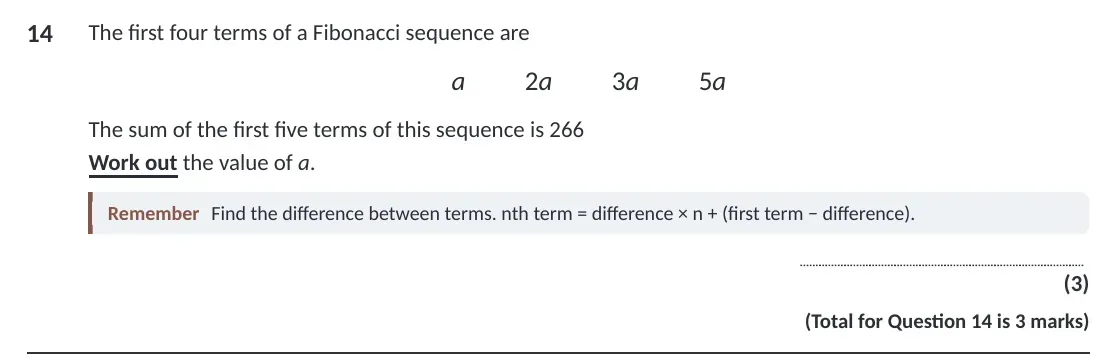
14 The first four terms of a Fibonacci sequence are a 2a 3a 5a The sum of the first five terms of this sequence is 266 Work out the value of a. Remember Find the difference between terms. nth term = difference × n + (first term − difference). 📄 sheet: Term-to-term rules and patterns (3) (Total for Question 14 is 3 marks)
◀ C15All papers
Answer the questions, then mark your paper.