Miss North Maths

Half paper C15

Paper 2 style · Calculator · 36 marks · about 35–40 minutes

How it works. Type each answer in its box. Tap any underlined word on the paper to see what it wants you to do. Stuck? Open the fact sheet under the question. When you finish, press Mark my paper, then check each question against the mark scheme and give yourself the marks you earned, including method marks.

1 Write 83% as a fraction. (1) 📄 sheet: Converting fractions, decimals and percentages (Total for Question 1 is 1 mark)
2 Change 4.5 metres into centimetres. centimetres (1) 📄 sheet: Converting units (Total for Question 2 is 1 mark)
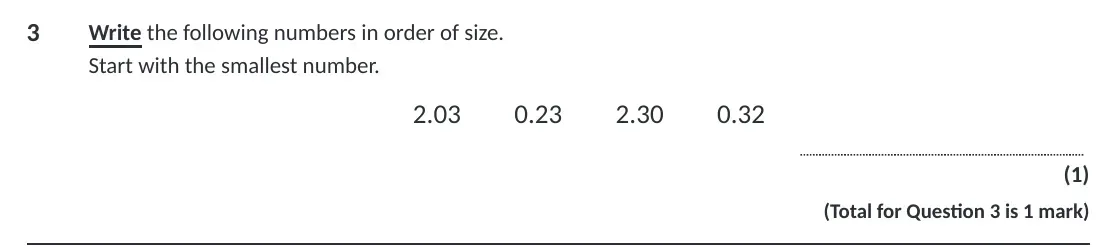
3 Write the following numbers in order of size. Start with the smallest number. 2.03 📄 sheet: Ordering decimals 0.23 2.30 0.32 (1) (Total for Question 3 is 1 mark)
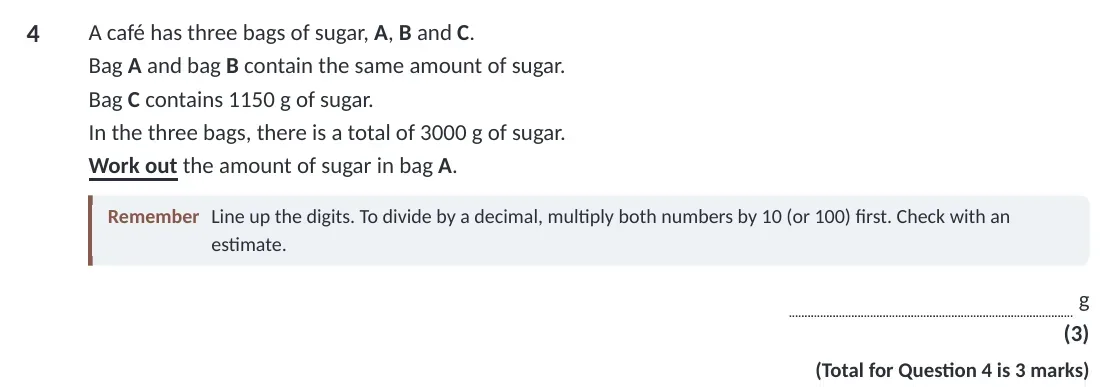
4 A café has three bags of sugar, A, B and C. Bag A and bag B contain the same amount of sugar. Bag C contains 1150 g of sugar. In the three bags, there is a total of 3000 g of sugar. Work out the amount of sugar in bag A. Remember Line up the digits. To divide by a decimal, multiply both numbers by 10 (or 100) first. Check with an estimate. g (3) 📄 sheet: Number problems and number machines (Tota
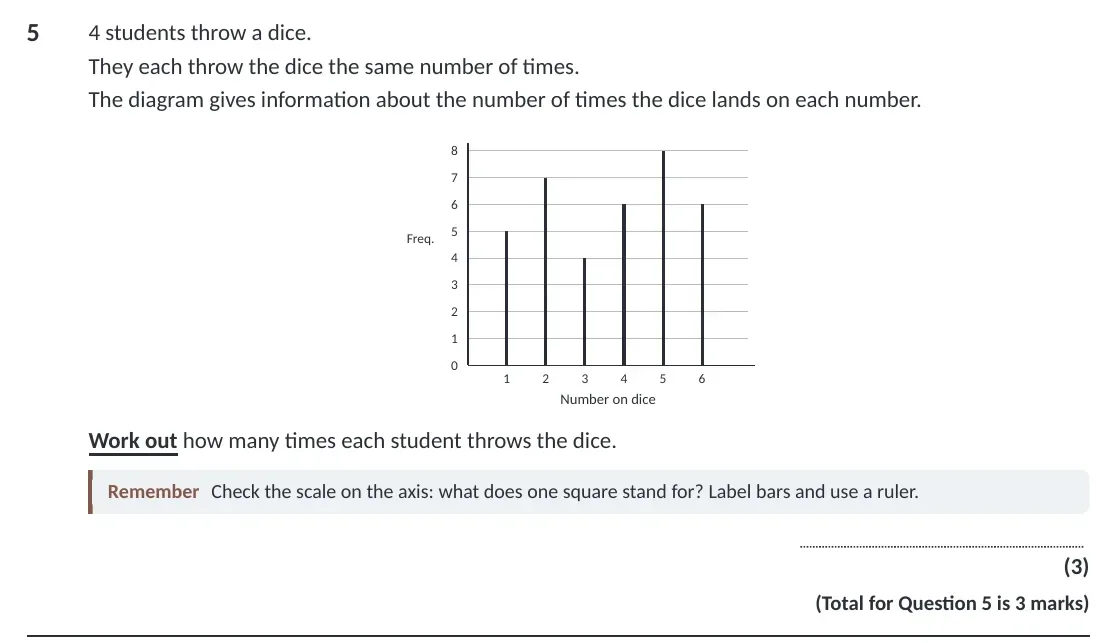
5 4 students throw a dice. They each throw the dice the same number of times. The diagram gives information about the number of times the dice lands on each number. 8 7 6 Freq. 5 4 3 2 1 0 1 2 3 4 5 6 Number on dice Work out how many times each student throws the dice. Remember Check the scale on the axis: what does one square stand for? Label bars and use a ruler. 📄 sheet: Probability tables, rel
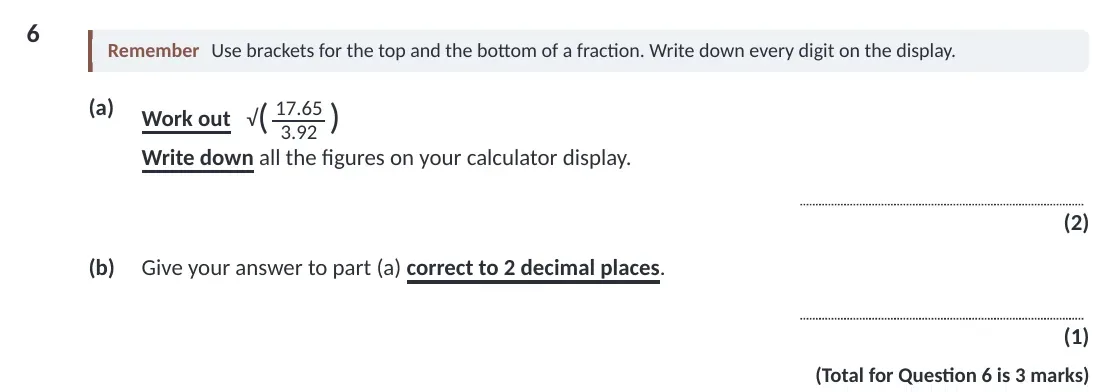
6 Remember Use brackets for the top and the bottom of a fraction. Write down every digit on the display. (a) ( 3.92 ) Work out √ 17.65 Write down all the figures on your calculator display. (2) (b) Give your answer to part (a) correct to 2 decimal places. (1) 📄 sheet: Decimal places and significant figures (Total for Question 6 is 3 marks)
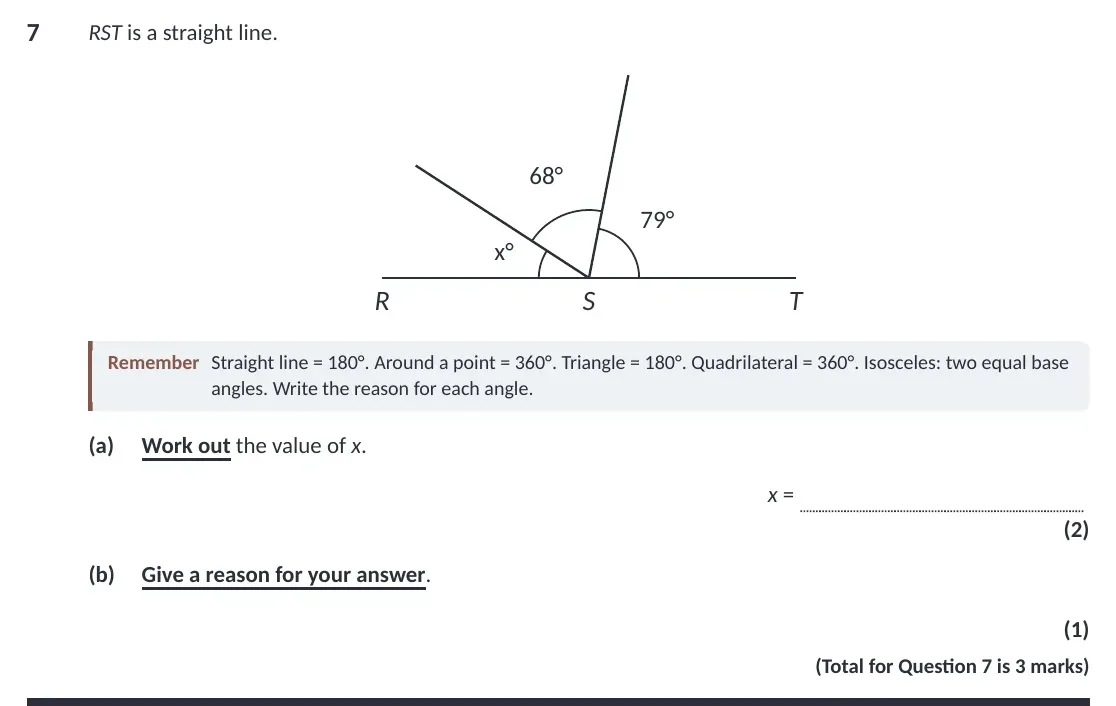
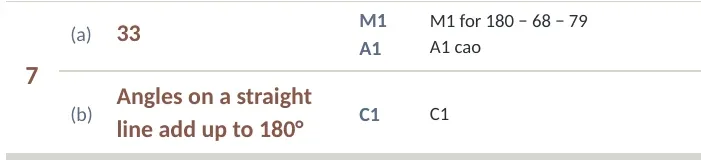
7 RST is a straight line. 68° 79° x° R S T Remember Straight line = 180°. Around a point = 360°. Triangle = 180°. Quadrilateral = 360°. Isosceles: two equal base angles. Write the reason for each angle. (a) Work out the value of x. x = (2) (b) Give a reason for your answer. 📄 sheet: Angle facts 📄 sheet: Substitution (1) (Total for Question 7 is 3 marks)
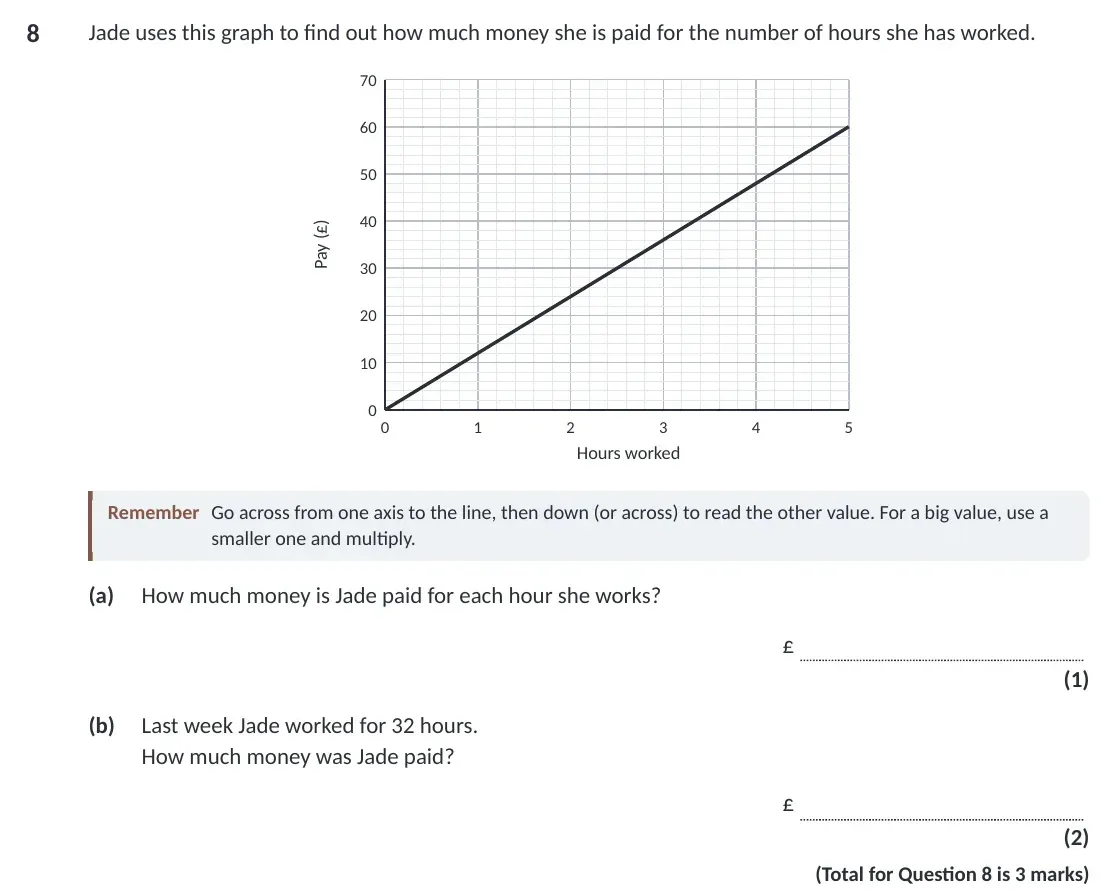
8 Jade uses this graph to find out how much money she is paid for the number of hours she has worked. 70 60 Pay (£) 50 40 30 20 10 0 0 1 2 3 4 5 Hours worked Remember Go across from one axis to the line, then down (or across) to read the other value. For a big value, use a smaller one and multiply. (a) How much money is Jade paid for each hour she works? £ (1) (b) Last week Jade worked for 32 hour
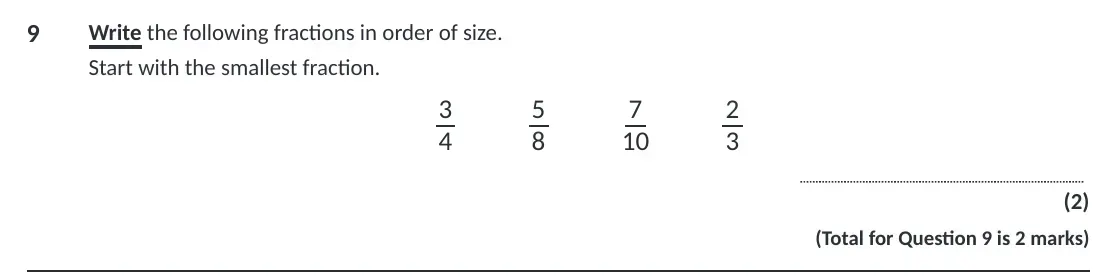
9 Write the following fractions in order of size. Start with the smallest fraction. 3 4 📄 sheet: Ordering fractions and mixed lists 5 8 7 10 2 3 (2) (Total for Question 9 is 2 marks)
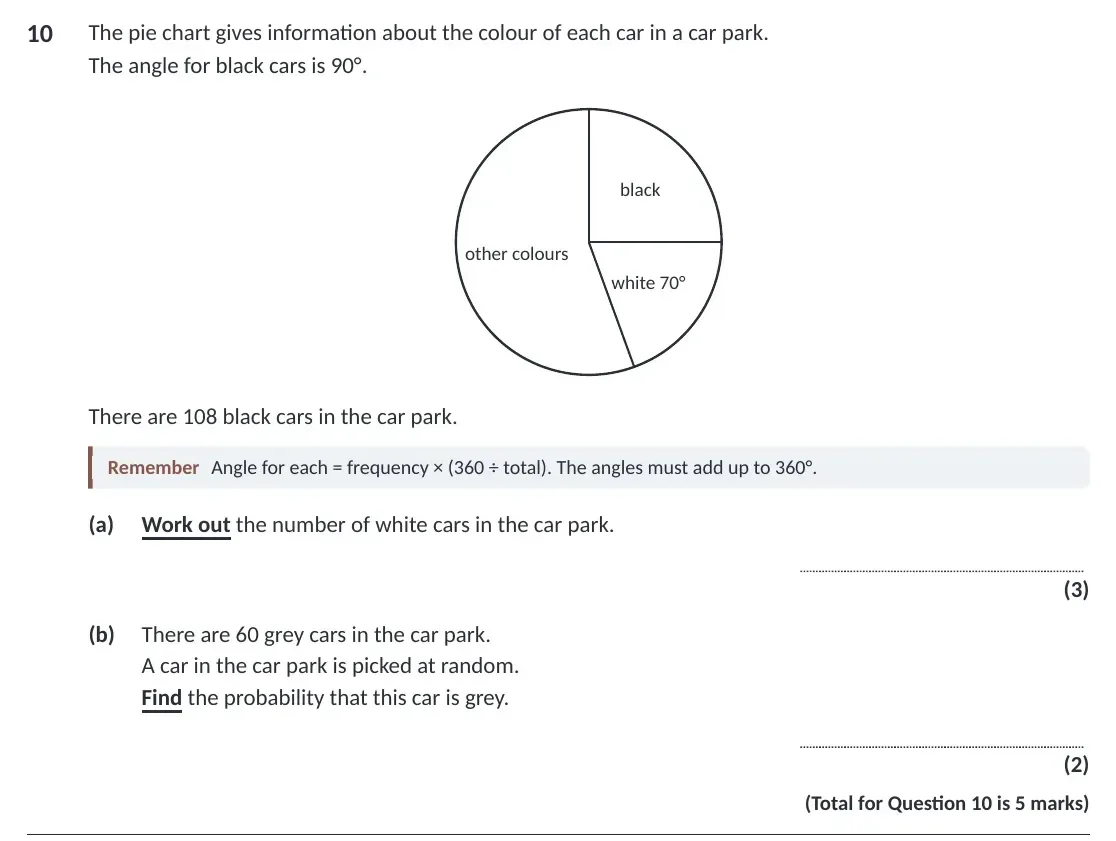
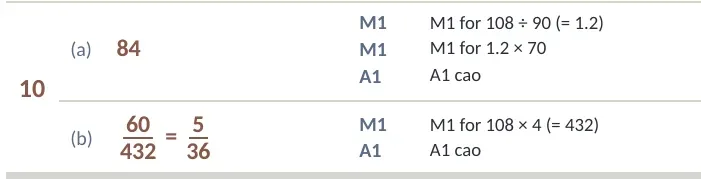
10 The pie chart gives information about the colour of each car in a car park. The angle for black cars is 90°. black other colours white 70° There are 108 black cars in the car park. Remember Angle for each = frequency × (360 ÷ total). The angles must add up to 360°. (a) Work out the number of white cars in the car park. (3) (b) There are 60 grey cars in the car park. A car in the car park is pic
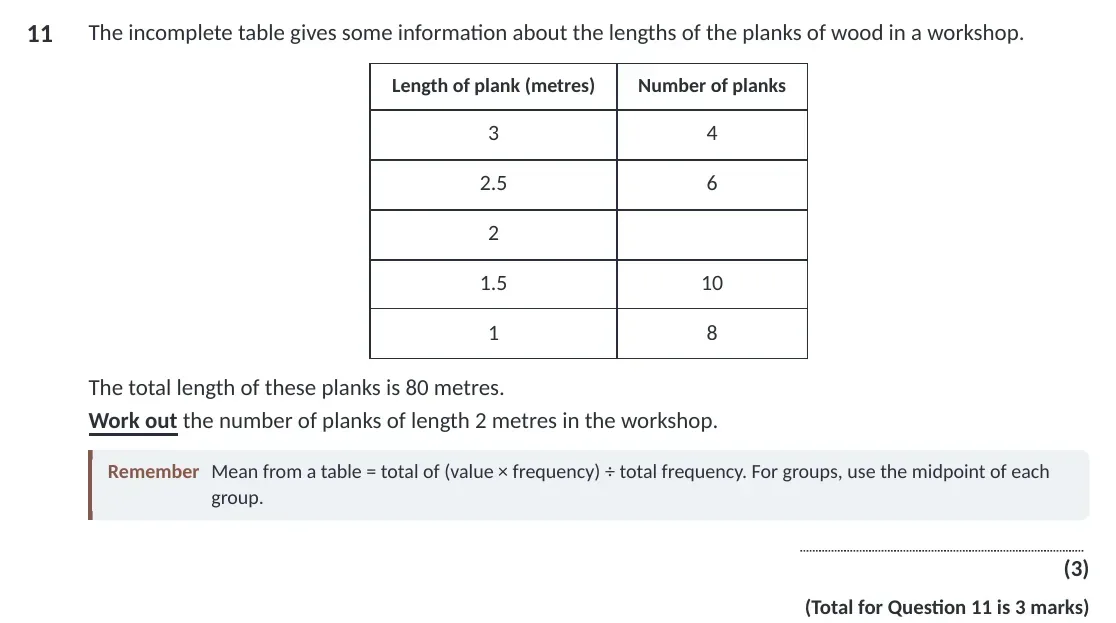
11 The incomplete table gives some information about the lengths of the planks of wood in a workshop. Length of plank (metres) Number of planks 3 4 2.5 6 2 1.5 10 1 8 The total length of these planks is 80 metres. Work out the number of planks of length 2 metres in the workshop. Remember Mean from a table = total of (value × frequency) ÷ total frequency. For groups, use the midpoint of each group.
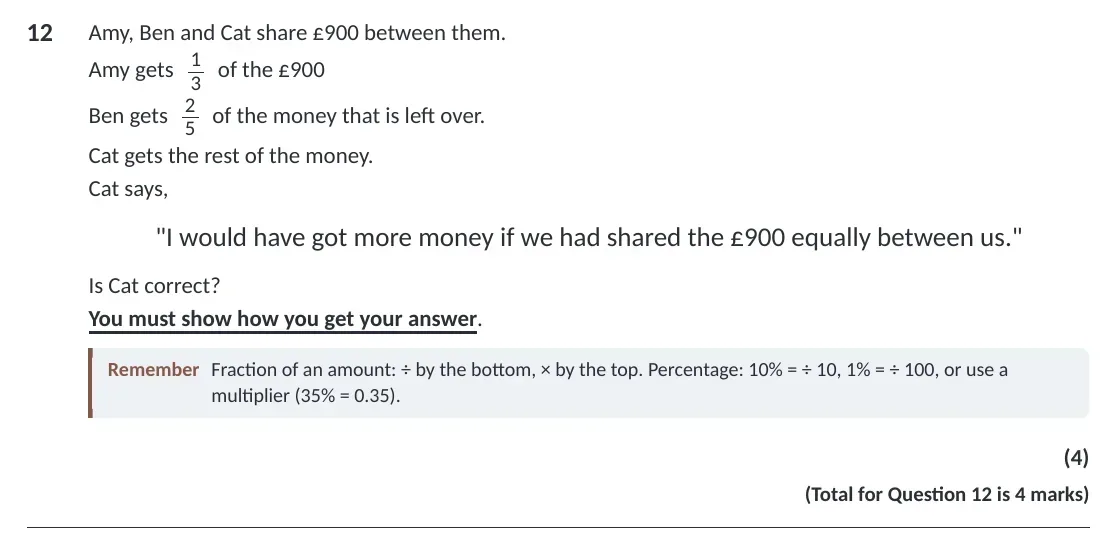
12 Amy, Ben and Cat share £900 between them. Amy gets 1 of the £900 3 2 Ben gets of the money that is left over. 5 Cat gets the rest of the money. Cat says, "I would have got more money if we had shared the £900 equally between us." Is Cat correct? You must show how you get your answer. Remember Fraction of an amount: ÷ by the bottom, × by the top. Percentage: 10% = ÷ 10, 1% = ÷ 100, or use a mult
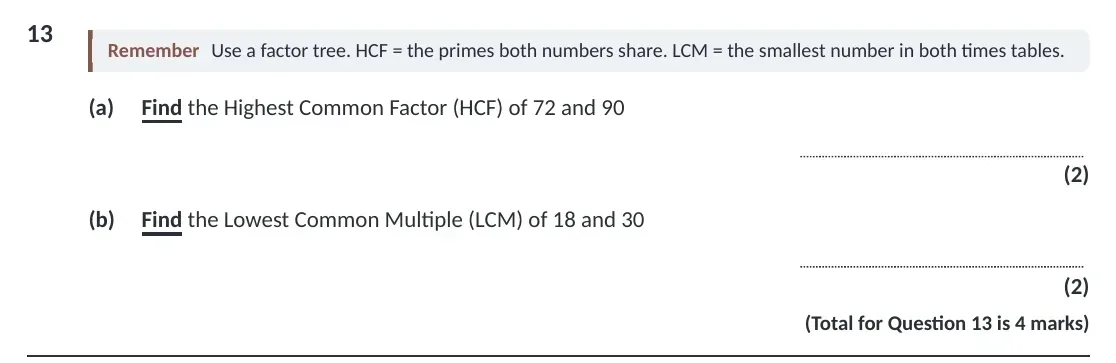
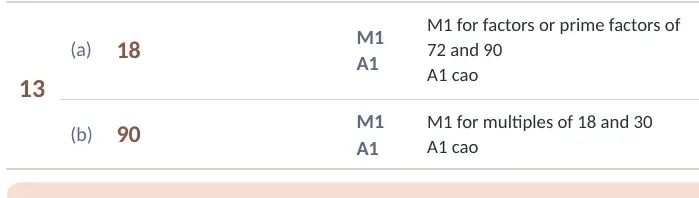
13 Remember Use a factor tree. HCF = the primes both numbers share. LCM = the smallest number in both times tables. (a) Find the Highest Common (HCF) of 72 and 90 (2) (b) Find the Lowest Common Multiple (LCM) of 18 and 30 (2) 📄 sheet: HCF and LCM (Total for Question 13 is 4 marks)
◀ C14All papersC16 ▶
Answer the questions, then mark your paper.