Miss North Maths

Full paper E2

Paper 2 style · Calculator · 80 marks · 1 hour 30 minutes

How it works. Type each answer in its box. Tap any underlined word on the paper to see what it wants you to do. Stuck? Open the fact sheet under the question. When you finish, press Mark my paper, then check each question against the mark scheme and give yourself the marks you earned, including method marks.

1 Write 4738 correct to the nearest hundred. 📄 sheet: Rounding to the nearest 10, 100 or 1000 (1) (Total for Question 1 is 1 mark)
2 Write 0.3 as a fraction. 📄 sheet: Converting fractions, decimals and percentages (1) (Total for Question 2 is 1 mark)
3 Change 6 metres into centimetres. centimetres 📄 sheet: Converting units (1) (Total for Question 3 is 1 mark)
4 Simplify 5 × 2k 📄 sheet: Expressions (1) (Total for Question 4 is 1 mark)
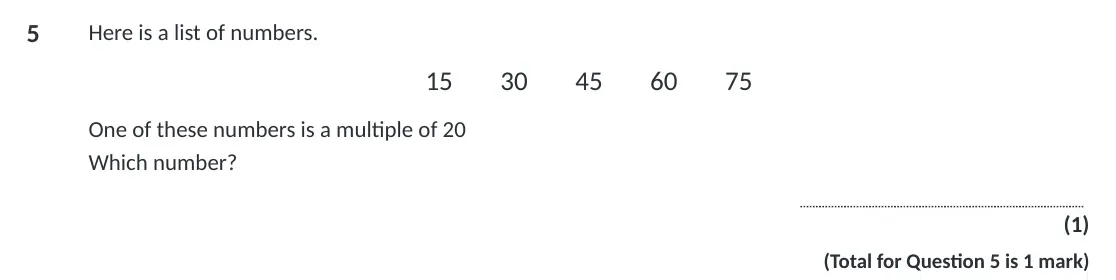
5 Here is a list of numbers. 15 30 45 60 75 One of these numbers is a multiple of 20 Which number? (1) 📄 sheet: and multiples (Total for Question 5 is 1 mark)
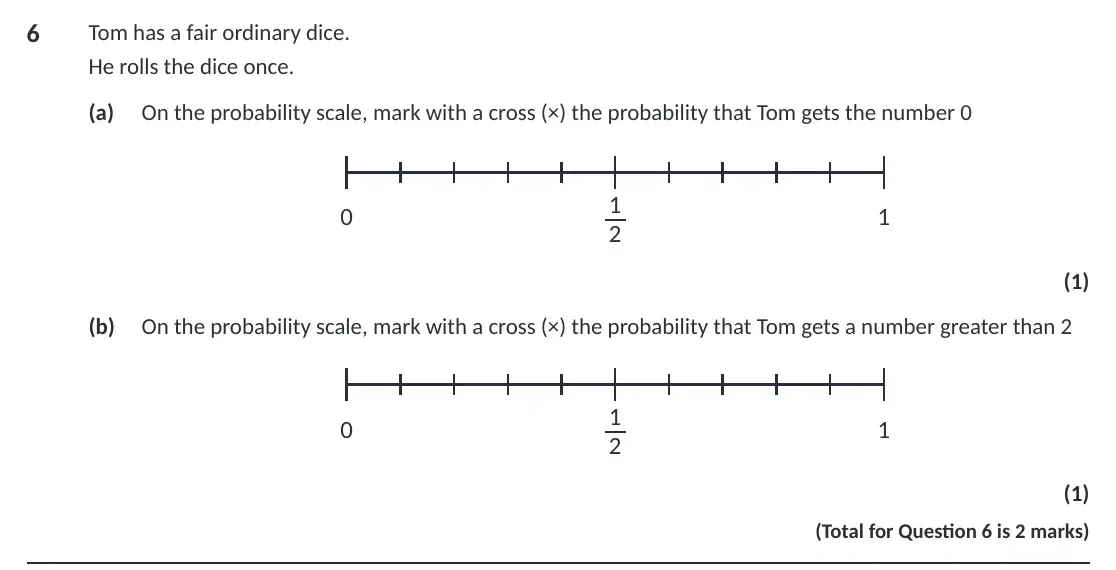
6 Tom has a fair ordinary dice. He rolls the dice once. (a) On the probability scale, mark with a cross (×) the probability that Tom gets the number 0 0 1 2 1 (1) (b) On the probability scale, mark with a cross (×) the probability that Tom gets a number greater than 2 0 📄 sheet: Probability of single events 1 2 1 (1) (Total for Question 6 is 2 marks)
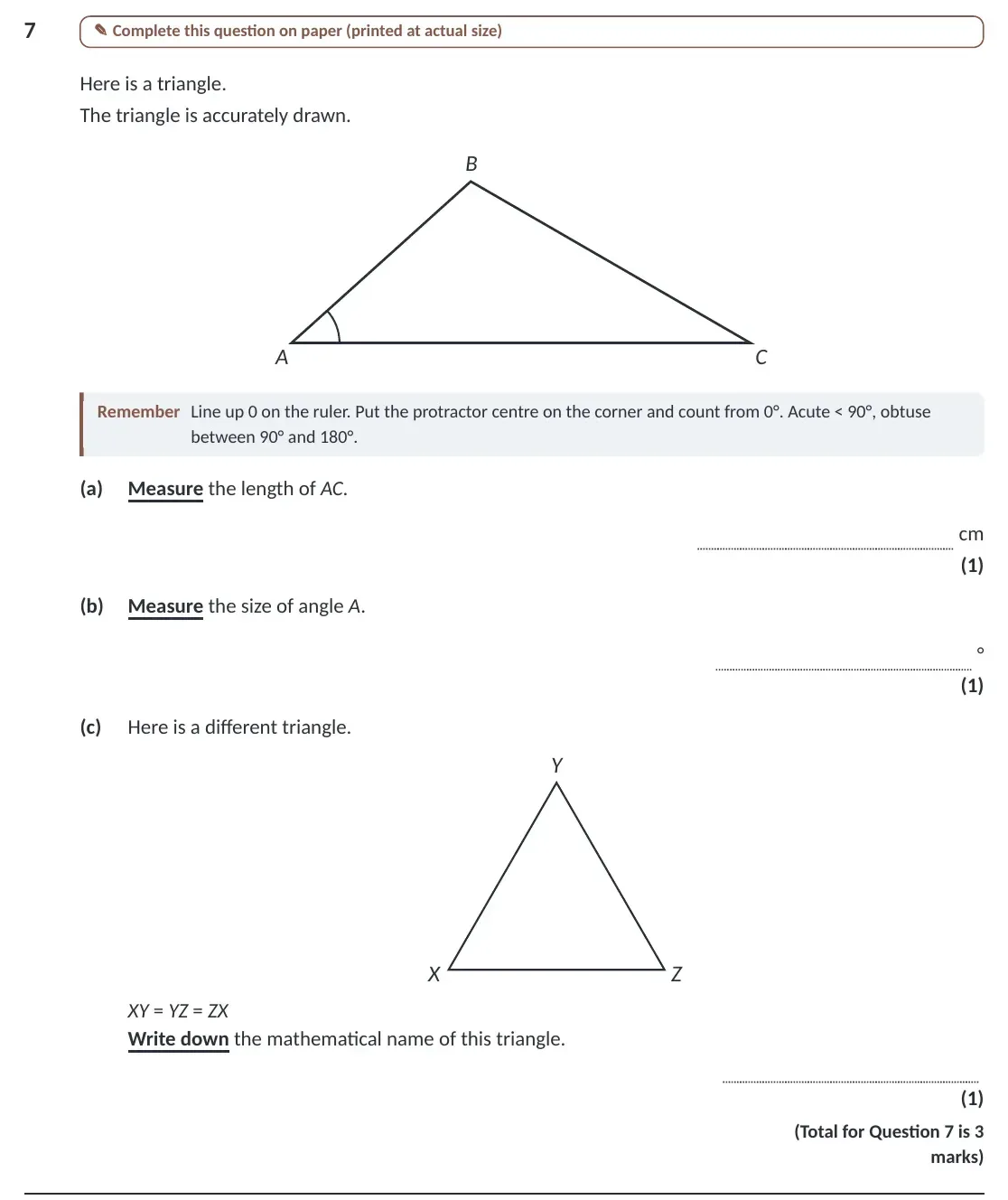
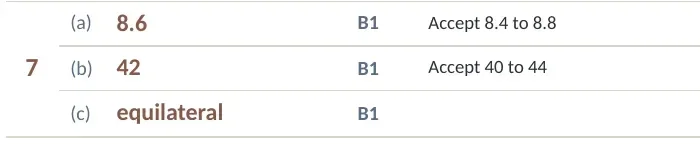
7 ✎ Complete this question on paper (printed at actual size) Here is a triangle. The triangle is accurately drawn. B A C Remember Line up 0 on the ruler. Put the protractor centre on the corner and count from 0°. Acute < 90°, obtuse between 90° and 180°. (a) Measure the length of AC. cm (1) (b) Measure the size of angle A. ° (1) (c) Here is a different triangle. Y X Z XY = YZ = ZX Write down the m

✎ You need a ruler, protractor or compasses for this one. Do it on paper, then mark it below.

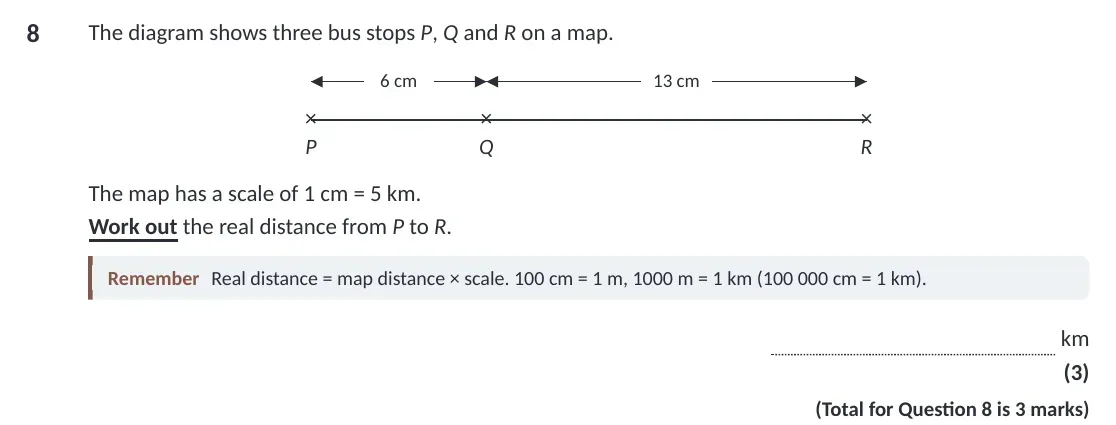
8 The diagram shows three bus stops P, Q and R on a map. 6 cm 13 cm × × × P Q R The map has a scale of 1 cm = 5 km. Work out the real distance from P to R. Remember Real distance = map distance × scale. 100 cm = 1 m, 1000 m = 1 km (100 000 cm = 1 km). km (3) 📄 sheet: Scale drawings (Total for Question 8 is 3 marks)
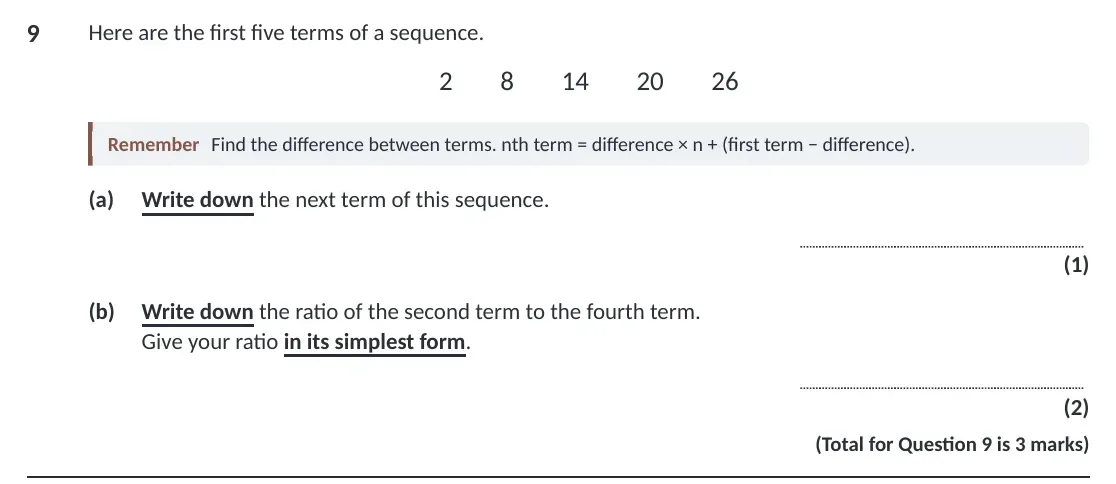
9 Here are the first five terms of a sequence. 2 8 14 20 26 Remember Find the difference between terms. nth term = difference × n + (first term − difference). (a) Write down the next term of this sequence. (1) (b) Write down the ratio of the second term to the fourth term. Give your ratio in its simplest form. 📄 sheet: Writing and simplifying ratios 📄 sheet: Sequences (2) (Total for Question 9 is
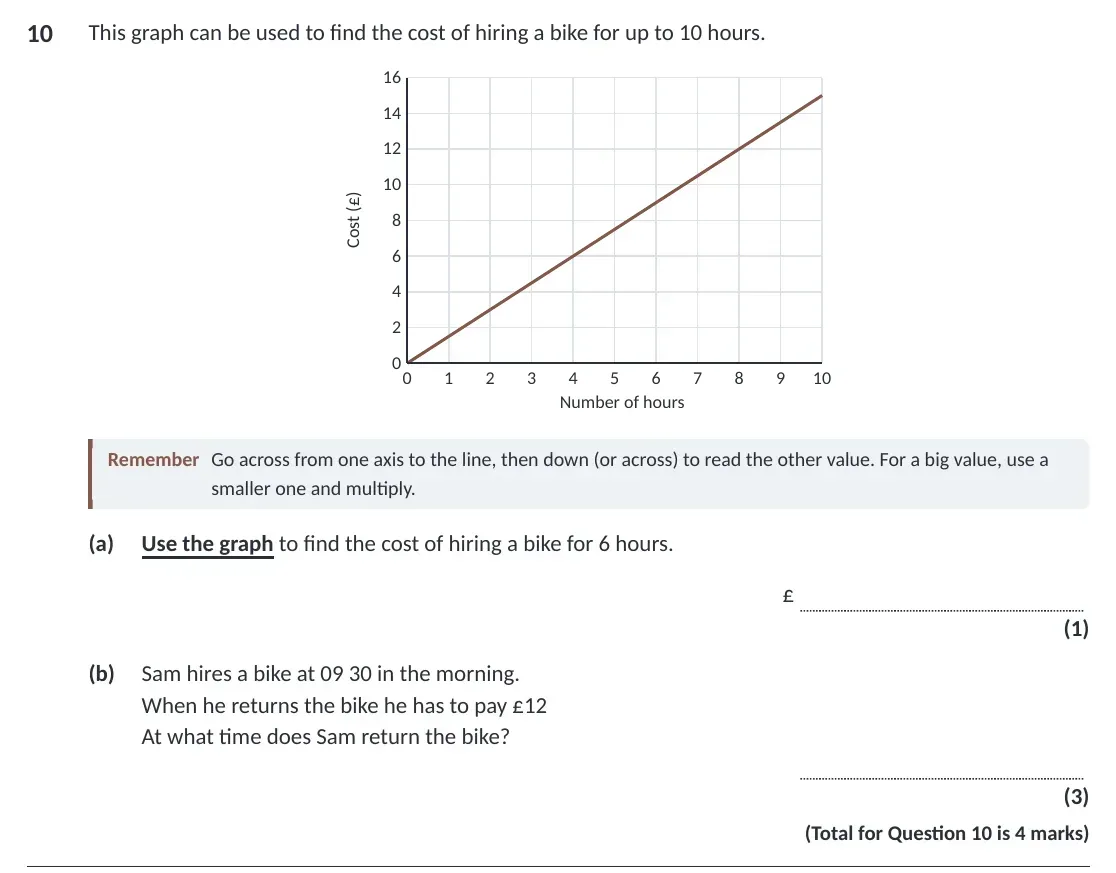
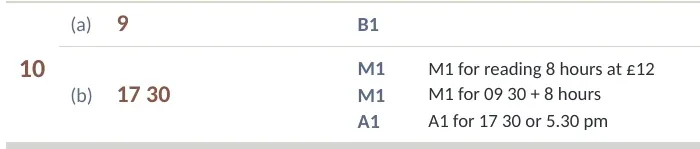
10 This graph can be used to find the cost of hiring a bike for up to 10 hours. 16 14 Cost (£) 12 10 8 6 4 2 0 0 1 2 3 4 5 6 7 Number of hours 8 9 10 Remember Go across from one axis to the line, then down (or across) to read the other value. For a big value, use a smaller one and multiply. (a) Use the graph to find the cost of hiring a bike for 6 hours. £ (1) (b) Sam hires a bike at 09 30 in the
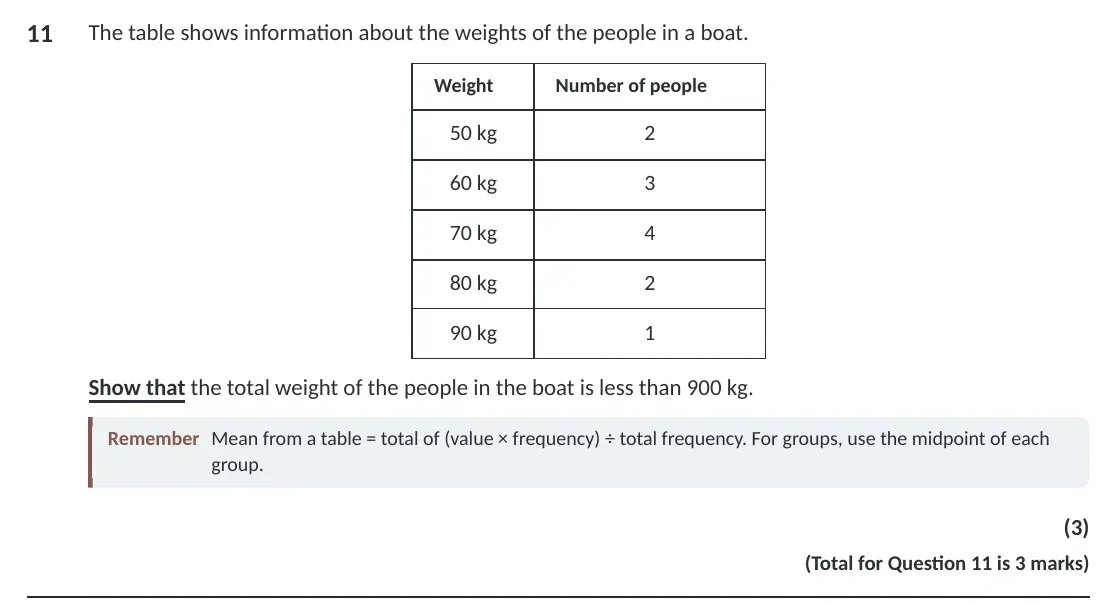
11 The table shows information about the weights of the people in a boat. Weight Number of people 50 kg 2 60 kg 3 70 kg 4 80 kg 2 90 kg 1 Show that the total weight of the people in the boat is less than 900 kg. Remember Mean from a table = total of (value × frequency) ÷ total frequency. For groups, use the midpoint of each group. 📄 sheet: Averages from tables (3) (Total for Question 11 is 3 marks
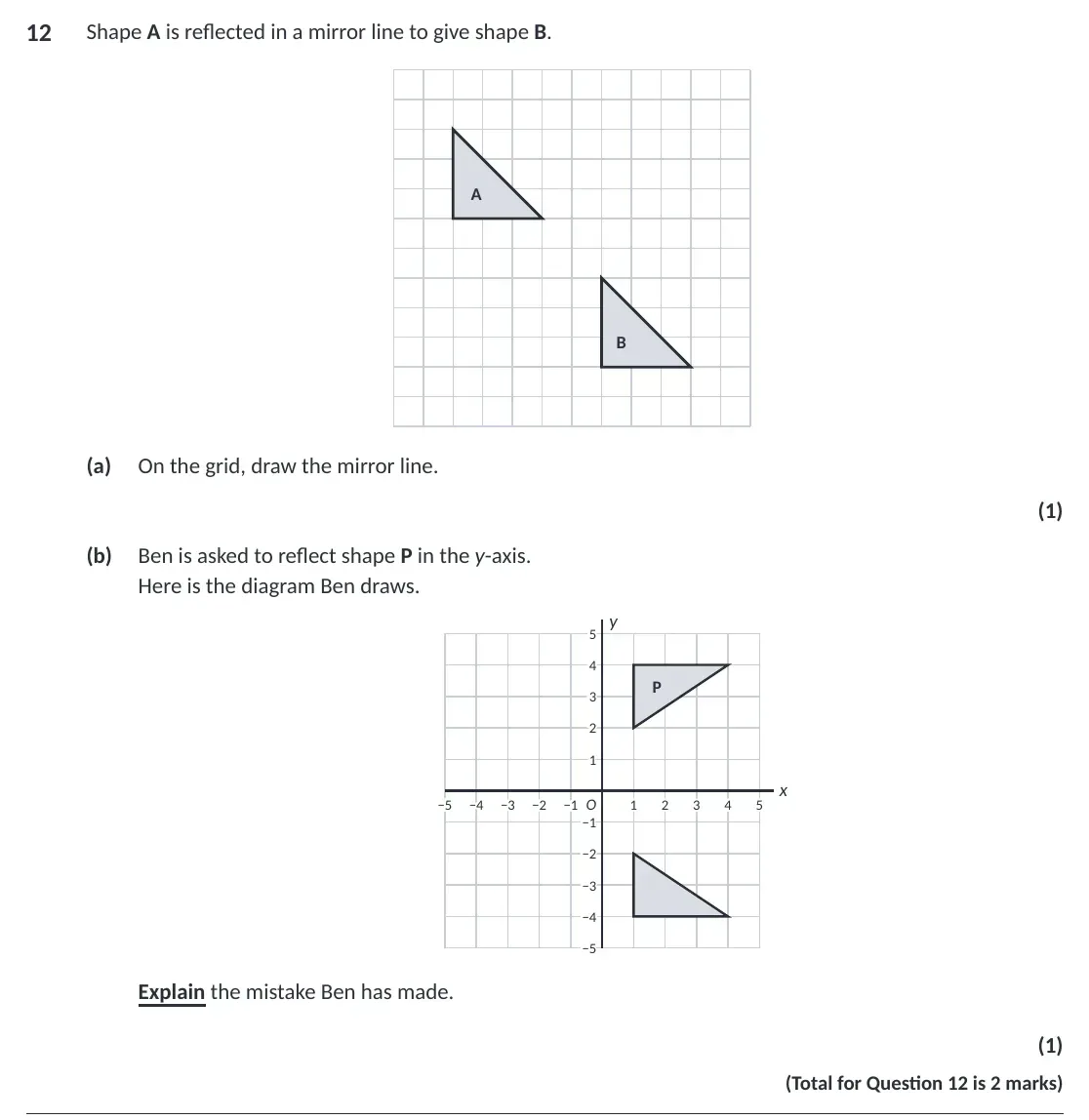
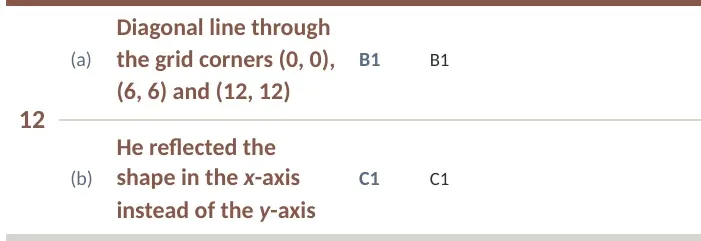
12 Shape A is reflected in a mirror line to give shape B. A B (a) On the grid, draw the mirror line. (1) (b) Ben is asked to reflect shape P in the y-axis. Here is the diagram Ben draws. 5 y 4 P 3 2 1 −5 −4 −3 −2 −1 O −1 1 2 3 4 5 x −2 −3 −4 −5 Explain the mistake Ben has made. 📄 sheet: Reflection (1) (Total for Question 12 is 2 marks)
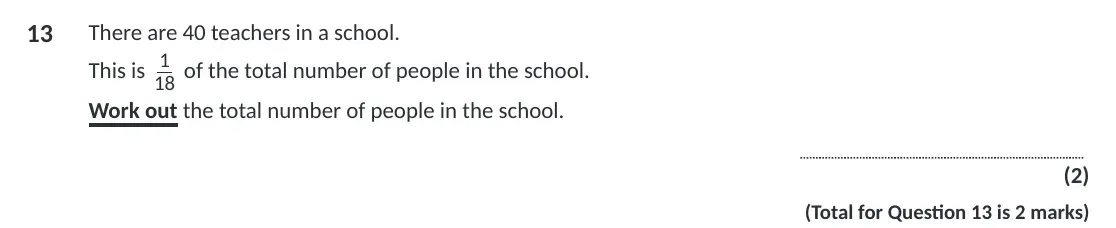
13 There are 40 teachers in a school. This is 1 of the total number of people in the school. 18 Work out the total number of people in the school. (2) 📄 sheet: Fractions of amounts and shapes, card 2 (Total for Question 13 is 2 marks)
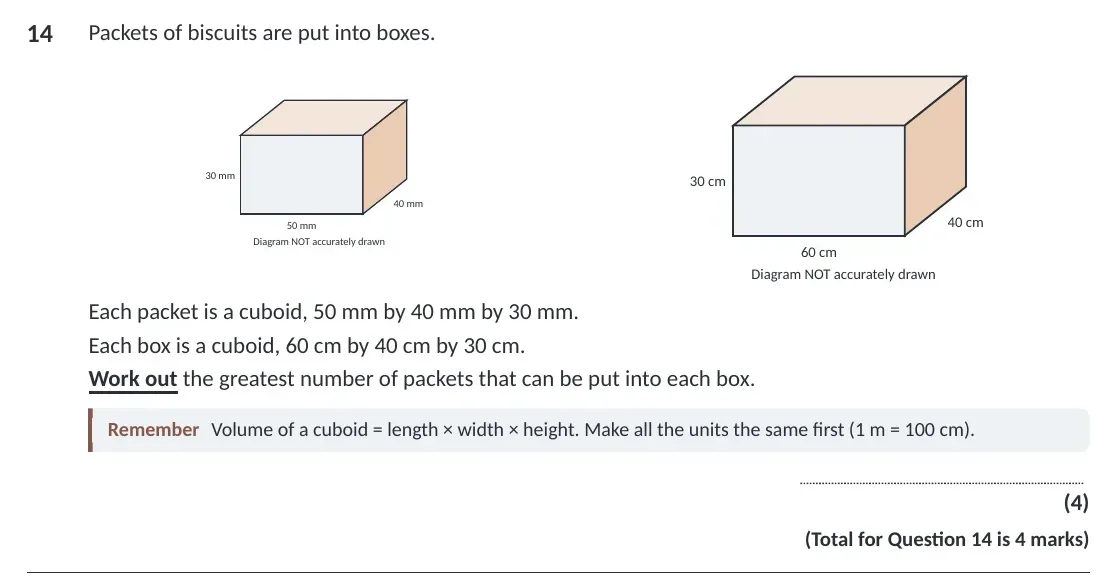
14 Packets of biscuits are put into boxes. 30 mm 30 cm 40 mm 40 cm 50 mm Diagram NOT accurately drawn 60 cm Diagram NOT accurately drawn Each packet is a cuboid, 50 mm by 40 mm by 30 mm. Each box is a cuboid, 60 cm by 40 cm by 30 cm. Work out the greatest number of packets that can be put into each box. Remember Volume of a cuboid = length × width × height. Make all the units the same first (1 m =
15 Here is a fair ordinary dice and a fair 10-sided spinner numbered 1 to 10 Kayla throws the dice once and spins the spinner once. Is Kayla more likely to get a number less than 3 on the dice or a number greater than 7 on the spinner? You must show all your working. Remember Probabilities add up to 1. P(event) = number of ways it can happen ÷ total number of outcomes. AND means multiply. 📄 sheet:
16 Lucy drives at an average speed of 64 km/h for 2 hours 15 minutes. Work out the distance Lucy drives. Remember Speed = distance ÷ time. Distance = speed × time. Time = distance ÷ speed. Change minutes to hours: ÷ 60 (30 min = 0.5 h). km 📄 sheet: Speed, distance and time, card 2 (3) (Total for Question 16 is 3 marks)
17 There are 3 theatres A, B and C. The mean number of seats per theatre is 410 There are 360 seats in theatre A. There are 290 seats in theatre B. Work out the number of seats in theatre C. Remember Mean = total ÷ how many. Median = middle value when in order. Mode = most common. Range = biggest − smallest. 📄 sheet: Working backwards from the mean, card 2 (4) (Total for Question 17 is 4 marks)
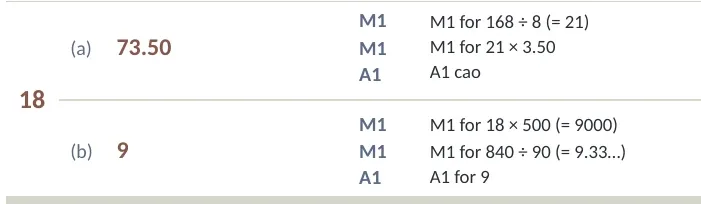
18 Mo buys 168 cans of lemonade. The cans are sold in packs. There are 8 cans in each pack. Each pack costs £3.50 Remember Write down each cost or amount as you work it out, then add them up. Write money with 2 decimal places (£4.50). 100p = £1. (a) Work out the total cost of the lemonade Mo buys. £ (3) (b) Kim buys a box of 18 bottles of water for £8.40 There are 500 ml of water in each bottle. W
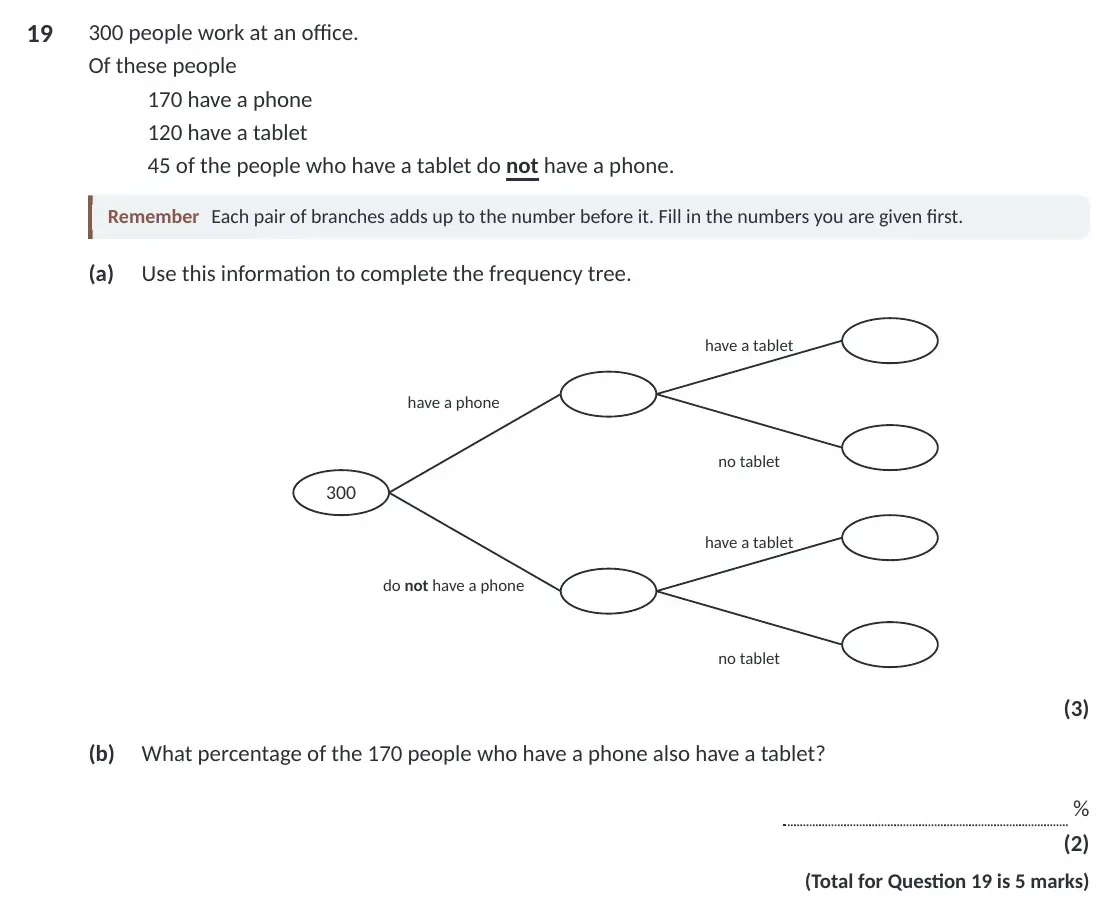
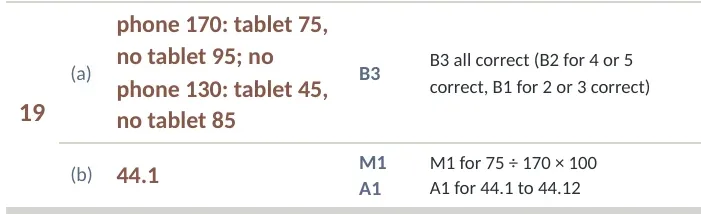
19 300 people work at an office. Of these people 170 have a phone 120 have a tablet 45 of the people who have a tablet do not have a phone. Remember Each pair of branches adds up to the number before it. Fill in the numbers you are given first. (a) Use this information to complete the frequency tree. have a tablet have a phone no tablet 300 have a tablet do not have a phone no tablet (3) (b) What
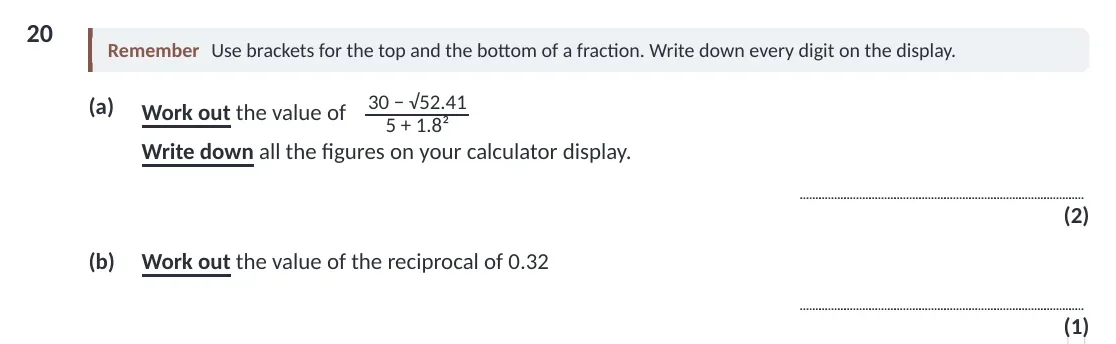
20 Remember Use brackets for the top and the bottom of a fraction. Write down every digit on the display. (a) Work out the value of 30 − √52.41 5 + 1.8² Write down all the figures on your calculator display. (2) (b) Work out the value of the reciprocal of 0.32 📄 (1)
21 Write 90 as a product of its prime factors. 📄 sheet: Product of prime factors (2) (Total for Question 21 is 2 marks)
22 There are 60 counters in a bag. There are only red counters and blue counters in the bag. number of red counters : number of blue counters = 1 : 3 Ken has to work out how many red counters are in the bag. He says, “There are 20 red counters in the bag because 1 is a third of 3 and 20 is a third of 60” Is Ken correct? You must give a reason for your answer. 📄 sheet: Sharing in a ratio, card 3 📄
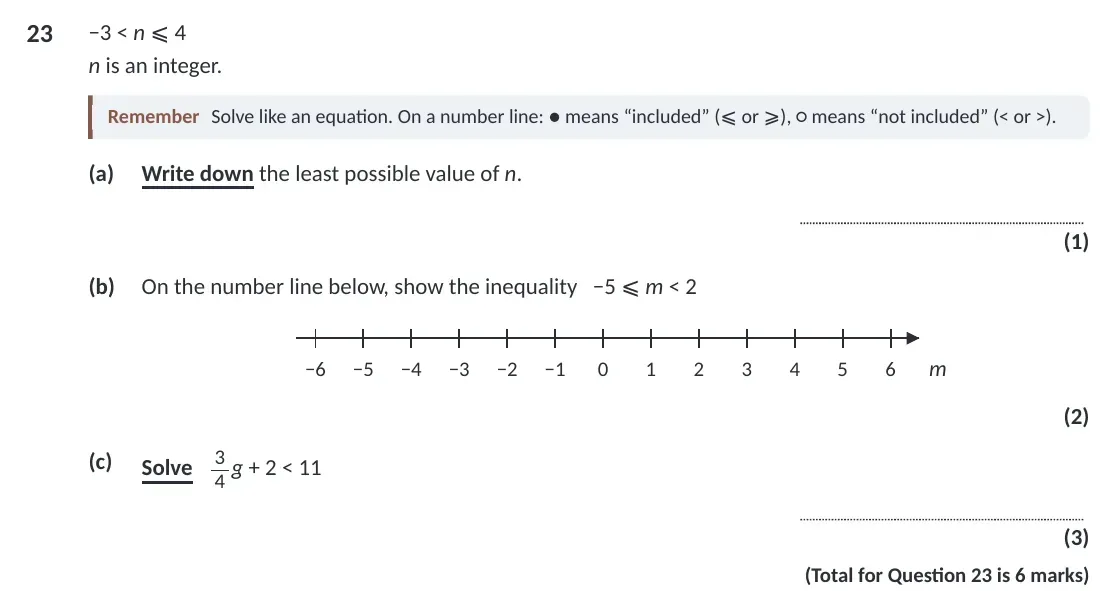
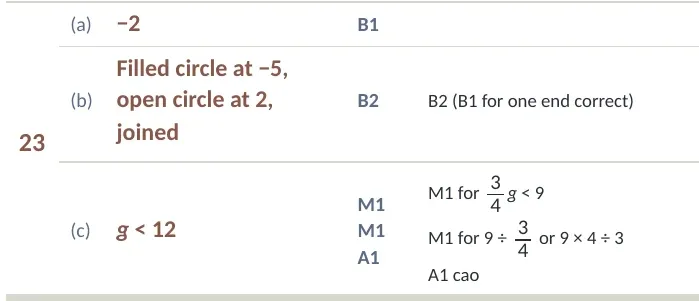
23 −3 < n ⩽ 4 n is an integer. Remember Solve like an equation. On a number line: ● means “included” (⩽ or ⩾), ○ means “not included” (< or >). (a) Write down the least possible value of n. (1) (b) On the number line below, show the inequality −5 ⩽ m < 2 −6 −5 −4 −3 −2 −1 0 1 2 3 4 5 6 m (2) (c) Solve 3 g + 2 < 11 4 (3) 📄 sheet: Inequalities on a number line (Total for Question 23 is 6 marks)
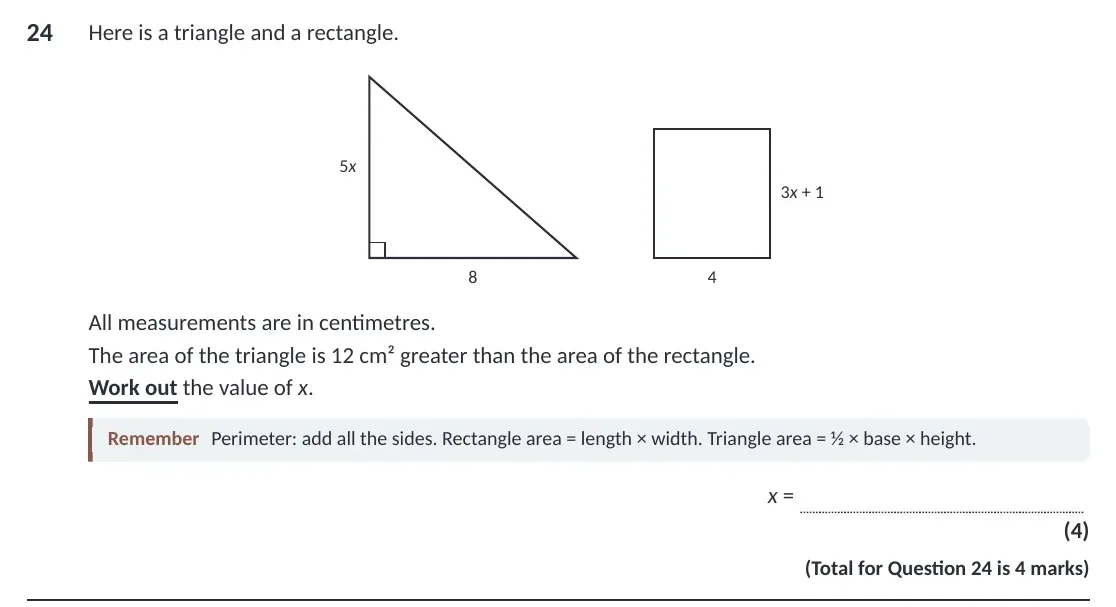
24 Here is a triangle and a rectangle. 5x 3x + 1 8 4 All measurements are in centimetres. The area of the triangle is 12 cm² greater than the area of the rectangle. Work out the value of x. Remember Perimeter: add all the sides. Rectangle area = length × width. Triangle area = ½ × base × height. x = 📄 sheet: Area and perimeter with algebra (4) (Total for Question 24 is 4 marks)
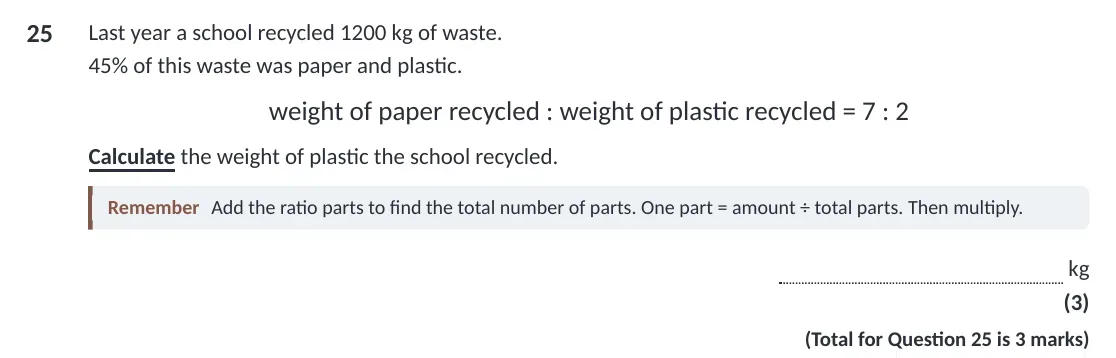
25 Last year a school recycled 1200 kg of waste. 45% of this waste was paper and plastic. weight of paper recycled : weight of plastic recycled = 7 : 2 Calculate the weight of plastic the school recycled. Remember Add the ratio parts to find the total number of parts. One part = amount ÷ total parts. Then multiply. kg 📄 sheet: Sharing in a ratio 📄 sheet: Percentages and interest (3) (Total for Que
26 A number, d, is rounded to 1 decimal place. The result is 8.4 Complete the error interval for d. 📄 sheet: Error intervals (2) (Total for Question 26 is 2 marks)
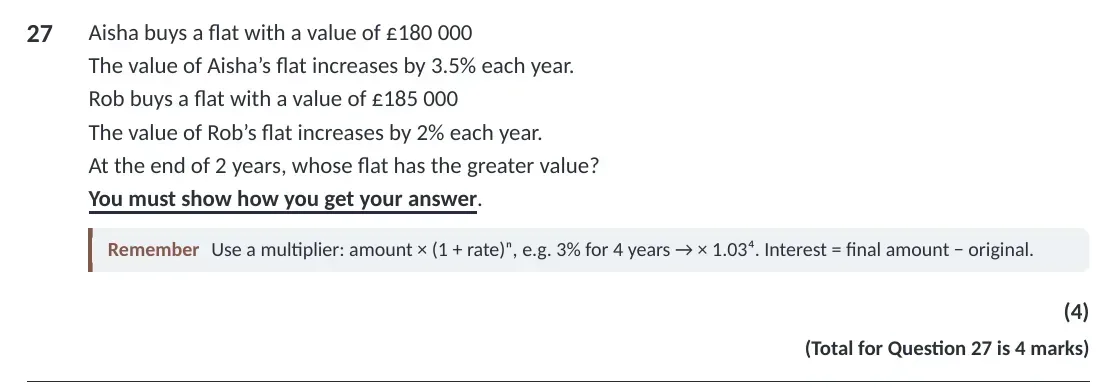
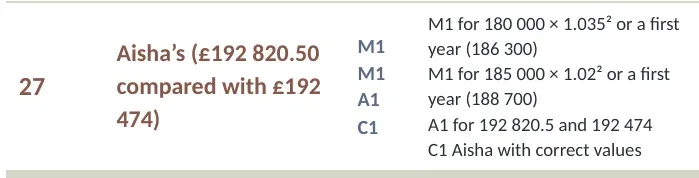
27 Aisha buys a flat with a value of £180 000 The value of Aisha’s flat increases by 3.5% each year. Rob buys a flat with a value of £185 000 The value of Rob’s flat increases by 2% each year. At the end of 2 years, whose flat has the greater value? You must show how you get your answer. Remember Use a multiplier: amount × (1 + rate)ⁿ, e.g. 3% for 4 years → × 1.03⁴. Interest = final amount − origi
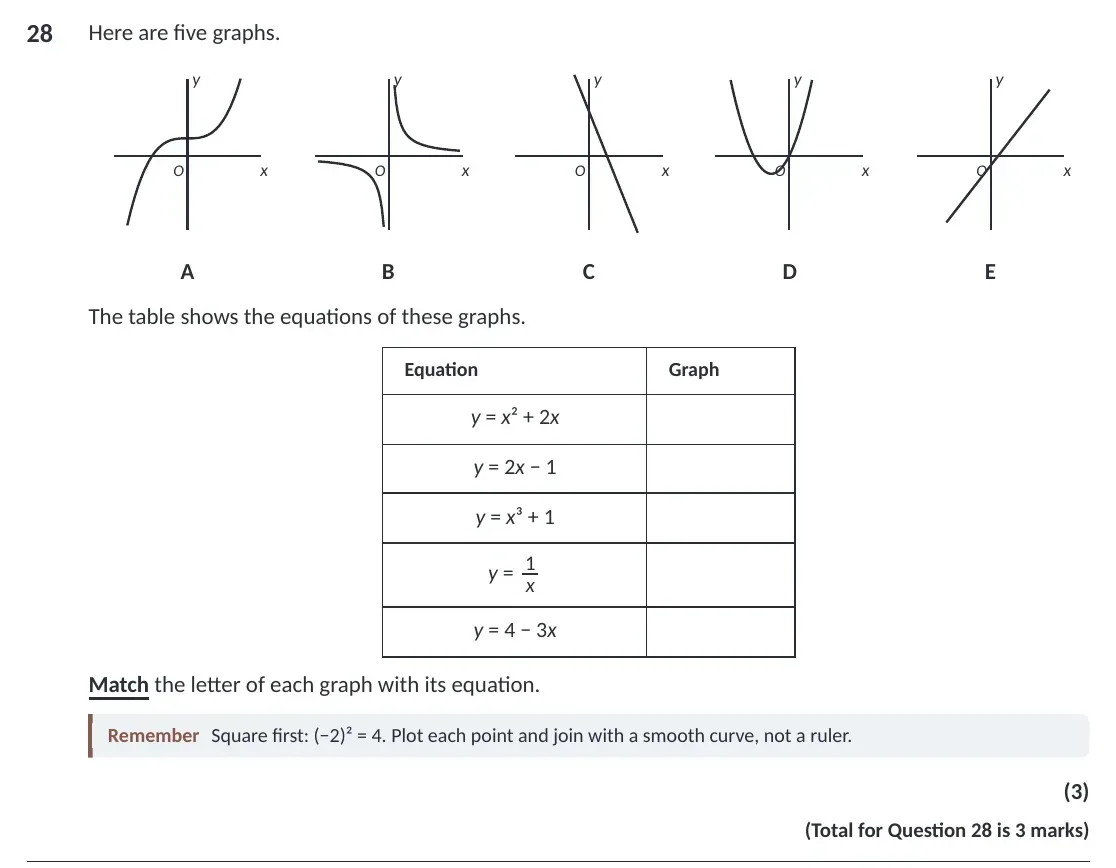
28 Here are five graphs. y O A y x O y x O B y x C y x O D O x E The table shows the equations of these graphs. Equation Graph y = x² + 2x y = 2x − 1 y = x³ + 1 y = 1 x y = 4 − 3x Match the letter of each graph with its equation. Remember Square first: (−2)² = 4. Plot each point and join with a smooth curve, not a ruler. (3) 📄 sheet: Recognising graph shapes (Total for Question 28 is 3 marks)
◀ E1All papersE3 ▶
Answer the questions, then mark your paper.