Miss North Maths

Full paper A2

Paper 2 style · Calculator · 80 marks · 1 hour 30 minutes

How it works. Type each answer in its box. Tap any underlined word on the paper to see what it wants you to do. Stuck? Open the fact sheet under the question. When you finish, press Mark my paper, then check each question against the mark scheme and give yourself the marks you earned, including method marks.

1 Change 5 days into hours. hours (1) 📄 sheet: Time and timetables (Total for Question 1 is 1 mark)
2 Simplify 4 × 5p (1) 📄 sheet: Expressions (Total for Question 2 is 1 mark)
3 Write 0.35 as a percentage. % (1) 📄 sheet: Converting fractions, decimals and percentages (Total for Question 3 is 1 mark)
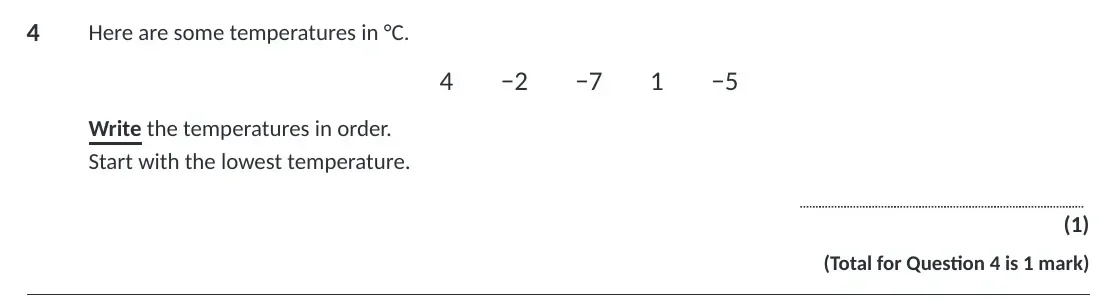
4 Here are some temperatures in °C. 4 −2 −7 1 −5 Write the temperatures in order. Start with the lowest temperature. 📄 sheet: Ordering negative numbers (1) (Total for Question 4 is 1 mark)
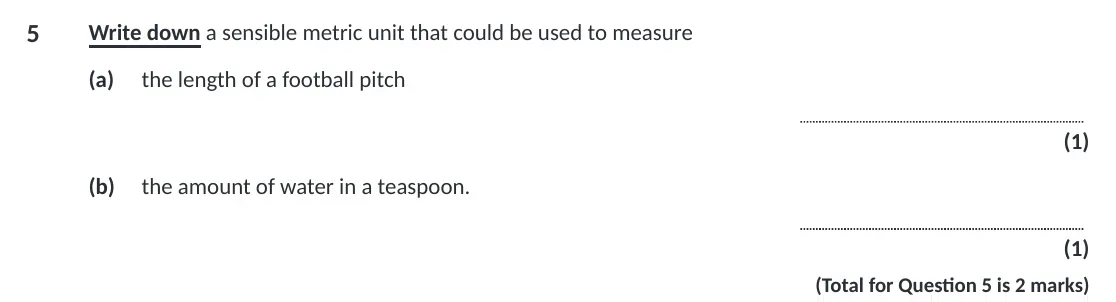
5 Write down a sensible metric unit that could be used to measure (a) the length of a football pitch (1) (b) the amount of water in a teaspoon. 📄 sheet: Measuring and reading scales (1) (Total for Question 5 is 2 marks)
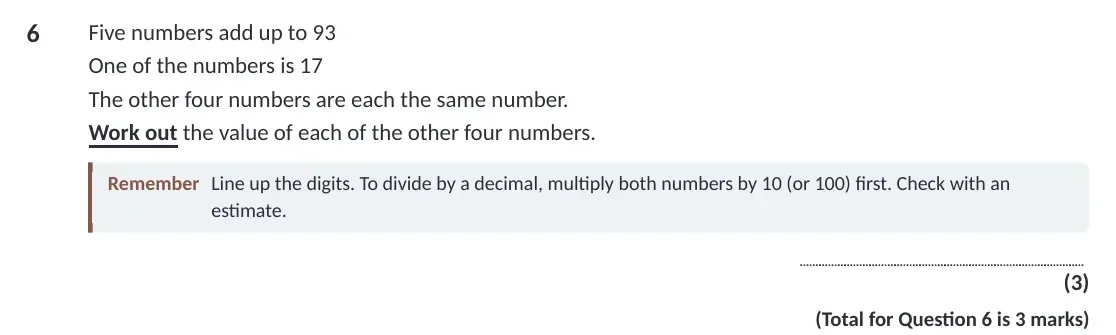
6 Five numbers add up to 93 One of the numbers is 17 The other four numbers are each the same number. Work out the value of each of the other four numbers. Remember Line up the digits. To divide by a decimal, multiply both numbers by 10 (or 100) first. Check with an estimate. 📄 sheet: Number problems and number machines (3) (Total for Question 6 is 3 marks)
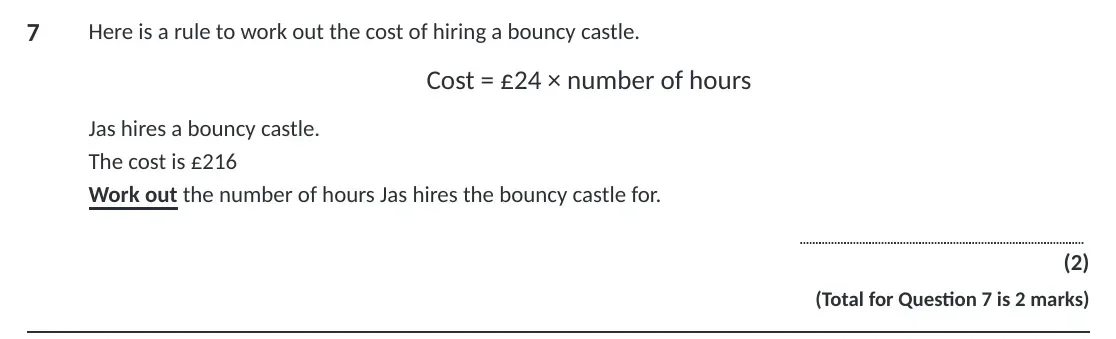
7 Here is a rule to work out the cost of hiring a bouncy castle. Cost = £24 × number of hours Jas hires a bouncy castle. The cost is £216 Work out the number of hours Jas hires the bouncy castle for. 📄 sheet: Substituting into formulae (2) (Total for Question 7 is 2 marks)
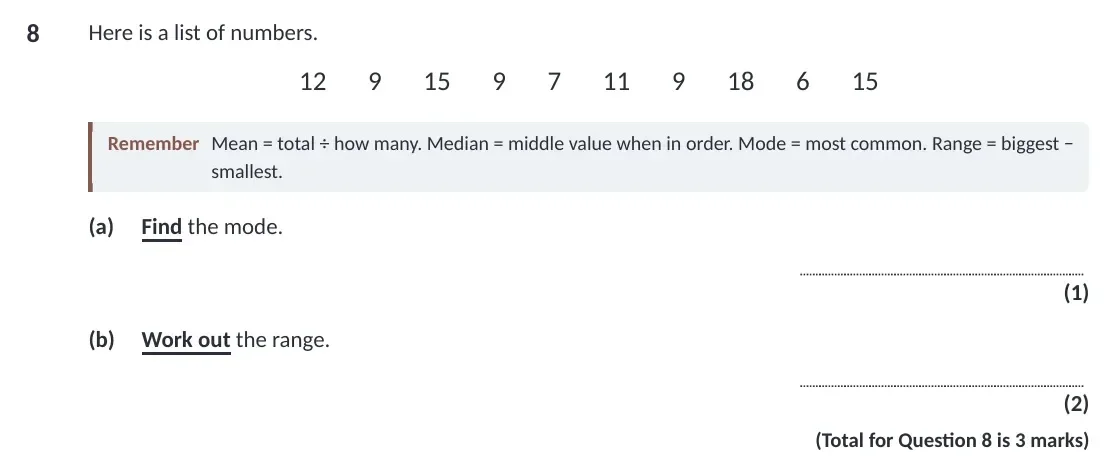
8 Here is a list of numbers. 12 9 15 9 7 11 9 18 6 15 Remember Mean = total ÷ how many. Median = middle value when in order. Mode = most common. Range = biggest − smallest. (a) Find the mode. (1) (b) Work out the range. (2) 📄 sheet: Mean, median, mode and range, cards 1 and 2 (Total for Question 8 is 3 marks)
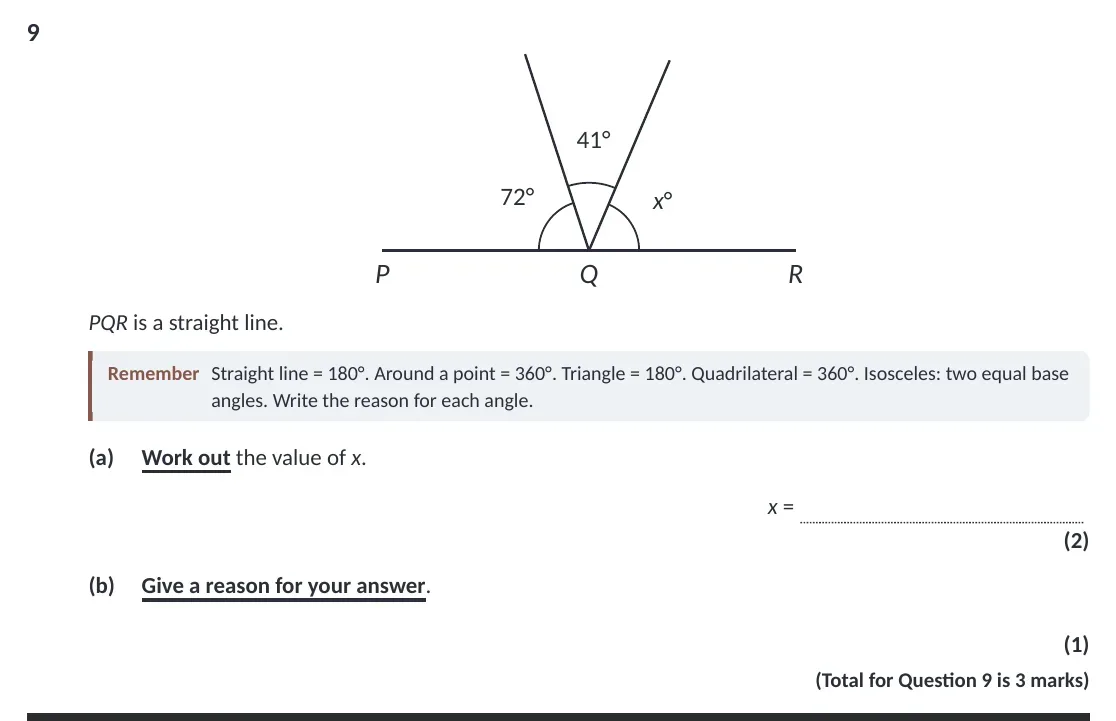
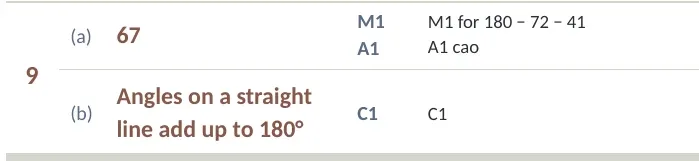
9 41° 72° P x° Q R PQR is a straight line. Remember Straight line = 180°. Around a point = 360°. Triangle = 180°. Quadrilateral = 360°. Isosceles: two equal base angles. Write the reason for each angle. (a) Work out the value of x. x = (2) (b) Give a reason for your answer. 📄 sheet: Angle facts (1) (Total for Question 9 is 3 marks)
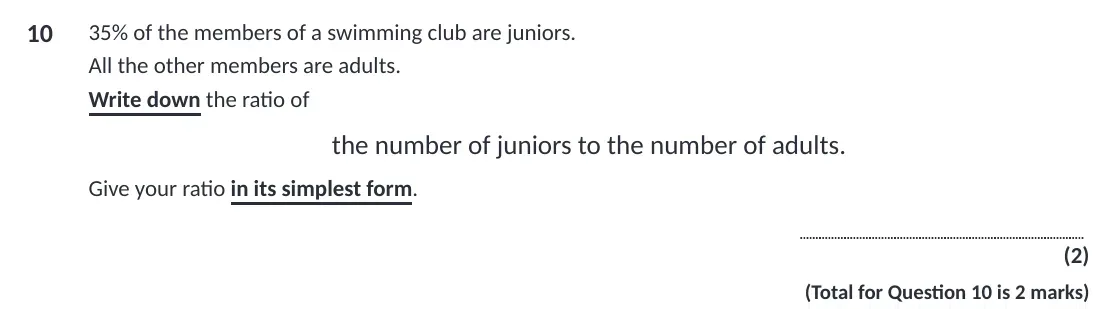
10 35% of the members of a swimming club are juniors. All the other members are adults. Write down the ratio of the number of juniors to the number of adults. Give your ratio in its simplest form. 📄 sheet: Writing and simplifying ratios (2) (Total for Question 10 is 2 marks)
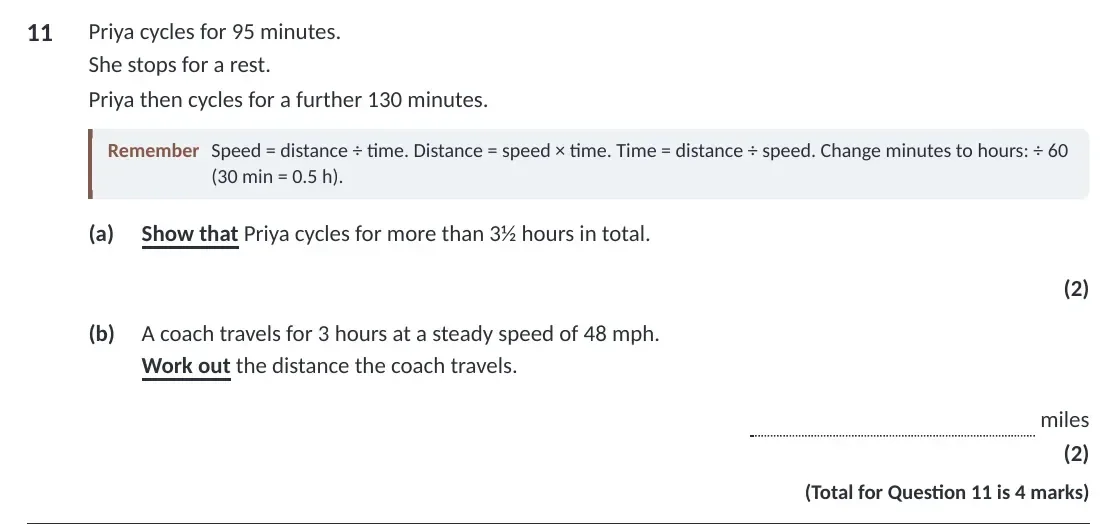
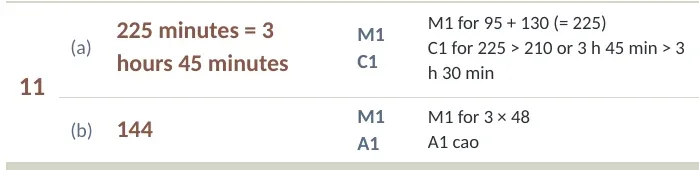
11 Priya cycles for 95 minutes. She stops for a rest. Priya then cycles for a further 130 minutes. Remember Speed = distance ÷ time. Distance = speed × time. Time = distance ÷ speed. Change minutes to hours: ÷ 60 (30 min = 0.5 h). (a) Show that Priya cycles for more than 3½ hours in total. (2) (b) A coach travels for 3 hours at a steady speed of 48 mph. Work out the distance the coach travels. mil
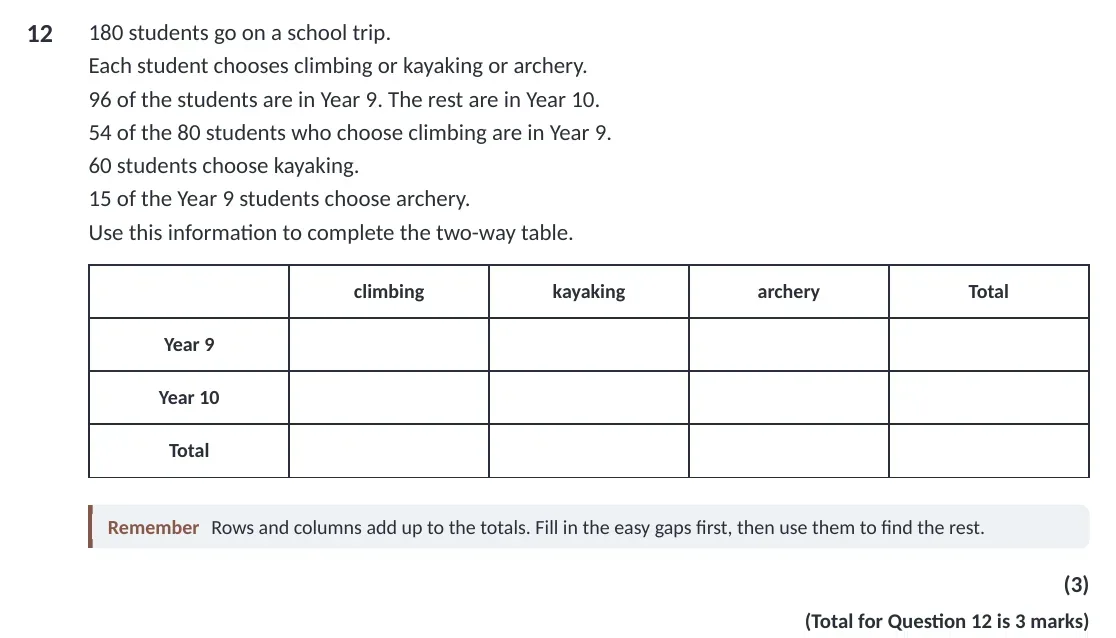
12 180 students go on a school trip. Each student chooses climbing or kayaking or archery. 96 of the students are in Year 9. The rest are in Year 10. 54 of the 80 students who choose climbing are in Year 9. 60 students choose kayaking. 15 of the Year 9 students choose archery. Use this information to complete the two-way table. climbing kayaking archery Total Year 9 Year 10 Total Remember Rows and
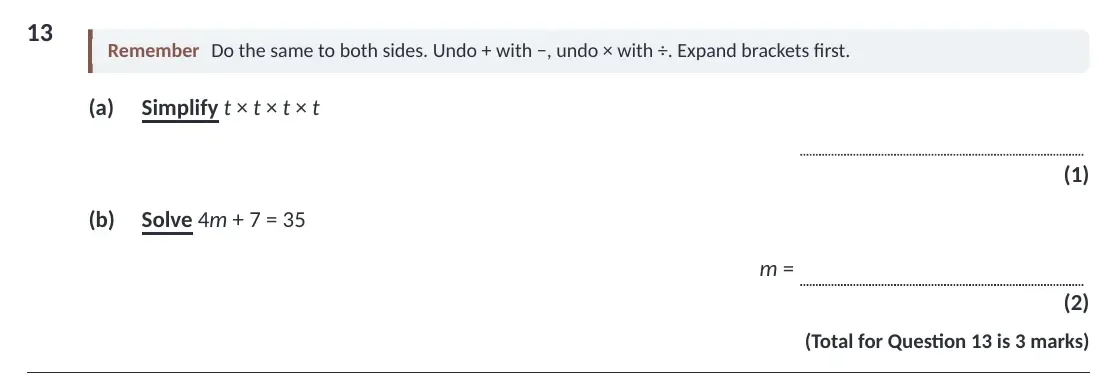
13 Remember Do the same to both sides. Undo + with −, undo × with ÷. Expand brackets first. (a) Simplify t × t × t × t (1) (b) Solve 4m + 7 = 35 m = 📄 sheet: Solving equations, card 1 (2) (Total for Question 13 is 3 marks)
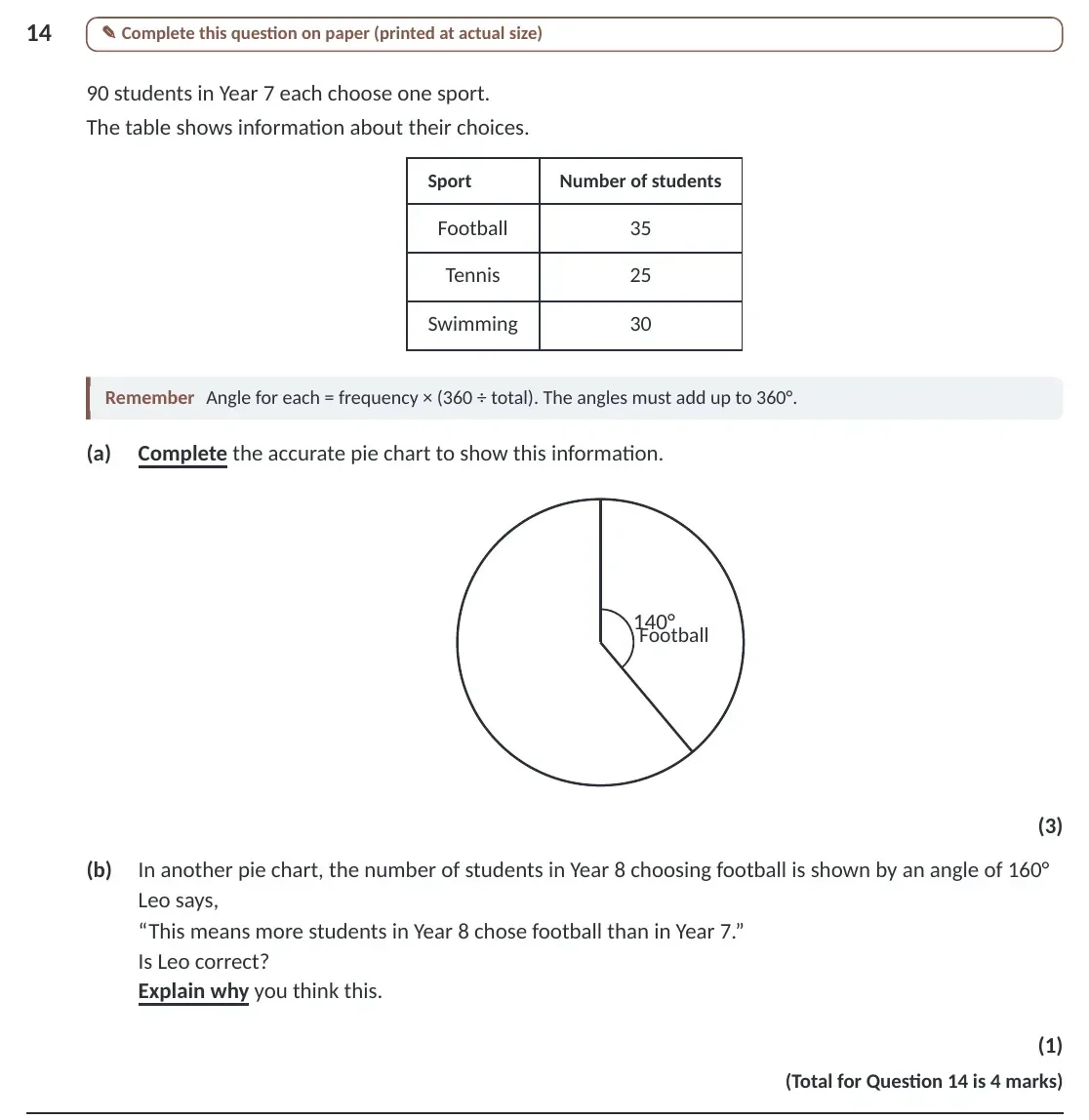
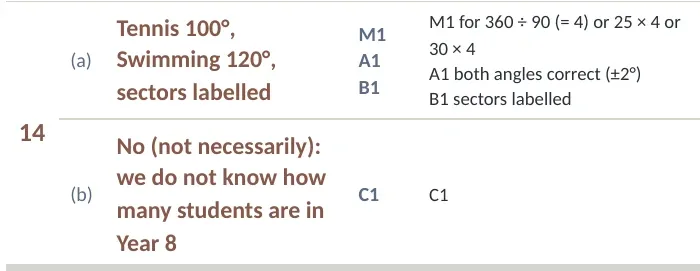
14 ✎ Complete this question on paper (printed at actual size) 90 students in Year 7 each choose one sport. The table shows information about their choices. Sport Number of students Football 35 Tennis 25 Swimming 30 Remember Angle for each = frequency × (360 ÷ total). The angles must add up to 360°. (a) Complete the accurate pie chart to show this information. 140° Football (3) (b) In another pie c

✎ You need a ruler, protractor or compasses for this one. Do it on paper, then mark it below.

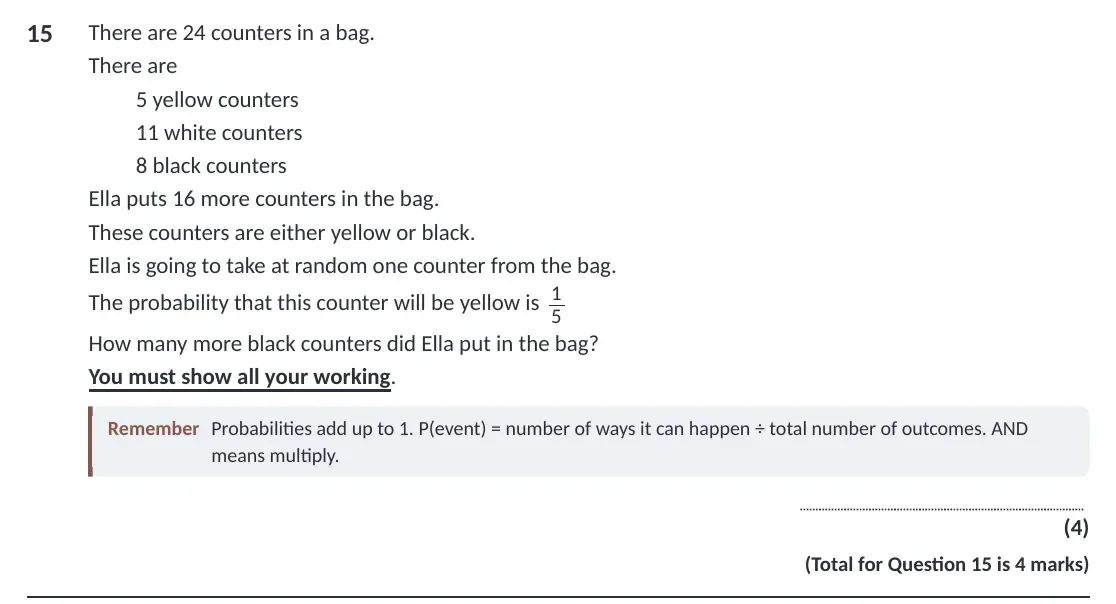
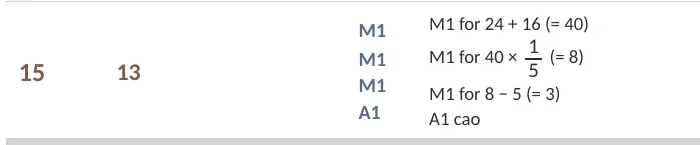
15 There are 24 counters in a bag. There are 5 yellow counters 11 white counters 8 black counters Ella puts 16 more counters in the bag. These counters are either yellow or black. Ella is going to take at random one counter from the bag. The probability that this counter will be yellow is 1 5 How many more black counters did Ella put in the bag? You must show all your working. Remember Probabiliti
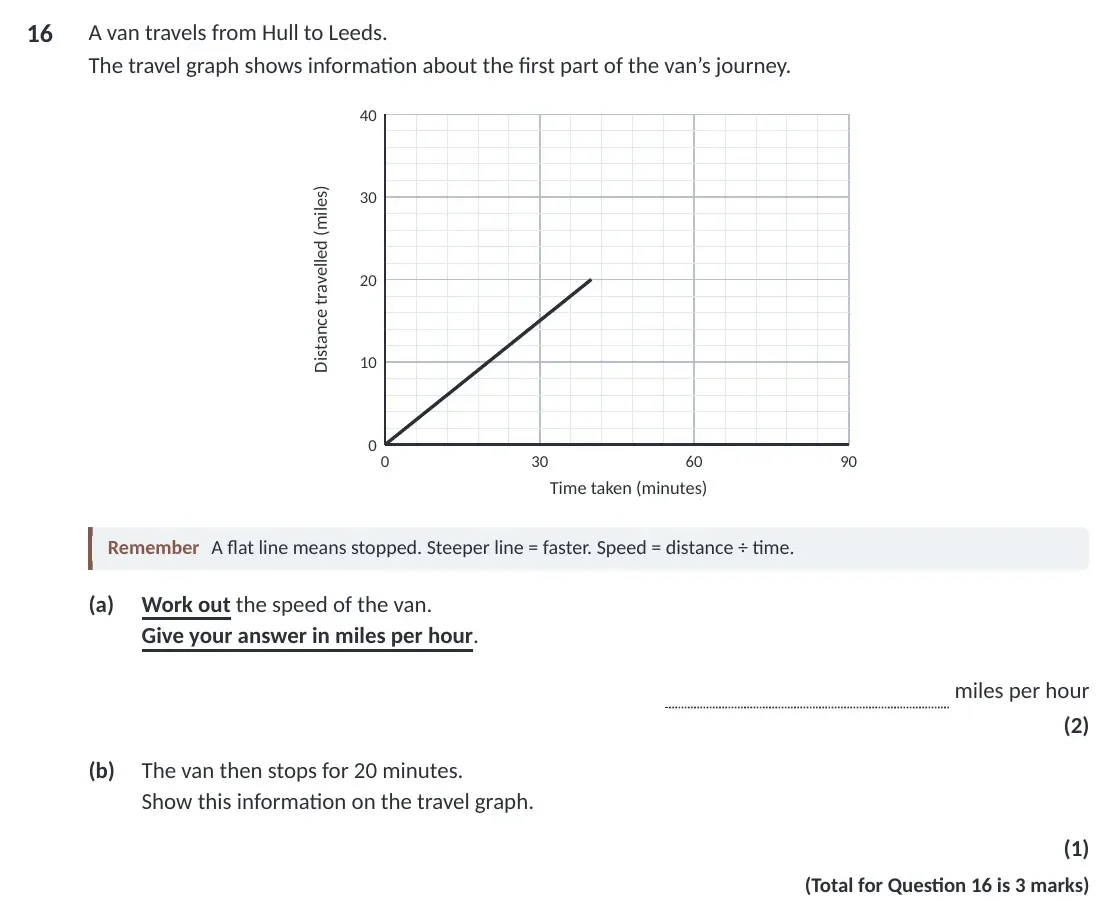
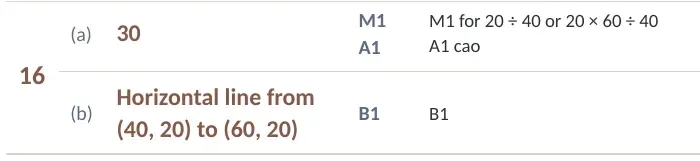
16 A van travels from Hull to Leeds. The travel graph shows information about the first part of the van’s journey. Distance travelled (miles) 40 30 20 10 0 0 30 60 90 Time taken (minutes) Remember A flat line means stopped. Steeper line = faster. Speed = distance ÷ time. (a) Work out the speed of the van. Give your answer in miles per hour. miles per hour (2) (b) The van then stops for 20 minutes.
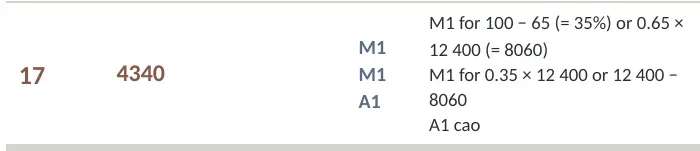
17 A school needs to repair its roof. The cost of the repair is £12 400 A building fund will pay 65% of this cost. The school will pay the rest of the cost. Work out how much the school will pay. Remember Fraction of an amount: ÷ by the bottom, × by the top. Percentage: 10% = ÷ 10, 1% = ÷ 100, or use a multiplier (35% = 0.35). £ 📄 sheet: Finding percentages (3) (Total for Question 17 is 3 marks)
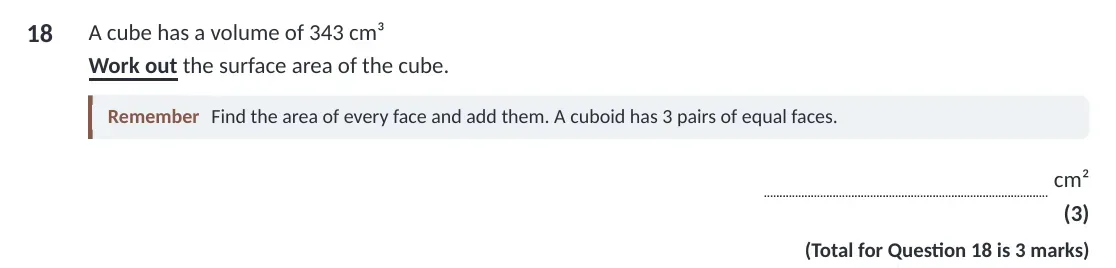
18 A cube has a volume of 343 cm³ Work out the surface area of the cube. Remember Find the area of every face and add them. A cuboid has 3 pairs of equal faces. cm² (3) 📄 sheet: Surface area (Total for Question 18 is 3 marks)
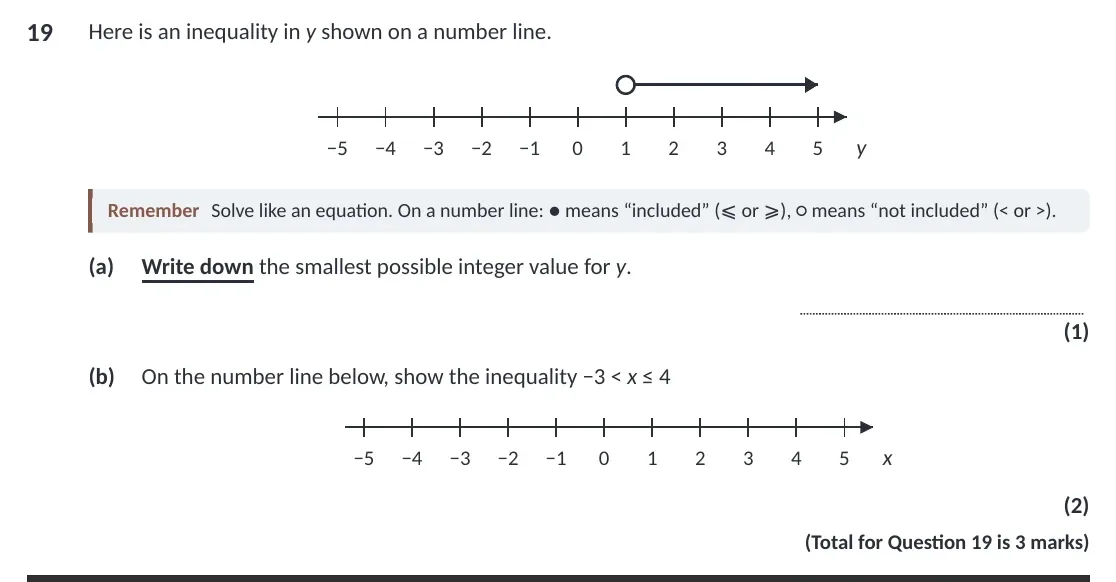
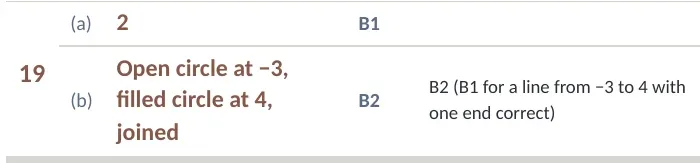
19 Here is an inequality in y shown on a number line. −5 −4 −3 −2 −1 0 1 2 3 4 y 5 Remember Solve like an equation. On a number line: ● means “included” (⩽ or ⩾), ○ means “not included” (< or >). (a) Write down the smallest possible integer value for y. (1) (b) On the number line below, show the inequality −3 < x ≤ 4 −5 −4 📄 sheet: Inequalities on a number line −3 −2 −1 0 1 2 3 4 5 x (2) (Total fo
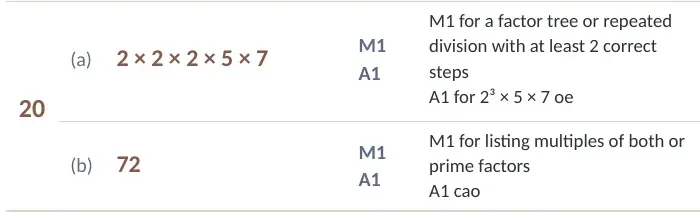
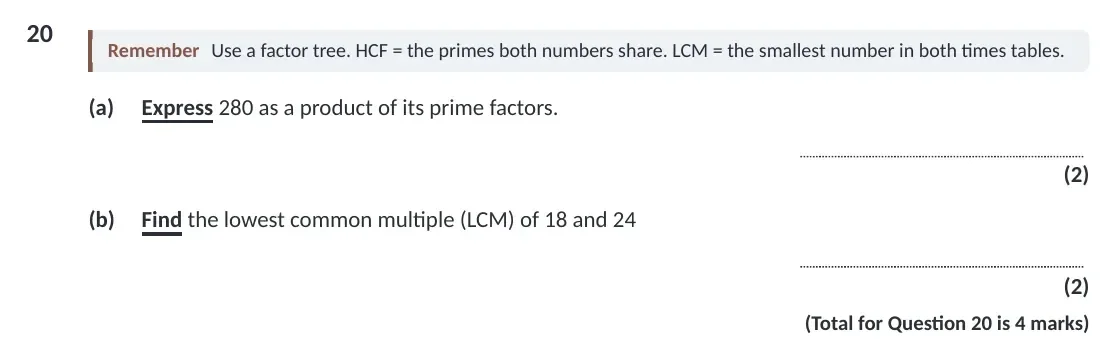
20 Remember Use a factor tree. HCF = the primes both numbers share. LCM = the smallest number in both times tables. (a) Express 280 as a product of its prime factors. (2) (b) Find the lowest common multiple (LCM) of 18 and 24 📄 sheet: Product of prime factors 📄 sheet: HCF and LCM (2) (Total for Question 20 is 4 marks)
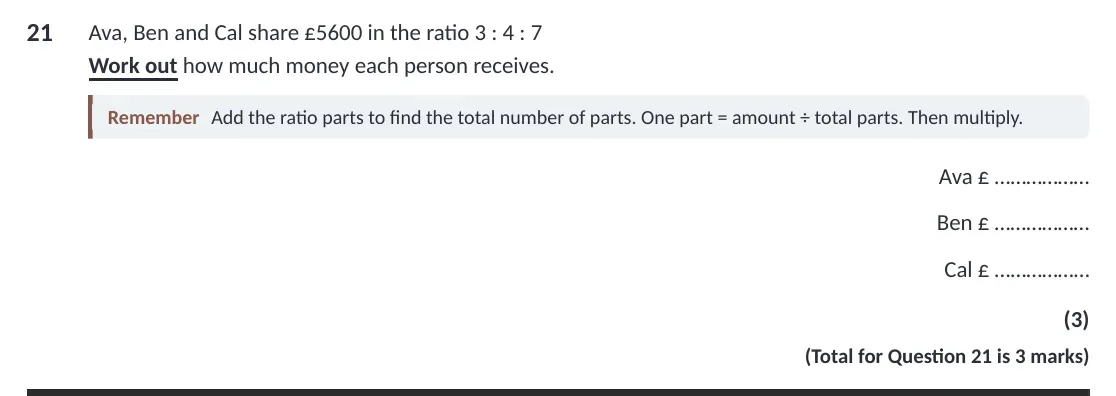
21 Ava, Ben and Cal share £5600 in the ratio 3 : 4 : 7 Work out how much money each person receives. Remember Add the ratio parts to find the total number of parts. One part = amount ÷ total parts. Then multiply. Ava £ ……………… Ben £ ……………… Cal £ ……………… 📄 sheet: Sharing in a ratio, card 2 (3) (Total for Question 21 is 3 marks)
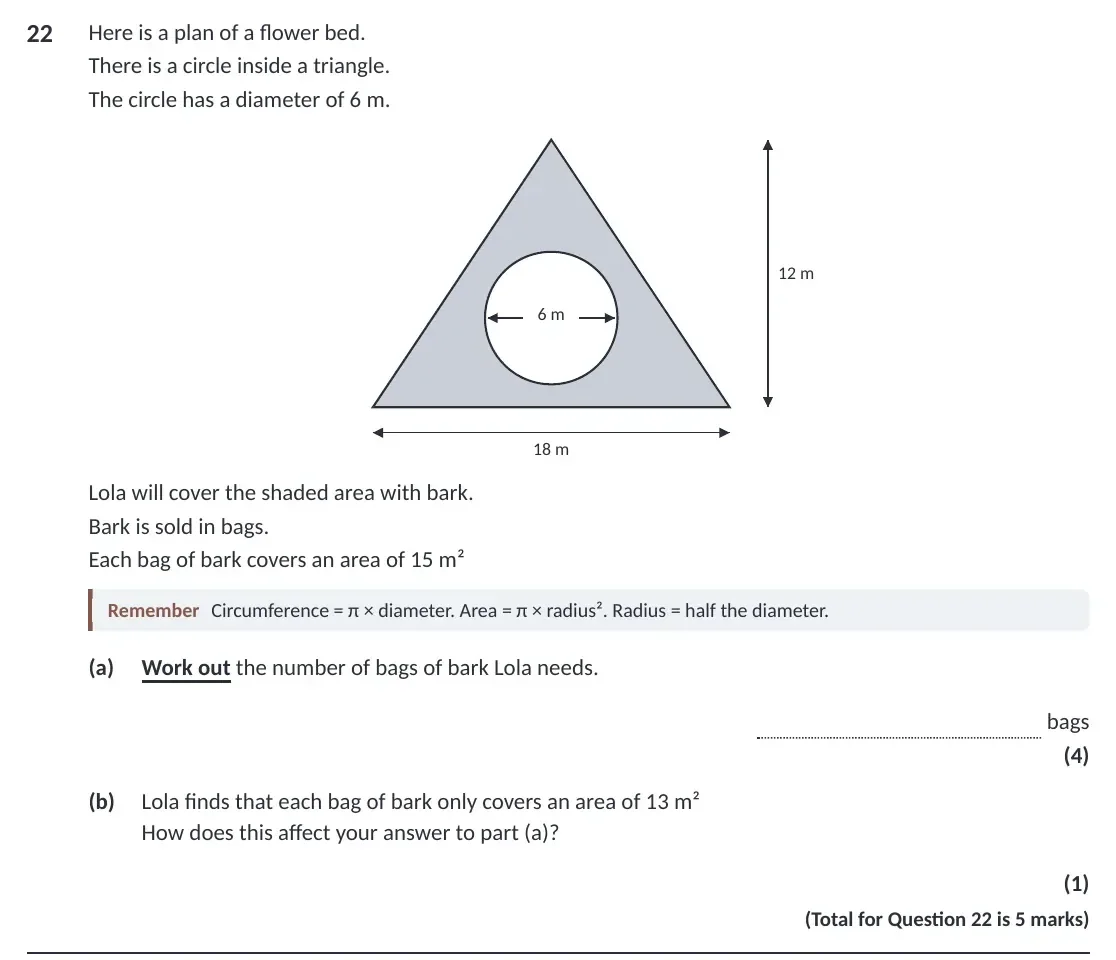
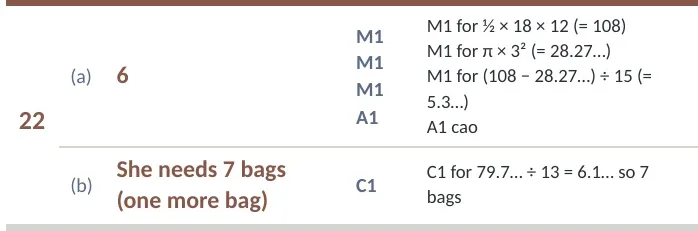
22 Here is a plan of a flower bed. There is a circle inside a triangle. The circle has a diameter of 6 m. 12 m 6 m 18 m Lola will cover the shaded area with bark. Bark is sold in bags. Each bag of bark covers an area of 15 m² Remember Circumference = π × diameter. Area = π × radius². Radius = half the diameter. (a) Work out the number of bags of bark Lola needs. bags (4) (b) Lola finds that each b
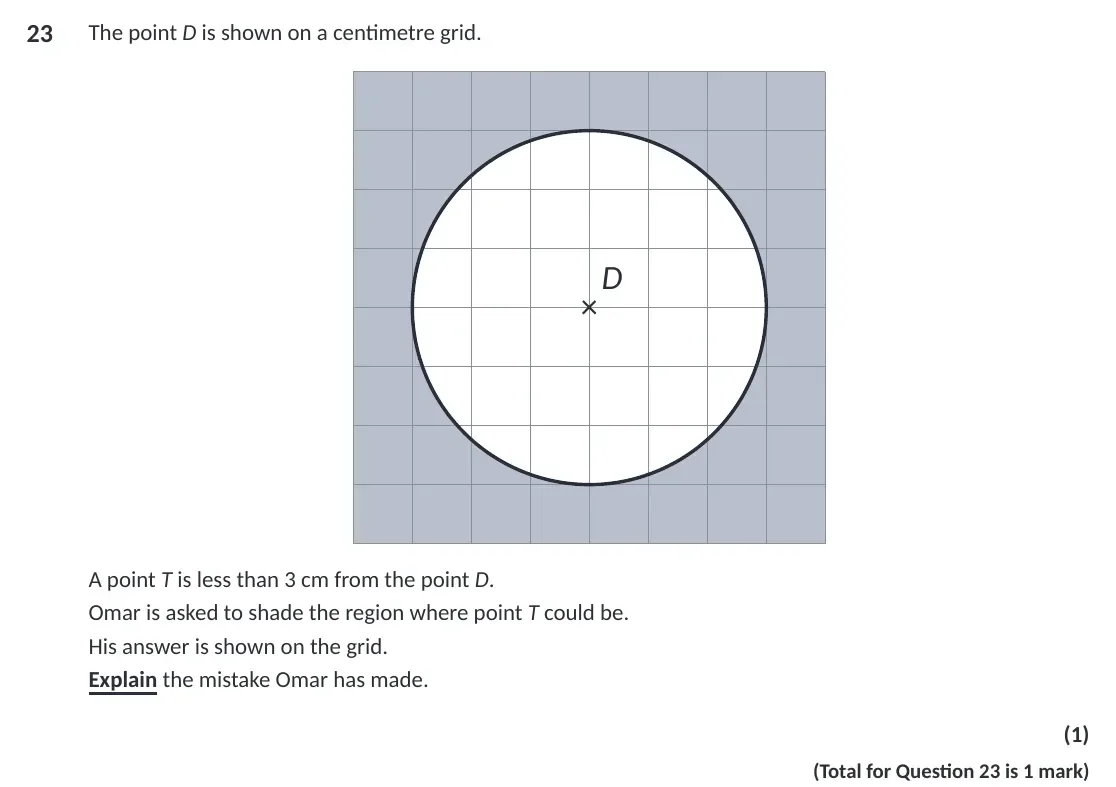
23 The point D is shown on a centimetre grid. × D A point T is less than 3 cm from the point D. Omar is asked to shade the region where point T could be. His answer is shown on the grid. Explain the mistake Omar has made. (1) 📄 sheet: Constructions (Total for Question 23 is 1 mark)
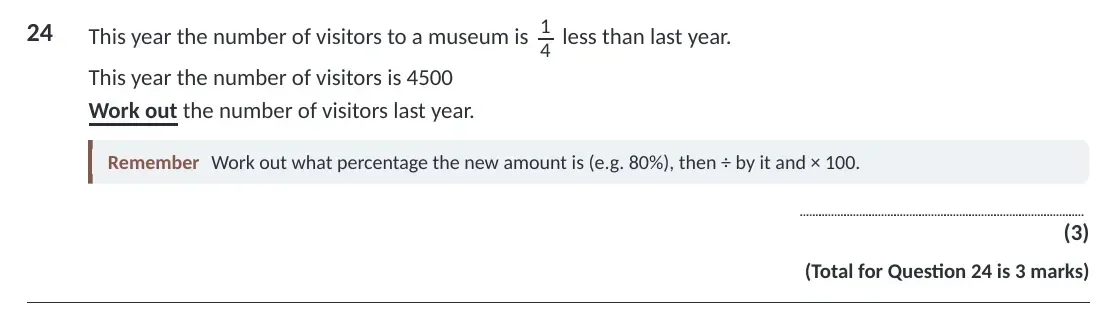
24 This year the number of visitors to a museum is 1 less than last year. 4 This year the number of visitors is 4500 Work out the number of visitors last year. Remember Work out what percentage the new amount is (e.g. 80%), then ÷ by it and × 100. 📄 sheet: Fractions of amounts and shapes, card 2 (3) (Total for Question 24 is 3 marks)
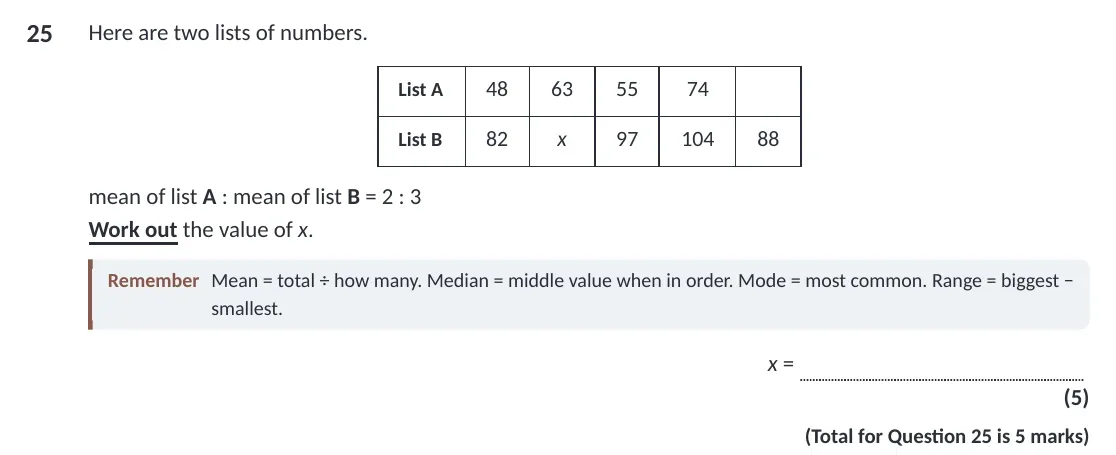
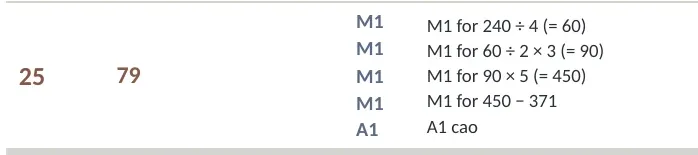
25 Here are two lists of numbers. List A 48 63 55 74 List B 82 x 97 104 88 mean of list A : mean of list B = 2 : 3 Work out the value of x. Remember Mean = total ÷ how many. Median = middle value when in order. Mode = most common. Range = biggest − smallest. x = (5) 📄 sheet: Working backwards from the mean, card 2 📄 sheet: Ratio (Total for Question 25 is 5 marks)
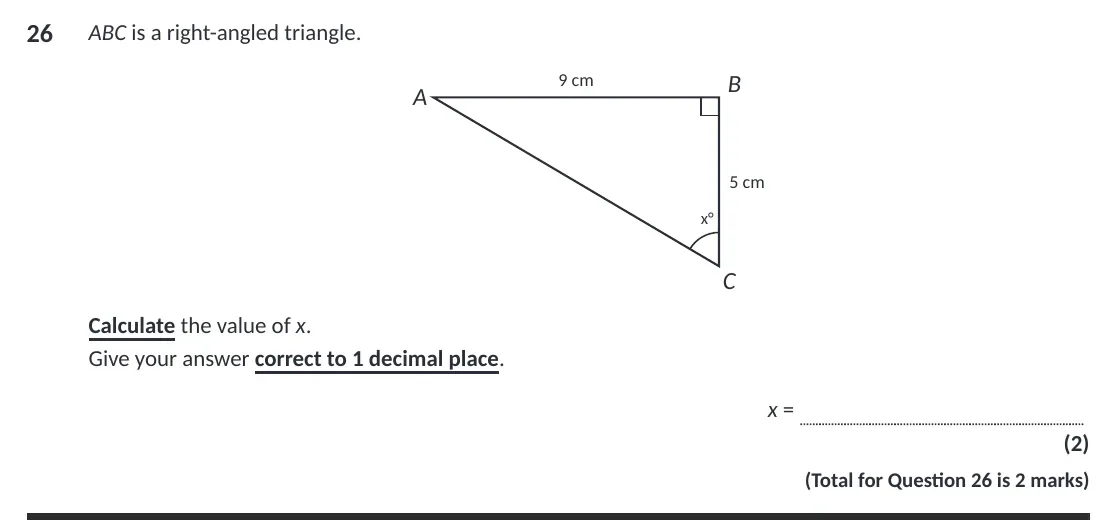
26 ABC is a right-angled triangle. A B 9 cm 5 cm x° C Calculate the value of x. Give your answer correct to 1 decimal place. x = 📄 sheet: Trigonometry, card 2 (2) (Total for Question 26 is 2 marks)
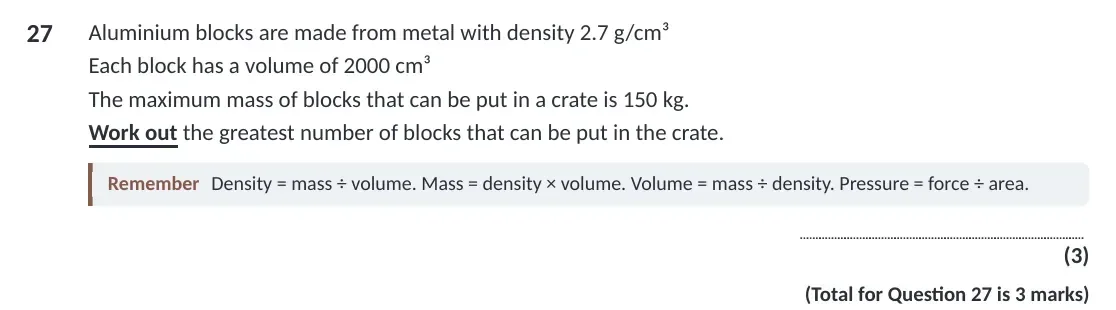
27 Aluminium blocks are made from metal with density 2.7 g/cm³ Each block has a volume of 2000 cm³ The maximum mass of blocks that can be put in a crate is 150 kg. Work out the greatest number of blocks that can be put in the crate. Remember Density = mass ÷ volume. Mass = density × volume. Volume = mass ÷ density. Pressure = force ÷ area. (3) 📄 sheet: Density (Total for Question 27 is 3 marks)
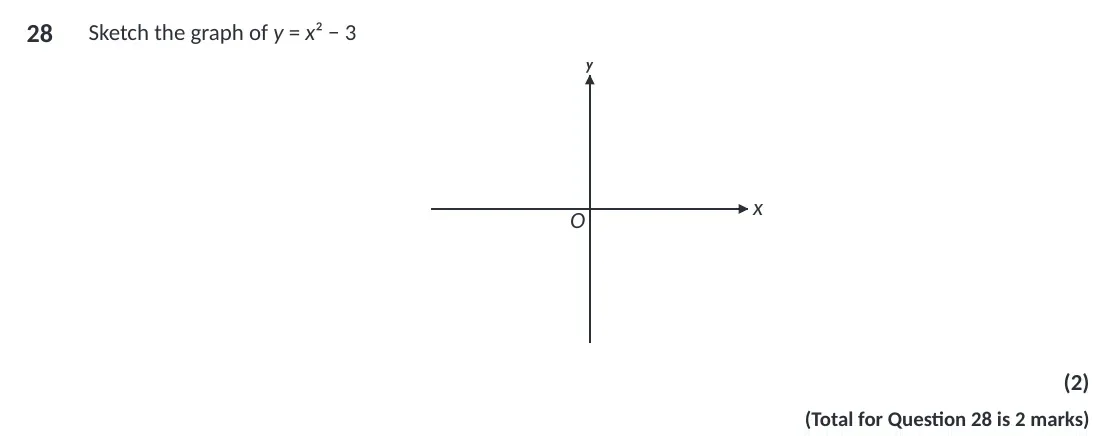
28 Sketch the graph of y = x² − 3 y x O (2) 📄 sheet: Drawing and using quadratic graphs (Total for Question 28 is 2 marks)
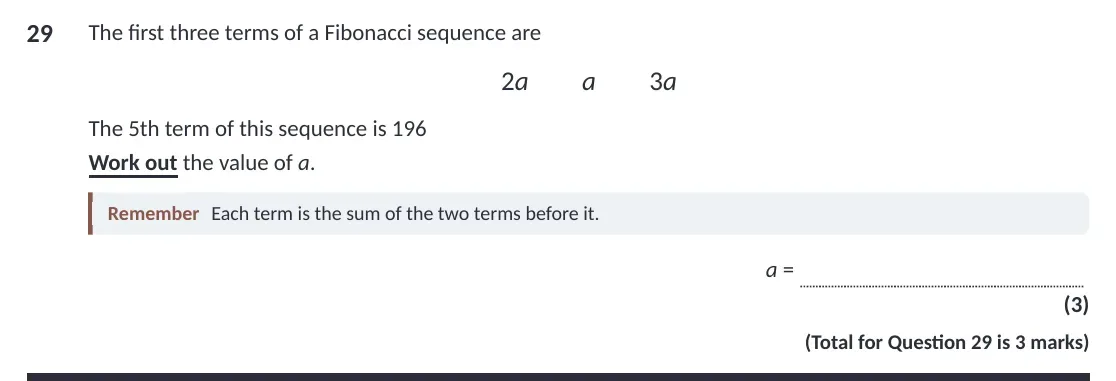
29 The first three terms of a Fibonacci sequence are 2a a 3a The 5th term of this sequence is 196 Work out the value of a. Remember Each term is the sum of the two terms before it. a = 📄 sheet: Term-to-term rules and patterns (3) (Total for Question 29 is 3 marks)
◀ A1All papersA3 ▶
Answer the questions, then mark your paper.