Miss North Maths

Half paper C5

Paper 2 style · Calculator · 36 marks · about 35–40 minutes

How it works. Type each answer in its box. Tap any underlined word on the paper to see what it wants you to do. Stuck? Open the fact sheet under the question. When you finish, press Mark my paper, then check each question against the mark scheme and give yourself the marks you earned, including method marks.

1 Write 9 as a percentage. 25 % 📄 sheet: Finding percentages (Total for Question 1 is 1 mark) (1)
2 (1) (Total for Question 2 is 1 mark) Write 4.951 correct to 1 decimal place. 📄 sheet: Decimal places and significant figures
Work out the value of 4 3 📄 sheet: Powers and roots 3 (1) (Total for Question 3 is 1 mark)
4 Write down a 5 digit number that has 3 as its hundreds digit. You can only use the digit 3 once. 📄 sheet: Place value and number facts (1) (Total for Question 4 is 1 mark)
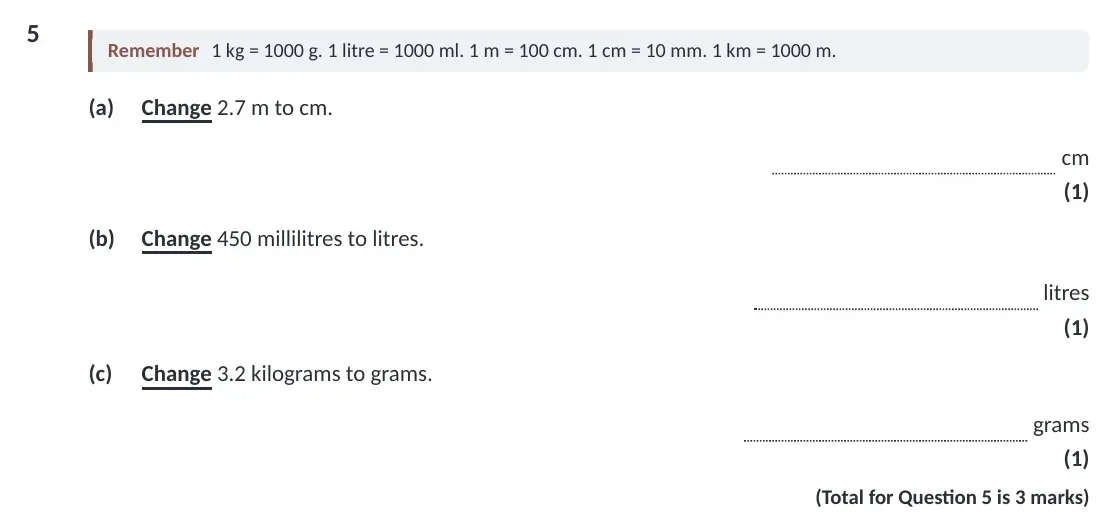
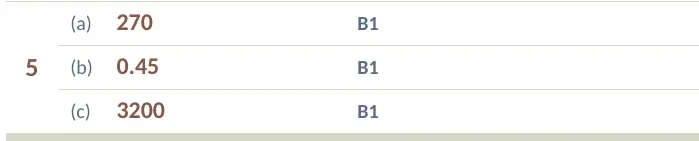
5 Remember 1 kg = 1000 g. 1 litre = 1000 ml. 1 m = 100 cm. 1 cm = 10 mm. 1 km = 1000 m. (a) Change 2.7 m to cm. cm (1) (b) Change 450 millilitres to litres. litres (1) (c) Change 3.2 kilograms to grams. grams 📄 sheet: Converting units (1) (Total for Question 5 is 3 marks)
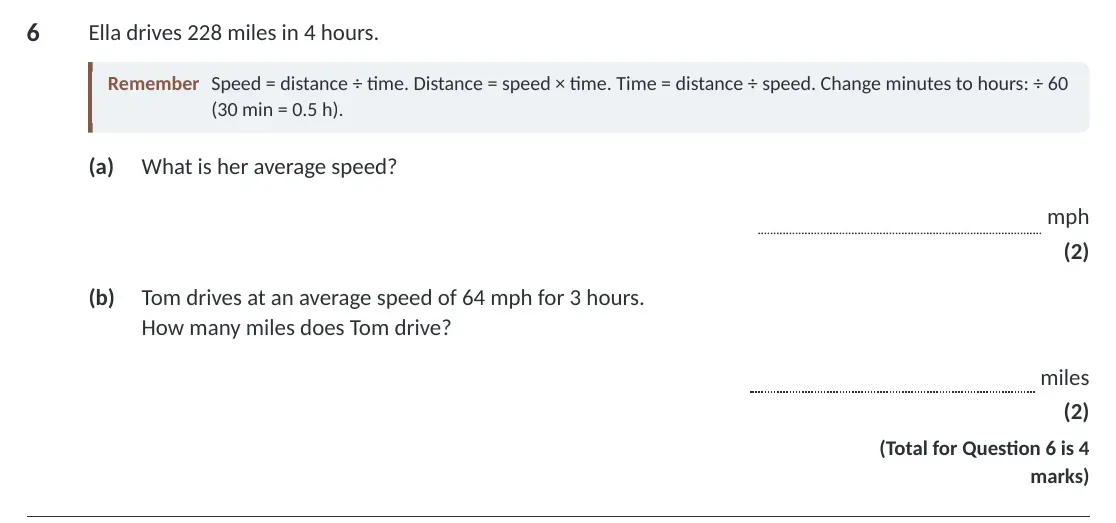
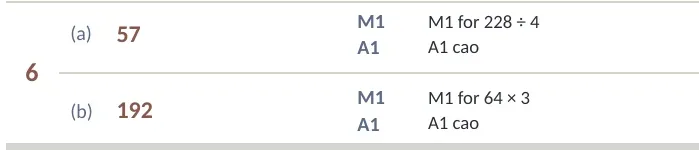
6 Ella drives 228 miles in 4 hours. Remember Speed = distance ÷ time. Distance = speed × time. Time = distance ÷ speed. Change minutes to hours: ÷ 60 (30 min = 0.5 h). (a) What is her average speed? mph (2) (b) Tom drives at an average speed of 64 mph for 3 hours. How many miles does Tom drive? miles 📄 sheet: Speed, distance and time, card 1 📄 sheet: Place value and written calculation (2) (Total
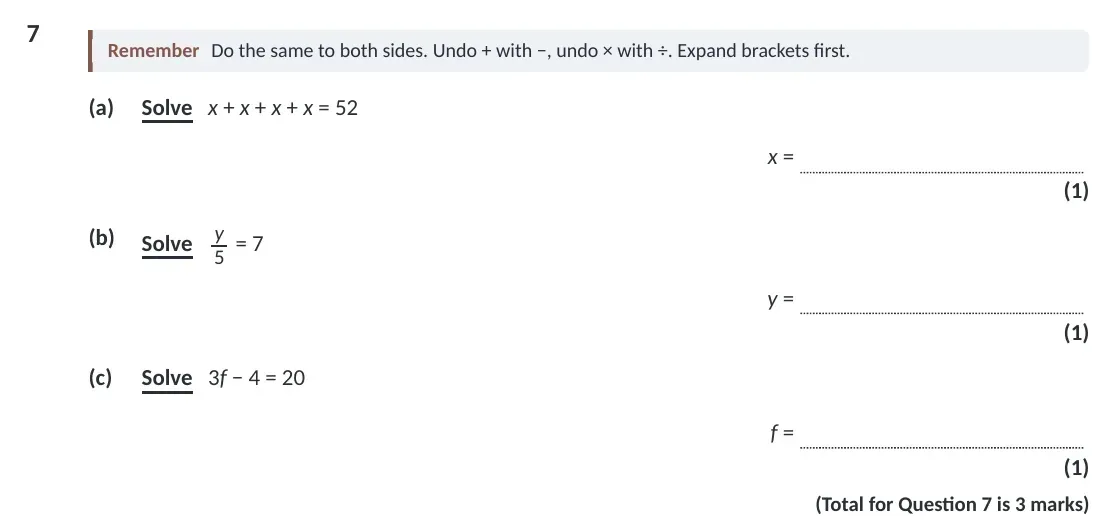
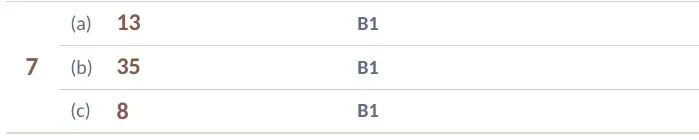
7 Remember Do the same to both sides. Undo + with −, undo × with ÷. Expand brackets first. (a) Solve x + x + x + x = 52 x = (1) (b) Solve y = 7 5 y = (1) (c) Solve 3f − 4 = 20 f = (1) 📄 sheet: Solving equations (Total for Question 7 is 3 marks)
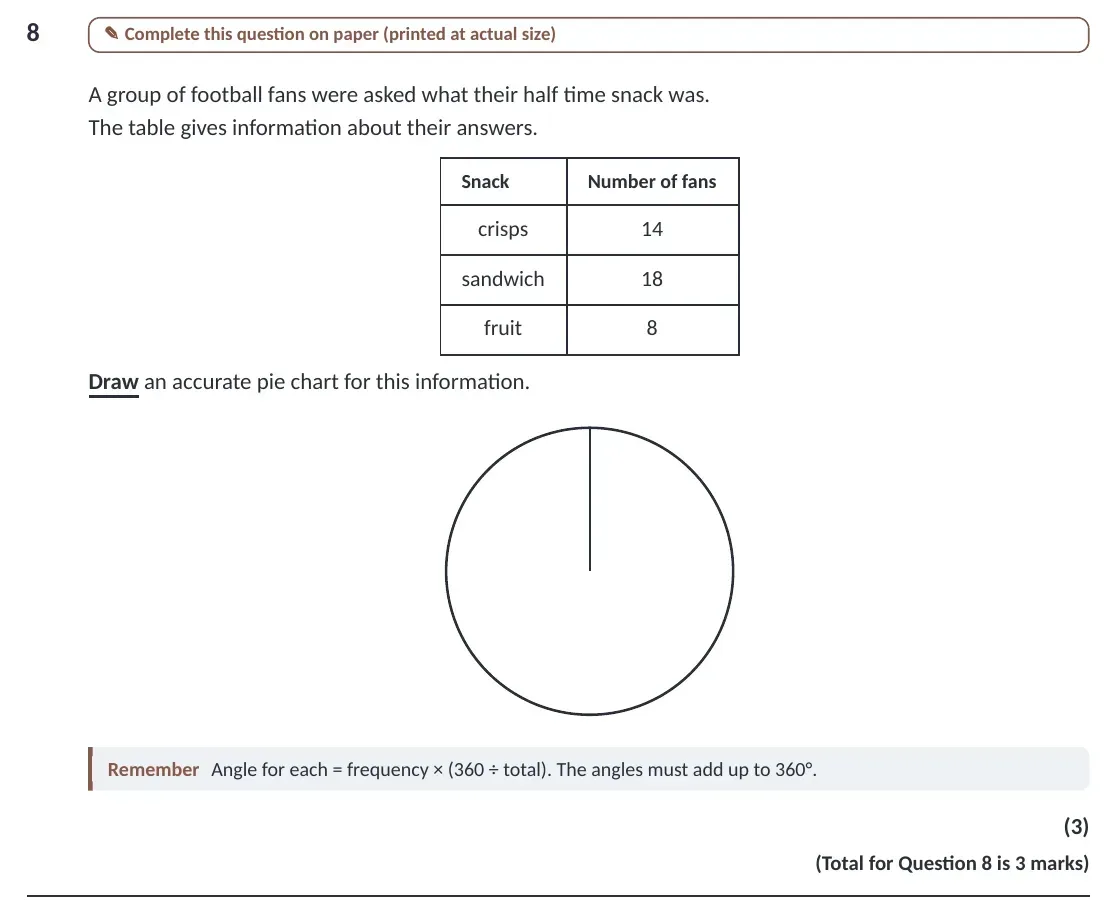
8 ✎ Complete this question on paper (printed at actual size) A group of football fans were asked what their half time snack was. The table gives information about their answers. Snack Number of fans crisps 14 sandwich 18 fruit 8 Draw an accurate pie chart for this information. Remember Angle for each = frequency × (360 ÷ total). The angles must add up to 360°. 📄 sheet: Pie charts (3) (Total for Qu

✎ You need a ruler, protractor or compasses for this one. Do it on paper, then mark it below.

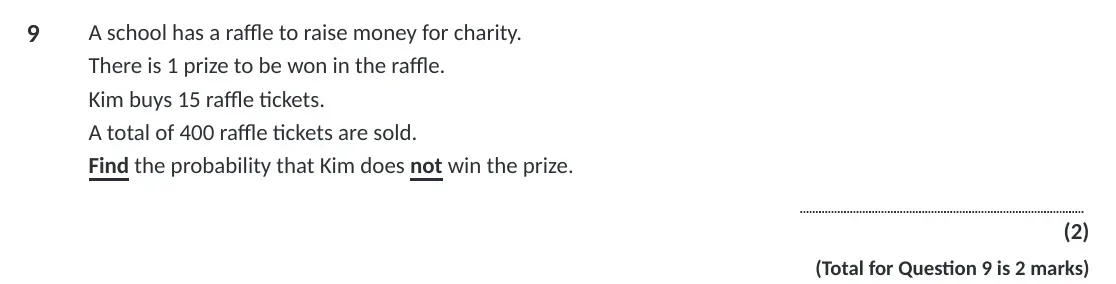
9 A school has a raffle to raise money for charity. There is 1 prize to be won in the raffle. Kim buys 15 raffle tickets. A total of 400 raffle tickets are sold. Find the probability that Kim does not win the prize. (2) 📄 sheet: Probability of single events (Total for Question 9 is 2 marks)
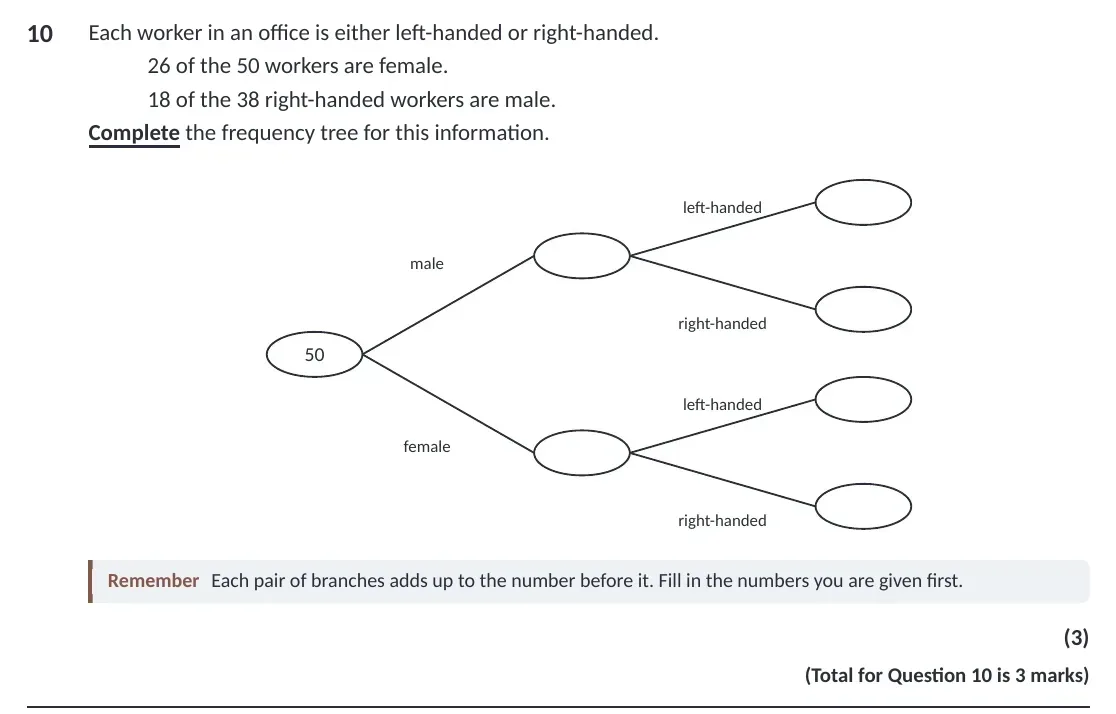
10 Each worker in an office is either left-handed or right-handed. 26 of the 50 workers are female. 18 of the 38 right-handed workers are male. Complete the frequency tree for this information. left-handed male right-handed 50 left-handed female right-handed Remember Each pair of branches adds up to the number before it. Fill in the numbers you are given first. 📄 sheet: Two-way tables (3) (Total f
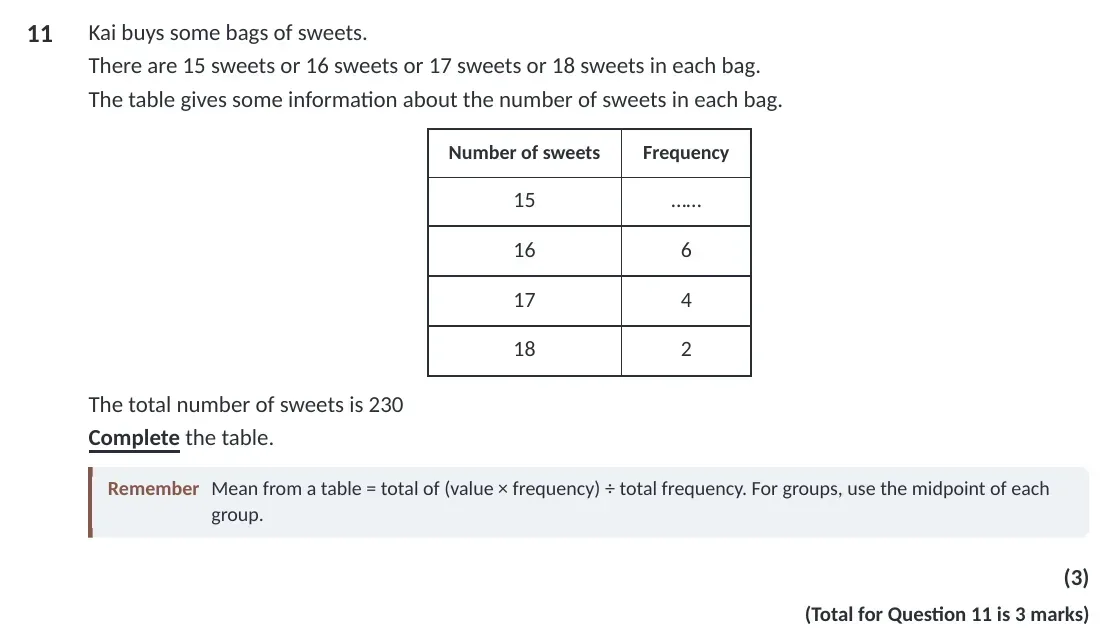
11 Kai buys some bags of sweets. There are 15 sweets or 16 sweets or 17 sweets or 18 sweets in each bag. The table gives some information about the number of sweets in each bag. Number of sweets Frequency 15 …… 16 6 17 4 18 2 The total number of sweets is 230 Complete the table. Remember Mean from a table = total of (value × frequency) ÷ total frequency. For groups, use the midpoint of each group.
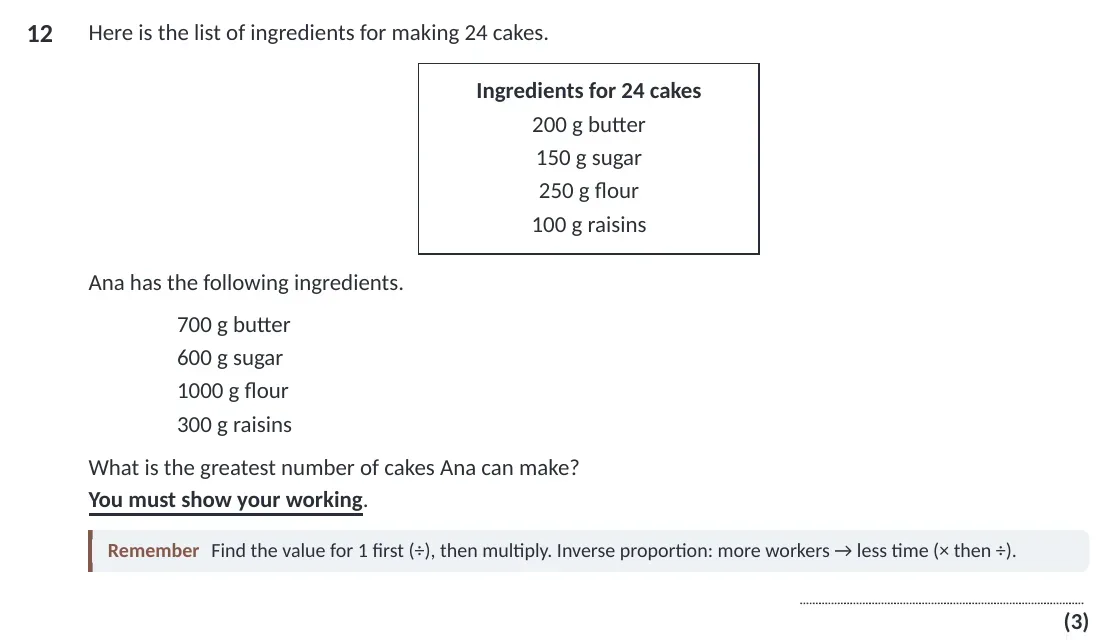
12 Here is the list of ingredients for making 24 cakes. Ingredients for 24 cakes 200 g butter 150 g sugar 250 g flour 100 g raisins Ana has the following ingredients. 700 g butter 600 g sugar 1000 g flour 300 g raisins What is the greatest number of cakes Ana can make? You must show your working. Remember Find the value for 1 first (÷), then multiply. Inverse proportion: more workers → less time (
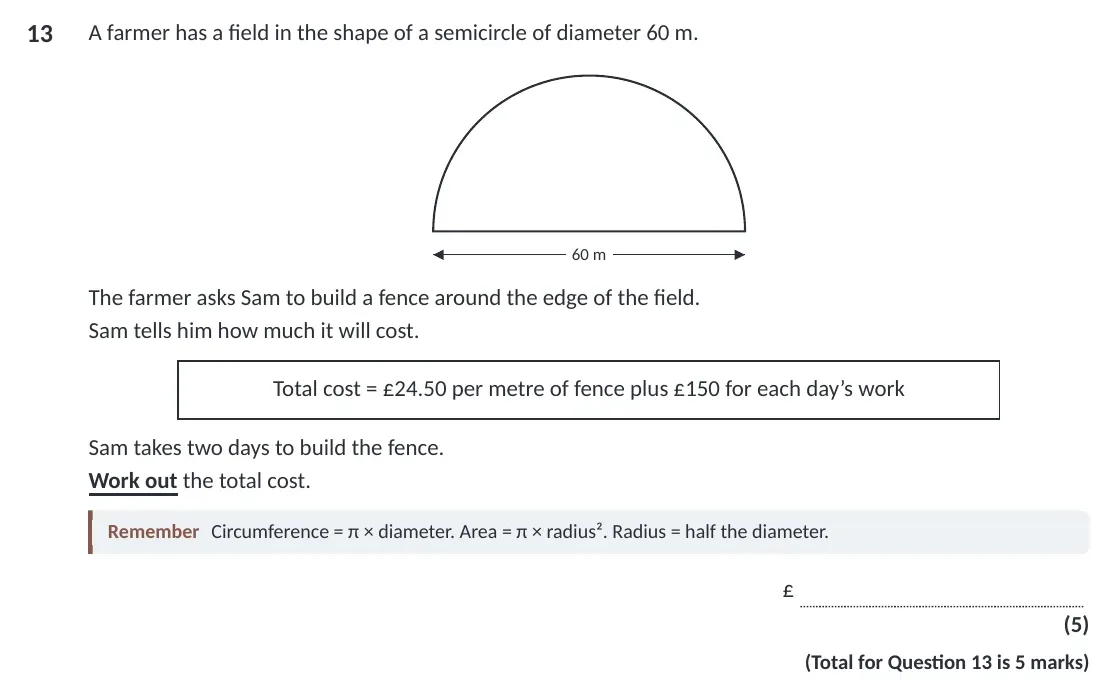
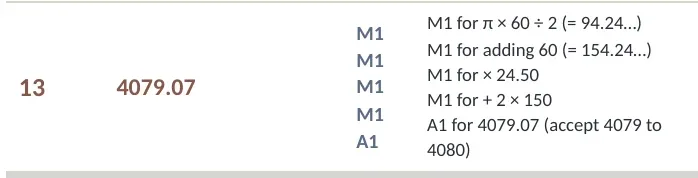
13 A farmer has a field in the shape of a semicircle of diameter 60 m. 60 m The farmer asks Sam to build a fence around the edge of the field. Sam tells him how much it will cost. Total cost = £24.50 per metre of fence plus £150 for each day’s work Sam takes two days to build the fence. Work out the total cost. Remember Circumference = π × diameter. Area = π × radius². Radius = half the diameter.
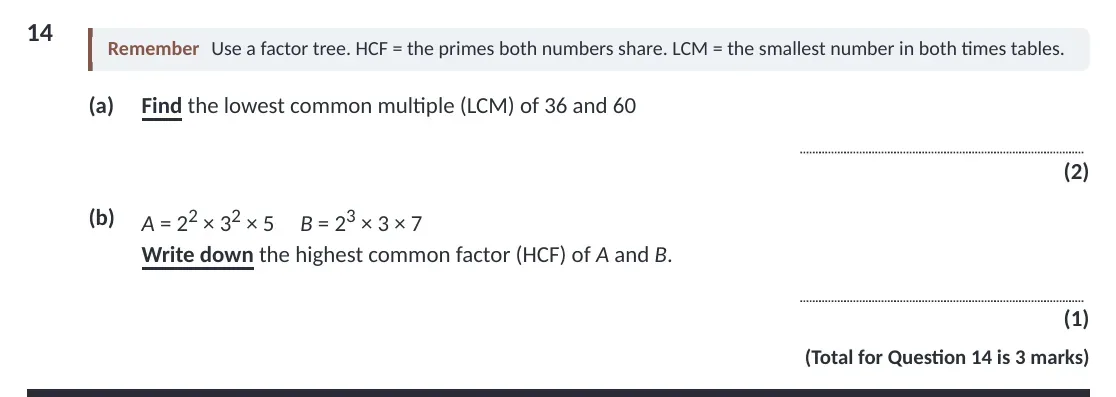
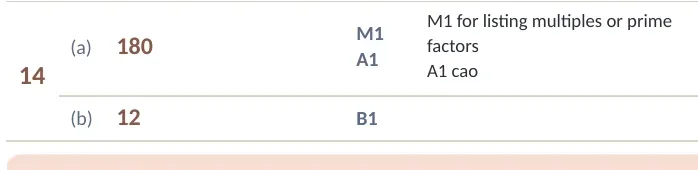
14 Remember Use a factor tree. HCF = the primes both numbers share. LCM = the smallest number in both times tables. (a) Find the lowest common multiple (LCM) of 36 and 60 (2) (b) A = 2 2 × 3 2 × 5 B = 2 3 × 3 × 7 Write down the highest common factor (HCF) of A and B. (1) 📄 sheet: HCF and LCM (Total for Question 14 is 3 marks)
◀ C4All papersC6 ▶
Answer the questions, then mark your paper.