Miss North Maths

Half paper C3

Paper 2 style · Calculator · 36 marks · about 35–40 minutes

How it works. Type each answer in its box. Tap any underlined word on the paper to see what it wants you to do. Stuck? Open the fact sheet under the question. When you finish, press Mark my paper, then check each question against the mark scheme and give yourself the marks you earned, including method marks.

1 3 as a decimal. 1000 Write 📄 sheet: Converting fractions, decimals and percentages (1) (Total for Question 1 is 1 mark)
2 Write down a multiple of 9 that is between 60 and 70 📄 sheet: and multiples (1) (Total for Question 2 is 1 mark)
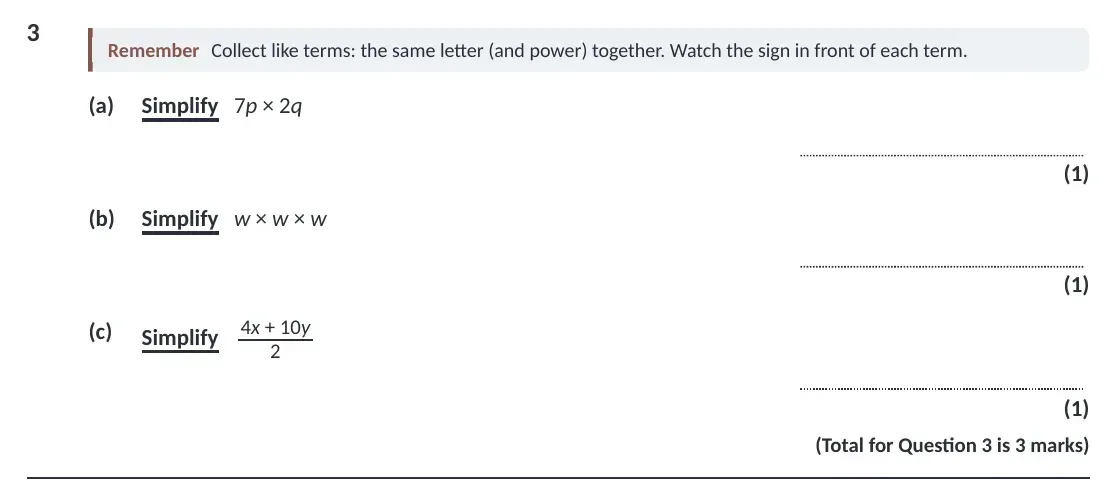
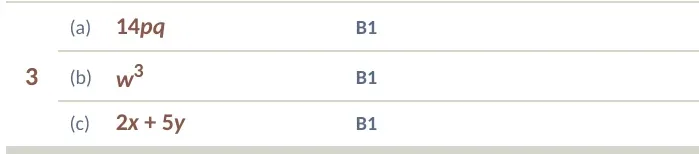
3 Remember Collect like terms: the same letter (and power) together. Watch the sign in front of each term. (a) Simplify 7p × 2q (1) (b) Simplify w × w × w (1) (c) Simplify 4x + 10y 2 📄 sheet: Expressions (1) (Total for Question 3 is 3 marks)
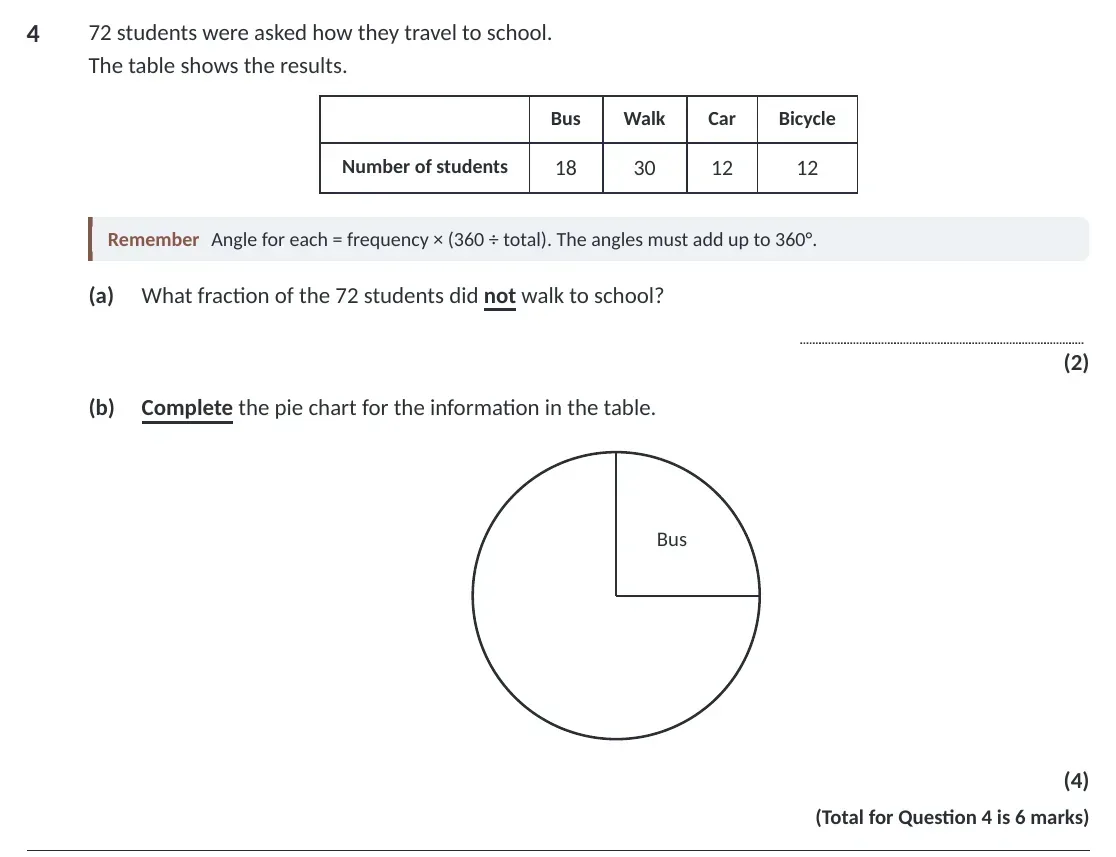
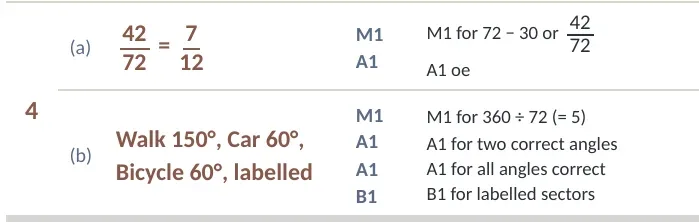
4 72 students were asked how they travel to school. The table shows the results. Number of students Bus Walk Car Bicycle 18 30 12 12 Remember Angle for each = frequency × (360 ÷ total). The angles must add up to 360°. (a) What fraction of the 72 students did not walk to school? (2) (b) Complete the pie chart for the information in the table. Bus 📄 sheet: Pie charts 📄 sheet: Fractions (4) (Total fo
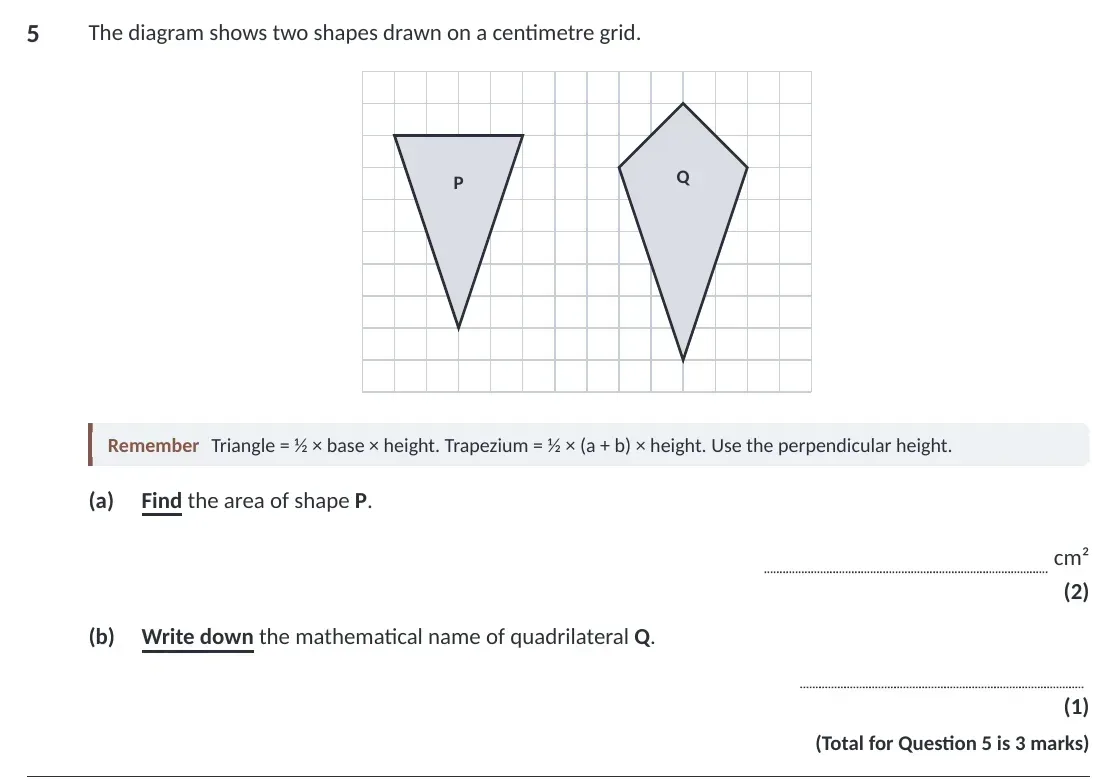
5 The diagram shows two shapes drawn on a centimetre grid. P Q Remember Triangle = ½ × base × height. Trapezium = ½ × (a + b) × height. Use the perpendicular height. (a) Find the area of shape P. cm² (2) (b) Write down the mathematical name of quadrilateral Q. 📄 sheet: Area 📄 sheet: Place value and written calculation (1) (Total for Question 5 is 3 marks)
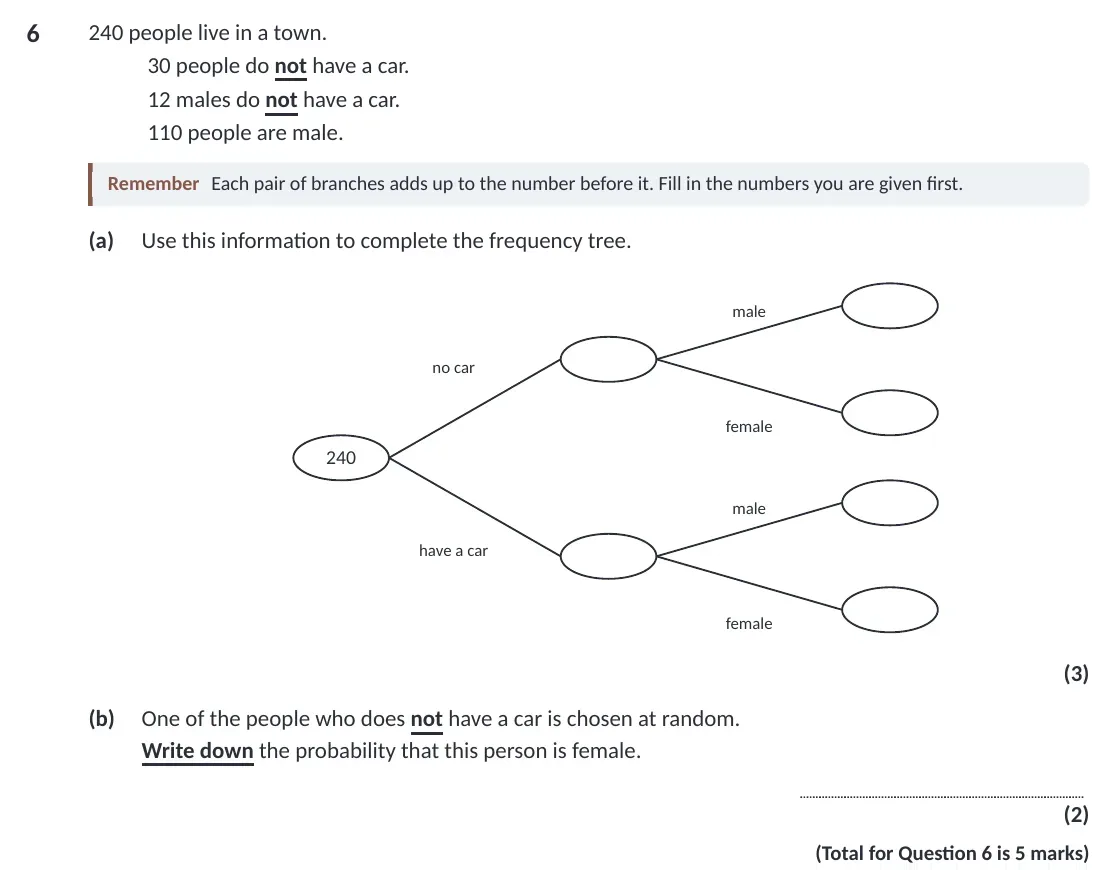
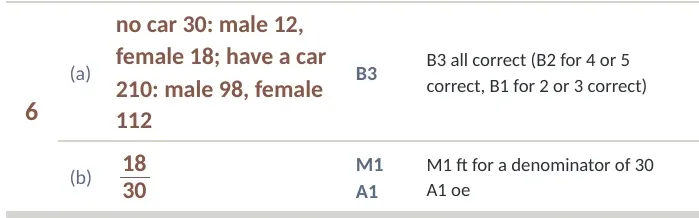
6 240 people live in a town. 30 people do not have a car. 12 males do not have a car. 110 people are male. Remember Each pair of branches adds up to the number before it. Fill in the numbers you are given first. (a) Use this information to complete the frequency tree. male no car female 240 male have a car female (3) (b) One of the people who does not have a car is chosen at random. Write down the
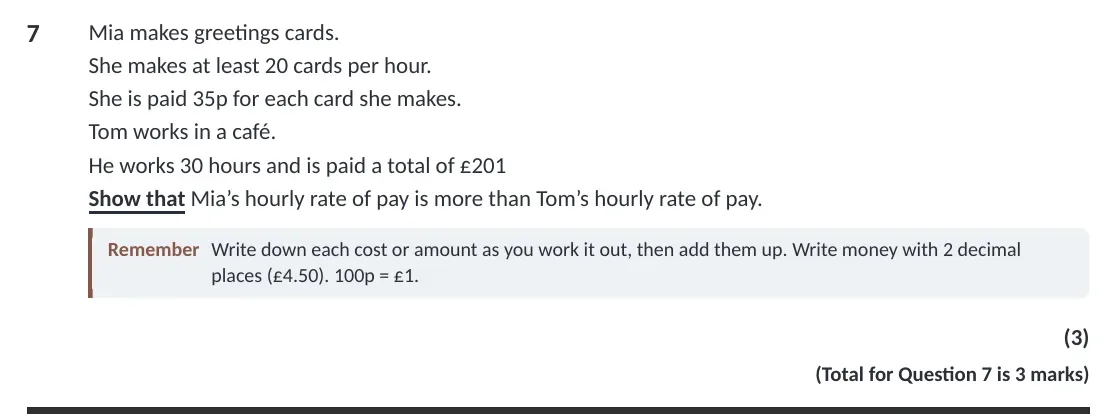
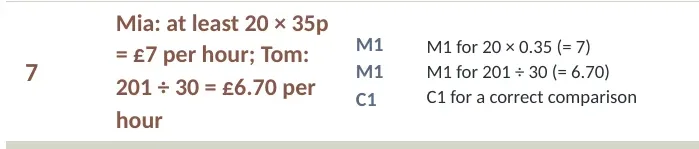
7 Mia makes greetings cards. She makes at least 20 cards per hour. She is paid 35p for each card she makes. Tom works in a café. He works 30 hours and is paid a total of £201 Show that Mia’s hourly rate of pay is more than Tom’s hourly rate of pay. Remember Write down each cost or amount as you work it out, then add them up. Write money with 2 decimal places (£4.50). 100p = £1. 📄 sheet: Wages, bil
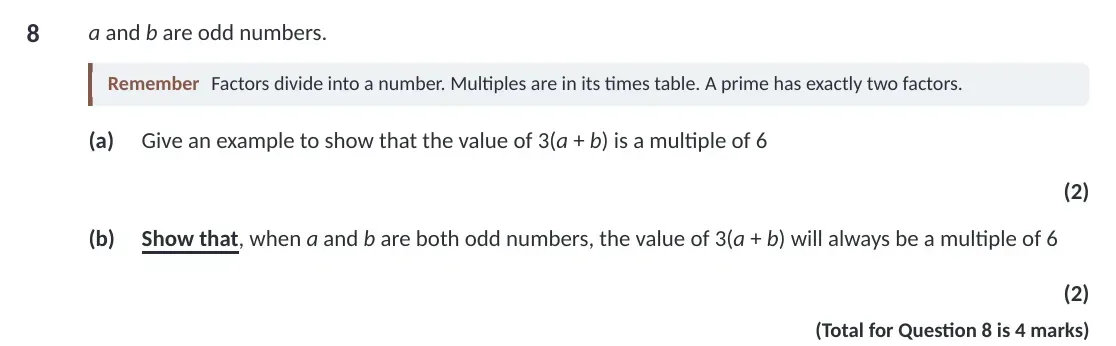
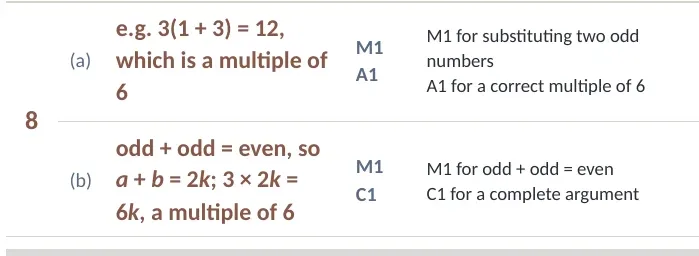
8 a and b are odd numbers. Remember divide into a number. Multiples are in its times table. A prime has exactly two factors. (a) Give an example to show that the value of 3(a + b) is a multiple of 6 (2) (b) Show that, when a and b are both odd numbers, the value of 3(a + b) will always be a multiple of 6 (2) 📄 sheet: Primes, squares, odd and even (Total for Question 8 is 4 marks)
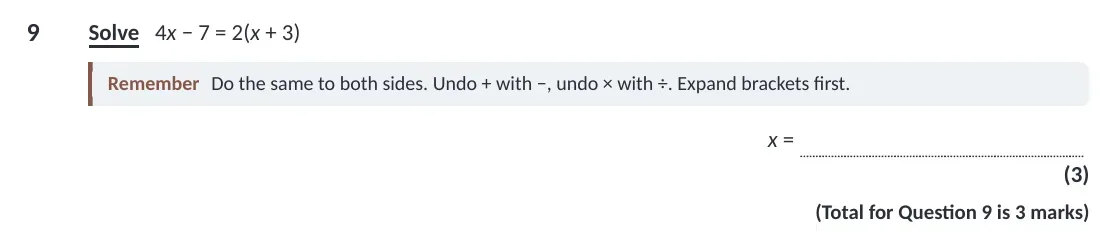
9 Solve 4x − 7 = 2(x + 3) Remember Do the same to both sides. Undo + with −, undo × with ÷. Expand brackets first. x = 📄 sheet: Letters on both sides, card 2 (3) (Total for Question 9 is 3 marks)
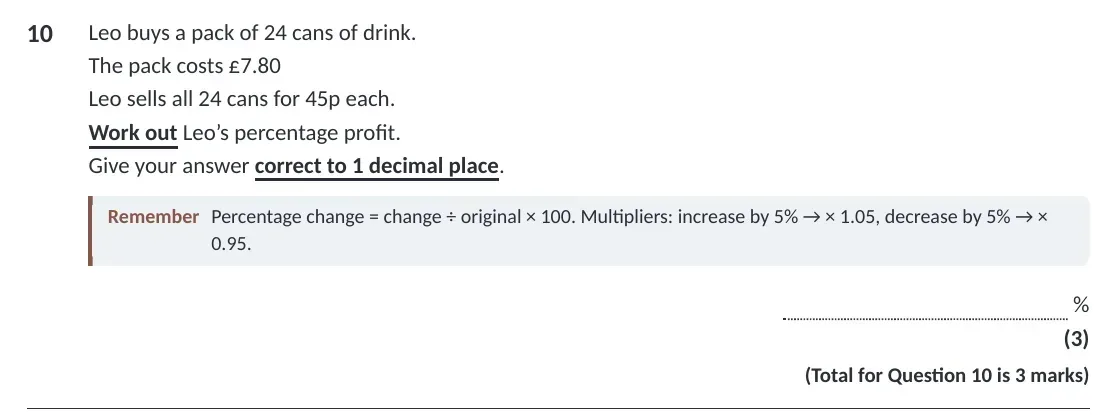
10 Leo buys a pack of 24 cans of drink. The pack costs £7.80 Leo sells all 24 cans for 45p each. Work out Leo’s percentage profit. Give your answer correct to 1 decimal place. Remember Percentage change = change ÷ original × 100. Multipliers: increase by 5% → × 1.05, decrease by 5% → × 0.95. % 📄 sheet: Percentage change, profit and loss, card 2 (3) (Total for Question 10 is 3 marks)
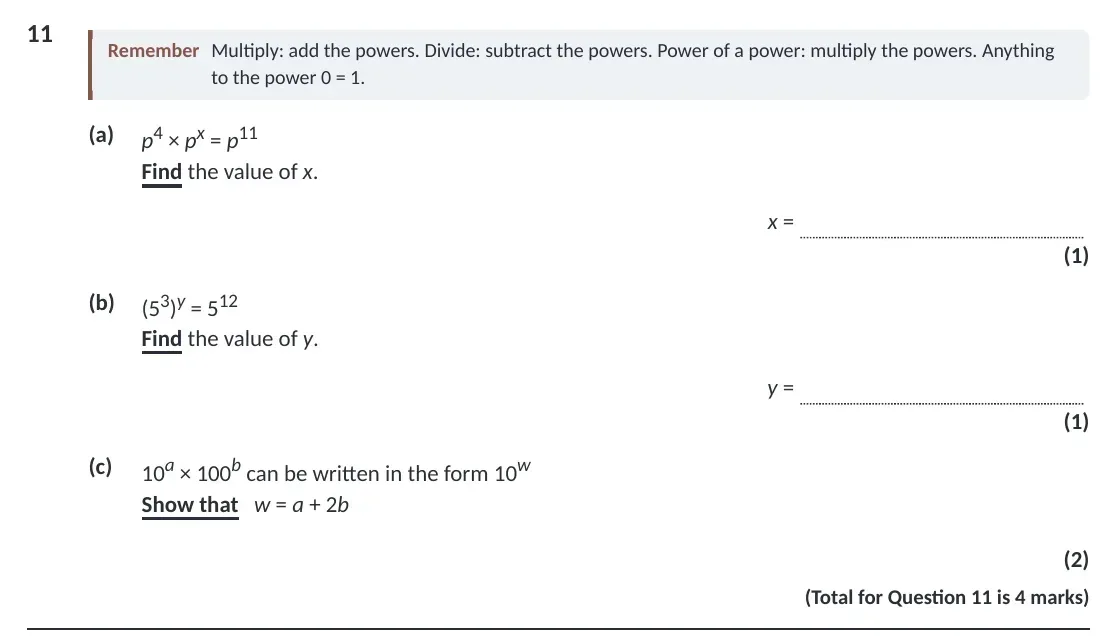
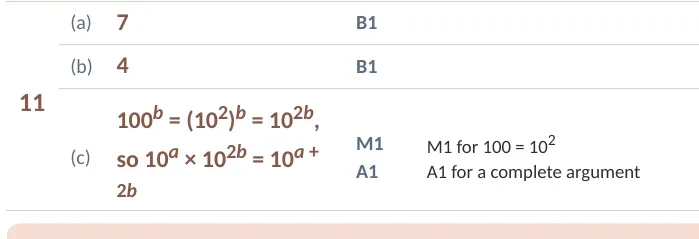
11 Remember Multiply: add the powers. Divide: subtract the powers. Power of a power: multiply the powers. Anything to the power 0 = 1. (a) p 4 × p x = p 11 Find the value of x. x = (1) (b) (5 3 ) y = 5 12 Find the value of y. y = (1) (c) 10 a × 100 b can be written in the form 10 w Show that w = a + 2b 📄 sheet: Laws of indices 📄 sheet: Place value and written calculation (2) (Total for Question 11
◀ C2All papersC4 ▶
Answer the questions, then mark your paper.