Miss North Maths

Half paper C10

Paper 3 style · Calculator · 36 marks · about 35–40 minutes

How it works. Type each answer in its box. Tap any underlined word on the paper to see what it wants you to do. Stuck? Open the fact sheet under the question. When you finish, press Mark my paper, then check each question against the mark scheme and give yourself the marks you earned, including method marks.

1 Write 14 952 to the nearest hundred. 📄 sheet: Rounding to the nearest 10, 100 or 1000 (1) (Total for Question 1 is 1 mark)
2 Change 0.35 kilometres to metres. metres 📄 sheet: Converting units (1) (Total for Question 2 is 1 mark)
3 Write 8% as a fraction. 📄 sheet: Converting fractions, decimals and percentages (1) (Total for Question 3 is 1 mark)
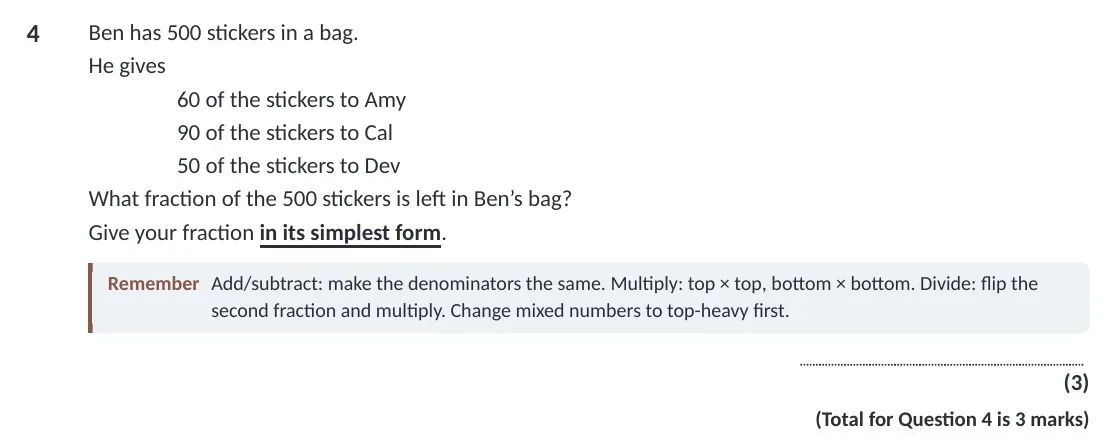
4 Ben has 500 stickers in a bag. He gives 60 of the stickers to Amy 90 of the stickers to Cal 50 of the stickers to Dev What fraction of the 500 stickers is left in Ben’s bag? Give your fraction in its simplest form. Remember Add/subtract: make the denominators the same. Multiply: top × top, bottom × bottom. Divide: flip the second fraction and multiply. Change mixed numbers to top-heavy first. (3
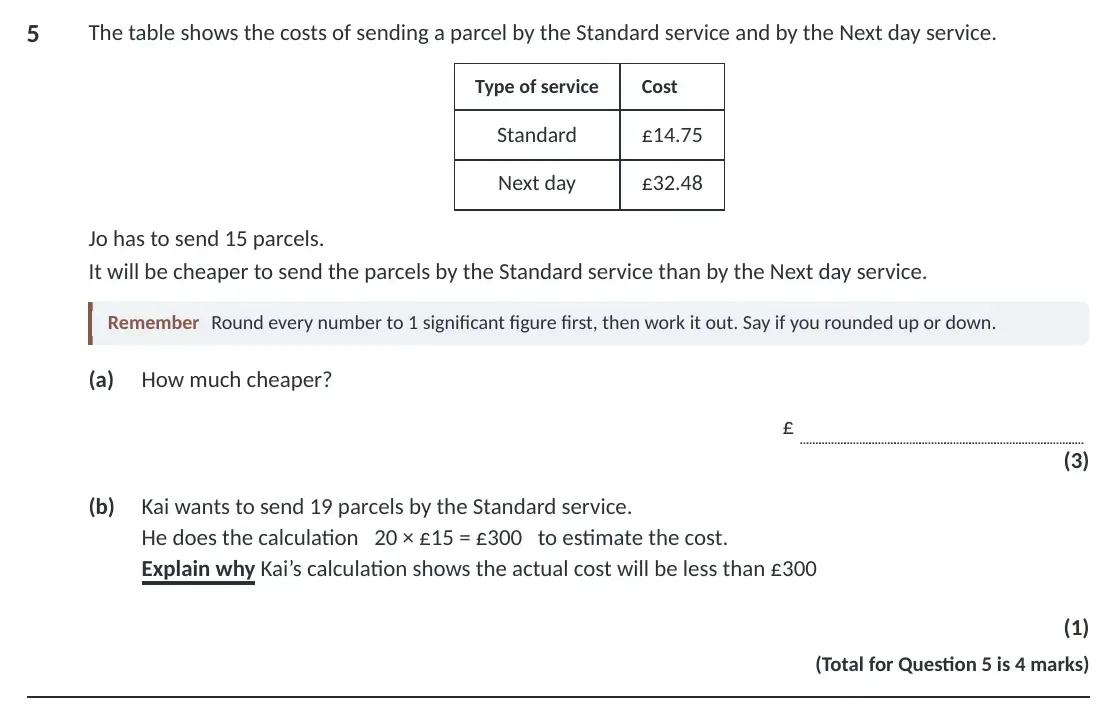
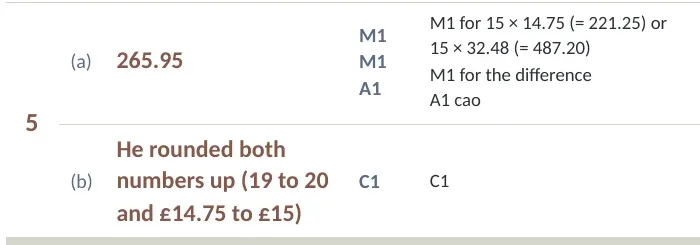
5 The table shows the costs of sending a parcel by the Standard service and by the Next day service. Type of service Cost Standard £14.75 Next day £32.48 Jo has to send 15 parcels. It will be cheaper to send the parcels by the Standard service than by the Next day service. Remember Round every number to 1 significant figure first, then work it out. Say if you rounded up or down. (a) How much cheap
6 Amy, Ben and Cal share an amount of money in the ratio 4 : 5 : 11 What fraction of the money does Ben get? 📄 sheet: Ratios and fractions (2) (Total for Question 6 is 2 marks)
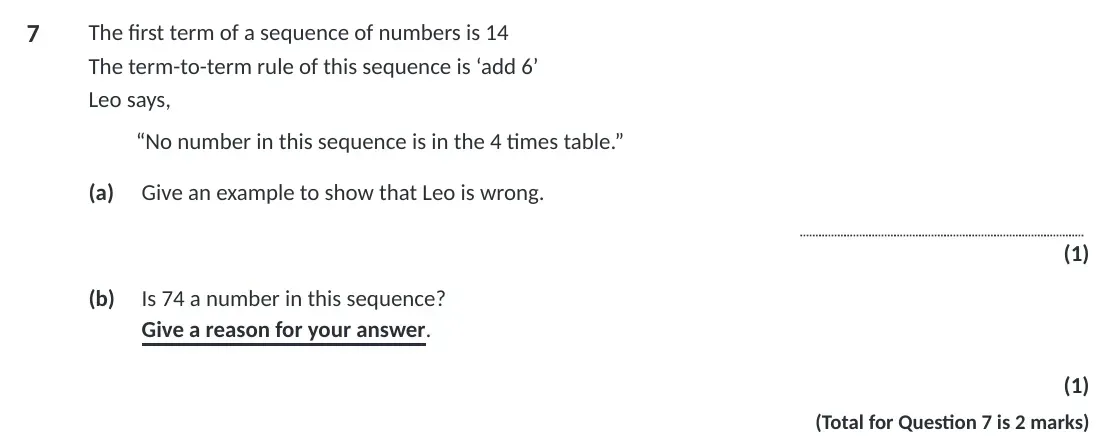
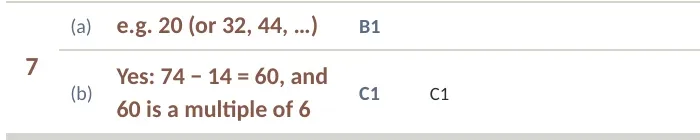
7 The first term of a sequence of numbers is 14 The term-to-term rule of this sequence is ‘add 6’ Leo says, “No number in this sequence is in the 4 times table.” (a) Give an example to show that Leo is wrong. (1) (b) Is 74 a number in this sequence? Give a reason for your answer. 📄 sheet: Term-to-term rules and patterns (1) (Total for Question 7 is 2 marks)
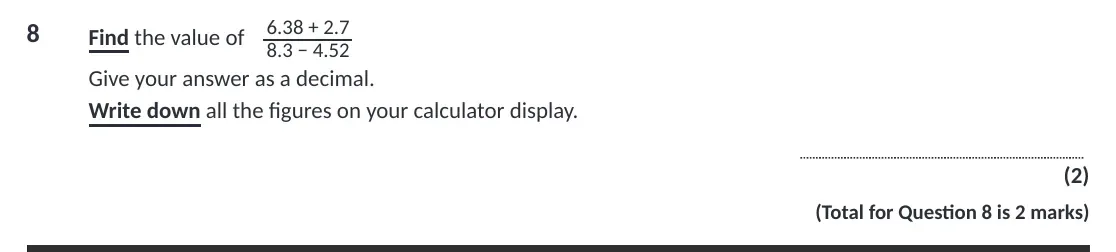
8 Find the value of 6.38 + 2.7 8.3 − 4.52 Give your answer as a decimal. Write down all the figures on your calculator display. 📄 sheet: Using a calculator (2) (Total for Question 8 is 2 marks)
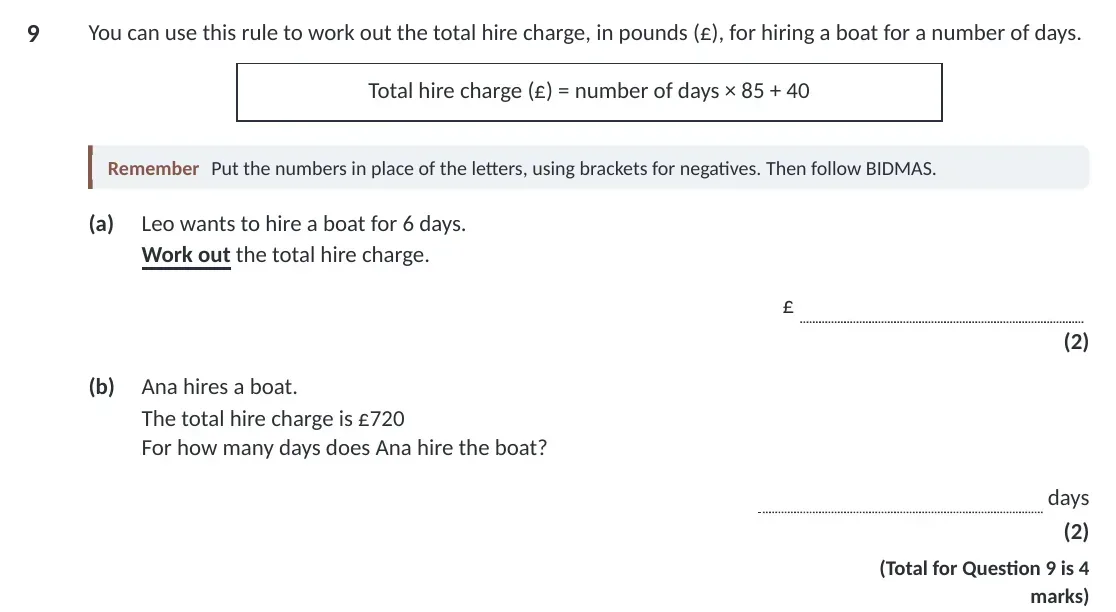
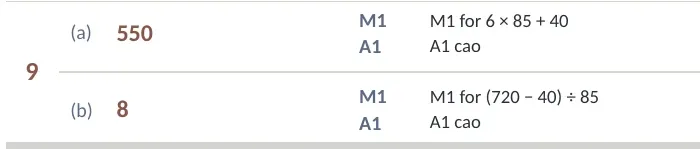
9 You can use this rule to work out the total hire charge, in pounds (£), for hiring a boat for a number of days. Total hire charge (£) = number of days × 85 + 40 Remember Put the numbers in place of the letters, using brackets for negatives. Then follow BIDMAS. (a) Leo wants to hire a boat for 6 days. Work out the total hire charge. £ (2) (b) Ana hires a boat. The total hire charge is £720 For ho
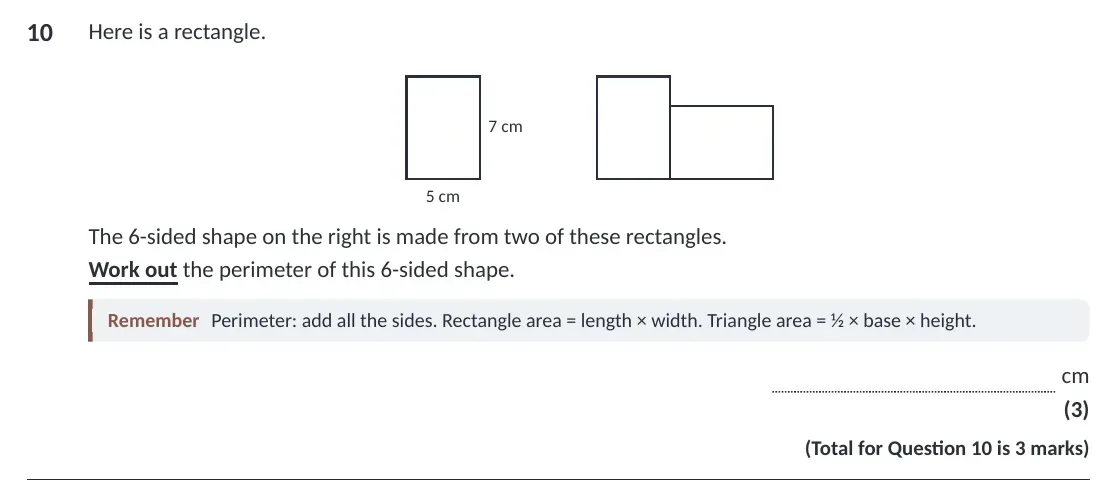
10 Here is a rectangle. 7 cm 5 cm The 6-sided shape on the right is made from two of these rectangles. Work out the perimeter of this 6-sided shape. Remember Perimeter: add all the sides. Rectangle area = length × width. Triangle area = ½ × base × height. cm 📄 sheet: Perimeter (3) (Total for Question 10 is 3 marks)
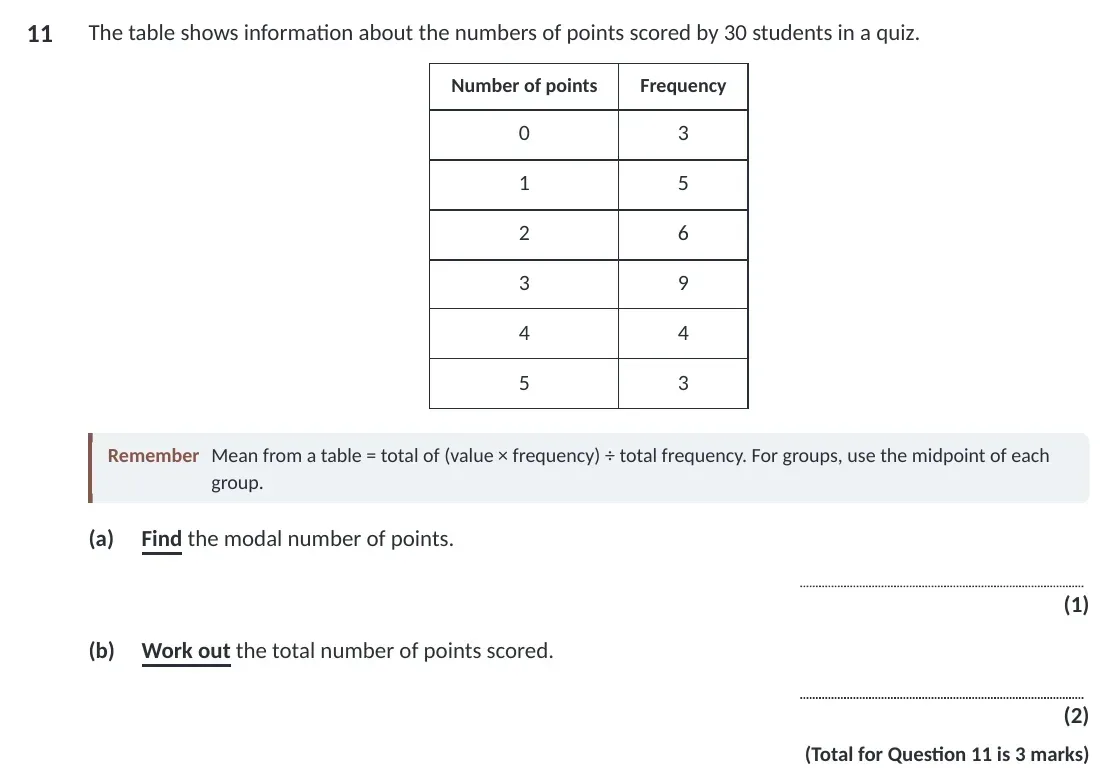
11 The table shows information about the numbers of points scored by 30 students in a quiz. Number of points Frequency 0 3 1 5 2 6 3 9 4 4 5 3 Remember Mean from a table = total of (value × frequency) ÷ total frequency. For groups, use the midpoint of each group. (a) Find the modal number of points. (1) (b) Work out the total number of points scored. 📄 sheet: Averages from tables (2) (Total for Qu
12 Make x the subject of the formula y = 3x − 5 📄 sheet: Rearranging formulae (2) (Total for Question 12 is 2 marks)
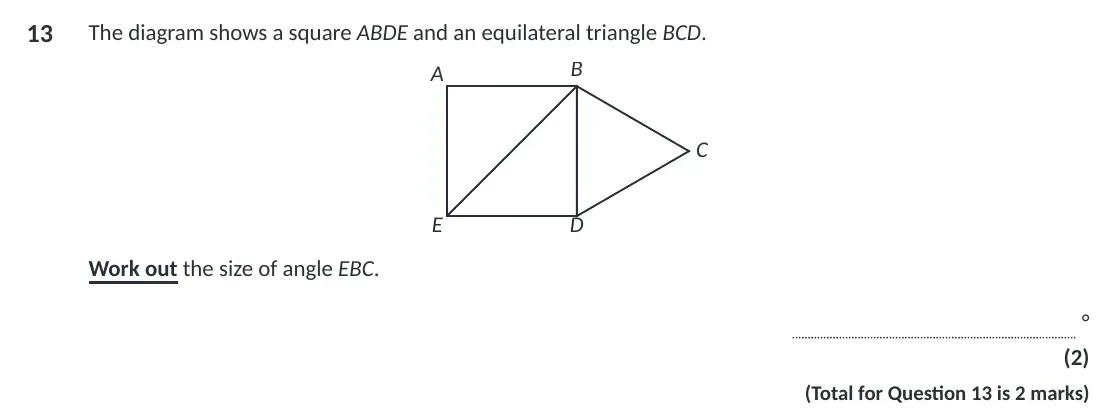
13 The diagram shows a square ABDE and an equilateral triangle BCD. A B C E D Work out the size of angle EBC. ° (2) 📄 sheet: Angle facts (Total for Question 13 is 2 marks)
14 Tom goes on holiday to Mexico. Tom wants to change £600 into Mexican pesos. He wants to get as many 500 peso notes as possible. The exchange rate is £1 = 23.4 pesos. Work out the greatest number of 500 peso notes that Tom can get for £600 Remember £ to another currency: multiply by the rate. Another currency to £: divide by the rate. (3) 📄 sheet: Exchange rates (Total for Question 14 is 3 marks
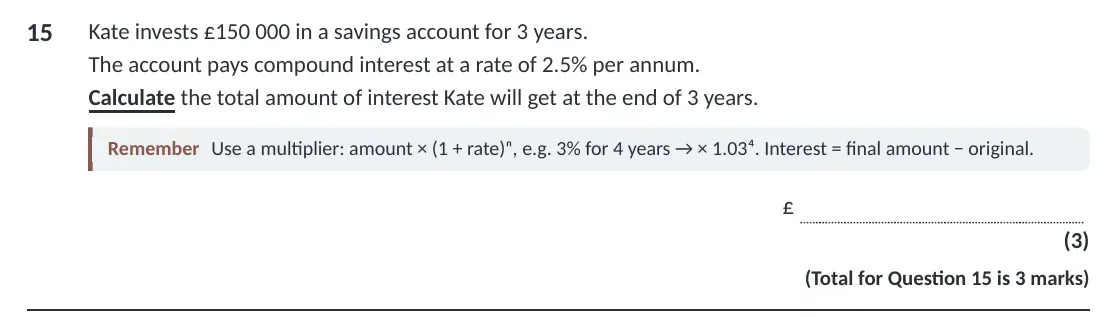
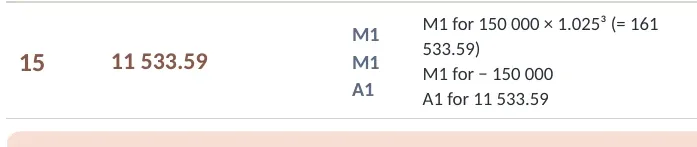
15 Kate invests £150 000 in a savings account for 3 years. The account pays compound interest at a rate of 2.5% per annum. Calculate the total amount of interest Kate will get at the end of 3 years. Remember Use a multiplier: amount × (1 + rate)ⁿ, e.g. 3% for 4 years → × 1.03⁴. Interest = final amount − original. £ 📄 sheet: Simple and compound interest (3) (Total for Question 15 is 3 marks)
◀ C9All papersC11 ▶
Answer the questions, then mark your paper.