Miss North Maths

Full paper D3

Paper 3 style · Calculator · 80 marks · 1 hour 30 minutes

How it works. Type each answer in its box. Tap any underlined word on the paper to see what it wants you to do. Stuck? Open the fact sheet under the question. When you finish, press Mark my paper, then check each question against the mark scheme and give yourself the marks you earned, including method marks.

1 Write 45% as a decimal. 📄 sheet: Converting fractions, decimals and percentages (Total for Question 1 is 1 mark) (1)
2 (1) (Total for Question 2 is 1 mark) Write 6347 correct to the nearest hundred. 📄 sheet: Rounding to the nearest 10, 100 or 1000
Write down a number that is less than −8 📄 sheet: Ordering negative numbers 3 (1) (Total for Question 3 is 1 mark)
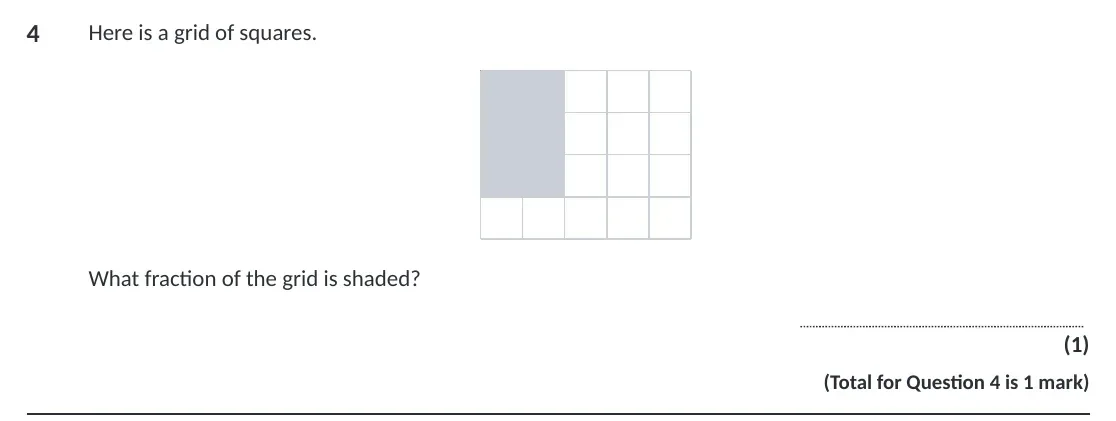
4 Here is a grid of squares. What fraction of the grid is shaded? 📄 sheet: Fractions of amounts and shapes, card 3 (1) (Total for Question 4 is 1 mark)

5 Write down the value of the 7 in the number 34.172 (1) 📄 sheet: Place value and number facts (Total for Question 5 is 1 mark)
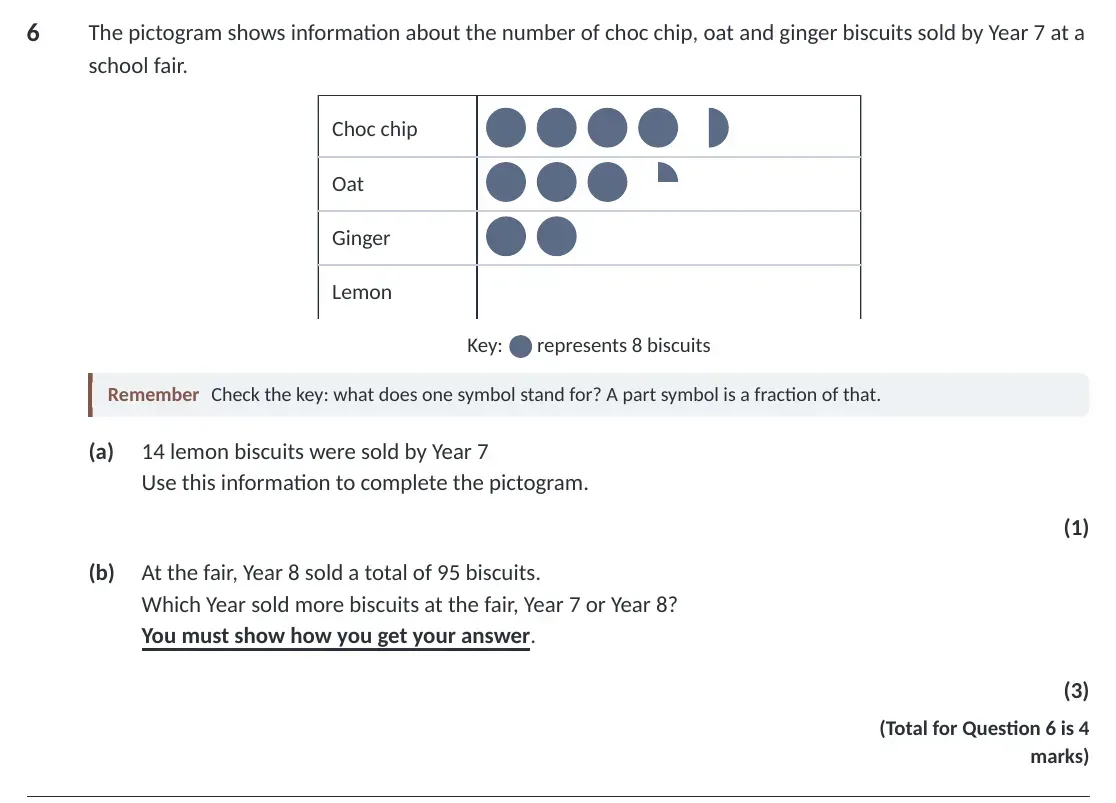
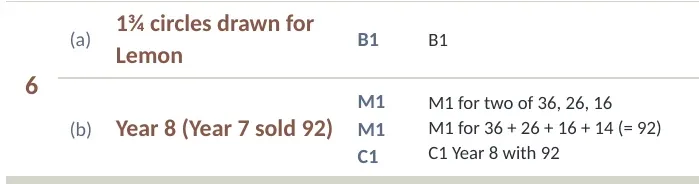
6 The pictogram shows information about the number of choc chip, oat and ginger biscuits sold by Year 7 at a school fair. Choc chip Oat Ginger Lemon Key: represents 8 biscuits Remember Check the key: what does one symbol stand for? A part symbol is a fraction of that. (a) 14 lemon biscuits were sold by Year 7 Use this information to complete the pictogram. (1) (b) At the fair, Year 8 sold a total
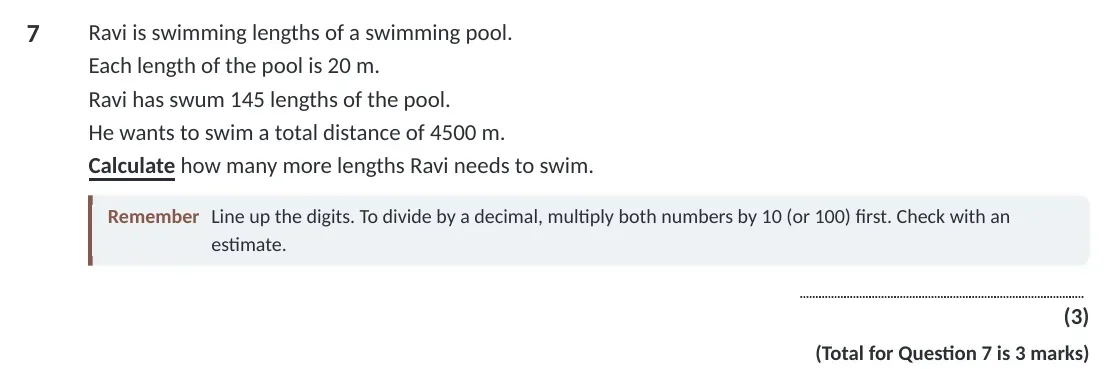
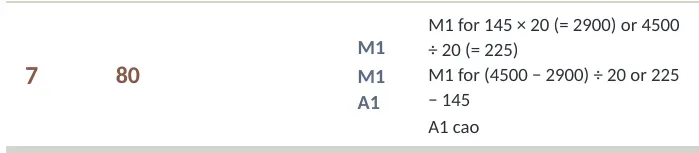
7 Ravi is swimming lengths of a swimming pool. Each length of the pool is 20 m. Ravi has swum 145 lengths of the pool. He wants to swim a total distance of 4500 m. Calculate how many more lengths Ravi needs to swim. Remember Line up the digits. To divide by a decimal, multiply both numbers by 10 (or 100) first. Check with an estimate. (3) 📄 sheet: Number problems and number machines (Total for Que
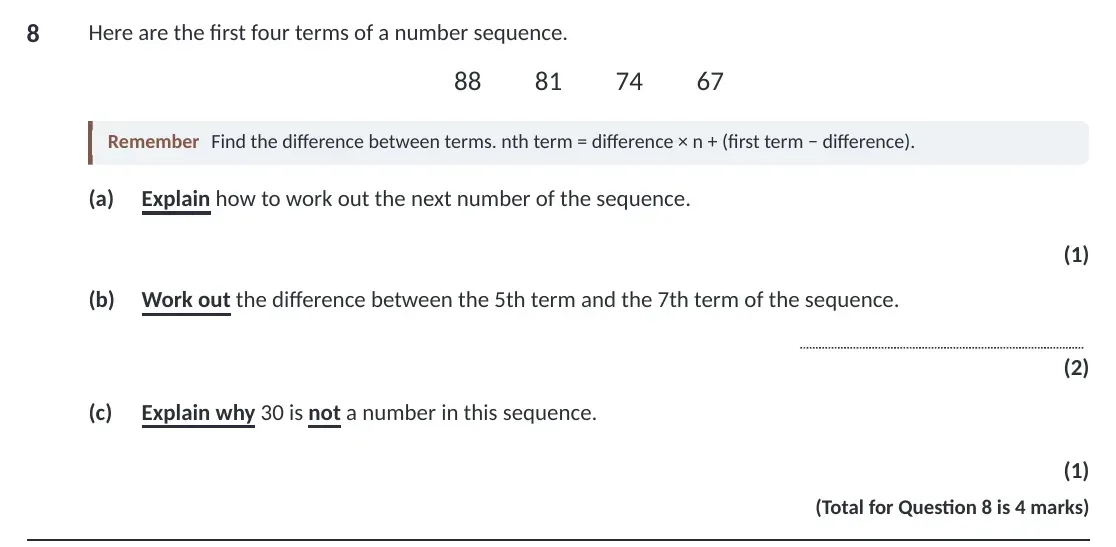
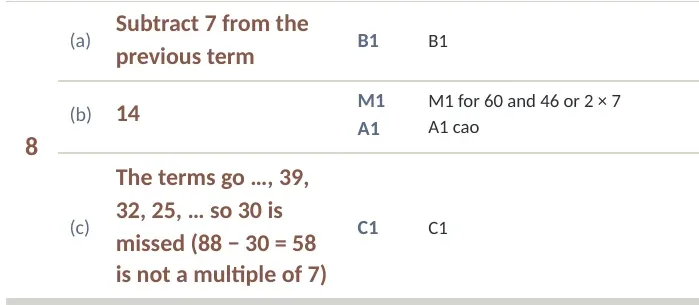
8 Here are the first four terms of a number sequence. 88 81 74 67 Remember Find the difference between terms. nth term = difference × n + (first term − difference). (a) Explain how to work out the next number of the sequence. (1) (b) Work out the difference between the 5th term and the 7th term of the sequence. (2) (c) Explain why 30 is not a number in this sequence. 📄 sheet: Term-to-term rules an
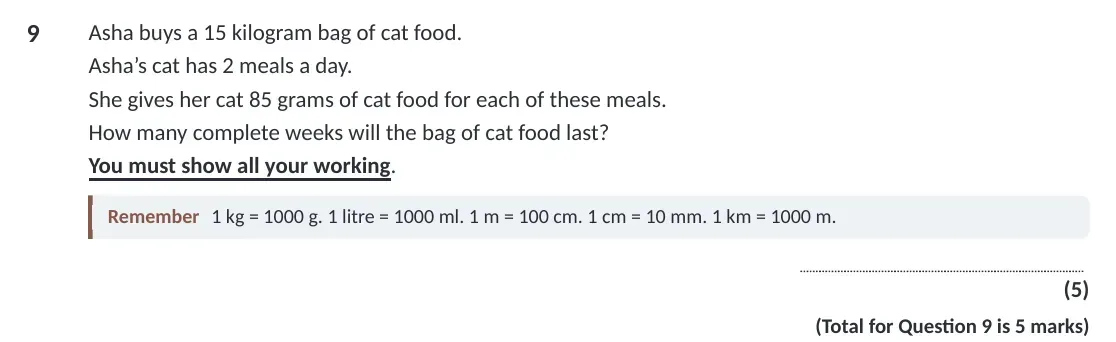
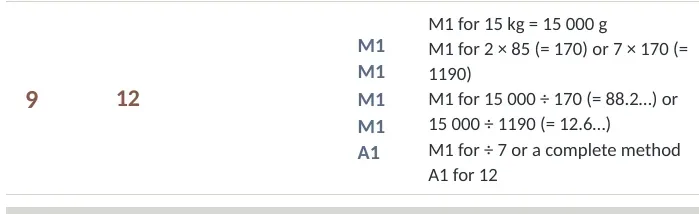
9 Asha buys a 15 kilogram bag of cat food. Asha’s cat has 2 meals a day. She gives her cat 85 grams of cat food for each of these meals. How many complete weeks will the bag of cat food last? You must show all your working. Remember 1 kg = 1000 g. 1 litre = 1000 ml. 1 m = 100 cm. 1 cm = 10 mm. 1 km = 1000 m. 📄 sheet: Converting units (5) (Total for Question 9 is 5 marks)
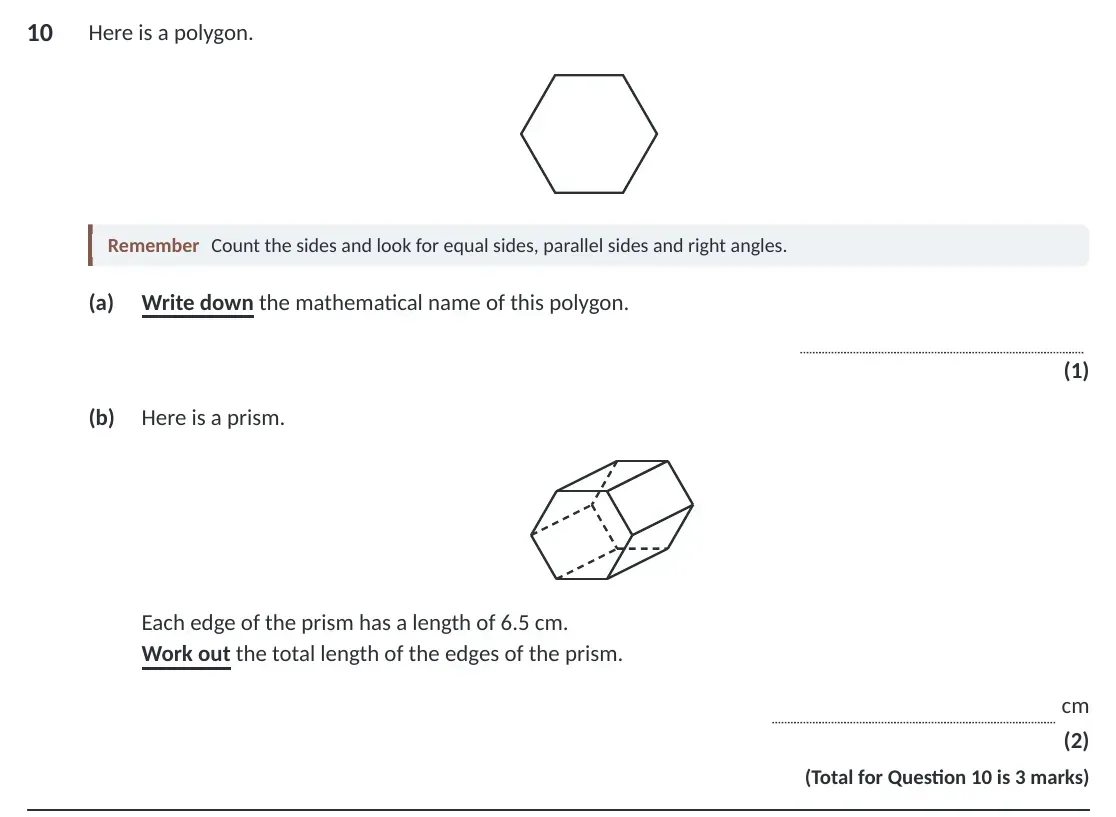
10 Here is a polygon. Remember Count the sides and look for equal sides, parallel sides and right angles. (a) Write down the mathematical name of this polygon. (1) (b) Here is a prism. Each edge of the prism has a length of 6.5 cm. Work out the total length of the edges of the prism. cm 📄 sheet: Names, faces and edges (2) (Total for Question 10 is 3 marks)
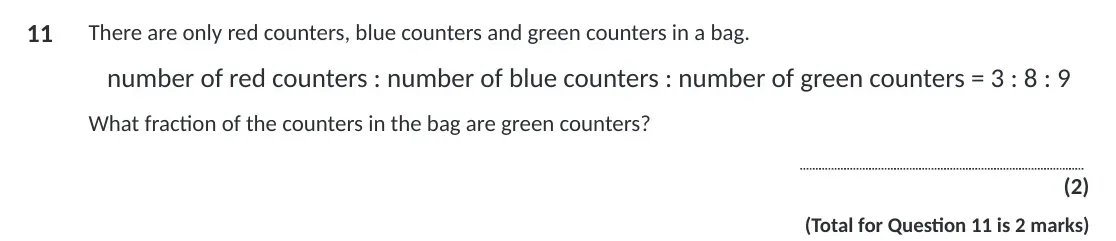
11 There are only red counters, blue counters and green counters in a bag. number of red counters : number of blue counters : number of green counters = 3 : 8 : 9 What fraction of the counters in the bag are green counters? (2) 📄 sheet: Ratios and fractions 📄 sheet: Fractions (Total for Question 11 is 2 marks)
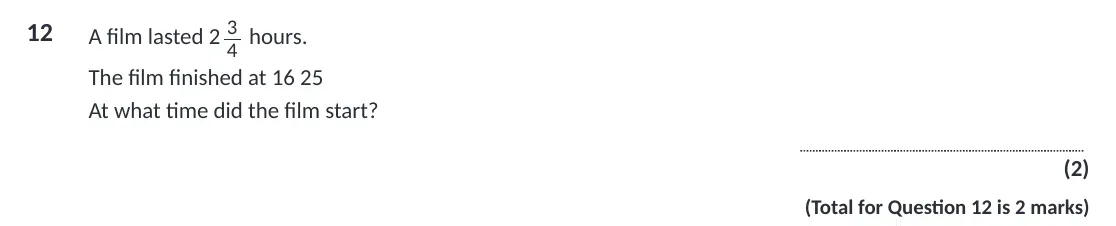
12 A film lasted 2 3 hours. 4 The film finished at 16 25 At what time did the film start? (2) 📄 sheet: Time and timetables (Total for Question 12 is 2 marks)
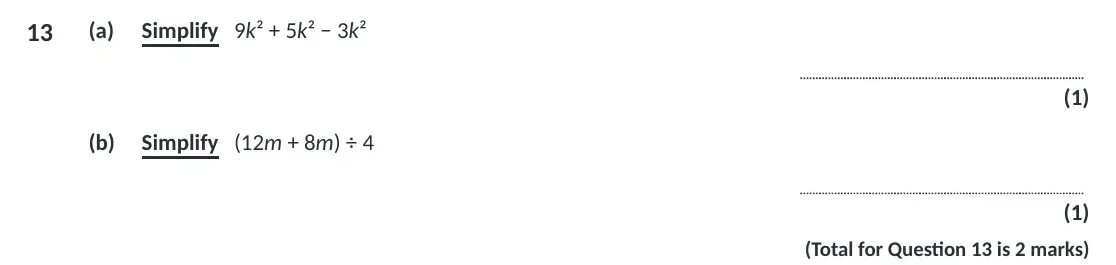
13 (a) Simplify 9k² + 5k² − 3k² (1) (b) Simplify (12m + 8m) ÷ 4 (1) 📄 sheet: Expressions (Total for Question 13 is 2 marks)
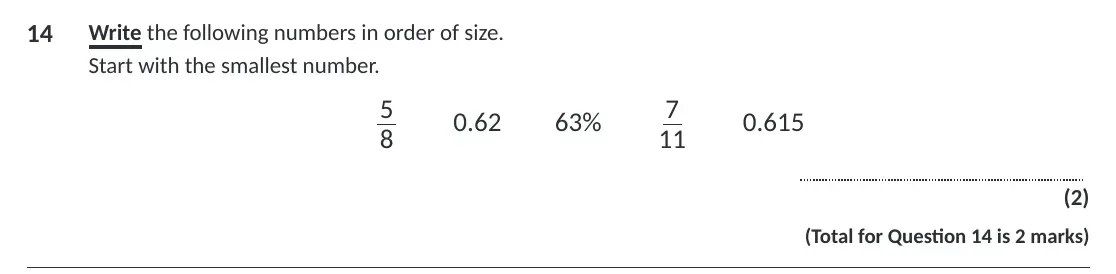
14 Write the following numbers in order of size. Start with the smallest number. 5 8 0.62 📄 sheet: Ordering fractions and mixed lists 63% 7 11 0.615 (2) (Total for Question 14 is 2 marks)
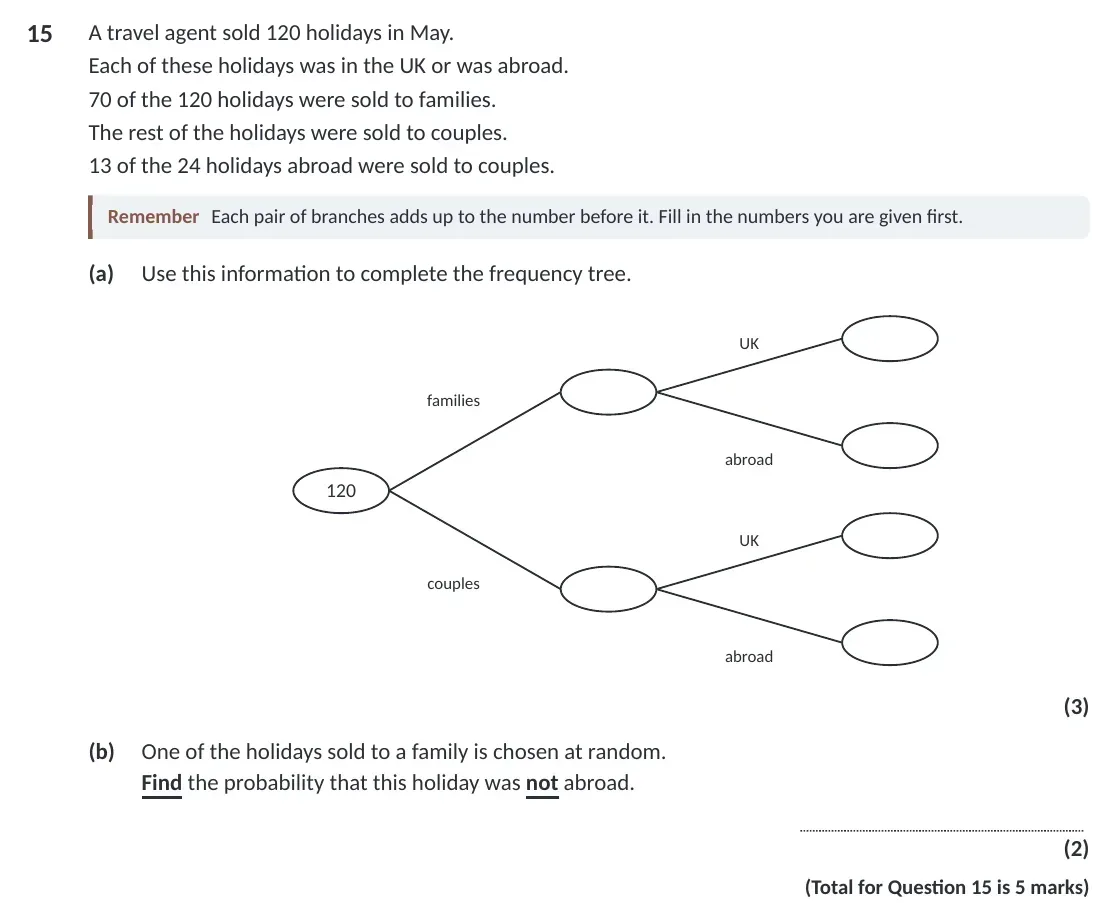
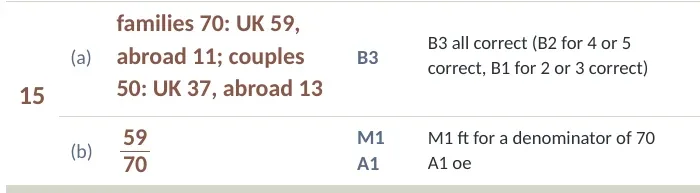
15 A travel agent sold 120 holidays in May. Each of these holidays was in the UK or was abroad. 70 of the 120 holidays were sold to families. The rest of the holidays were sold to couples. 13 of the 24 holidays abroad were sold to couples. Remember Each pair of branches adds up to the number before it. Fill in the numbers you are given first. (a) Use this information to complete the frequency tree
16 Solve x + 7 = 3 5 x = 📄 sheet: Solving equations, card 3 (2) (Total for Question 16 is 2 marks)
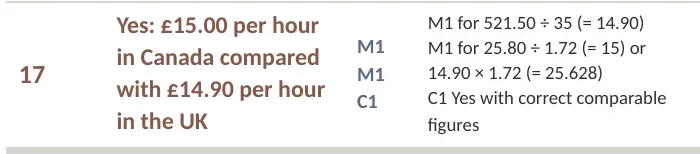
17 Callum works 35 hours a week in the UK. He is paid £521.50 per week. Callum applies for a job in Canada. The rate of pay is 25.80 Canadian dollars per hour. £1 = 1.72 Canadian dollars Callum thinks the rate of pay in Canada is greater than the rate of pay in the UK. Is Callum correct? You must show how you get your answer. Remember £ to another currency: multiply by the rate. Another currency t
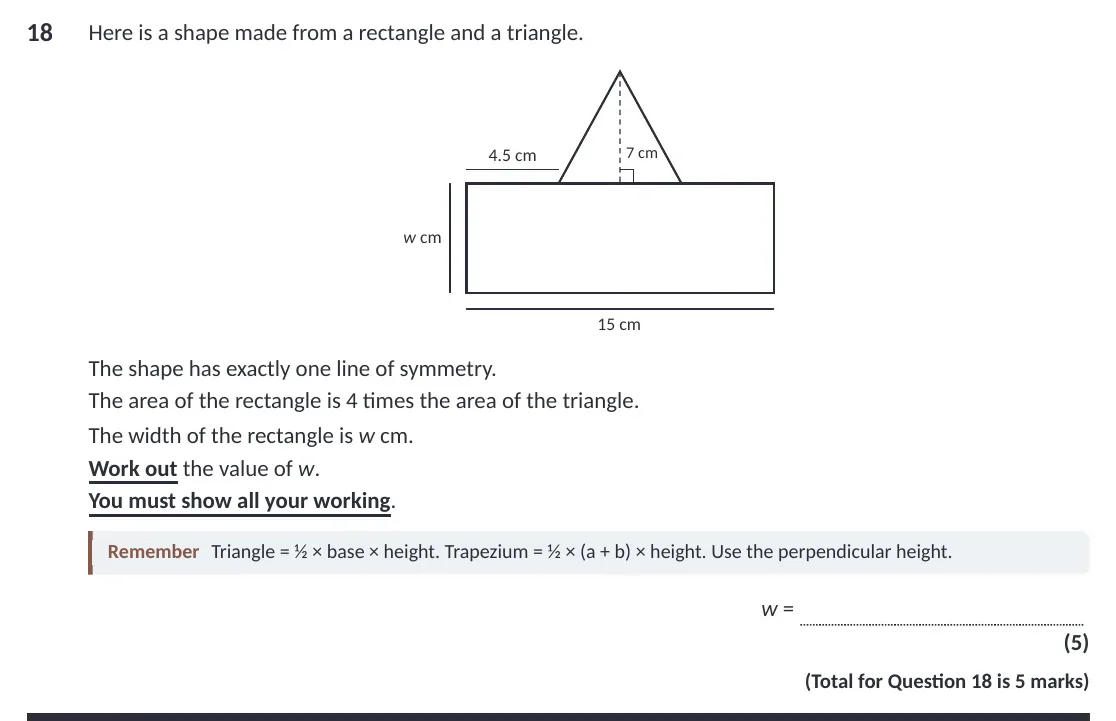
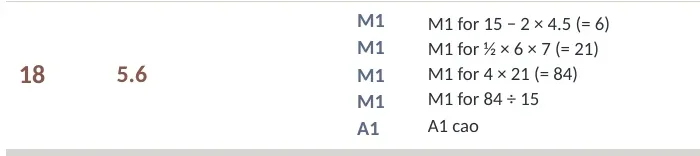
18 Here is a shape made from a rectangle and a triangle. 4.5 cm 7 cm w cm 15 cm The shape has exactly one line of symmetry. The area of the rectangle is 4 times the area of the triangle. The width of the rectangle is w cm. Work out the value of w. You must show all your working. Remember Triangle = ½ × base × height. Trapezium = ½ × (a + b) × height. Use the perpendicular height. w = 📄 sheet: Area
Fact sheet: Area
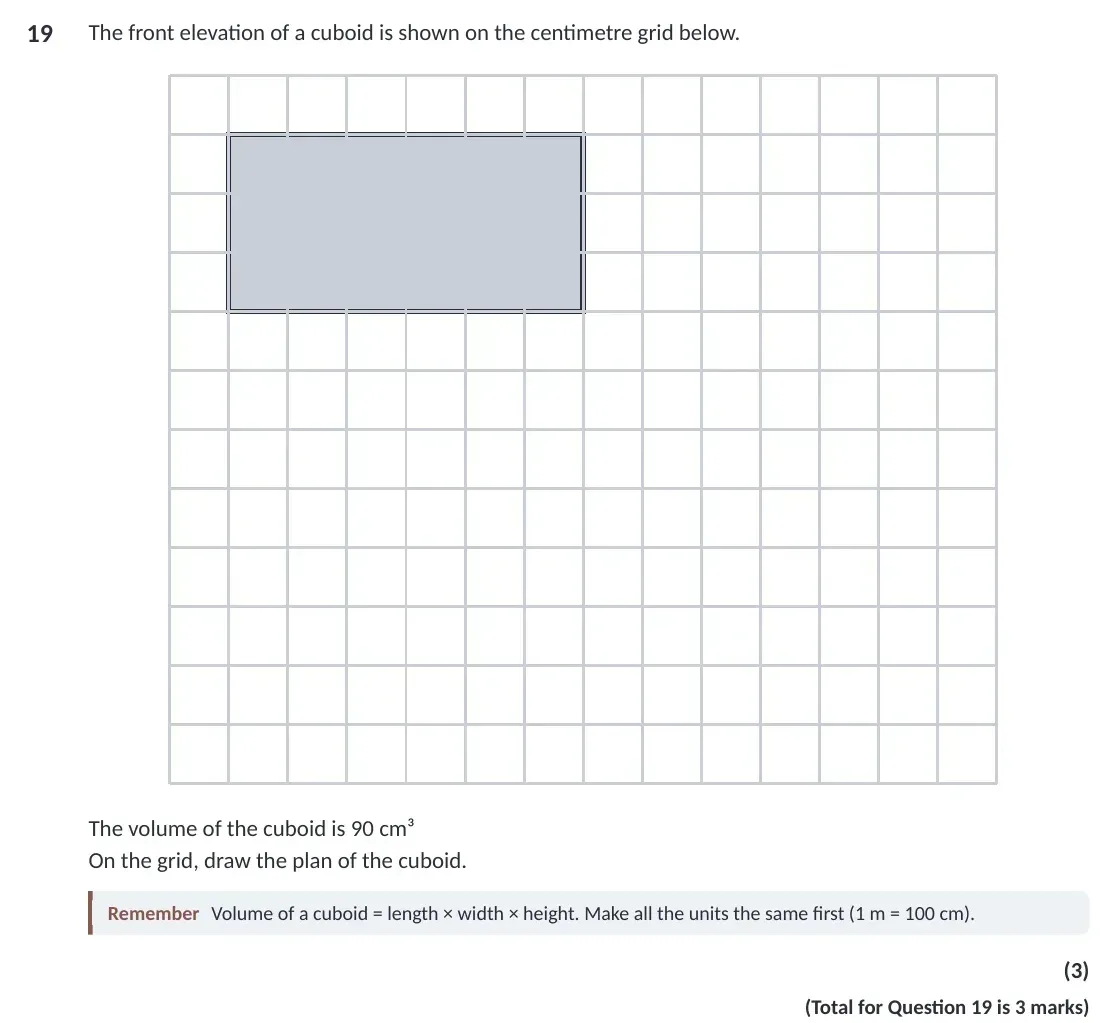
19 The front elevation of a cuboid is shown on the centimetre grid below. The volume of the cuboid is 90 cm³ On the grid, draw the plan of the cuboid. Remember Volume of a cuboid = length × width × height. Make all the units the same first (1 m = 100 cm). 📄 sheet: Volume of cuboids and prisms (3) (Total for Question 19 is 3 marks)
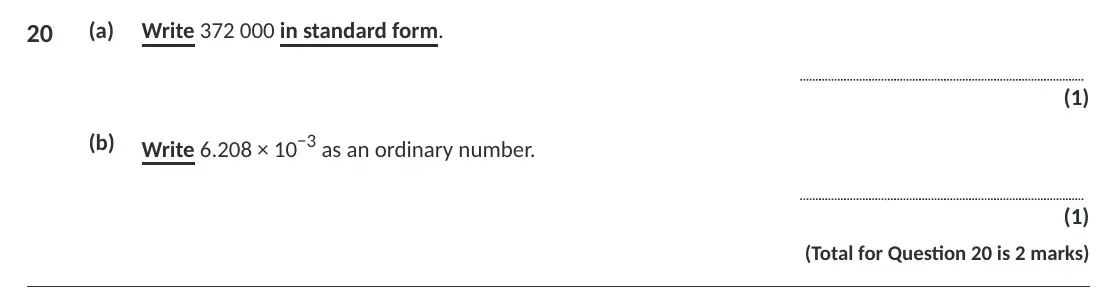
20 (a) Write 372 000 in standard form. (1) (b) Write 6.208 × 10 −3 as an ordinary number. 📄 sheet: Writing numbers in standard form (1) (Total for Question 20 is 2 marks)
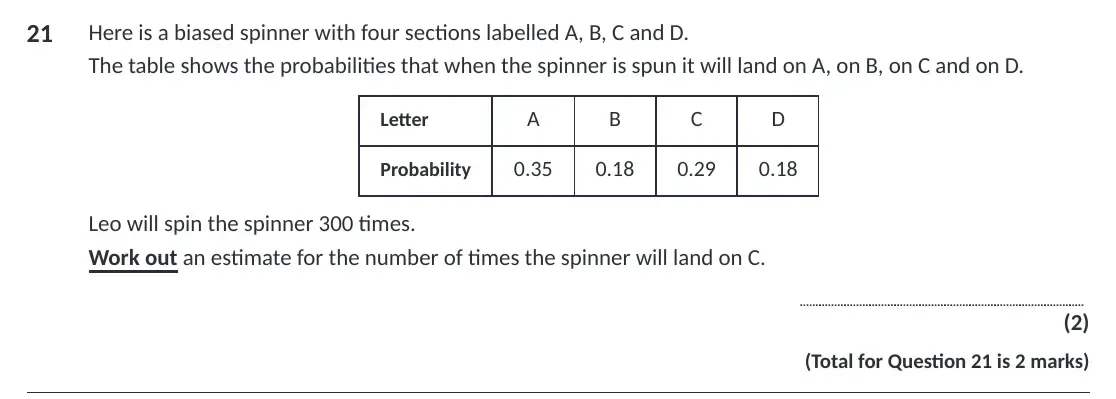
21 Here is a biased spinner with four sections labelled A, B, C and D. The table shows the probabilities that when the spinner is spun it will land on A, on B, on C and on D. Letter A B C D Probability 0.35 0.18 0.29 0.18 Leo will spin the spinner 300 times. Work out an estimate for the number of times the spinner will land on C. 📄 sheet: Probability tables, relative frequency and expected results
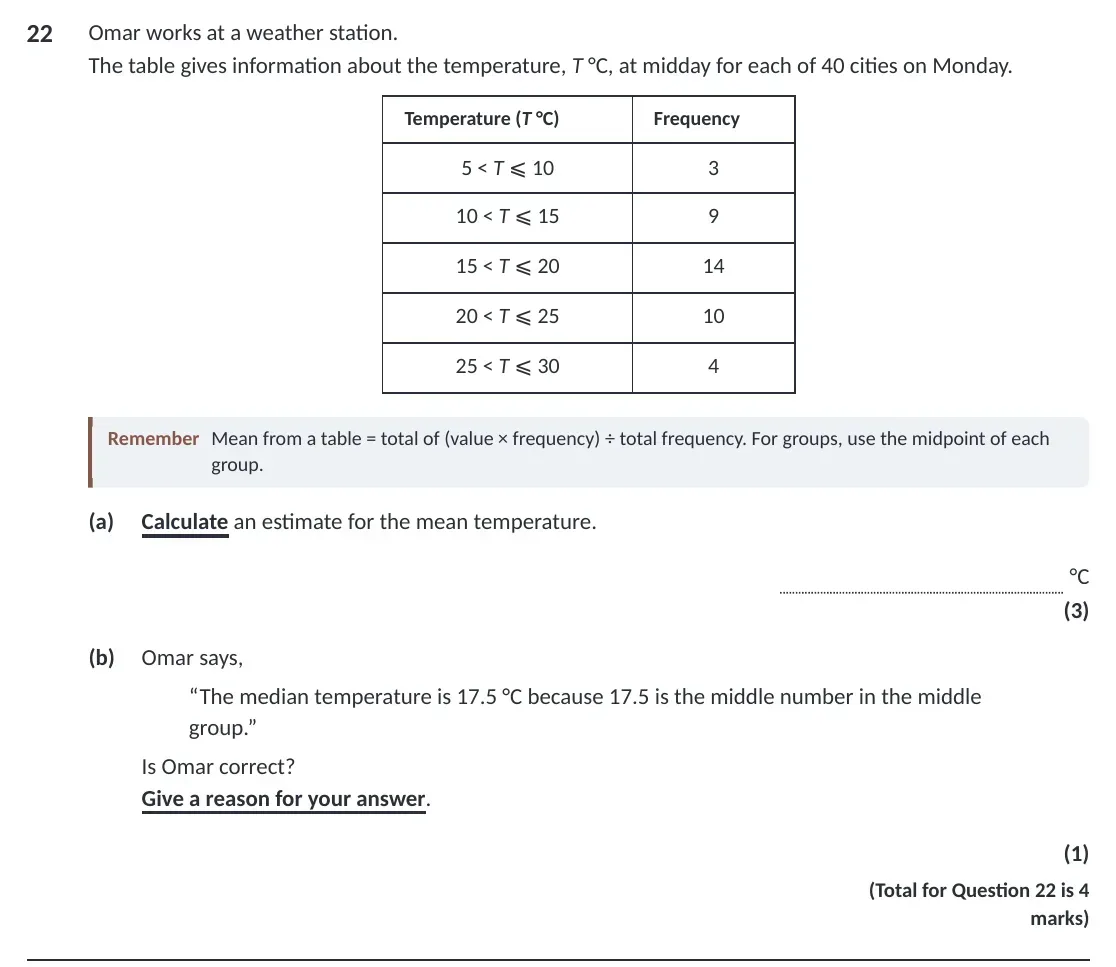
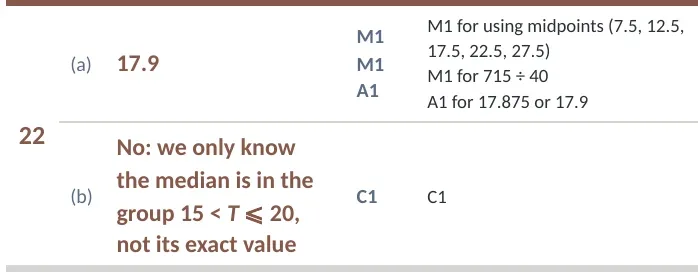
22 Omar works at a weather station. The table gives information about the temperature, T °C, at midday for each of 40 cities on Monday. Temperature (T °C) Frequency 5 < T ⩽ 10 3 10 < T ⩽ 15 9 15 < T ⩽ 20 14 20 < T ⩽ 25 10 25 < T ⩽ 30 4 Remember Mean from a table = total of (value × frequency) ÷ total frequency. For groups, use the midpoint of each group. (a) Calculate an estimate for the mean temp
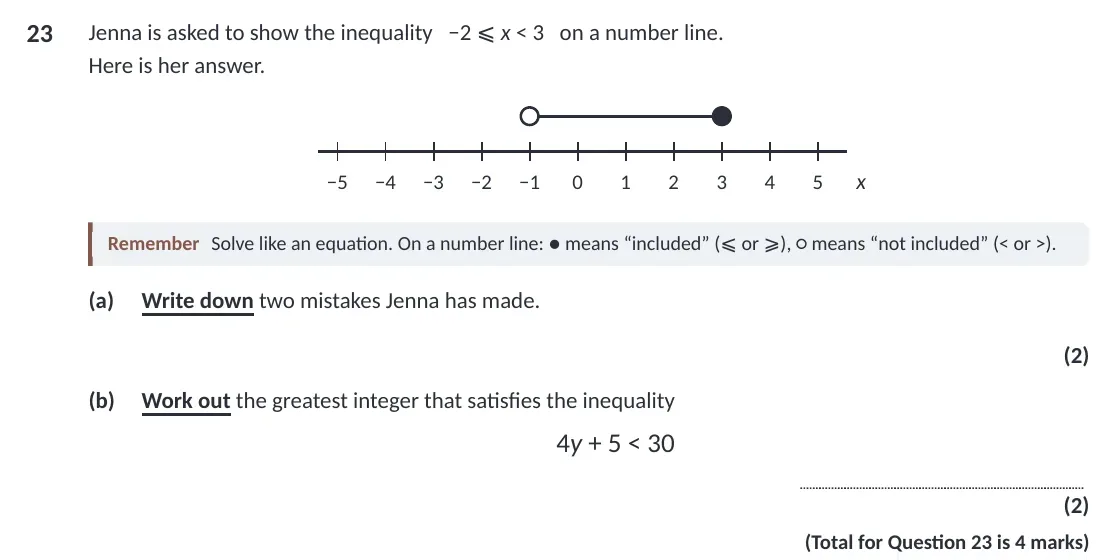
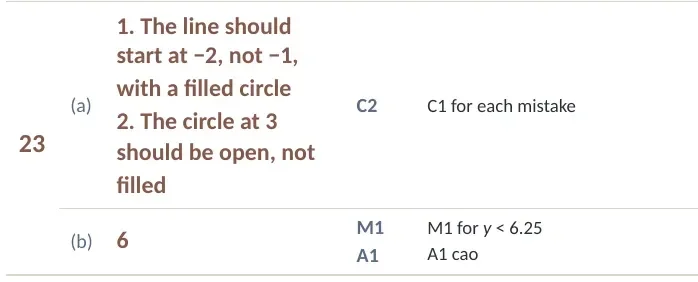
23 Jenna is asked to show the inequality −2 ⩽ x < 3 on a number line. Here is her answer. −5 −4 −3 −2 −1 0 1 2 3 4 5 x Remember Solve like an equation. On a number line: ● means “included” (⩽ or ⩾), ○ means “not included” (< or >). (a) Write down two mistakes Jenna has made. (2) (b) Work out the greatest integer that satisfies the inequality 4y + 5 < 30 📄 sheet: Inequalities on a number line (2) (
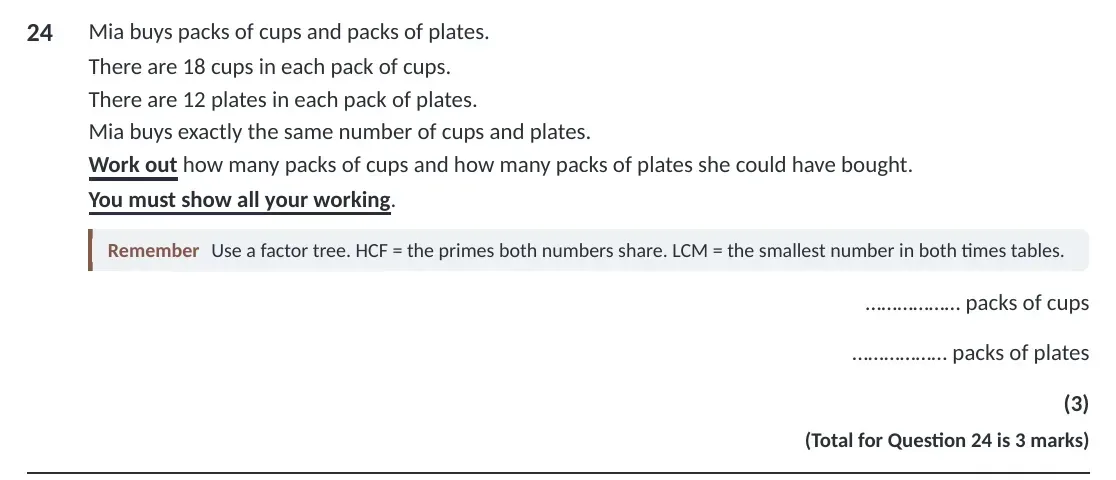
24 Mia buys packs of cups and packs of plates. There are 18 cups in each pack of cups. There are 12 plates in each pack of plates. Mia buys exactly the same number of cups and plates. Work out how many packs of cups and how many packs of plates she could have bought. You must show all your working. Remember Use a factor tree. HCF = the primes both numbers share. LCM = the smallest number in both t
25 A company orders a large number of mugs from a factory. It would take 24 hours to make all the mugs using 5 machines. How many machines are needed to make all the mugs in 8 hours? (2) 📄 sheet: Inverse proportion, card 1 (Total for Question 25 is 2 marks)
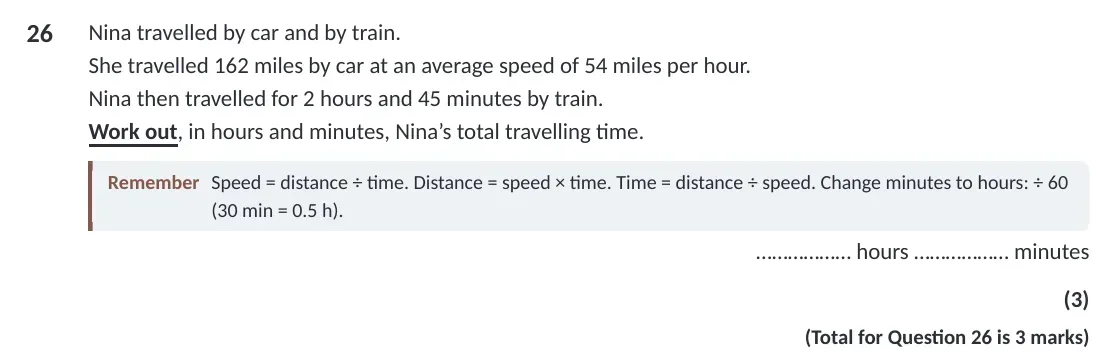
26 Nina travelled by car and by train. She travelled 162 miles by car at an average speed of 54 miles per hour. Nina then travelled for 2 hours and 45 minutes by train. Work out, in hours and minutes, Nina’s total travelling time. Remember Speed = distance ÷ time. Distance = speed × time. Time = distance ÷ speed. Change minutes to hours: ÷ 60 (30 min = 0.5 h). ……………… hours ……………… minutes (3) 📄 she
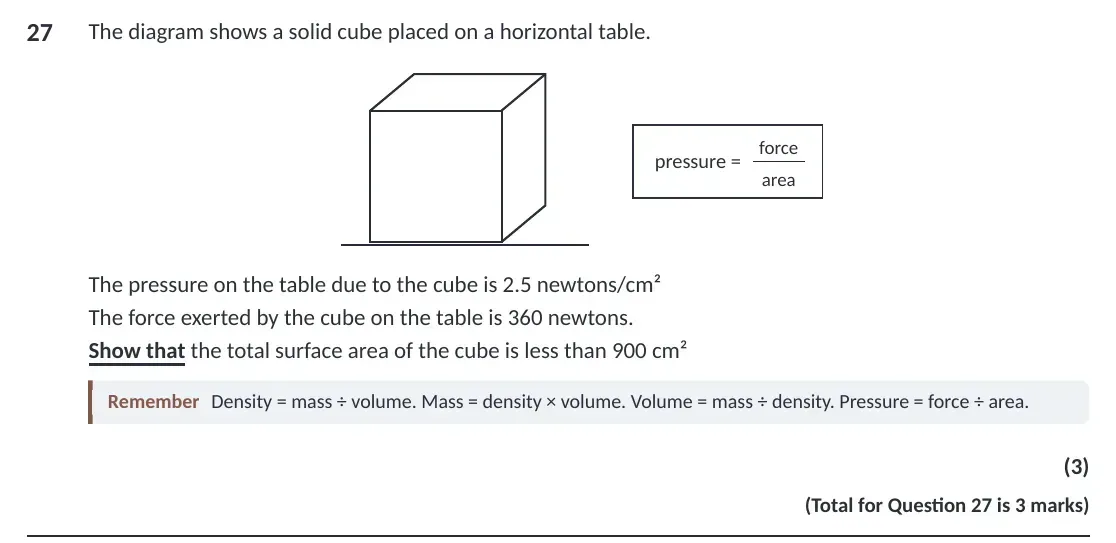
27 The diagram shows a solid cube placed on a horizontal table. pressure = force area The pressure on the table due to the cube is 2.5 newtons/cm² The force exerted by the cube on the table is 360 newtons. Show that the total surface area of the cube is less than 900 cm² Remember Density = mass ÷ volume. Mass = density × volume. Volume = mass ÷ density. Pressure = force ÷ area. 📄 sheet: Compound m
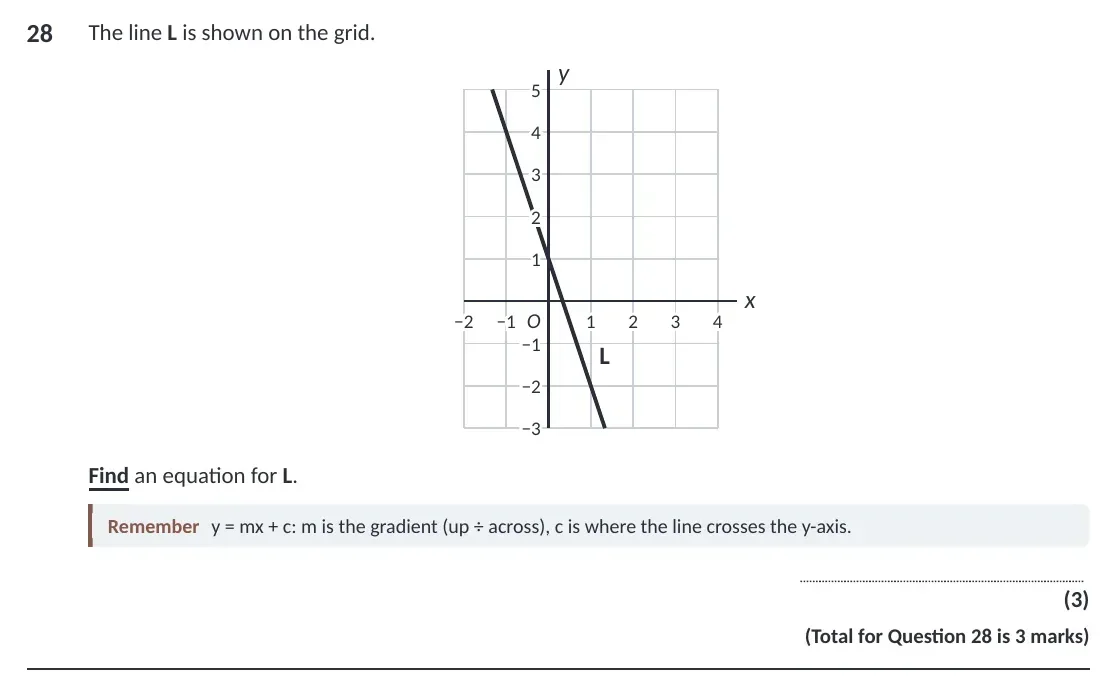
28 The line L is shown on the grid. 5 y 4 3 2 1 −2 −1 O −1 1 2 3 4 x L −2 −3 Find an equation for L. Remember y = mx + c: m is the gradient (up ÷ across), c is where the line crosses the y-axis. 📄 sheet: Gradient and y = mx + c (3) (Total for Question 28 is 3 marks)
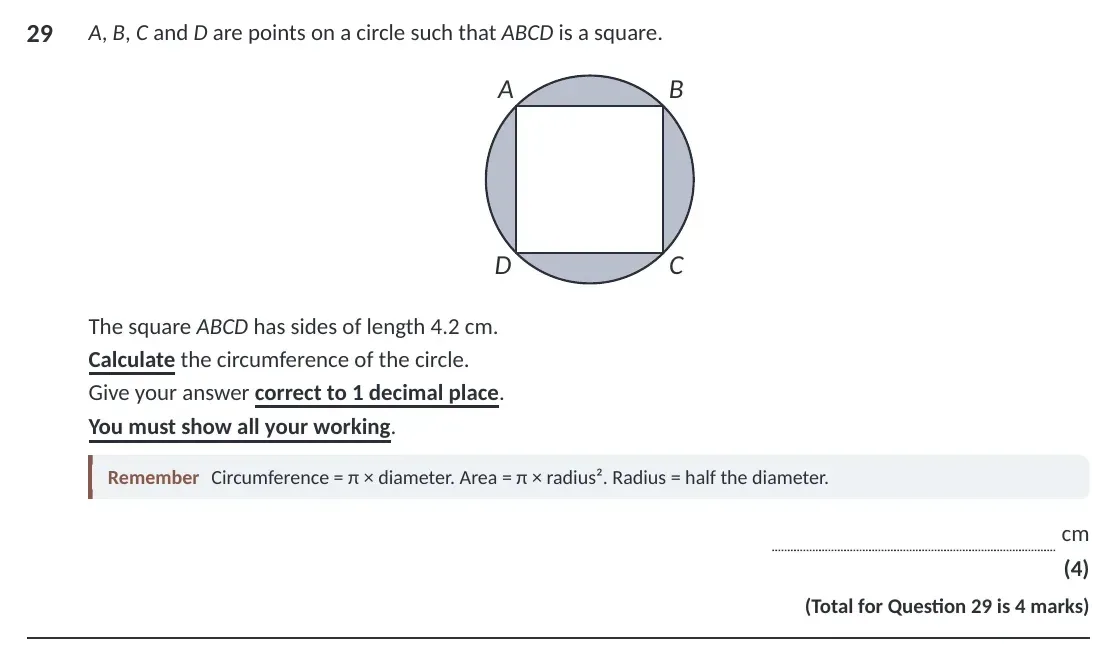
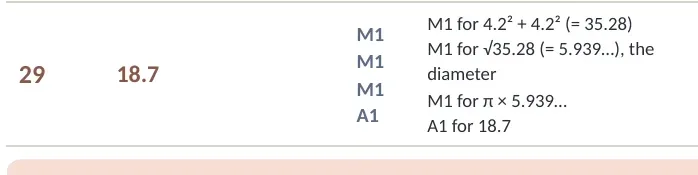
29 A, B, C and D are points on a circle such that ABCD is a square. A B D C The square ABCD has sides of length 4.2 cm. Calculate the circumference of the circle. Give your answer correct to 1 decimal place. You must show all your working. Remember Circumference = π × diameter. Area = π × radius². Radius = half the diameter. cm (4) 📄 sheet: Circumference (Total for Question 29 is 4 marks)
◀ D2All papersE1 ▶
Answer the questions, then mark your paper.