Miss North Maths
GCSE Foundation › Algebra

Sequences

Covers term-to-term rules and patterns and the nth term. On the Year 11 revision planner in week 2.

1. Watch

Miss North: Sequences. Pause the video when it says, and try the questions yourself.

2. Learn the facts

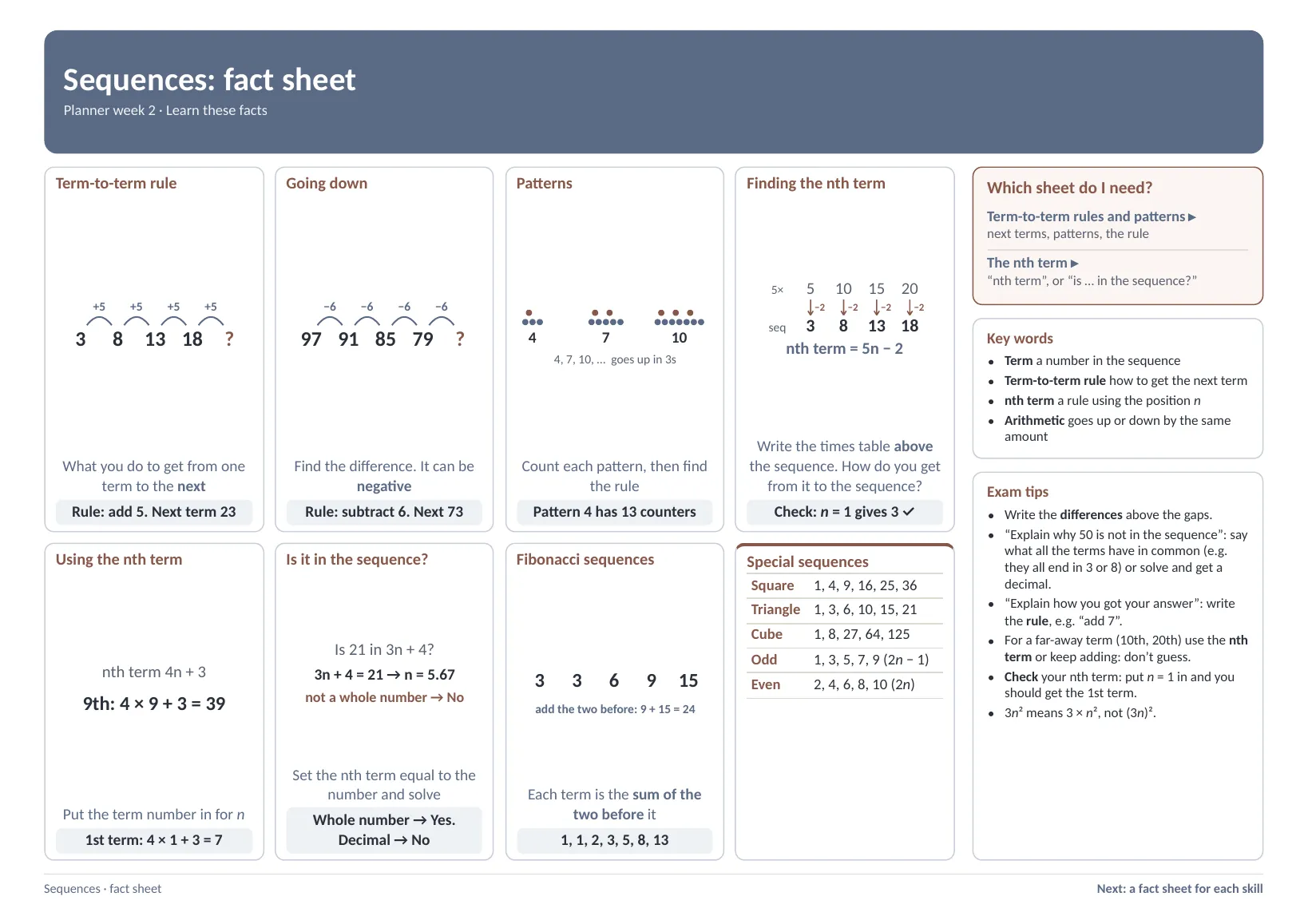
Sequences fact sheet: Overview
1 of 3 · OverviewTap the sheet to open it full size
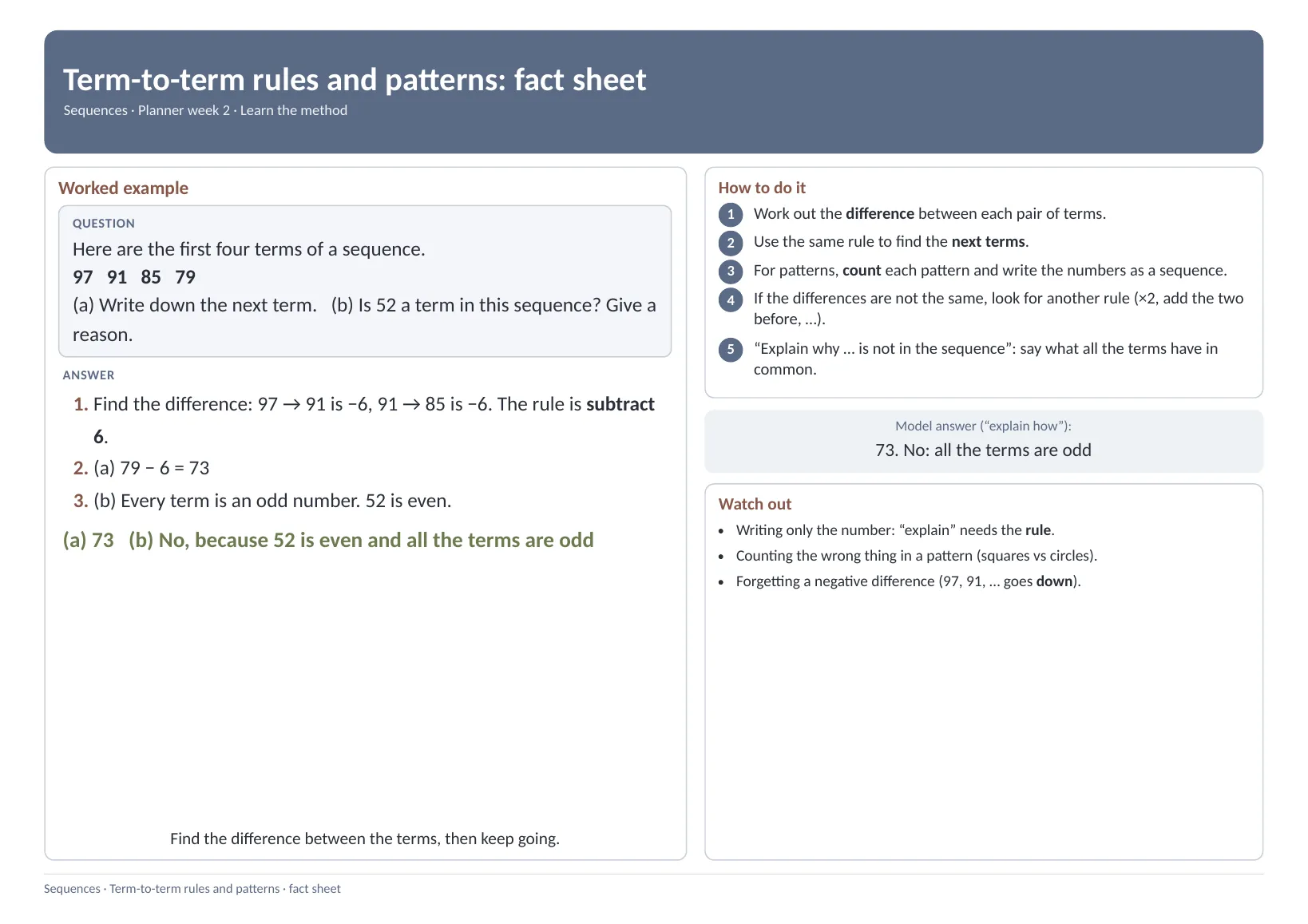
Sequences fact sheet: Term-to-term rules and patterns
2 of 3 · Term-to-term rules and patternsTap the sheet to open it full size
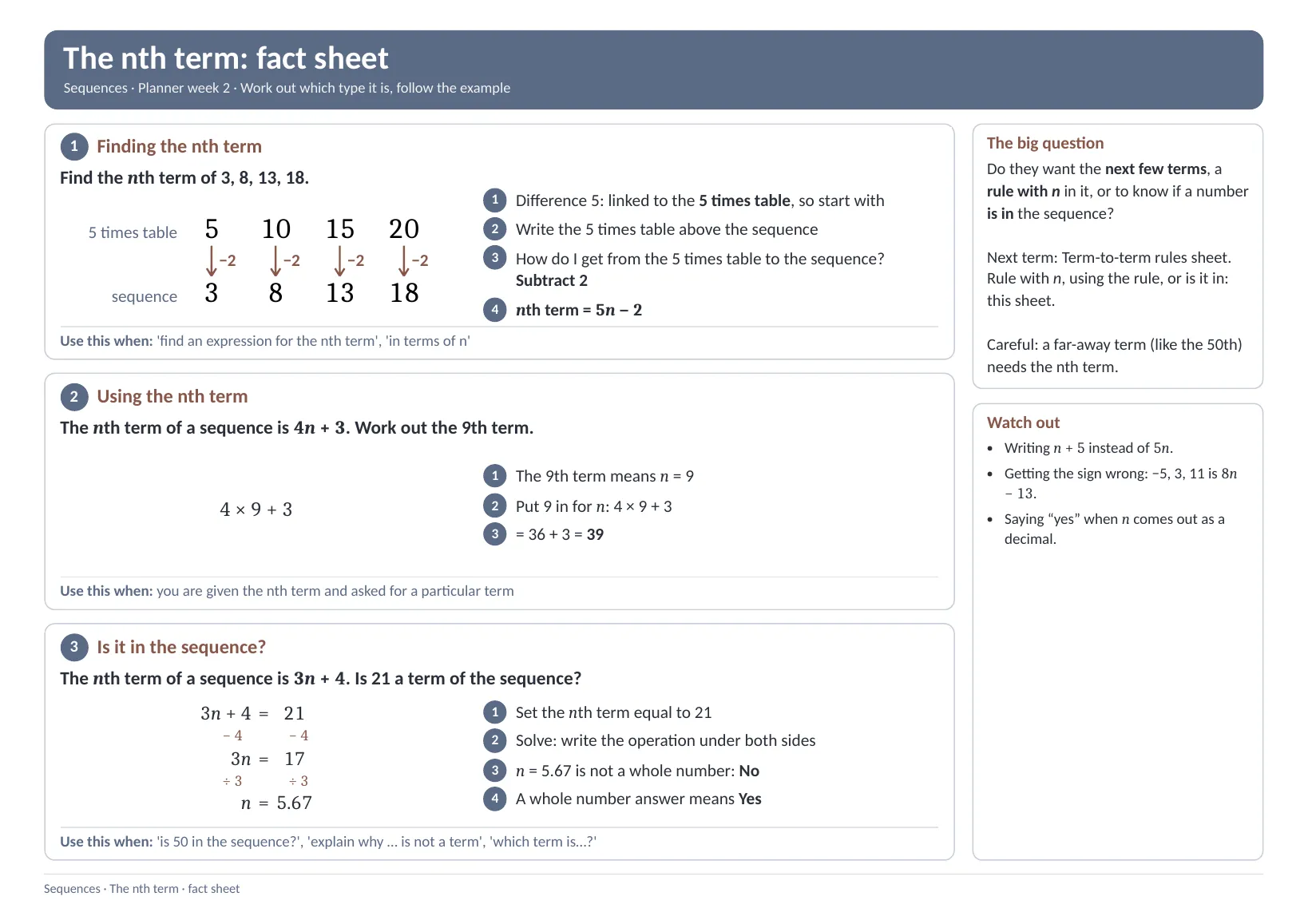
Sequences fact sheet: The nth term
3 of 3 · The nth termTap the sheet to open it full size

3. Practice questions

Try each one on paper first, then check.

Your score: 0 / 16 marks
1
Grade 1Non-calculator2 marks

Here are the first four terms of a sequence: 2, 11, 20, 29

(a)Write down the next term in the sequence.(1)
(b)Write down the term-to-term rule.(1)
Show the answer
(a) 38
(b) add 9
(a) B1 38; (b) B1 add 9 ( or +9 )
Watch out: (b) Giving the first term (2) or 'goes up'. Say exactly what you do to get the next term: add 9.
2
Grade 1Non-calculator2 marks

The nth term of a sequence is 7n + 2

(a)Write down the first three terms of the sequence.(1)
(b)Work out the 20th term of the sequence.(1)
Show the answer
(a) 9, 16, 23
(b) 142
(a) B1 9, 16, 23; (b) B1 142
Watch out: Writing 7n as 7 next to n (720). 7n means 7 × n: 7 × 20 = 140.
3
Grade 2Non-calculator2 marks

Here are the first four terms of a sequence: 2, 5, 8, 11
Find an expression, in terms of n, for the nth term of the sequence. (2)

Show the answer
3n − 1
M1 3n; A1 3n − 1
Watch out: Writing n + 3 (that is the term-to-term rule). The difference 3 goes in front of n: 3n, then adjust.
4
Grade 3Non-calculator2 marks

The nth term of a sequence is 3n + 8
Is 70 a term in the sequence? You must give a reason for your answer. (2)

Show the answer
No: 3n + 8 = 70 gives n = 20.66…, not a whole number
M1 3n + 8 = 70, or terms listed either side of 70; A1 No, with a reason
Watch out: Answering ‘yes’ or ‘no’ with no reason. Show the working: solve nth term = the number, and look at n.
5
Grade 3Non-calculator3 marks

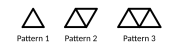
The diagram shows the first three patterns in a sequence made from sticks.Diagram for this question, with the measurements and labels from the question

(a)Find an expression for the number of sticks in Pattern n.(2)
(b)Which pattern uses 63 sticks?(1)
Show the answer
(a) 2n + 1
(b) Pattern 31
(a) M1 2n; A1 2n + 1; (b) B1 31 (follow through from (a))
Watch out: Counting shared sticks twice. Count them: 3, 5, 7. The rule is 2n + 1, not 2n.
6
Grade 3Non-calculator3 marks

Here are the first five terms of an arithmetic sequence: 2, 11, 20, 29, 38

(a)Find an expression, in terms of n, for the nth term of the sequence.(2)
(b)Is 72 a term of this sequence? Give a reason for your answer.(1)
Show the answer
(a) 9n − 7
(b) No: 9n − 7 = 72 gives n = 8.78…, not a whole number
(a) M1 9n + k (k ≠ −7) or difference 9; A1 9n − 7; (b) B1 No, with a correct reason
Watch out: (a) Writing n + 9 (the difference goes in FRONT of n). Check with n = 1: 9 × 1 − 7 = 2.
7
Grade 4Non-calculator2 marks

Here are the first four terms of a sequence: 70, 63, 56, 49
Find an expression, in terms of n, for the nth term of the sequence. (2)

Show the answer
77 − 7n
M1 −7n; A1 77 − 7n
Watch out: Writing 7n + …: the sequence goes DOWN, so the n term is negative (77 − 7n).

4. Quiz yourself

The Blooket for this topic is coming soon.

5. Print it

The whole sequences fact sheet as a PDF, 3 pages, ready to print or keep on your phone.

Download the fact sheet (PDF)