Miss North Maths
GCSE Foundation › Algebra

Equations

Covers solving equations, letters on both sides and forming and solving equations. On the Year 11 revision planner in week 9.
1. Watch

Miss North: EquationsVideo coming soon. Use the fact sheet below in the meantime.

2. Learn the facts

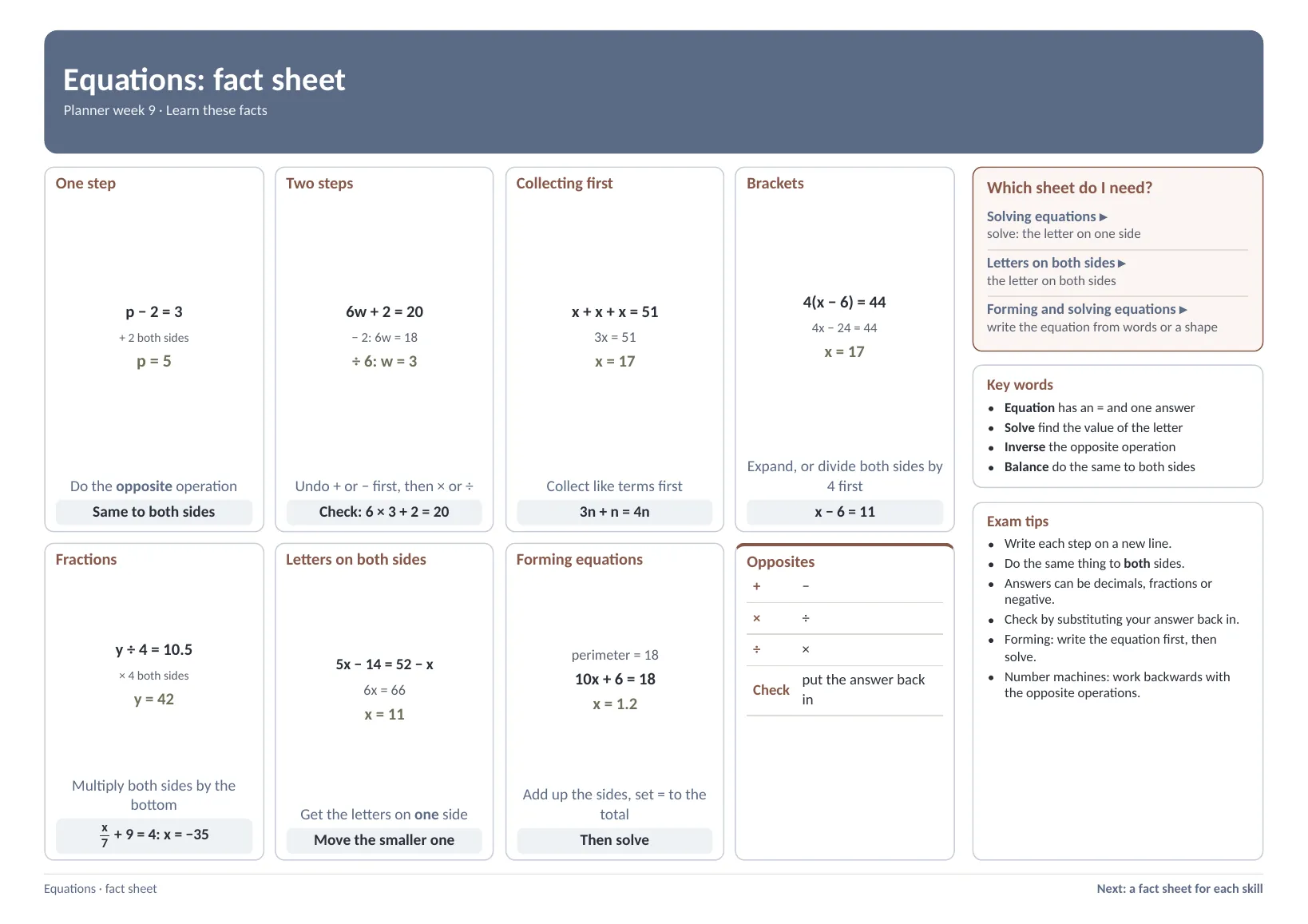
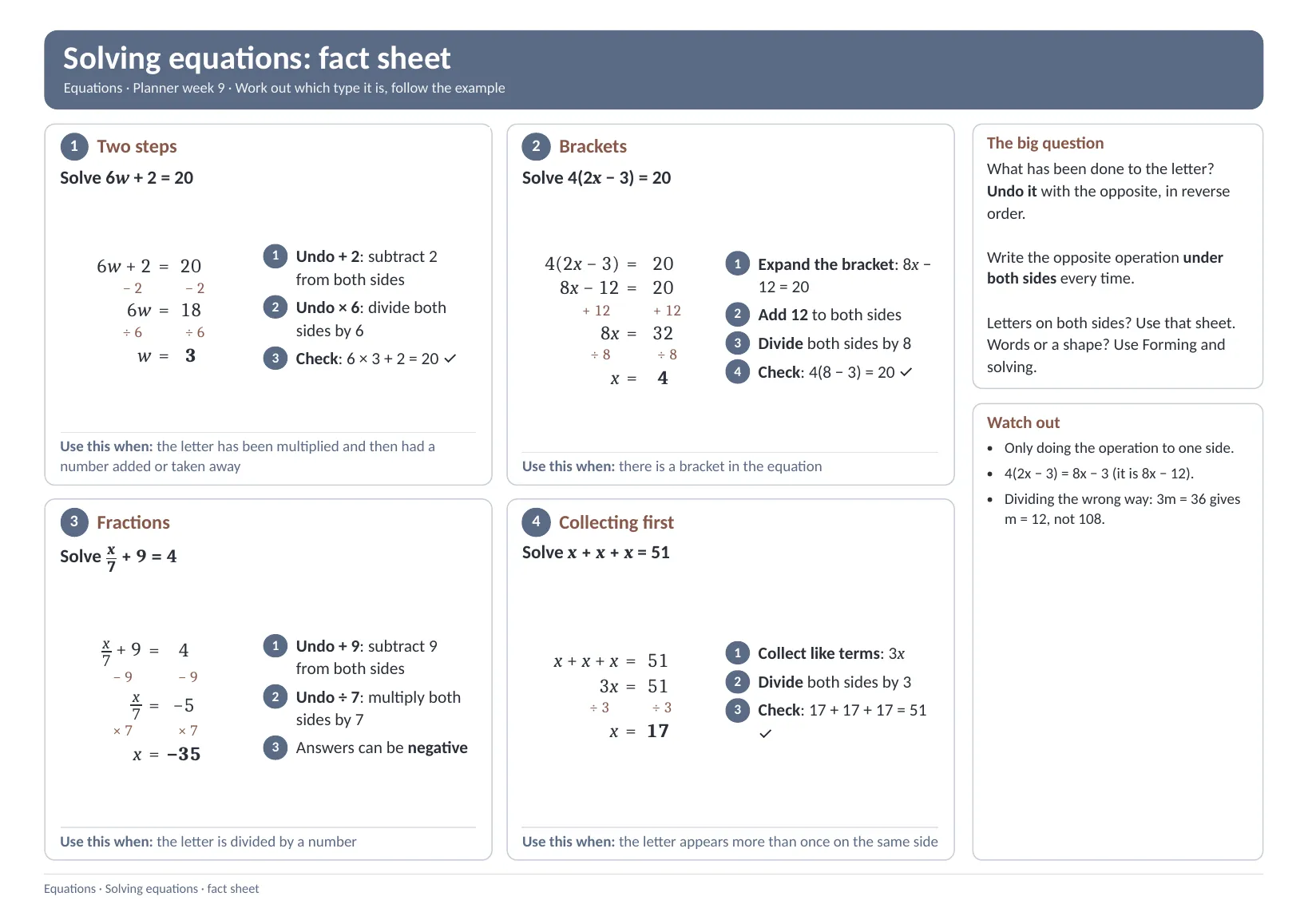
Equations fact sheet: Overview
1 of 4 · OverviewTap the sheet to open it full size
Equations fact sheet: Solving equations
2 of 4 · Solving equationsTap the sheet to open it full size
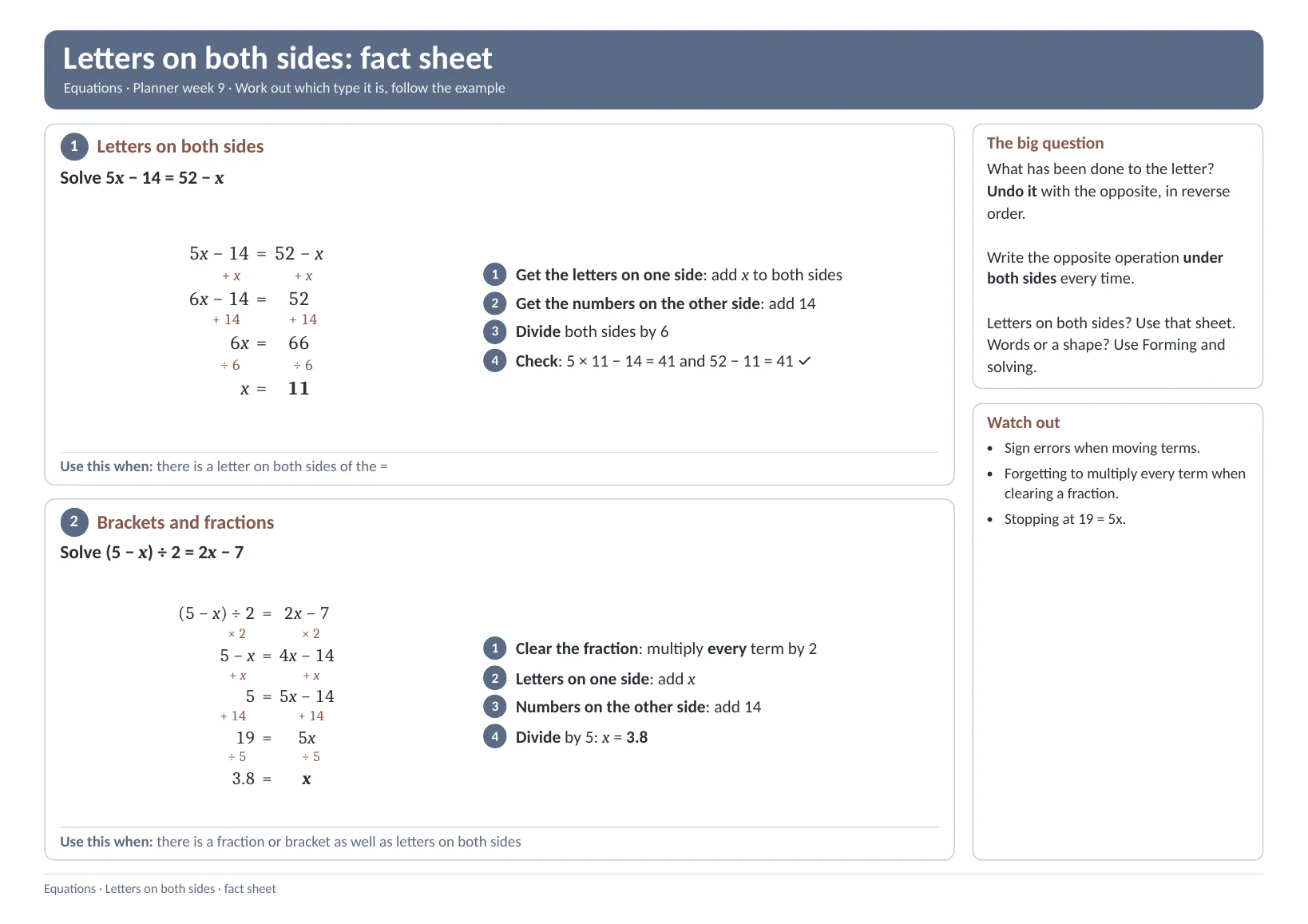
Equations fact sheet: Letters on both sides
3 of 4 · Letters on both sidesTap the sheet to open it full size
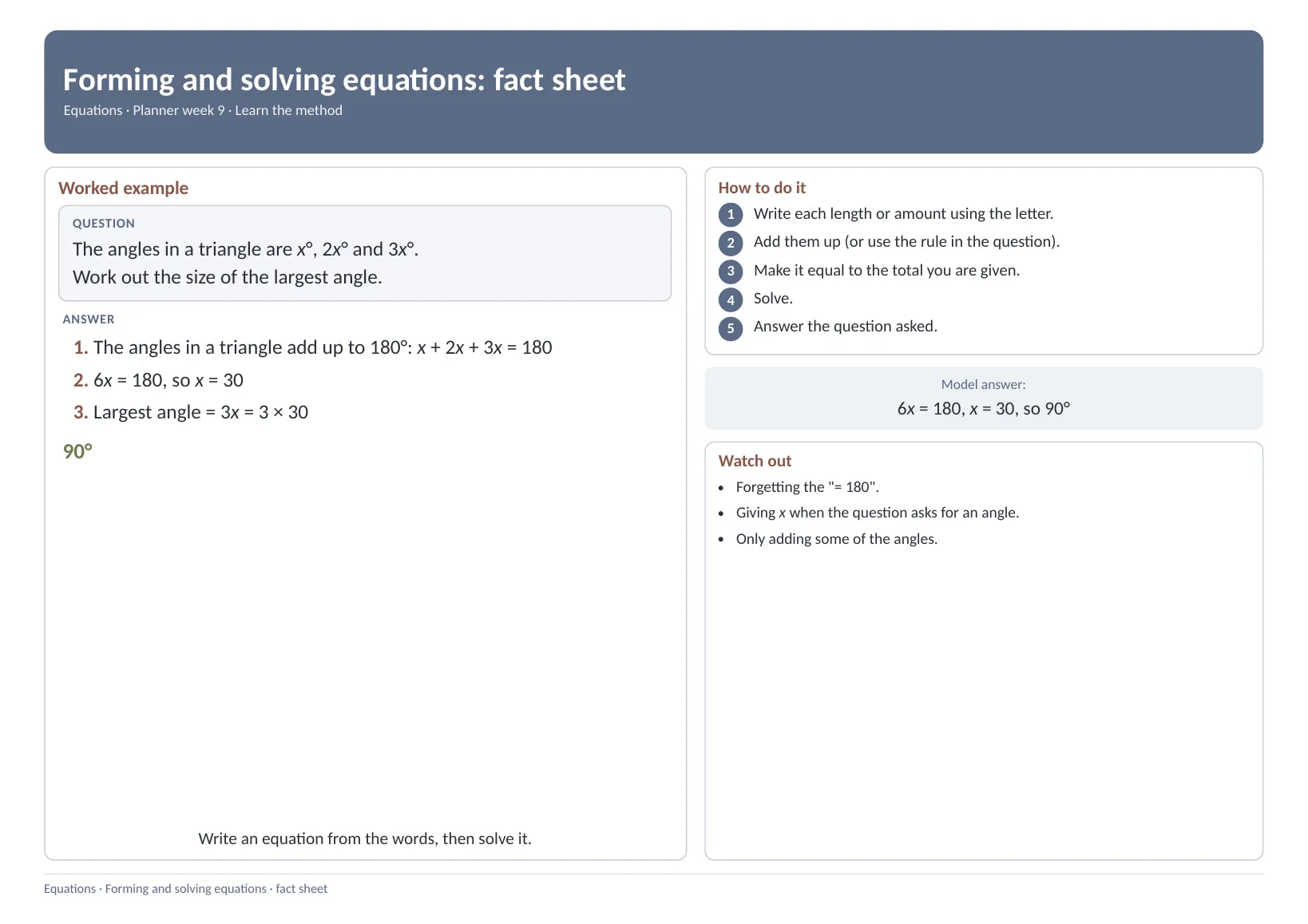
Equations fact sheet: Forming and solving equations
4 of 4 · Forming and solving equationsTap the sheet to open it full size

See it move

Explore first, then try 5 questions. Press Board to fill the screen.

Which method? Follow the flowchart

Start at the top, answer each question and follow the arrows to the method you need. Tap it to open it full size.
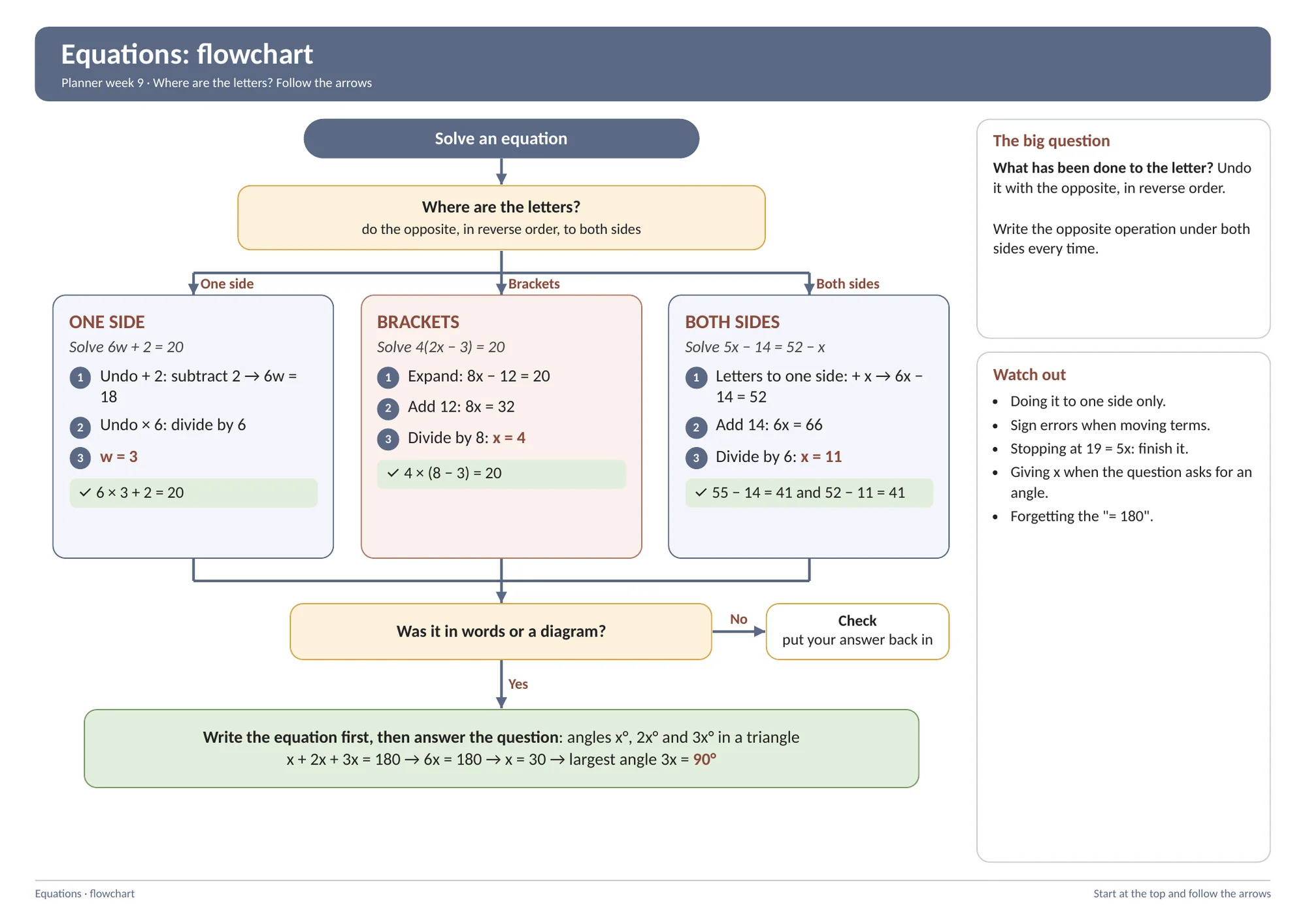
Equations flowchart: which method to use
Equations flowchartPrint the flowchart (PDF)

3. Practice questions

Try each one on paper first, then check.

Your score: 0 / 32 marks
1
Grade 1Non-calculator2 marks

Solve

(a)x + 8 = 27(1)
(b)7y = 63(1)
Show the answer
(a) x = 19
(b) y = 9
(a) B1 x = 19; (b) B1 y = 9
Watch out: (b) Taking 7 away (56) or multiplying (441). 7y means 7 × y: undo it by dividing.
2
Grade 1Non-calculator2 marks

Solve 7x − 4 = 52 (2)

Show the answer
x = 8
M1 7x = 56; A1 x = 8
Watch out: Dividing first: 52 ÷ 7, then adding 4. Undo the − 4 first, then the × 7.
3
Grade 2Non-calculator2 marks

Solve x4 + 6 = 11 (2)

Show the answer
x = 20
M1 x/4 = 5; A1 x = 20
Watch out: Dividing by 4 instead of multiplying. x ÷ 4 = 5, so x = 5 × 4 = 20.
4
Grade 2Non-calculator2 marks

Solve 6(x − 2) = 30 (2)

Show the answer
x = 7
M1 6x − 12 = 30 or x − 2 = 5; A1 x = 7
Watch out: Expanding only the x: 6(x − 2) is 6x − 12, not 6x − 2.
5
Grade 2Non-calculator2 marks

I think of a number. I multiply it by 6, then I subtract 5. My answer is 49.
What number did I think of? (2)

Show the answer
9
M1 6x − 5 = 49, or 49 + 5 then ÷ 6; A1 9
Watch out: Doing the steps in the same order (49 × 6 …). Work backwards: undo the last step first.
6
Grade 2Non-calculator2 marks

Solve 4x − 7 = 45 (2)

Show the answer
x = 13
M1 4x = 52; A1 x = 13
Watch out: Taking away 7 instead of adding it (4x = 38). Do the OPPOSITE: − 7 becomes + 7.
7
Grade 3Non-calculator3 marks

Solve 6x + 1 = 2x + 25 (3)

Show the answer
x = 6
M1 x terms on one side: 6x − 2x; M1 4x = 24; A1 x = 6
Watch out: Adding 2x to both sides instead of subtracting it (giving 8x). Do the same to both sides to REMOVE 2x.
8
Grade 3Non-calculator2 marks

Solve 2x + 11 = 4 (2)

Show the answer
x = −3.5
M1 2x = −7; A1 x = −3.5
Watch out: Writing 4 − 11 = 7. 4 − 11 is negative (−7), so x is negative too.
9
Grade 3Non-calculator3 marks

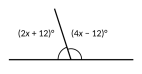
The diagram shows two angles on a straight line.Diagram for this question, with the measurements and labels from the questionWork out the value of x. (3)
Show the answer
x = 30
M1 2x + 12 + 4x − 12 = 180; M1 6x = 180; A1 x = 30
Watch out: Using 360° (that is angles around a point), or giving an angle (72°) instead of x.
10
Grade 3Non-calculator3 marks

Gus is x years old. Hana is 4 years younger than Gus. Ivy is twice as old as Gus. The total of their ages is 48 years.
Work out Gus’s age. (3)

Show the answer
13 years
B1 Hana: x − 4, Ivy: 2x; M1 x + x − 4 + 2x = 48; A1 13
Watch out: Writing Ivy’s age as x + 2 instead of 2x (‘twice as old’ means multiply).
11
Grade 4Non-calculator3 marks

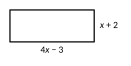
The diagram shows a rectangle. The lengths are in centimetres. The perimeter of the rectangle is 58 cm.Diagram for this question, with the measurements and labels from the questionWork out the value of x. (3)
Show the answer
x = 6
M1 2(4x − 3) + 2(x + 2) = 58 or 10x − 2 = 58; M1 10x = 60; A1 x = 6
Watch out: Adding only two sides (5x − 1 = 58). A rectangle has FOUR sides: two of each.
12
Grade 4Non-calculator3 marks

Solve 3(2x + 1) = 5(x + 3) (3)

Show the answer
x = 12
M1 6x + 3 = 5x + 15; M1 6x − 5x = 15 − 3; A1 x = 12
Watch out: Multiplying only the first term in a bracket (3(2x + 1) is 6x + 3, not 6x + 1).
13
Grade 4Non-calculator3 marks

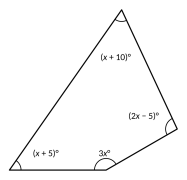
The diagram shows a quadrilateral.Diagram for this question, with the measurements and labels from the questionWork out the size of the largest angle. (3)

Show the answer
150°
M1 x + 5 + 3x + 2x − 5 + x + 10 = 360; M1 7x = 350, x = 50; A1 150°
Watch out: Stopping at x = 50. The question asks for the largest ANGLE: put x back into each expression.

4. Quiz yourself

The Blooket for this topic is coming soon.

5. Print it

The whole equations fact sheet as a PDF, 4 pages, ready to print or keep on your phone.

Download the fact sheet (PDF)