Miss North Maths
GCSE Foundation › Geometry and measures

Area and perimeter

Covers perimeter, area and area and perimeter with algebra. On the Year 11 revision planner in week 12.

1. Watch

Miss North: Area and perimeterVideo coming soon. Use the fact sheet below in the meantime.

2. Learn the facts

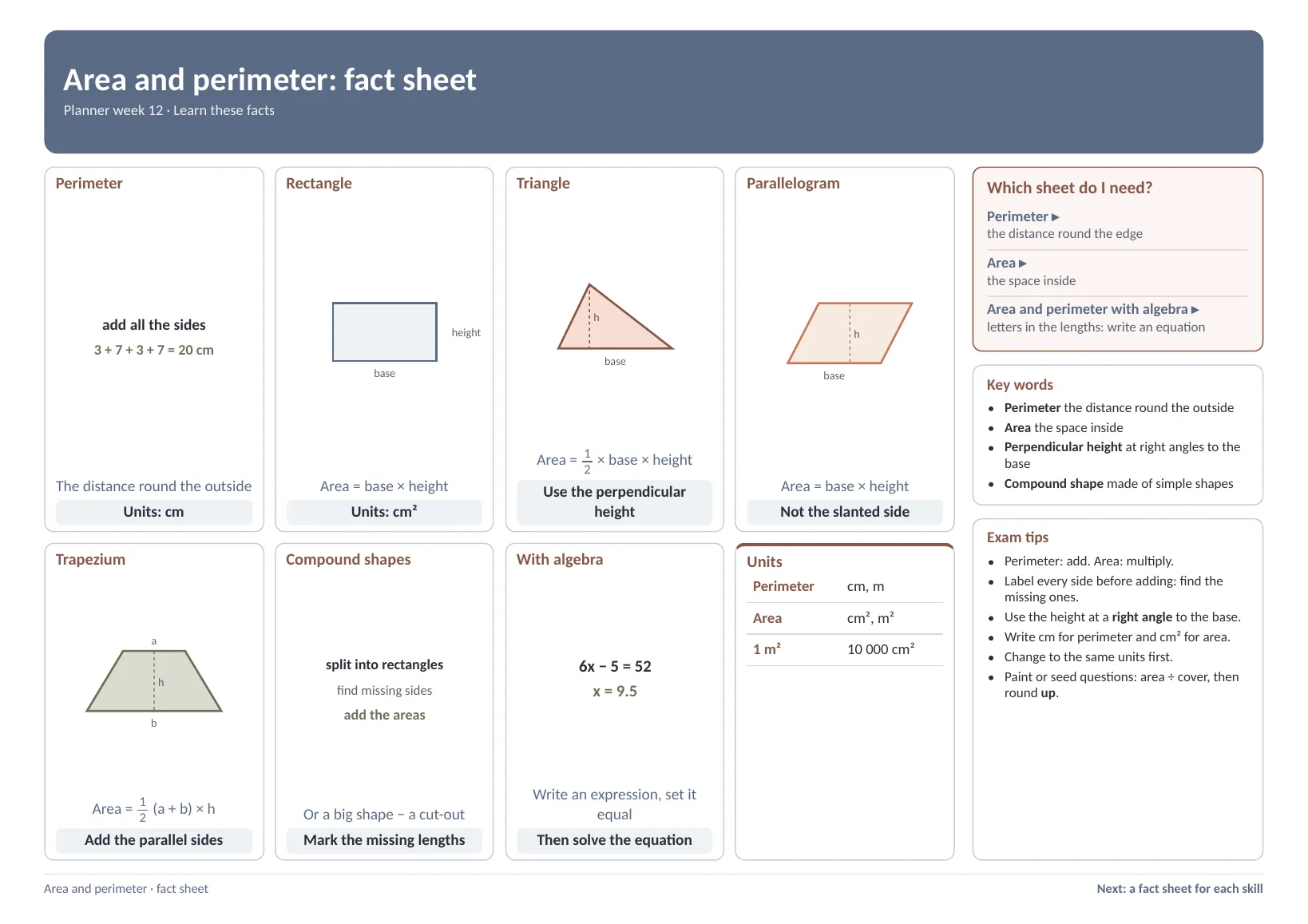
Area and perimeter fact sheet: Overview
1 of 4 · OverviewTap the sheet to open it full size
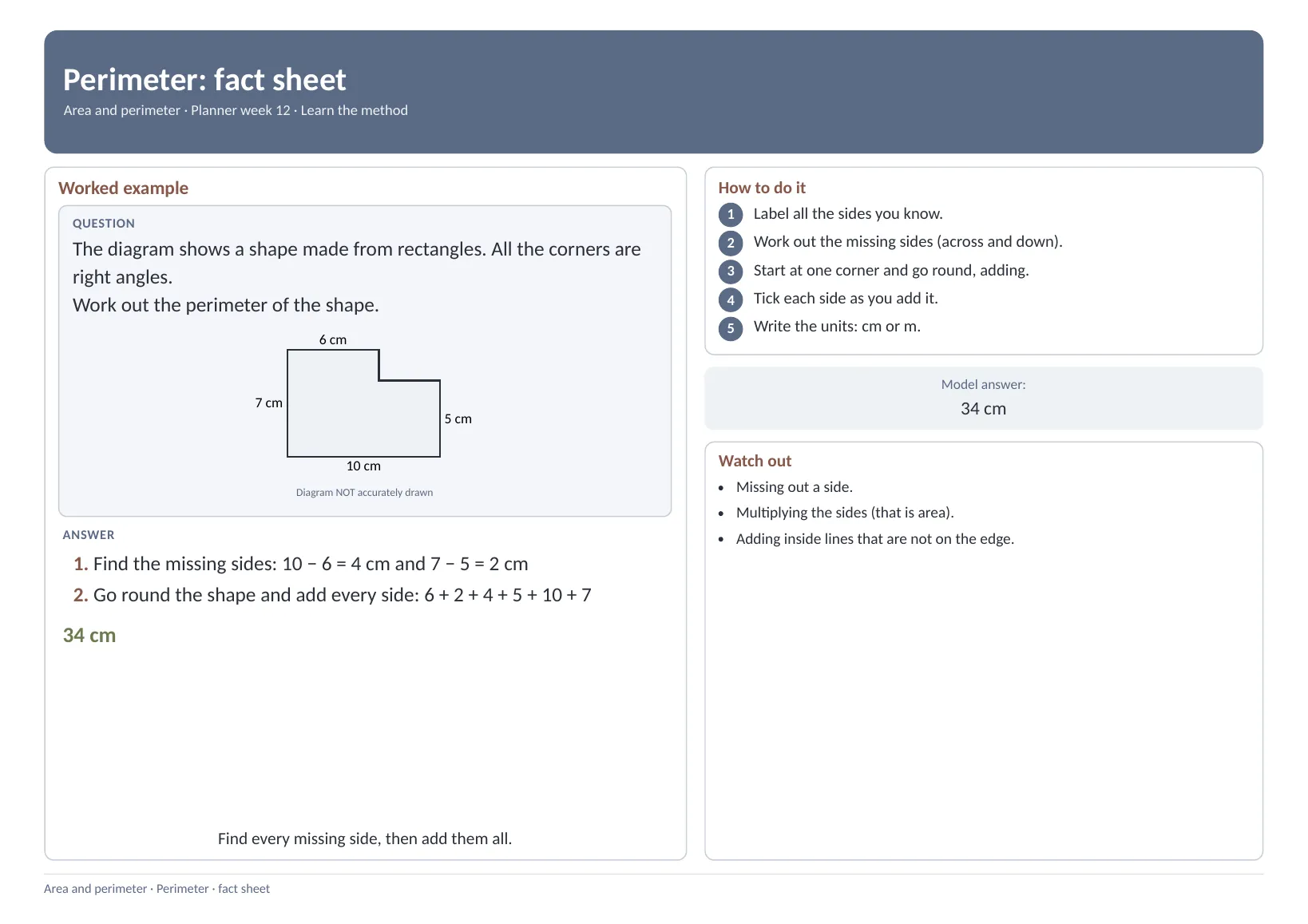
Area and perimeter fact sheet: Perimeter
2 of 4 · PerimeterTap the sheet to open it full size
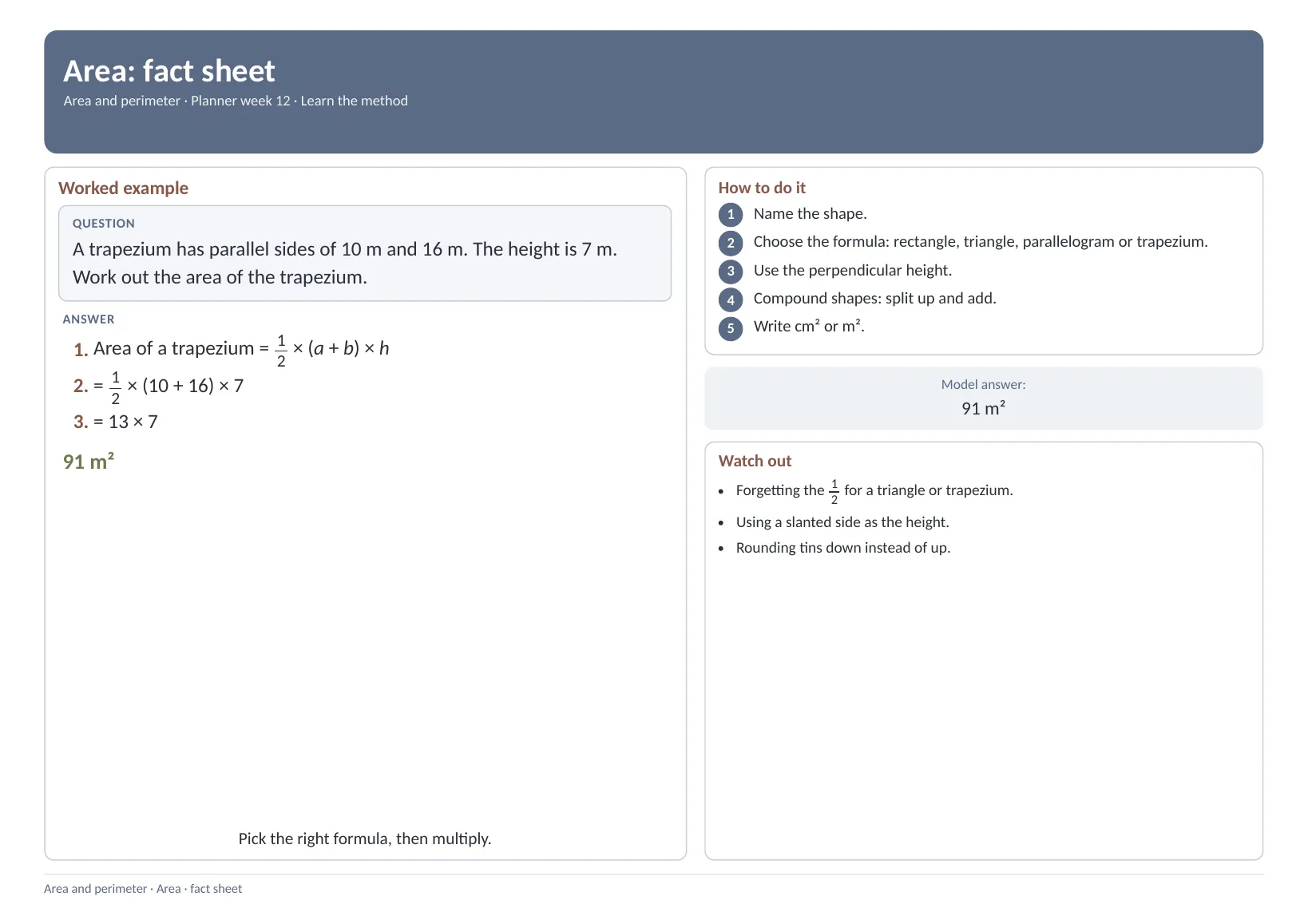
Area and perimeter fact sheet: Area
3 of 4 · AreaTap the sheet to open it full size
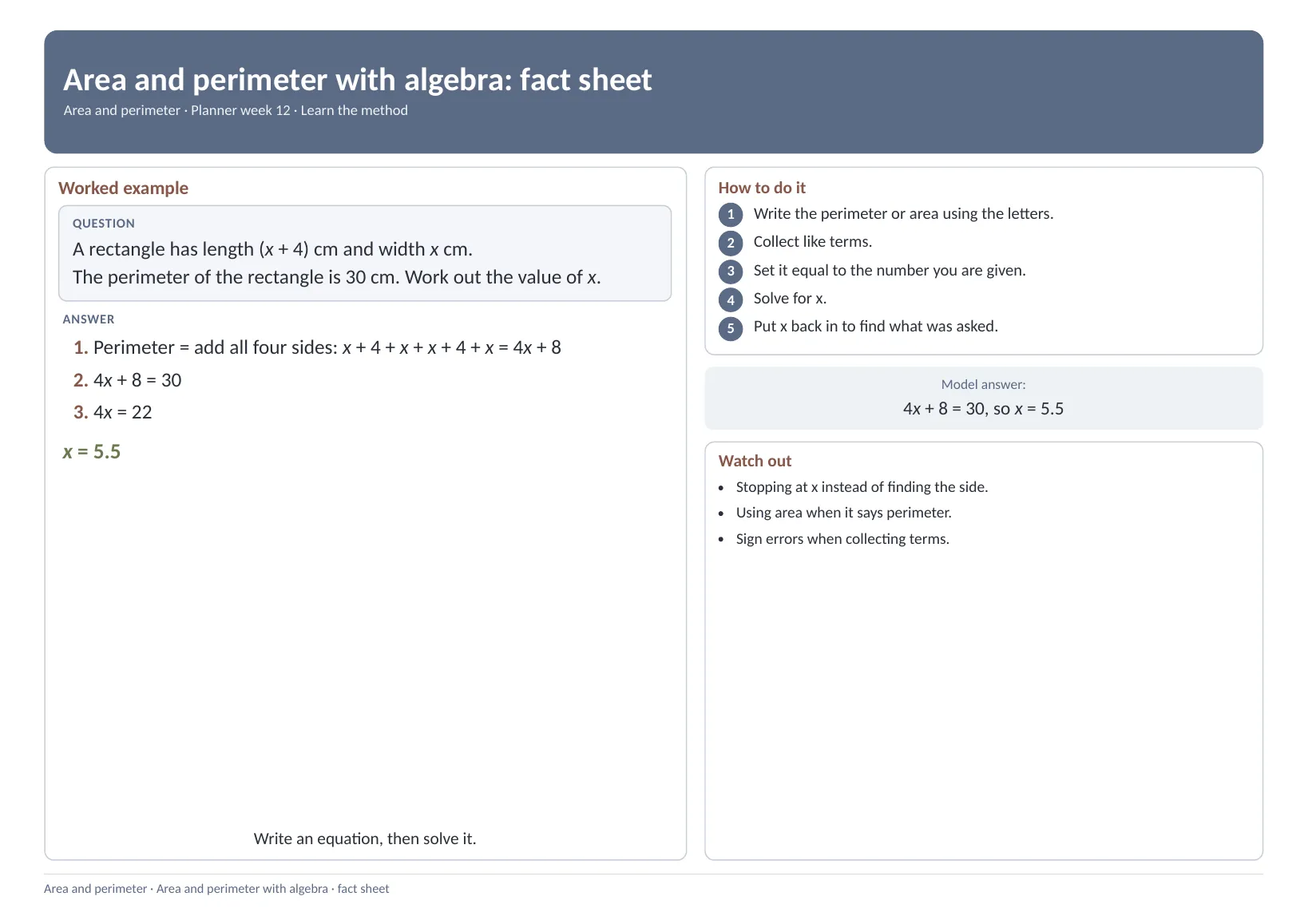
Area and perimeter fact sheet: Area and perimeter with algebra
4 of 4 · Area and perimeter with algebraTap the sheet to open it full size

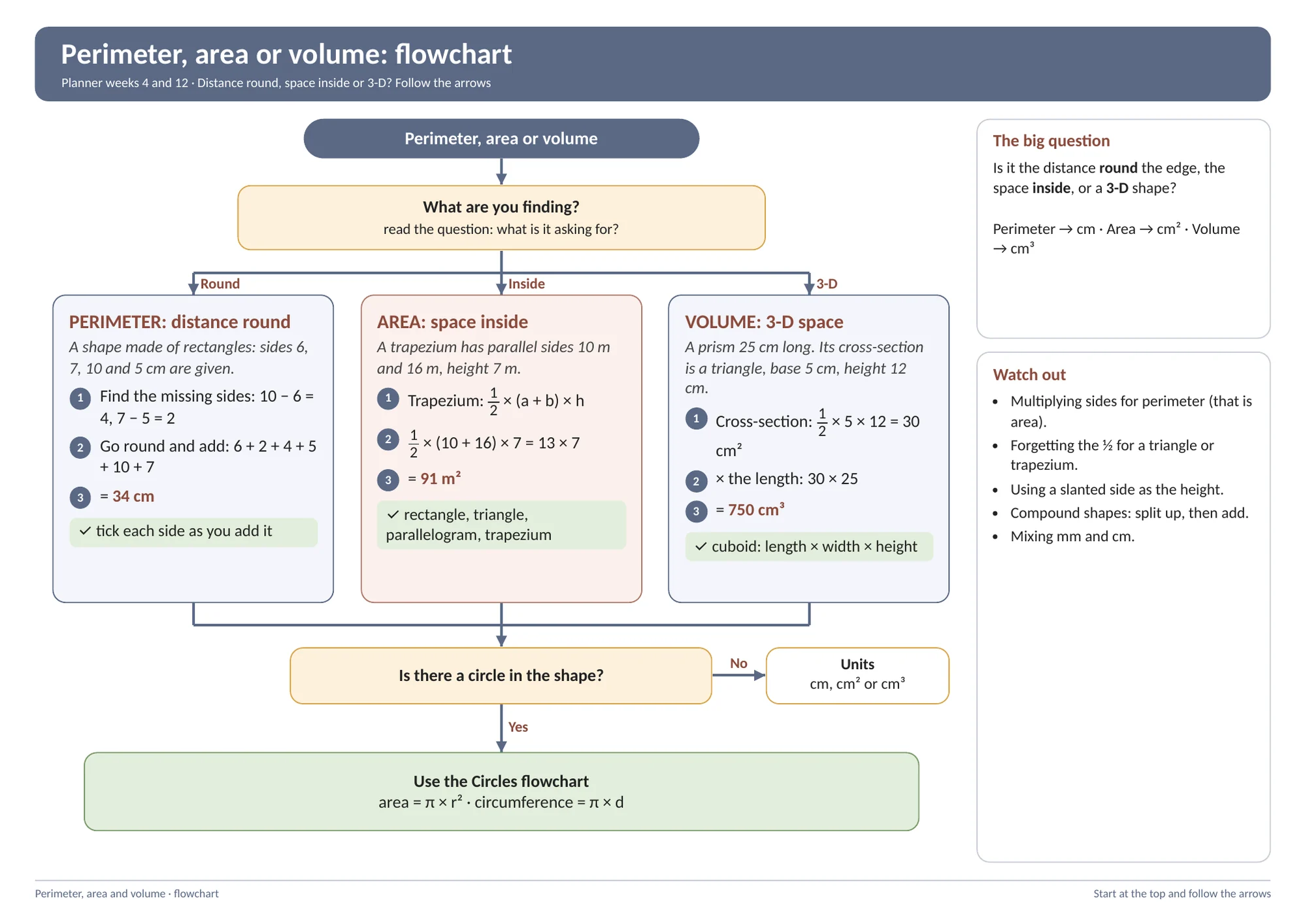
Which method? Follow the flowchart

Start at the top, answer each question and follow the arrows to the method you need. Tap it to open it full size.

Perimeter, area or volume flowchart: which method to use
Perimeter, area or volume flowchartPrint the flowchart (PDF)

3. Practice questions

Try each one on paper first, then check.

Your score: 0 / 20 marks
1
Grade 1Non-calculator2 marks

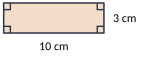
The diagram shows a rectangle.Diagram for this question, with the measurements and labels from the question

(a)Work out the perimeter of the rectangle.(1)
(b)Work out the area of the rectangle.(1)
Show the answer
(a) 26 cm
(b) 30 cm²
(a) B1 26 cm; (b) B1 30 cm²
Watch out: Mixing them up: 30 is the area (cm²) and 26 is the perimeter (cm). Perimeter = all the way round.
2
Grade 1Non-calculator2 marks

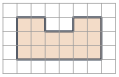
The shape is drawn on a grid of squares. Each square is 1 cm by 1 cm.Diagram for this question, with the measurements and labels from the question

(a)Find the area of the shape.(1)
(b)Find the perimeter of the shape.(1)
Show the answer
(a) 16 cm²
(b) 20 cm
(a) B1 16 cm²; (b) B1 20 cm
Watch out: Counting squares for the perimeter. The perimeter is the length of the EDGE: count the sides of the squares on the outside.
3
Grade 2Non-calculator2 marks

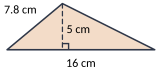
The diagram shows a triangle.Diagram for this question, with the measurements and labels from the questionWork out the area of the triangle. (2)

Show the answer
40 cm²
M1 ½ × 16 × 5 (or 16 × 5 ÷ 2); A1 40 cm²
Watch out: Using the sloping side (7.8 cm) or forgetting to halve (80 cm²). Use the height at a right angle to the base, then halve.
4
Grade 2Non-calculator3 marks

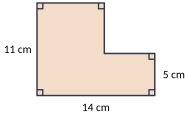
The diagram shows a shape made from rectangles. All the corners are right angles.Diagram for this question, with the measurements and labels from the questionWork out the perimeter of the shape. (3)

Show the answer
50 cm
M1 one missing side: 14 − 8 = 6 or 11 − 5 = 6; M1 all six sides added; A1 50 cm
Watch out: Adding only the four lengths you can see (38 cm). Work out the two missing sides first: there are SIX sides.
5
Grade 2Non-calculator2 marks

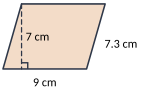
The diagram shows a parallelogram.Diagram for this question, with the measurements and labels from the questionWork out the area of the parallelogram. (2)
Show the answer
63 cm²
M1 9 × 7; A1 63 cm²
Watch out: Using the sloping side: 9 × 7.3 is wrong. Use the height at a right angle to the base. (No halving: that is a triangle.)
6
Grade 3Non-calculator3 marks

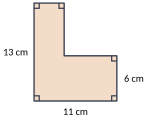
The diagram shows a shape made from rectangles. All the corners are right angles.Diagram for this question, with the measurements and labels from the questionWork out the area of the shape. (3)

Show the answer
94 cm²
M1 splits into two rectangles (or a big rectangle minus the corner); M1 11 × 6 = 66 and 4 × 7 = 28; A1 94 cm²
Watch out: Multiplying all the lengths, or doing 11 × 13 = 143 (that includes the missing corner). Split into rectangles.
7
Grade 3Non-calculator2 marks

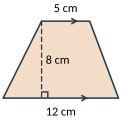
The diagram shows a trapezium.Diagram for this question, with the measurements and labels from the questionWork out the area of the trapezium. (2)

Show the answer
68 cm²
M1 ½ × (5 + 12) × 8; A1 68 cm²
Watch out: Multiplying all three lengths (5 × 12 × 8) or forgetting to halve. Add the parallel sides, times the height, halve.
8
Grade 4Calculator4 marks

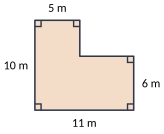
The diagram shows a lawn. All the corners are right angles.Diagram for this question, with the measurements and labels from the questionGrass seed is sold in boxes. One box covers 20 m² and costs £5.75. Work out the cost of the grass seed to cover the lawn. (4)

Show the answer
£28.75
M1 area: 11 × 6 + 5 × 4; A1 86 m²; M1 86 ÷ 20 rounded UP = 5 boxes; A1 £28.75
Watch out: Using 4 boxes (4.30 rounded down). 4 boxes would not cover the lawn: round UP.

4. Quiz yourself

The Blooket for this topic is coming soon.

5. Print it

The whole area and perimeter fact sheet as a PDF, 4 pages, ready to print or keep on your phone.

Download the fact sheet (PDF)